Introduction
Many companies see ASEAN as a strong growth opportunity, but entering the market is rarely straightforward. Building operations from scratch takes time, local knowledge, and delays early traction. Because of this, companies turn to merger and acquisition services (M&A) as a faster way to enter the market and start operating.
With the right deal, companies gain access to customers, licenses, and local teams. However, ASEAN is not one market. Each country has its own rules, ownership limits, and business practices, which can slow down or complicate execution. At the same time, deals are becoming harder to find as more investors compete for a limited number of quality targets. Valuation expectations between buyers and sellers are often misaligned, especially in high-growth sectors where future potential is priced aggressively.
In this article, we, Source of Asia, outline how to structure effective merger and acquisition strategies, navigate the process, and improve execution in ASEAN.
Key Insights
- M&A in ASEAN requires careful planning, disciplined due diligence, and local market insight to achieve successful execution.
- Each ASEAN country presents unique opportunities and legal frameworks, making market-specific strategies essential for effective deals.
- Structured deal sourcing, flexible deal structuring, and alignment with key stakeholders reduce execution risk and valuation gaps.
- Post-merger integration is critical to retain talent, align operations, and realize projected value from transactions.
- End-to-end M&A services bridge strategy and execution, from target identification to deal execution and post-merger integration, helping companies navigate complex markets and capture long-term growth.
What are mergers and acquisitions (M&A)?
M&A enables companies to enter new markets, access capabilities, and scale faster. Understanding its definition, structures, and use cases helps you choose the right approach for ASEAN expansion.
Merger and acquisition definition
Mergers and acquisitions are strategic consolidations of companies through various financial transactions. This process allows businesses to expand market reach, acquire new technologies, or improve operational efficiency. While often used together, they represent distinct financial actions:
- Merger: Two firms of similar size combine to form a brand-new legal entity.
- Acquisition: One company purchases another, absorbing its assets and operations directly.
Beyond these differences, the success of any deal relies on several key aspects:
- Strategic rationale: Ensuring the deal aligns with core business goals, such as vertical integration or market entry.
- Due diligence: A rigorous, 360-degree investigation into the target’s financial, legal, and cultural health.
- Post-merger integration: The critical phase of aligning workflows and cultures to realize the projected value.
According to the Corporate Finance Institute, these deals are essential for rapid scaling and entering unfamiliar markets efficiently.

Definition of merger and acquisition, including key structural differences.
Common M&A structures
Selecting the right transaction structure is critical for balancing operational control with financial risk. Depending on market maturity and local regulations, businesses typically utilize three primary frameworks:
- Minority entry: Investors acquire a small stake initially, allowing for staged expansion as they gain local market confidence.
- Full acquisition: This provides total strategic control, enabling the seamless integration of assets and decision-making processes.
- Joint ventures: Partnering with local entities is often essential in restricted industries to navigate complex legal requirements.
Ultimately, these structures help companies manage risk while gradually increasing control in the market.
When M&A is the preferred entry approach
Choosing mergers and acquisitions is a tactical decision driven by efficiency. While organic growth offers control, M&A is superior when speed to market is your primary objective. By acquiring an established entity, you gain immediate revenue and a localized footprint instantly.
Furthermore, this approach is effective when local licenses, regulatory approvals, or specialized capabilities are difficult to build internally. In many ASEAN markets, navigating fragmented regulatory frameworks and informal business practices creates barriers for new entrants, making acquisition a more practical path to establish a local presence.
| To succeed with M&A in ASEAN, understanding regional investment trends is essential. Explore “Invest in ASEAN 2026″ for practical guidance on navigating opportunities, regulations, and market entry strategies. |
Why Merger and Acquisition Services Matter In ASEAN
In 2026, M&A in ASEAN offers strong growth potential, but outcomes depend on how well you navigate market differences, investor behavior, and execution risks across countries.
Shifting dynamics in the ASEAN M&A market
Since late 2024, investors have recognized that the M&A market in the ASEAN region has entered a positive cycle, with both deal activity and investor confidence gradually recovering. Data from Bank of America shows that M&A deal volume in ASEAN increased by 51% in 2024 compared to 2023.
However, execution is not getting easier. ASEAN remains highly fragmented, with 11 markets and different legal frameworks. Investors are also becoming more selective, shifting toward deal quality over volume, with fewer but more strategic transactions. Meanwhile, regional investors are playing a bigger role. In some markets, they account for over 50% of deals and often move faster than global players, increasing competition for attractive targets.
Key trends shaping the M&A market in ASEAN
The M&A market in ASEAN is being shaped by a clear shift in investor focus and deal strategy. Activity is increasingly concentrated in sectors with strong growth and scalability:
- Technology and digitalization: AI, fintech, and digital infrastructure are key targets for capability building
- Sustainability and energy transition: Investments in renewable energy and green infrastructure are accelerating
- Sector concentration: Healthcare, financial services, and logistics continue to attract consistent deal flow
At the same time, cross-border capital flows remain strong, led by foreign and private equity investors using buy-and-build strategies. Deals are typically smaller but more selective, with a stronger focus on scalable assets and clear value creation potential.
To address valuation gaps between buyers and sellers, deal structures such as earn-outs and staged investments are increasingly used to balance risk and return expectations.
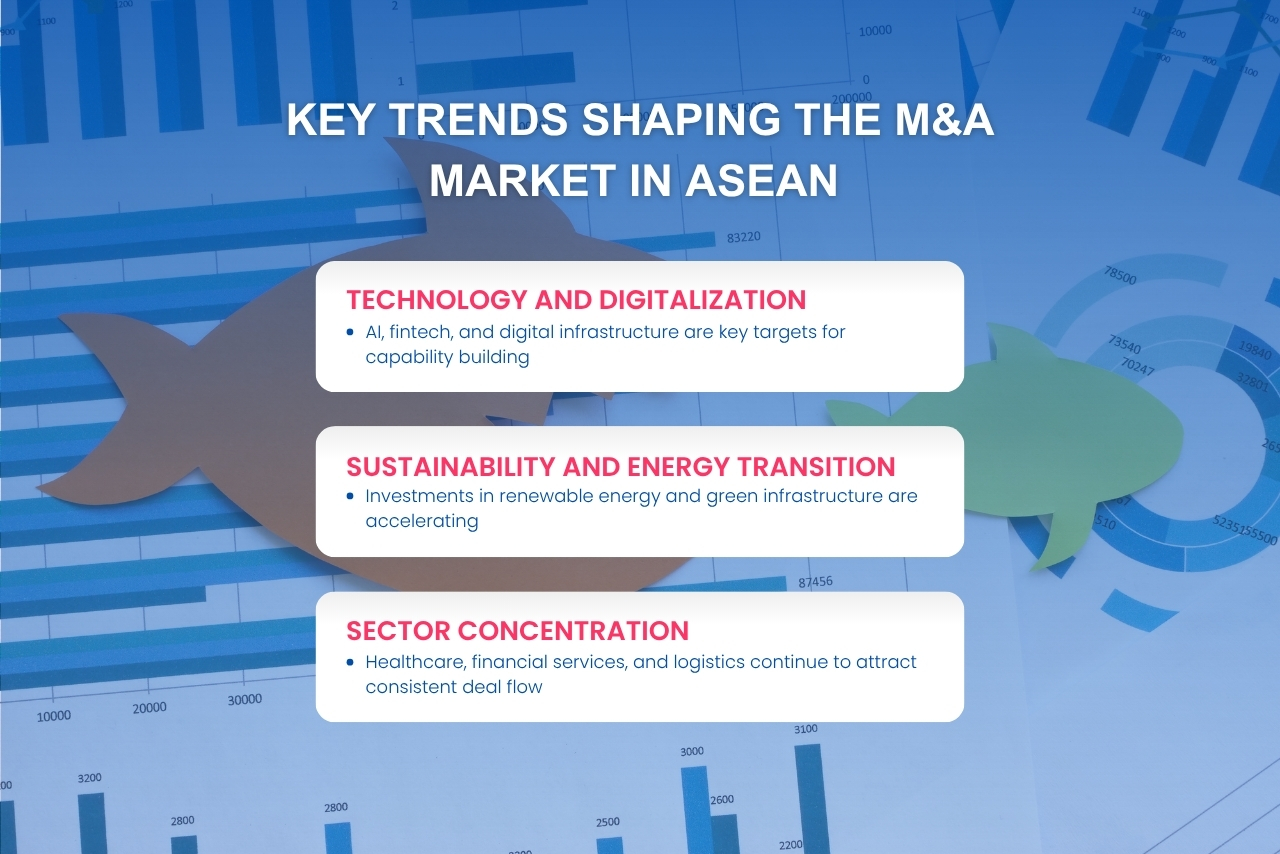
Key trends driving merger and acquisition activity in the ASEAN market.
Comparing key ASEAN markets for M&A entry
Each ASEAN market presents a different balance between opportunity and execution complexity. Understanding these differences helps you prioritize where to enter and how to structure your merger and acquisition process. The following table summarizes key M&A opportunities across selected ASEAN markets:
| Market | Core M&A Opportunities | Strategic Drivers |
| Vietnam | High-tech & Renewables. Focus on semiconductors, AI, and green energy. | Market recovery and structural reforms enhance foreign investment transparency. |
| Singapore | Fintech & Digital Infrastructure. Emphasis on data centers and AI-enabled platforms. | Status as a regional financial hub with a stable, highly predictable legal environment. |
| Thailand | Automotive & Manufacturing. Dominance in electric vehicles (EVs) and smart electronics. | Government mandates for domestic production driving new strategic partnerships. |
| These country differences are driven by sector-specific dynamics and investment priorities. Explore Sectorial Notes in ASEAN for deeper industry-level insights across key ASEAN markets. |
The Merger and Acquisition Process In ASEAN: From Strategy to Execution
Executing M&A in ASEAN requires a structured approach across sourcing, validation, negotiation, and integration. Each step presents distinct risks that directly affect deal feasibility and post-deal performance, making merger and acquisition services critical to execution.
1. Deal sourcing and target identification
Many targets in ASEAN are not publicly visible. Relying only on open market deals often leads to limited access and higher competition. In practice, companies look for off-market opportunities through relationships. Local advisors help open doors, but verifying reliable partners is still challenging due to limited transparency.
2. Due diligence in Southeast Asia
Financial data is not always complete or consistent. It often needs to be cross-checked with multiple sources. Legal and compliance requirements also vary by country, which can slow down deals. Simultaneously, operational and cultural gaps, such as management style or decision-making processes, are harder to detect but can affect performance after closing.
3. Deal structuring and negotiation
Valuation expectations between buyers and sellers are often misaligned. To manage this, deals use flexible structures such as earn-outs. It is important to keep founders and key managers aligned, especially when they remain involved. Without clear incentives, execution risks increase after the deal.
4. Post-merger integration challenges
After the deal closes, attention shifts to execution. Keeping key people is often the first issue. At the same time, companies need to align processes, reporting, and working cultures. Without clear planning, integration slows down, and the expected value is harder to achieve.
|
Looking to execute M&A in ASEAN with more clarity and less risk? Explore how companies approach real execution through Source of Asia’s case studies:
|

Four stages of the merger and acquisition process in ASEAN.
How Merger and Acquisition Consultants Support Market Entry
To move from merger and acquisition strategies to execution, companies rely on consultants to navigate local complexity, identify viable targets, and manage deal risks across the full M&A lifecycle in ASEAN.
Role of merger and acquisition consultants
In ASEAN, working with merger and acquisition consultants is often necessary to move from strategy to execution. Market conditions vary, and without local insight, deals can stall at early stages. Their core contributions include:
- Market assessment: Developing data-driven entry strategies that account for specific regional growth drivers and legal barriers.
- Target identification: Leveraging established networks to screen and vet partners that align with your strategic vision.
- Execution & negotiation: Providing sophisticated support during valuation and due diligence to protect your interests.
They act as a bridge between planning and execution, ensuring that merger and acquisition strategies are adapted to real market conditions and can be implemented effectively.
Value of end-to-end merger and acquisition services
End-to-end merger and acquisition services extend beyond advisory, covering strategy, target selection, and deal structuring. They reduce execution risk, improve transaction success, and help companies navigate diverse legal and operational frameworks across ASEAN.
After closing, these services ensure smooth integration of operations, culture, and governance, retaining key talent and strategic assets. In markets shaped by informal practices and local dynamics, end-to-end support enables companies to capture value, optimize synergies, and achieve sustainable growth, making M&A a reliable path for long-term expansion.
Conclusion
Merger and Acquisition services in ASEAN demand precision over scale. Success hinges on structured sourcing, disciplined due diligence, and careful integration planning. Understanding sector trends, deal dynamics, and country-specific risks is essential to convert strategy into results, as even high-potential transactions can stall or underperform without local insight and execution discipline.
At Source of Asia, we provide end-to-end M&A services across Southeast Asia, combining deep local knowledge with practical execution support. From market assessment and target screening to structuring and integration, we help companies minimize risks, save time, and realize sustainable value while bridging strategy and on-the-ground execution effectively.
| Are you planning to merge or acquire across ASEAN? Contact us to discuss your strategy and get tailored insights to navigate the region’s markets effectively. |
Frequently Asked Questions
Assess risks through thorough due diligence on financials, legal compliance, operational practices, and cultural integration. Local market insights and advisory support help identify hidden challenges and prevent costly execution errors.
Engaging local partners or M&A consultants is essential to access off-market opportunities, navigate country-specific regulations, and leverage networks, ensuring smoother deal execution and reducing the likelihood of costly delays.
High-growth sectors include technology, fintech, renewable energy, healthcare, logistics, and digital infrastructure, with investors targeting scalable opportunities and companies that enable rapid market entry and operational expansion.