Summary
The medtech Asia landscape is entering a dynamic new phase, powered by demographic change, digital health adoption, and regional investment. According to Statista, the Asia Pacific medtech market is projected to reach US$16.3 billion in 2025 and expand to US$18.6 billion by 2029, reflecting a CAGR of 7.18%.
Singapore, Malaysia, Thailand, Vietnam, and Indonesia are now critical players in the med-tech industry, each building strong ecosystems for medical-device manufacturing, healthcare innovation, and digital transformation. Moreover, the region’s population is aging quickly; ASEAN’s share of citizens aged over 60 will double from 11 % in 2020 to 22 % by 2050, driving sustained demand for diagnostics, home care, and digital solutions.
Med Tech Market Overview and Innovation
The Asia Pacific medtech market is valued at US$14.1 billion in 2025, with Singapore accounting for more than 25 % of total output. Meanwhile, Vietnam and Indonesia are expanding rapidly, thanks to lower production costs, strong policy support, and fast-growing healthcare networks.
The med tech industry in Southeast Asia is evolving beyond manufacturing. It is becoming a center for digital health, biotechnology, and applied medical technology. Startups across the region, notably in Singapore, Malaysia, and Thailand, are developing AI diagnostics, wearables, and telemedicine solutions. These innovations align with global med tech industry trends and create opportunities for collaboration with leading medical technology companies worldwide.
In addition, partnerships with the Asia Pacific Medical Technology Association (APACMed) and regional universities are accelerating research, localization, and regulatory harmonization. The result is a thriving innovation ecosystem connecting hospitals, startups, and investors across the medtech landscape in the Asia Pacific region.
MedTech in Southeast Asia: Key Growth Drivers
-
Aging population. According to Medical Manufacturing Asia, over 109 million people in ASEAN will be aged 60+ by 2030, fueling demand for medical devices and care technologies.
-
Digital transformation. Investment in health data systems and Meditech medical information technology is rising by 8.6 % per year.
-
Government incentives. National frameworks such as RIE2025 (Singapore) and NIMP 2030 (Malaysia) encourage R&D and industrial upgrading.
-
Private-sector partnerships. Global medical technology companies are entering joint ventures to serve the Asia Pacific medtech market with localized products.
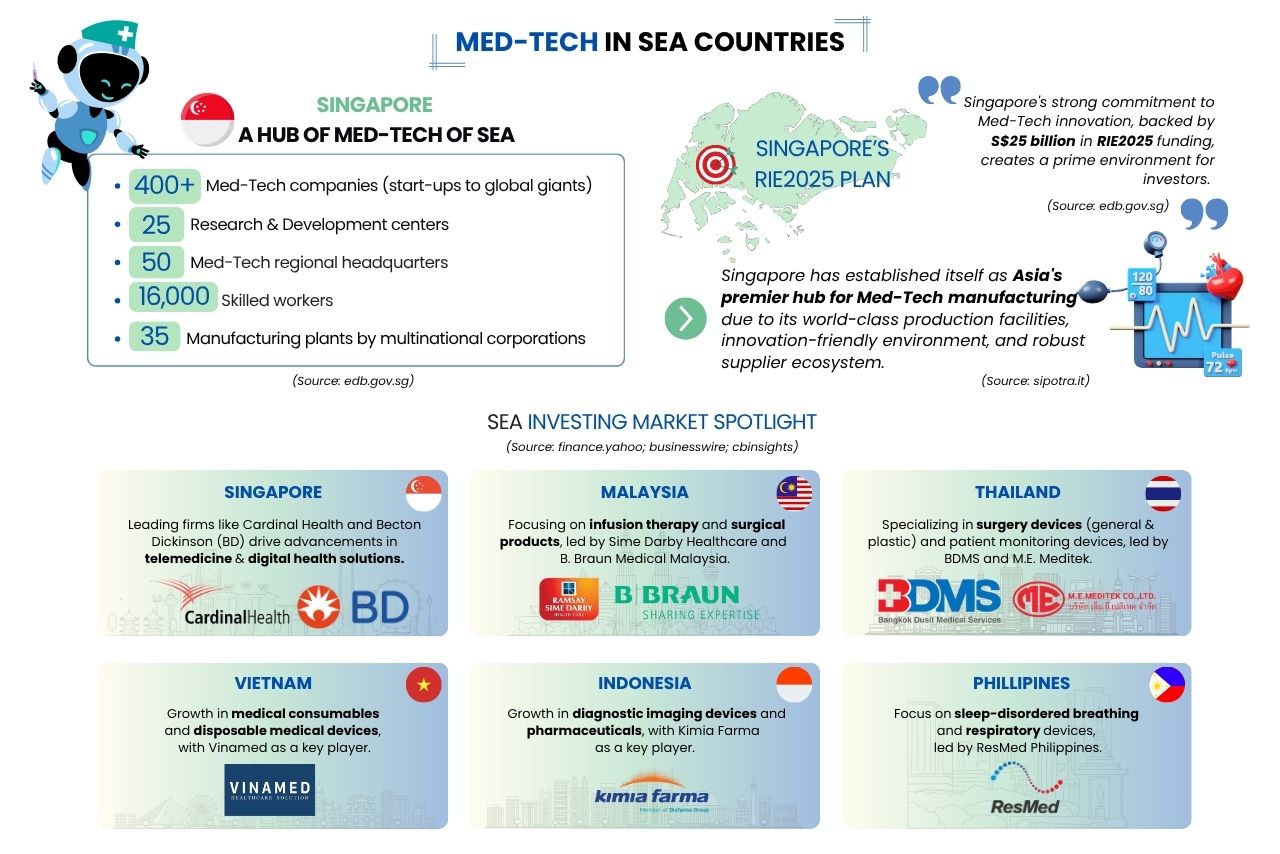
A spotlight on investing in Med Tech’s Southeast Asia markets.
Med Tech in Southeast Asia: Country Highlights
-
Singapore. The region’s innovation hub, home to over 500 Medtech companies, is supported by US$25 billion in R&D funding.
-
Malaysia. A global leader in catheters and medical gloves, investing US$1.1 billion in healthcare infrastructure in 2024.
-
Thailand. Major exporter of single-use devices and implants; government incentives encourage new foreign investments.
-
Vietnam. Expanding diagnostics, consumables, and telehealth services; new firms like Vinamed and Doctor Anywhere drive growth.
-
Indonesia. Domestic demand for medical equipment is surging; over 1,300 hospitals and laboratories rely on local Medtech imports.

Opportunities and challenges of Med Tech Asia landscape.
Why Southeast Asia Matters
Southeast Asia has become a strategic pillar of the med tech industry, offering competitive production costs, skilled labor, and an innovation-friendly business climate. Moreover, governments are aligning policies to strengthen the Asia Pacific medtech network, simplify regulations, and attract sustainable investment.
The region’s unique mix of industrial capacity, digital health innovation, and applied medical technology makes it vital to the Asia Pacific medtech market. In addition, its integration with global supply chains and its growing base of medical technology companies position it as a hub for both manufacturing and advanced research.
Therefore, the medtech in the Asia Pacific ecosystem increasingly depends on ASEAN to deliver affordability, scale, and next-generation healthcare solutions. From robotic surgery to smart diagnostics, Southeast Asia is not just following trends; it is shaping the future of the med-tech industry.
Download Free Sectorial Note
The full Sectorial Note: Medtech in Southeast Asia 2025–2026 includes:
-
Market forecasts and investment outlook.
-
Country profiles and regulatory frameworks.
-
Digital-health innovation and AI use cases.
-
Partnership models across the Asia Pacific medtech market.
-
Strategic recommendations for investors and manufacturers.

Explore more insights from Source of Asia
- Vietnam’s rapid digitalization is transforming healthcare, education, and logistics. Moreover, its strong tech ecosystem is attracting foreign innovation partners. Explore now!
- Explore how France balances innovation and accessibility in its healthcare model. As a result, it serves as a reference for Medtech collaboration in Asia.
- Vietnam’s startup ecosystem is growing fast, driven by innovation and venture funding. In addition, Medtech and Healthtech are leading the movement.
- Understand how regional regulatory frameworks shape the Asia Pacific Medtech market. Therefore, compliance and harmonization are key to global competitiveness.