Summary
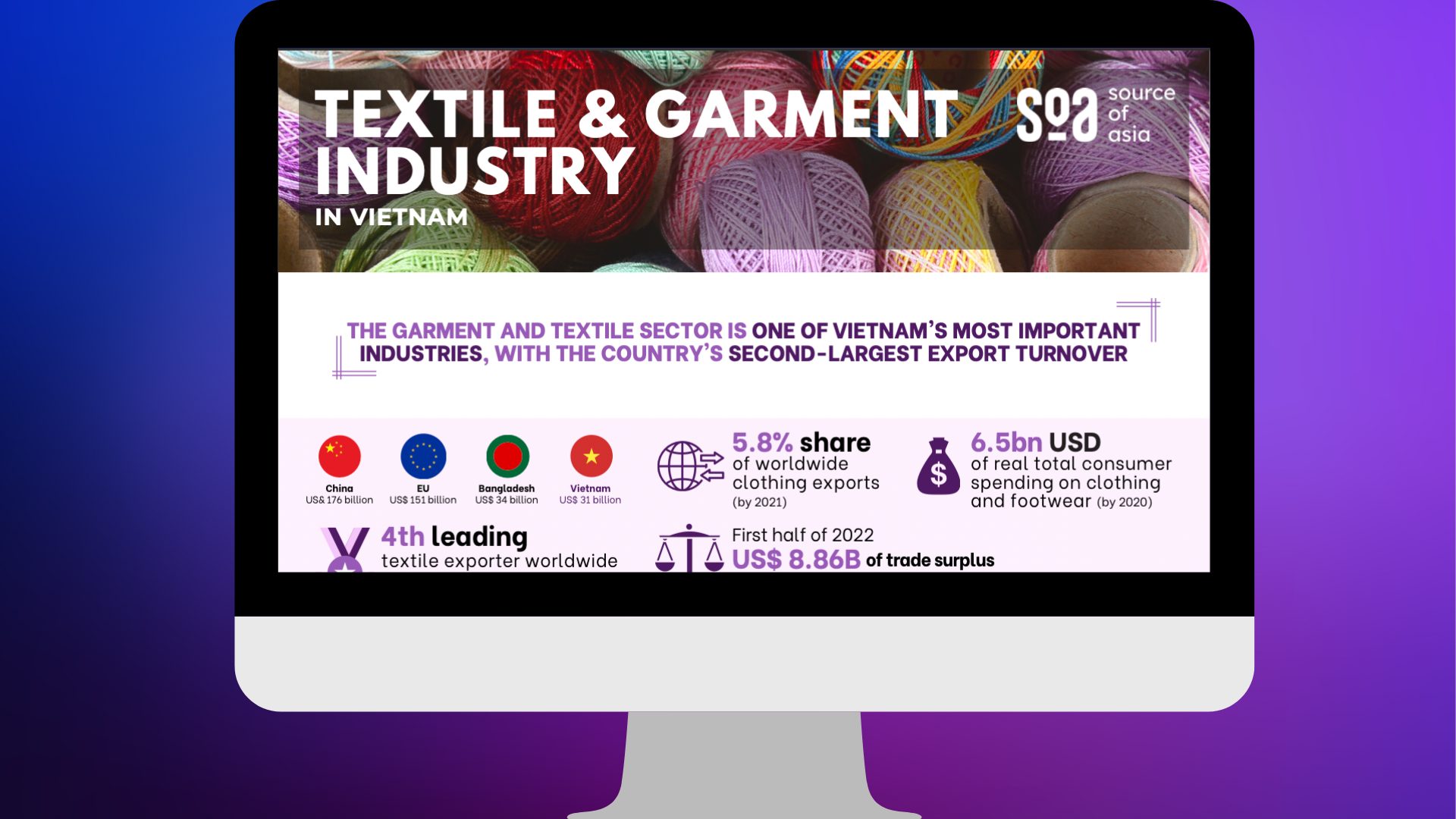
The textile and garment industry is one of Vietnam’s most important economic pillars, ranking second in export turnover after electronics. The country was now the 4th largest textile exporter worldwide, with a trade surplus of US$8.86 billion in the first half of 2022.
In 2022, Vietnam exported US$42 billion in textile and apparel goods, a 17.7% increase year-on-year. Moreover, the sector contributes 6–7% annual growth to the national economy and is projected to reach US$55 billion in exports by 2025.
Therefore, the Vietnam textile industry is not only a key driver of industrial development but also a symbol of the country’s resilience and adaptability in global manufacturing.
Vietnam Textile and Garment Industry Overview
Vietnam’s textile and garment industry includes more than 7,000 enterprises, employing millions nationwide. Among them, 18% produce fabric materials, 12% produce yarn, and 68% specialize in garment manufacturing.
Geographically, production is concentrated in three major regions:
- Northern region (Hanoi, Hai Phong, Hung Yen): focus on yarn and fabric manufacturing.
- Central region (Quang Nam, Da Nang, Hue): focus on weaving and dyeing.
- Southern region (Binh Duong, Dong Nai, Tay Ninh): the hub for garment industry Vietnam, handling over 40% of total textile projects.
In addition, Vietnam’s garment and textile industry exports mainly to the U.S., EU, Japan, and South Korea, which together account for nearly 80% of total export turnover.
Meanwhile, the Vietnam international textile and garment industry exhibition continues to play a central role in connecting local suppliers with global buyers, fostering innovation, sustainability, and partnerships.
Export Performance and Market Growth
Vietnam’s textile and garment exports reached US$22.3 billion in the first half of 2022, up 17.7% year-on-year, while imports of textile raw materials totaled US$13.4 billion.
The Vietnam garment industry has shown consistent growth, with exports of:
- Garments: 30.8% (jackets, shirts, T-shirts, pants).
- Fabric materials: 18%.
- Yarn: 12%.
Moreover, the EU remains a crucial partner, recording a +32% increase in imports of Vietnamese garment products. Vietnam’s apparel shipments account for 5.8% of global clothing exports, solidifying its reputation as a high-quality, cost-competitive manufacturing base.
Therefore, the textile industry Vietnam continues to attract global brands seeking reliable sourcing partners amid shifting trade dynamics.
Opportunities and Challenges
Opportunities
- Trade advantages. Vietnam benefits from 10 bilateral and multilateral agreements, including EVFTA and RCEP, which reduce or eliminate tariffs on garment and textile exports.
- Sustainability drive. New circular-economy policies encourage green production and traceable supply chains.
- Strong investment base. Low labor costs, political stability, and government incentives continue to draw foreign manufacturers.
Challenges
- Raw-material dependency. Over 70% of textile inputs are imported, primarily from China and South Korea.
- Environmental pressure. Around 20% of water pollution originates from dyeing and chemical processes.
- Compliance requirements. To benefit from EVFTA rules of origin, local production of fabrics and yarn must expand.
However, Vietnam’s transition toward sustainability and digital manufacturing is reshaping the garment and textile industry Vietnam into a modern, competitive global player.
Why Vietnam Matters in Global Apparel Manufacturing
Vietnam ranks 4th among global textile exporters, after China, the EU, and Bangladesh. Its cost-effectiveness, skilled labor, and consistent quality make it one of the world’s preferred sourcing destinations.
Furthermore, Vietnam’s participation in sustainability initiatives and its expanding textile industrial zones support the long-term vision of becoming a regional leader in green manufacturing.
In addition, SOA’s Note on Vietnam Textile and Garment Industry highlights how digital transformation, ESG compliance, and value-added innovation will define the industry’s next decade of growth.
Download Free Sectorial Note
The Free Sectorial Note: Vietnam’s Textile & Garment Industry provide:
- Updated data on exports, investments, and production trends.
- Analysis of the Vietnam textile industry report and global positioning.
- Overview of the garment and textile industry Vietnam supply chain.
- Key insights from the Vietnam international textile and garment industry exhibition.
- Strategic recommendations for foreign investors and sourcing partners.

Explore more insights from Source of Asia
- Discover how the agriculture sector supports regional supply chains.
- Learn how Source of Asia helps companies enter and scale across ASEAN markets. In addition, explore tailor-made solutions for investors in the Vietnamese textile industry.