Introduction
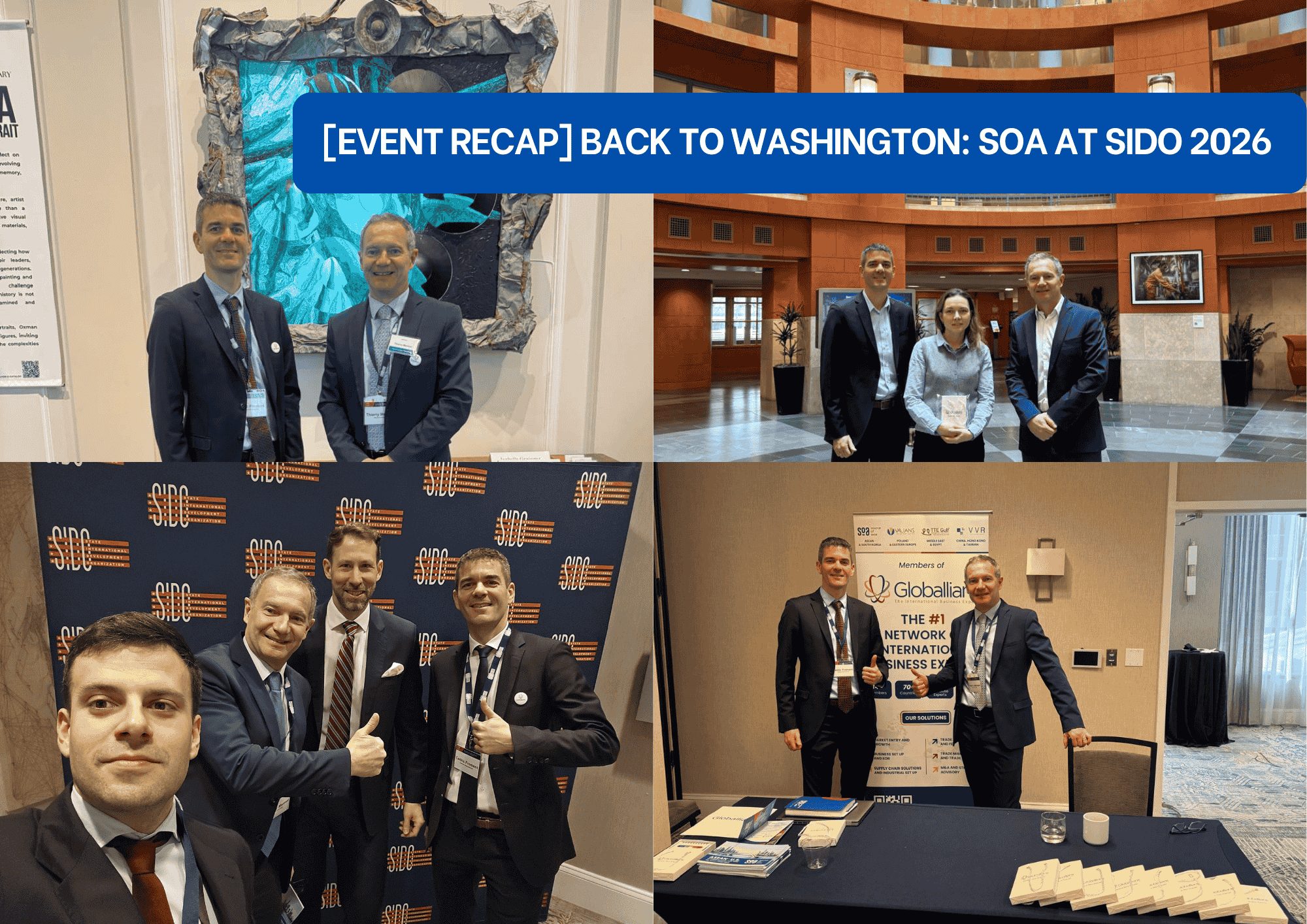
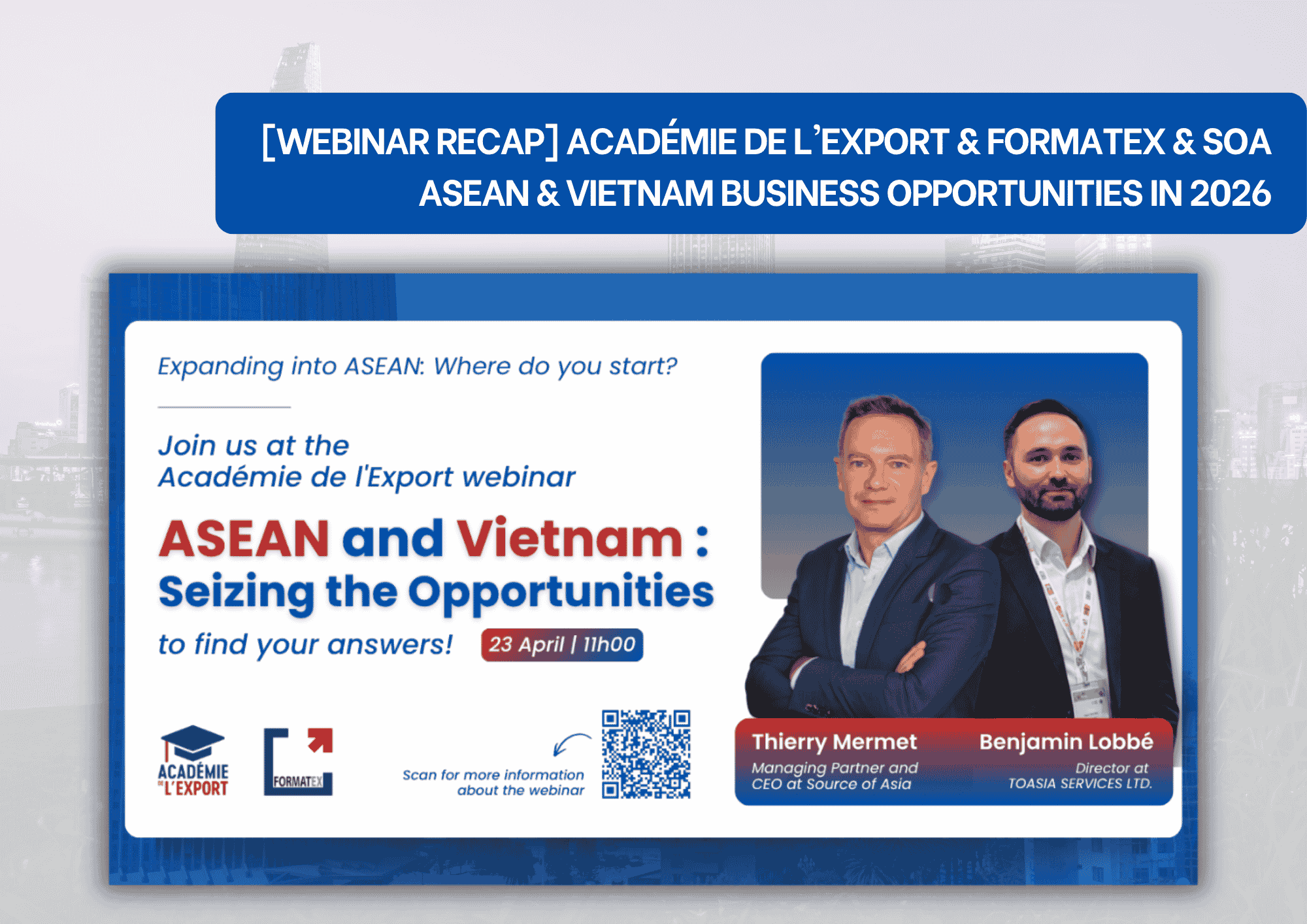
On April 23, 2026, Source of Asia presented at the ASEAN et Vietnam: Saisir les Opportunités webinar. It is organized by Académie de l’Export in partnership with Formatex. The session brought business leaders, export professionals, and trade specialists together to explore the most promising business opportunities in ASEAN and Vietnam for international companies in 2026 and beyond.
Mr. Thierry Mermet, CEO of Source of Asia, led the session alongside Benjamin Lobbé, Asia Export Sales Manager at ToAsia Services Ltd. Together, they delivered a structured overview covering ASEAN’s macroeconomic trajectory, Vietnam’s accelerating rise as a regional production and commercial hub, a practical market entry framework, and sector-specific deep dives into med-tech and healthcare.
In this article, we capture key insights, with added context and analysis, on the strategic themes that matter most to companies evaluating Southeast Asia as their next growth market.
ASEAN Business Opportunities: A Market Too Big to Ignore
Southeast Asia is a market demanding immediate attention. The ASEAN bloc currently ranks as the 5th-largest economy in the world, accounting for 3.5% of global GDP.
Between 2015 and 2023, ASEAN GDP grew by 51%. The region reached USD 3,950 billion in total GDP. The presentation projects ASEAN GDP to exceed USD 4,500 billion by 2030 — a trajectory that would elevate the bloc to the 4th largest economic grouping globally, overtaking Japan.
Moreover, the region is home to over 700 million people, making it the third most populous in the world. But the more commercially significant figure is this: by 2030, ASEAN will welcome 140 million new middle-class consumers, representing over 16% of global middle-class growth – ahead of Central Europe and Latin America, and just behind China and India. For companies pursuing long-term growth, this demand curve is difficult to ignore.
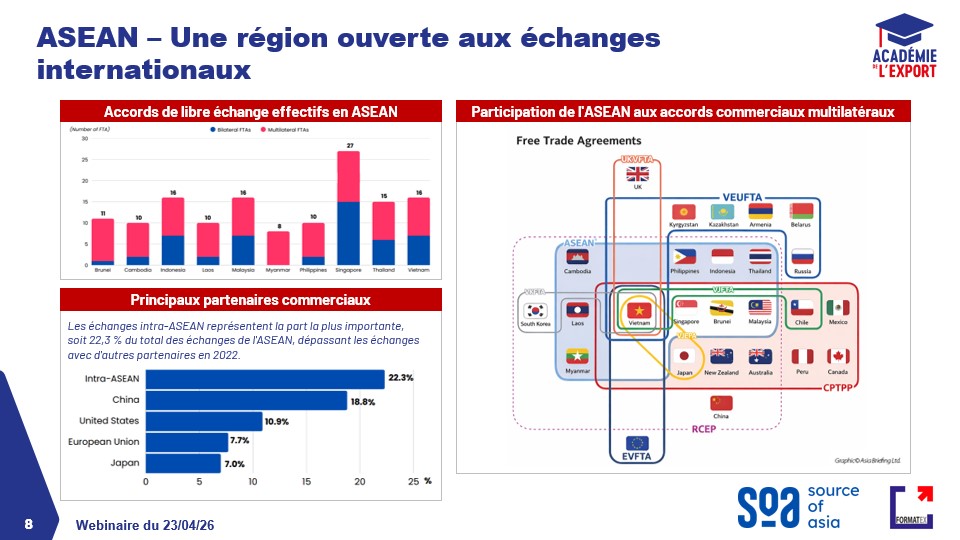
ASEAN continues to strengthen its position as one of the world’s most connected trade regions. The region is supported by extensive free trade agreements and strong international partnerships.
From a trade perspective, ASEAN is deeply embedded in global supply chains. Intra-ASEAN trade leads all partnerships at 22.3% of total trade volume, followed by China (18.8%), the United States (10.9%), the EU (7.7%), and Japan (7.0%). The region’s share of global merchandise exports also grew from 6.1% in 2005 to 7.4% in 2023, surpassing the combined share of Japan and South Korea.
On the investment front, ASEAN attracted USD 229.8 billion in foreign direct investment in 2023, reflecting sustained confidence from global investors. The leading sectors drawing capital include financial services and insurance, manufacturing, and professional and technical services.
To sum up, the macro case for ASEAN is compelling on every dimension: political stability, open trade agreements, a young and competitive labor force, and rapidly evolving consumer markets.
Vietnam Business Opportunities and Regional Growth Potential
Among ASEAN members, Vietnam has emerged as the breakout economy of the decade. The online seminar made a strong case for why.
Geographically, Vietnam sits at the heart of ASEAN. It is positioned between North Asia and Europe along critical maritime trade and logistics routes. From Ho Chi Minh City or Hanoi, every ASEAN capital is reachable in just 2 to 3 hours by air – a connectivity advantage that translates directly into operational efficiency for regionally-focused businesses.
Next, the macroeconomic indicators are equally striking. Vietnam’s GDP growth is forecast at +8.02% for 2025, well above the ASEAN average of 4.5-5%. Total GDP stands at approximately USD 514 billion, placing Vietnam firmly among the top 4 economies in the region. Vietnam attracted USD 27.6 billion in FDI in 2025, while manufacturing captured 83% of all inbound investment, concentrated in electronics, textiles, and footwear, and industrial assembly.
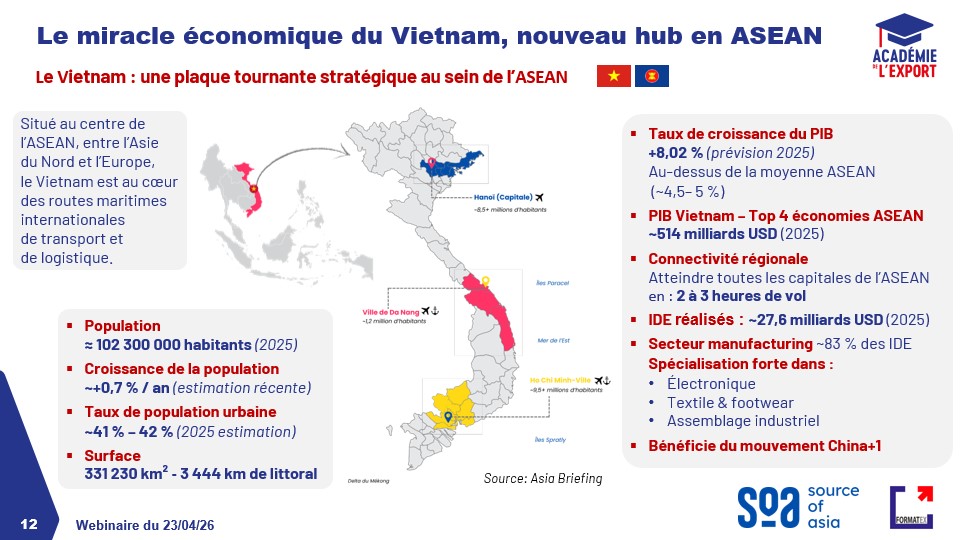
Vietnam continues to strengthen its role as a regional manufacturing and investment hub, supported by strong GDP growth, strategic connectivity, and rising foreign investment.
How the China+1 Strategy Creates Vietnam Business Opportunities
A critical driver of Vietnam’s rise is the China+1 strategy. It is worth understanding why this strategy has become so structurally important for multinational supply chains.
The core risk that China+1 addresses is over-dependence on a single manufacturing market. For decades, global companies concentrated production in China, drawn by scale, cost, and infrastructure. But a series of disruptions — including escalating US-China trade tensions, COVID-19-era supply chain shocks, and rising Chinese labor costs — exposed the fragility of single-country dependency. Consequently, when one node in your supply chain fails, the entire system stalls.
China+1 is the strategic response. Companies are not abandoning China. Instead, they are adding a second production base to improve resilience, flexibility, and tariff management. Therefore, Vietnam has become the preferred destination for this diversification, precisely because of the combination of three factors: geography, infrastructure, and people.
So why has Vietnam become the preferred destination?
The first reason is that Vietnam borders China, shares maritime access to key Pacific trade routes, and benefits from modern port infrastructure and improved road and rail connectivity. On the human capital side, Vietnam offers a workforce that is not only cost-competitive, with a minimum wage of USD 175/month, among the lowest in ASEAN for a skilled labor market, but also young, educated, and increasingly specialized.
Furthermore, with a median age of just 32.6 years (compared to China’s 38.4), a literacy rate of 95.8%, and a labor force participation rate of 68.9%, Vietnam delivers a rare combination: affordable talent that is not aging out of the workforce. This structural shift is reshaping global supply chains, and Vietnam is at the center of it.
How to Succeed in ASEAN: The 5P Framework of SOA
Understanding the business opportunities is one thing. Executing on it is another. This is where Source of Asia’s presentation moved from analysis to actionable strategy, encapsulated in the 5P framework, including Préparation, Persévérance, Prudence, Présence, and Professionnalisme.
Each “P” addresses a specific failure mode that companies encounter when entering ASEAN markets. But not all five carry equal weight in practice, and the webinar was candid about which one presents the greatest challenge.
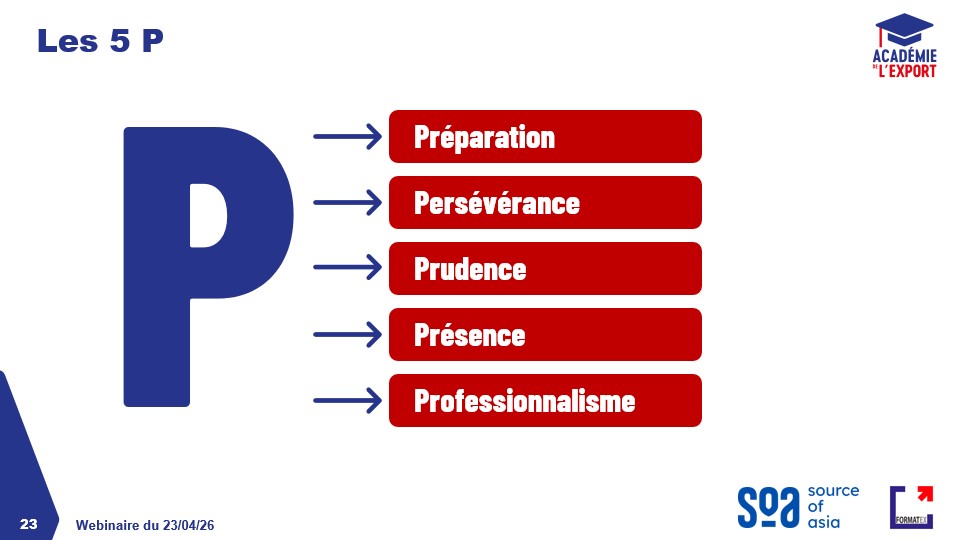
Source of Asia’s 5P framework highlights the five essential principles for successful expansion in ASEAN.
Présence (Presence) is the most critical and most underestimated barrier
As stated directly in the presentation: “In Asia, the barriers are not just tariff-based — they are cultural, regulatory, and logistical. Without a local relay, it is difficult to establish a durable footprint.”
From a B2B market development and communications standpoint, this is the bottleneck that cascades into every other failure. Without physical or operational presence on the ground, European companies struggle to identify reliable local partners, navigate shifting regulatory requirements, manage recruitment effectively, and coordinate field-level execution.
As a result, marketing campaigns fall flat when they are designed for Western audiences without local cultural calibration. Lead generation stalls because there is no trusted local entity to convert interest into meetings, and meetings into contracts. Finally, preparation without presence produces research that sits on a shelf.
The other four Ps reinforce and depend on Présence
Préparation means thorough market research, regulatory mapping, and competitive benchmarking before committing capital. This is the foundation. However, it must be built on local knowledge, not assumptions made from abroad.
In practice, ASEAN markets reward long-term commitment. Persévérance is vital in this context. Relationship-building takes time. Companies earn trust through consistent local presence, not one-off visits. Companies that enter with a short-term mindset consistently underperform.
Prudence means careful partner vetting, rigorous contract structuring, and respect for local compliance frameworks. Commercial risks in ASEAN are real, but they are manageable with the right guidance.
In markets where reputation travels fast, and relationships are built on credibility, consistent standards of delivery and engagement are non-negotiable. That is what Professionnalisme means.
Real-World Business Opportunities in ASEAN: SOA Case Studies
These principles become clearer in real business situations. Thus, in this section, we presented two client case studies that illustrate what successful ASEAN market entry looks like when these principles are applied.
- Case Study 1 – Renewable Energy Services (Akrocean)
Akrocean, a specialist in offshore monitoring and floating LiDAR platforms, needed to develop its presence in Vietnam and South Korea. Source of Asia delivered a 45-page market study within two months and identified 11 qualified local partners.
Over the following two years, a fully operational local team of four was assembled in Vietnam, covering recruitment, employer-of-record services, office setup, and marketing coordination.
In South Korea, reliable technical providers for buoy deployment were sourced through a structured sourcing mission, enabling a secure and compliant product rollout.


- Case Study 2 – Cosmetics (SVR Laboratoire Dermatologique)
A French cosmetics company needed to move fast — establishing local HR, office infrastructure, product registration, and legal entity creation simultaneously. We organized coworking facilities for initial operations, conducted salary benchmarking, managed full executive recruitment, and coordinated ERP digital transformation alongside regulatory compliance. The company recruited and onboarded two senior managers within two months. At the same time, it established regional distribution across Southeast Asia.
From the above case studies, we have learned a common lesson: the companies that succeeded did not try to figure out ASEAN from their headquarters. They built local presence – efficiently, compliantly, and quickly – through a partner who already had the network, knowledge, and operational infrastructure in place.


Closing Remarks
To sum up, this webinar highlighted a clear reality that Southeast Asia is becoming a strategic growth region. For international companies evaluating long-term business opportunities in Southeast Asia, the region now offers one of the strongest combinations of market growth, manufacturing capacity, and consumer expansion globally.
As shared by Benjamin Lobbé at ToAsia Services and Tesalys through his experience across the ASEAN market, the med-tech sector is also entering a strong growth phase, driven by rising healthcare demand, aging populations, and accelerating digital health investment in countries such as Vietnam and Indonesia.
At the same time, successful expansion requires more than market potential. Through Source of Asia’s 5P framework, we help companies turn opportunities into practical execution, from market validation and partner identification to operational setup and local support across ASEAN.
We would also like to sincerely thank Académie de l’Export and Formatex for organizing this insightful webinar and creating a valuable space for international business exchange.
If your company is exploring Southeast Asia as its next growth market, we would be pleased to continue the conversation. Book a free consultation with our experts now!
Frequently Asked Questions (FAQs)
The China+1 strategy helps companies reduce dependence on China as a single manufacturing base. Instead of relying on one country, businesses add a second production location to improve supply chain resilience and flexibility.
Vietnam benefits strongly from this shift. The country combines proximity to China, competitive labor costs, strong manufacturing capabilities, and favorable trade agreements such as the EVFTA with the European Union. As a result, many international manufacturers now view Vietnam as a strategic alternative production hub in ASEAN.
European companies often face operational and regulatory complexity when entering ASEAN markets. The webinar highlighted five major challenges: changing market dynamics, local product adaptation, compliance requirements, partner identification, and on-the-ground execution.
However, the biggest barriers are usually not tariffs. Instead, companies struggle with cultural differences, local regulations, and execution capacity. Without local knowledge and presence, businesses often face delays in recruitment, logistics coordination, and commercial development.
With the right local partner, companies can typically become operational in Vietnam within two to three months. This process may include office setup, executive recruitment, employer-of-record services, and initial compliance procedures.
The webinar highlighted the SVR Laboratoire Dermatologique case study as a practical example. Source of Asia helped the company recruit two senior managers and launch operations within two months while supporting the regional distribution setup across Southeast Asia.