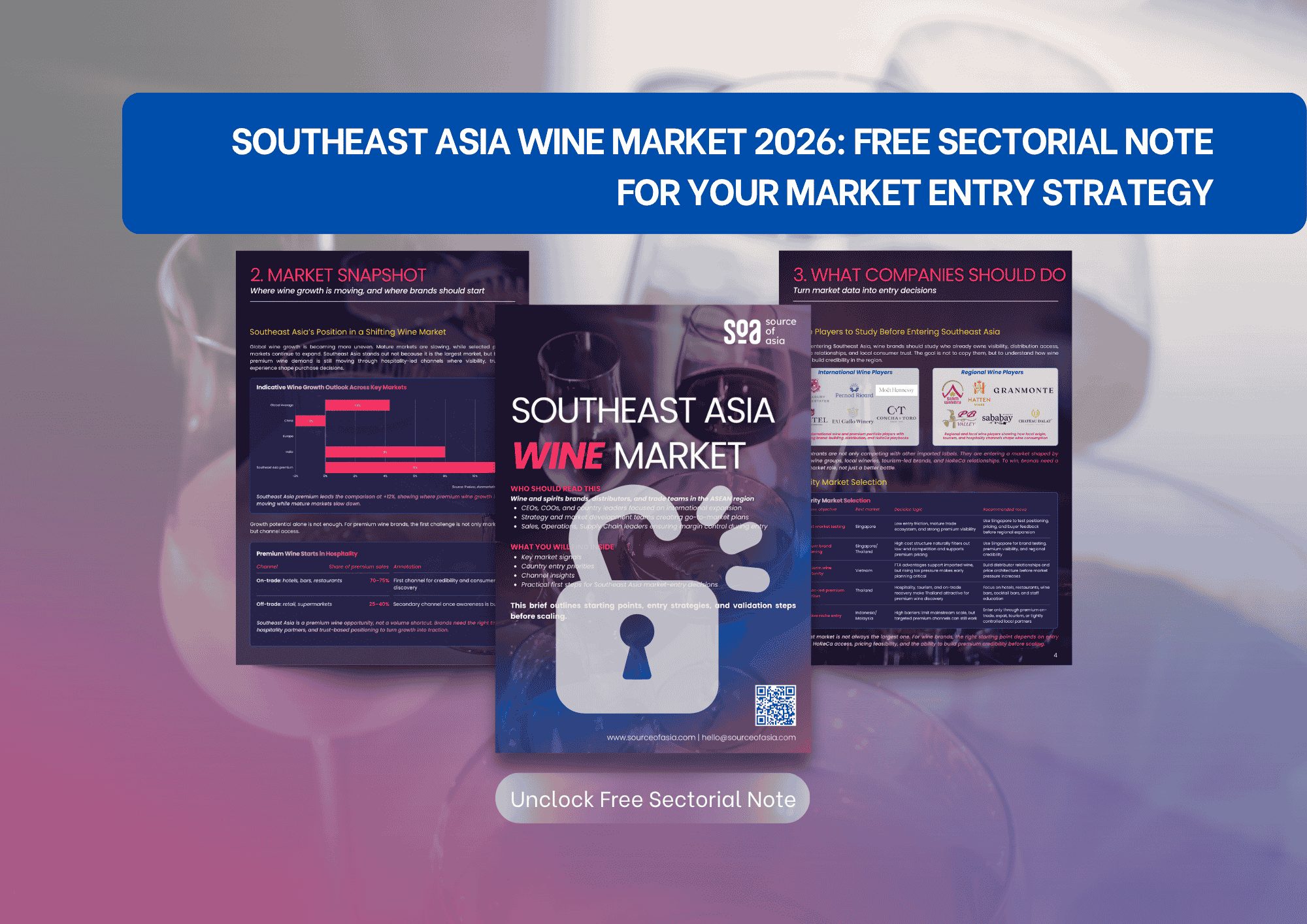
Overview
A practical market-entry brief for wine brands, distributors, and trade teams exploring Southeast Asia.
Each country in the SEA region comes with different import rules, tax pressure, consumer behavior, channel maturity, and route-to-market challenges. This free sectorial note helps wine companies understand where premium demand is moving, which markets are easier to test first, and how to validate opportunities before committing to a full regional launch.
Download the free PDF and get a clear starting point for your Southeast Asia market-entry decisions.
Southeast Asia Wine Market 2026: Where Should Your Brand Start?
The Southeast Asia wine market is gaining attention. However, the opportunity is not evenly distributed. Mature markets are slowing, while selected Asian markets continue to offer premium growth potential. For wine and spirits brands, the real question changes from “Should we enter Southeast Asia?” to “Which market should we test first, through which channel, and with what level of investment?”
In markets such as Singapore, Thailand, Vietnam, Indonesia, and Malaysia, entry conditions can vary widely. Some offer lower friction for brand testing. Others require stronger compliance preparation, careful partner selection, and a more selective premium approach.
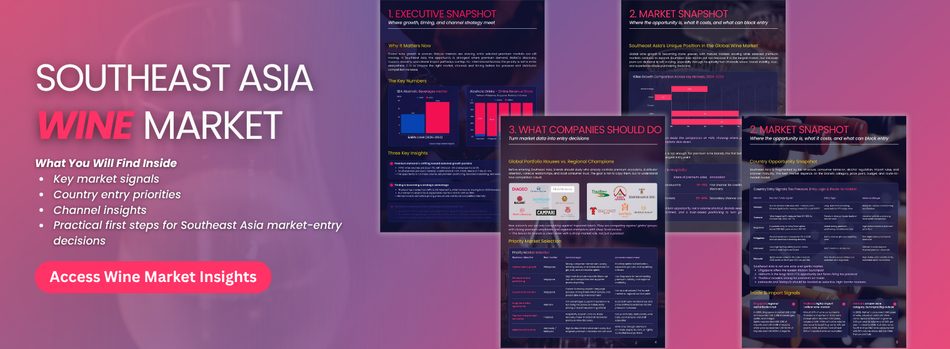
Inside the Southeast Asia Wine Market 2026 sectorial note, you will find a structured view of the region’s premium wine opportunity, including:
1. Key market signals. Understand why premium wine demand is shifting toward selected growth pockets in Southeast Asia, especially where import reliance, tourism recovery, HoReCa discovery, and tariff changes overlap.
2. Country opportunity snapshot. Compare market-entry conditions across key Southeast Asian markets, including Singapore, Thailand, Vietnam, the Philippines, Indonesia, and Malaysia.
3. Channel insights. Learn why premium wine brands often need to validate demand through HoReCa first, before scaling into retail or online channels.
4. Priority market selection. Identify which market may fit your objective, whether you want to test pricing, build premium positioning, develop a long-term wine opportunity, or activate tourism-led demand.
5. Budget-based entry paths. See how your strategy may differ depending on whether you are testing with under US$50,000, building a controlled two-market entry, or preparing for regional activation.
6. 30-day market validation sprint. Discover a practical approach to test one market first, assess distributor fit, validate pricing, and collect real market feedback before investing further.
Who Should Download This Brief?
This PDF is especially relevant for:
- Wine and spirits brands considering Southeast Asia expansion
- Export managers and international business development teams
- Importers, distributors, and trade partners looking for market signals
- CEOs, COOs, and country leaders assessing regional opportunities
- Strategy and market development teams building go-to-market plans
- Sales, operations, and supply chain leaders preparing market-entry decisions
Whether your brand is already present in Asia or still exploring the region, this brief helps you understand where to start, what to test, and what to avoid.
FAQs about the Southeast Asia Wine Market
The guide includes market signals, country opportunity snapshots, channel insights, budget-based entry paths, and practical validation steps for wine and spirits brands exploring Southeast Asia.
It is designed for wine and spirits brands, distributors, export managers, trade teams, and business leaders evaluating market-entry opportunities across Southeast Asia.
The Southeast Asia Wine Market 2026 covers key markets including Singapore, Thailand, Vietnam, the Philippines, Indonesia, and Malaysia, with practical notes on entry logic, tax pressure, channel access, and market challenges.
Yes. Source of Asia can support market research, distributor mapping, B2B matchmaking, market validation, and commercial activation across Southeast Asia.
Yes, in key markets like Vietnam and Thailand, operating through a locally licensed importer/distributor is a strict legal requirement. While Singapore offers slightly more flexibility, a highly capable local partner is non-negotiable for practical market access across the region.
Win the Right Market, with the Right Partner, with SOA
Success in Southeast Asia doesn’t mean entering everywhere at once. The brands that win are the ones that choose the right market, the right channel, and the right local distributor before scaling. Equip your export and expansion teams with the insights they need to make profitable decisions.
Don’t let your competitors capture the premium market share while you navigate complex regulations alone. Arm your export team with the exact blueprint to confidently enter, price, and scale.
If your team is exploring Southeast Asia but needs clarity on where to start, we are ready to help you assess the right market, channel, distributor profile, and validation path.
Book a market-entry discussion with our team to identify the best first step for your brand.