Introduction
Over the past few years, supply chain rebalancing has moved from operational discussions to the boardroom. Rising production costs, tariff shifts, geopolitical tension, and pandemic disruption have forced companies to question whether their current footprint is still safe. Many companies first focus on rising costs or tariff exposure. Soon after, they realize the deeper issue is concentration risk and limited flexibility across their global supply chain.
This is where supply chain rebalancing comes in. It is not a simple relocation. It is a redesign of how global supply chain management distributes production, suppliers, and compliance exposure across regions. In this transition, ASEAN has become a central node within the evolving US-ASEAN supply chain landscape. In this guide, we – Source of Asia, explain how supply chain rebalancing works in practice and how companies should approach ASEAN as part of that shift.
Key Insights
- Supply chain rebalancing is a structural shift that spreads production across multiple countries to reduce concentration risk and improve long-term flexibility.
- ASEAN in China Plus One strategies as a complement to China, helping companies balance cost, tariff exposure, and operational continuity.
- Regional integration and trade agreements make cross-border production more efficient, but infrastructure gaps and talent shortages still require attention.
- Success depends on disciplined execution, including supplier validation, compliance oversight, and alignment with long term strategy.
Global Supply Chain 101 Overview
Before changing factory locations or suppliers, it is important to clarify what supply chain rebalancing means.
What is supply chain rebalancing?
Supply chain rebalancing is the process of spreading production, sourcing, and logistics across more than one country. It does not mean leaving one market completely. Instead, it means reducing heavy dependence on a single location.
It is also different from simple diversification:
- Diversification adds backup suppliers.
- Rebalancing changes how much production each country carries.
Over time, this shift moves companies away from concentrated risk and toward distributed production networks.
In the US–ASEAN supply chain dynamic, this often means relocating selected manufacturing stages to Southeast Asia while maintaining certain operations elsewhere. The goal is flexibility, continuity, and better risk control.

What Is Supply Chain Rebalancing? A Structural Shift in Global Production
Why rebalancing accelerated after 2018
According to the International Monetary Fund, the US–China trade tensions prompted immediate effects, with rising import duties forcing companies dependent on Chinese production to reevaluate their risks. This was compounded by pandemic disruptions that halted operations – factories paused, ports slowed, and deliveries became uncertain, highlighting that efficiency alone wasn’t sufficient without flexibility.
Amid these challenges, the US and parts of Europe shifted their industrial policies to emphasize domestic manufacturing in strategic sectors, transforming supply chains into national priorities. As a response, the China Plus One strategy gained traction, with many companies not abandoning China but integrating ASEAN as a second base to balance risk and maintain operational continuity.
How rebalancing differs from full decoupling
Rebalancing and decoupling are often used together, but they mean different things.
- Rebalancing is about spreading risk. Companies adjust where they produce and source, so they are not overly dependent on one country.
- Decoupling suggests a clear break. It implies separating supply chains for political or strategic reasons.
In practice, most multinational firms are not leaving China entirely. They are reducing exposure, not cutting ties. ASEAN, in this context, works as a complement rather than a replacement.
Production networks remain connected. Components may still move between China and Southeast Asia before final assembly. Instead of a clean split, companies are building layered supply chains that allow flexibility without full separation.
ASEAN’s Strategic Position in Global Supply Chain Rebalancing
ASEAN’s position in supply chain rebalancing reflects lasting changes in global production. The region is shifting from a secondary option to a strategic manufacturing hub.
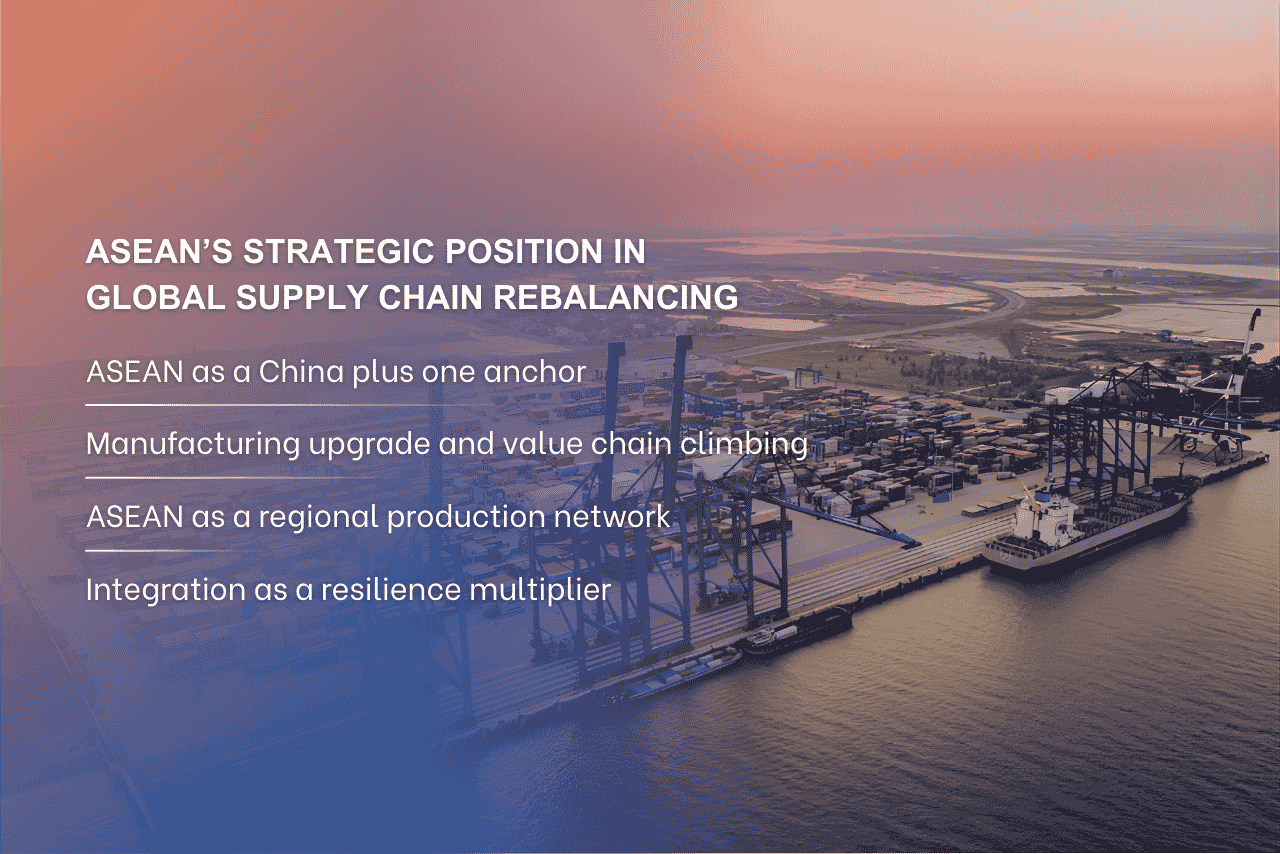
ASEAN’s Strategic Position in Global Supply Chain Rebalancing
ASEAN as a China plus one anchor
As reported by CNBC, Southeast Asia has become a top choice for companies diversifying supply chains away from China, particularly under the China Plus One strategy. Instead of leaving China, firms are adding production sites in Southeast Asia to reduce risk and manage tariff pressure. Several countries play clear roles:
- Vietnam has expanded into electronics assembly and consumer goods.
- Thailand continues to anchor regional automotive production.
- Indonesia is moving into battery materials and EV-related industries.
This shift supports broader US–ASEAN supply chain realignment. American companies are moving selected production stages into the region to reduce tariff exposure while maintaining links with existing operations in China.
Manufacturing upgrade and value chain climbing
ASEAN is no longer seen as a low-cost assembly base. In recent years, several countries have started moving into component production and more technical stages of manufacturing. This shift shows a gradual climb up the value chain.
Growth is visible in higher-value sectors such as Semiconductor packaging and testing, precision components, EV supply chains, and battery materials, etc.
Industrial parks play a key role by offering ready-built infrastructure, stable utilities, and cluster networks. At the same time, governments support this upgrade through tax incentives, land access, and investment programs. These factors help ASEAN move from a cost-driven model toward a capability-driven manufacturing base.
ASEAN as a regional production network
ASEAN is gradually operating as a regional production network rather than a group of separate markets. Production can move across borders depending on cost, capacity, and specialization.
For example, components may be produced in Malaysia, assembled in Vietnam, and shipped through Thai logistics hubs. Agreements such as RCEP and CPTPP reduce tariff friction and support cross-border flows.
Thus, it is easier for firms to split production stages across countries. As a result, ASEAN integration strengthens supply chain resilience by spreading risk across multiple locations instead of relying on a single base.
Integration as a resilience multiplier
Resilience improves when companies build redundancy into their supply networks. Instead of relying on a single site, firms distribute operations across several ASEAN countries. If disruption affects one location, production can shift to another.
This multi-country network works because the region is becoming more connected. Port expansions, new logistics corridors, and digital customs systems make cross-border movement faster and more predictable.
As ASEAN functions more like an integrated production base rather than separate national markets, rebalancing becomes more practical. Companies gain flexibility, reduce single-point risk, and maintain continuity even when local disruptions occur.
What Is Driving ASEAN Supply Chain Resilience?
ASEAN’s supply chain resilience is driven by a mix of trade shifts, capital inflows, and policy support. These forces are strengthening the region’s role in global supply chain rebalancing.
Trade diversion and policy shifts
First, ASEAN’s supply chain resilience has strengthened as tariffs reshaped global trade. When the US imposed higher duties on selected Chinese goods, trade flows began shifting toward Southeast Asia. US import data shows increased sourcing from ASEAN in sectors such as electronics, furniture, and machinery.
Investment moved in the same direction. American and multinational firms expanded operations in countries such as Vietnam, Thailand, and Indonesia to manage tariff exposure. This reflects a broader FDI realignment trend, where companies adjust production locations to fit new trade rules and reduce concentration risk.
Record FDI inflows and industrial policy
Secondly, ASEAN economies have recorded strong FDI inflows, especially in manufacturing and infrastructure. Governments are actively competing to attract investors through tax breaks, land support, and streamlined licensing. At the same time, they are prioritizing strategic sectors such as electronics, renewable energy, and digital services to strengthen long-term industrial capacity.
Infrastructure modernization supports this direction. Ports are expanding, highways are improving, and new industrial zones are being developed to handle rising export volumes. Together, incentive competition, sector focus, and infrastructure upgrades reinforce ASEAN’s position in ongoing supply chain rebalancing.
Digitalization and sustainable supply chains
Last but not least, digital tools and sustainability are reshaping ASEAN supply chains. Buyers are increasing ESG compliance pressure, as environmental and labor standards become stricter. At the same time, some limits remain, including port congestion, inland transport gaps, and uneven energy supply.
In response, firms are investing in smart manufacturing and digital tracking to improve efficiency and transparency. New carbon border adjustment mechanisms (such as the EU’s CBAM) in advanced markets are pushing cleaner production, while digital trade facilitation systems help goods move across borders with fewer delays and less paperwork.
Structural Constraints in ASEAN Supply Chain Development
ASEAN’s supply chain growth is strong, but structural constraints in infrastructure, labor capacity, and regulatory alignment continue to limit deeper regional integration.

Key structural constraints in ASEAN supply chain development
Infrastructure gaps and logistics bottlenecks
Physical connectivity across ASEAN is still uneven, and this affects supply chain performance and limits operational efficiency across the region in different ways:
- Port congestion often happens during peak export seasons, leading to shipment delays and higher logistics costs.
- Inland transport inefficiencies remain in some areas, where highways, rail links, and last-mile delivery are not equally developed.
- Energy reliability varies depending on location. While major industrial zones usually have stable power, some areas still face supply inconsistency that can disrupt advanced manufacturing.
Skilled labor and technology depth
As ASEAN moves into more advanced production, workforce limits become clearer:
- The talent gap in high-tech manufacturing is visible in sectors that require engineers, skilled technicians, and specialized operators. In many cases, demand grows faster than local supply.
- Automation readiness differs by country and industry. Some sectors use digital systems and robotics, while others still depend heavily on manual labor.
Companies planning to relocate complex production need to evaluate whether local workforce capability can support their technology and operational standards.
Regulatory fragmentation and non-tariff barriers
Regulatory differences across ASEAN continue to affect cross-border operations:
- Customs inconsistency remains an issue, as procedures and documentation standards vary between countries.
- Compliance duplication increases administrative costs when firms must meet overlapping reporting and regulatory requirements.
- Intra-ASEAN harmonization gaps limit smoother integration and reduce the efficiency of regional production networks.
These regulatory frictions slow the development of a fully integrated ASEAN supply chain.
How ASEAN Can Move from Diversification to Strategic Rebalancing
Diversification lowers risk, but strategic rebalancing requires deeper coordination, stronger regional integration, and long-term policy alignment across ASEAN economies.
Strengthen ASEAN regional supply chain integration
Closer regional coordination would reduce operational friction and improve efficiency:
- Harmonized standards across member states would lower compliance complexity for cross-border production.
- Faster cross-border clearance through aligned customs systems would shorten lead times and reduce logistics costs.
- Regional industrial clustering can concentrate on suppliers, technical expertise, and supporting services, making higher-value manufacturing more viable.
Stronger integration would allow ASEAN to function as a connected production network rather than separate national markets.
Invest in human capital and innovation
Upgrading production also requires upgrading skills:
- Expanded technical training programs can address workforce shortages in engineering and advanced manufacturing.
- Deeper industry–academia collaboration helps align education with real production needs.
- Greater automation investment improves productivity and supports long-term supply chain optimization.
Without sustained investment in talent and technology, movement up the value chain will remain limited.
Balance openness and strategic autonomy
ASEAN must remain globally connected to sustain long-term growth. Open trade and clear policies help maintain FDI attractiveness and investor confidence. At the same time, policymakers must avoid overprotectionism as excessive barriers would weaken competitiveness and reduce integration with global markets. Strategic autonomy should focus on strengthening domestic capability without closing the door to trade and capital flows. A balanced approach will reinforce ASEAN’s position within the global supply chain system.
Implications for US Companies
For US firms, supply chain rebalancing is both a defensive response to risk and a long-term strategic adjustment. ASEAN is not replacing existing production bases, but it is becoming a structured complement that increases flexibility and reduces overdependence on one country.
Why ASEAN matters for the US supply chain strategy
ASEAN supports several core priorities within the US supply chain planning:
- Risk diversification by spreading production across multiple countries rather than relying on a single hub
- Market proximity provides closer access to key Asian suppliers and growing consumer markets
- Trade agreement leverage helps firms manage tariff costs and improve export positioning through regional frameworks
This evolving US–ASEAN supply chain structure allows companies to rebalance without fully disconnecting from existing operations.
Best practices for managing global manufacturing supply chains in ASEAN
Execution requires structure and active oversight, especially when operations span multiple countries:
- A multi-country sourcing strategy reduces operational concentration risk and gives firms fallback options if disruption occurs.
- On-the-ground supplier validation helps confirm real production capacity, labor standards, and quality control systems before scaling orders.
- Continuous compliance and ESG monitoring protect against regulatory exposure and reputational risk in both ASEAN and the US market.
- A hybrid sourcing and market entry model allows companies to begin with contract manufacturing or supplier partnerships, then gradually build a deeper commercial presence over time.
In practice, many US firms do not treat sourcing and market entry as separate steps. They use global sourcing as an execution tool to test partners and assess market conditions before expanding into broader investment or direct operations.
Conclusion
To conclude, ASEAN is not replacing China in global manufacturing. Instead, it is becoming a structural complement within a more distributed production system. Rebalancing today is about networked production across multiple countries, not moving from one single base to another.
In this structure, ASEAN provides flexibility, supports risk diversification, and strengthens long-term operational stability. For US companies, the objective is not simple relocation, but disciplined supply chain design aligned with long-term strategy.
At Source of Asia, we support this shift through practical, on-the-ground execution. Our team provides supplier identification, B2B matching, negotiation support, and buying office services. For relocation projects, we assist with feasibility studies, factory setup, and supply chain audits across Southeast Asia.
If your company is evaluating supply chain rebalancing in ASEAN, these insights from Source of Asia may help guide your next steps:
Frequently Asked Questions
Supply chain rebalancing is the deliberate shift of production, sourcing, and logistics across multiple countries to reduce overdependence on a single base. It does not imply full relocation. It is a structural adjustment that spreads risk and improves operational flexibility.
ASEAN offers an additional production base within Asia that supports risk diversification, tariff management, and regional integration. Its growing manufacturing capacity, trade agreements, and cross-border networks make it a practical complement within global supply chains.
No. Most multinational firms are not exiting China entirely. Instead, they are adding ASEAN as a second base. The result is a distributed production network rather than a one-to-one replacement.
US firms should focus on multi-country sourcing to reduce concentration risk, conduct on-the-ground supplier validation, maintain strong compliance and ESG oversight, and align sourcing decisions with long-term market strategy rather than short-term cost savings.