Introduction
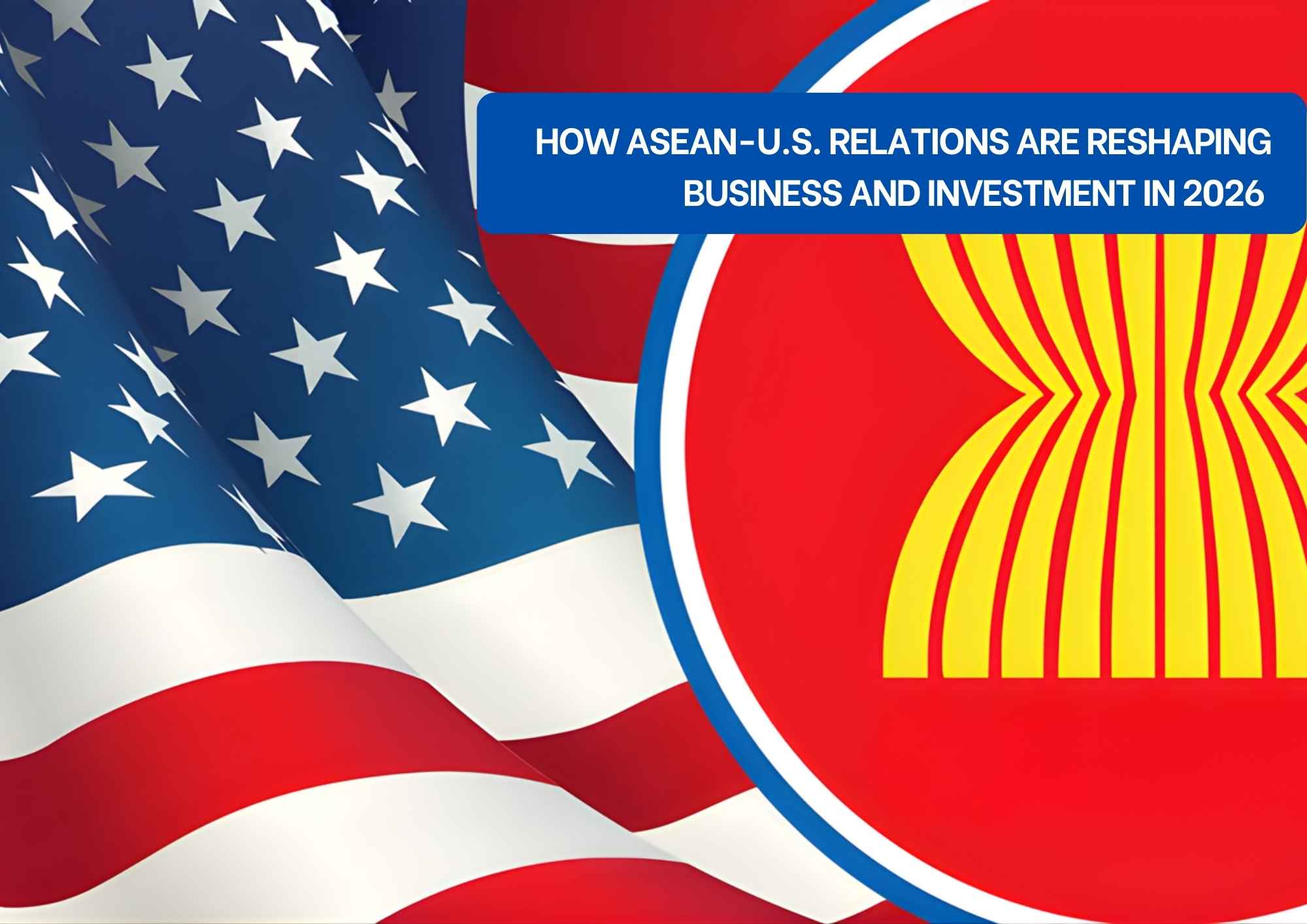
In 2026, ASEAN will become a core strategic market for U.S. companies as they restructure supply chains and manage geopolitical risk. ASEAN-U.S. relations are increasingly shaping how companies plan manufacturing, technology transfer, energy investment, and long-term capital allocation across Southeast Asia. The relationship now influences not only where companies sell products, but where they build, source, and deploy capital.
In this article, we – Source of Asia, outline how the ASEAN-U.S. relations have evolved, where it stands in 2026, and what it means for U.S. companies considering ASEAN as a growth market.
Key Insights:
- ASEAN-U.S. relations have shifted from trade-focused engagement to a broader strategic partnership.
- The relationship now rests on three pillars: trade integration, investment flows, and regulatory alignment.
- Companies are prioritizing supply chain resilience, compliance, and diversification over pure cost efficiency.
- Strategic sectors include semiconductors, clean energy, digital infrastructure, healthcare, and advanced manufacturing.
- Execution varies by country, making policy monitoring and local assessment critical for long-term success.
The ASEAN–U.S. Business Outlook 2026–2030 booklet provides structured comparisons of sector priorities, policy alignment, and execution conditions across ASEAN markets.
Download the booklet to explore the full ASEAN–U.S. relations and investment landscape.
Save your free copy of ASEAN-U.S. Business Outlook 2026 – 2030
Evolution Of ASEAN–U.S. Relations Over The Past Decade
Over the last ten years, ASEAN–U.S. relations have expanded beyond trade balances into a broader strategic partnership. That shift is now evident in deeper cooperation across investment, policy, and regional stability.
From trade partnership to strategic framework
A decade ago, most conversations focused on tariffs, exports, and market access. Governments worked to lower trade barriers and expanded bilateral commerce. That foundation remains important, but the agenda has expanded.
Today, cooperation between the two sides includes:
- Digital policy and data governance
- Energy transition and clean technology
- Advanced manufacturing and semiconductors
- Supply chain resilience
This reflects a broader understanding that ASEAN is not simply a consumer market but also a strategic production and investment platform within global value chains. For U.S. policymakers, ASEAN also plays a role in maintaining Indo-Pacific stability.
Key policy developments that shaped the ASEAN-U.S. relations
Several milestones formalized this shift and gave it structure:
- The upgrade to a Comprehensive Strategic Partnership in 2022
- The launch of the Indo-Pacific Economic Framework (IPEF)
- U.S. industrial policies such as the IRA and CHIPS Act
- ASEAN’s regional integration under RCEP and AEC
These initiatives extend cooperation beyond trade cycles. They shape standards, investment flows, and long-term coordination.
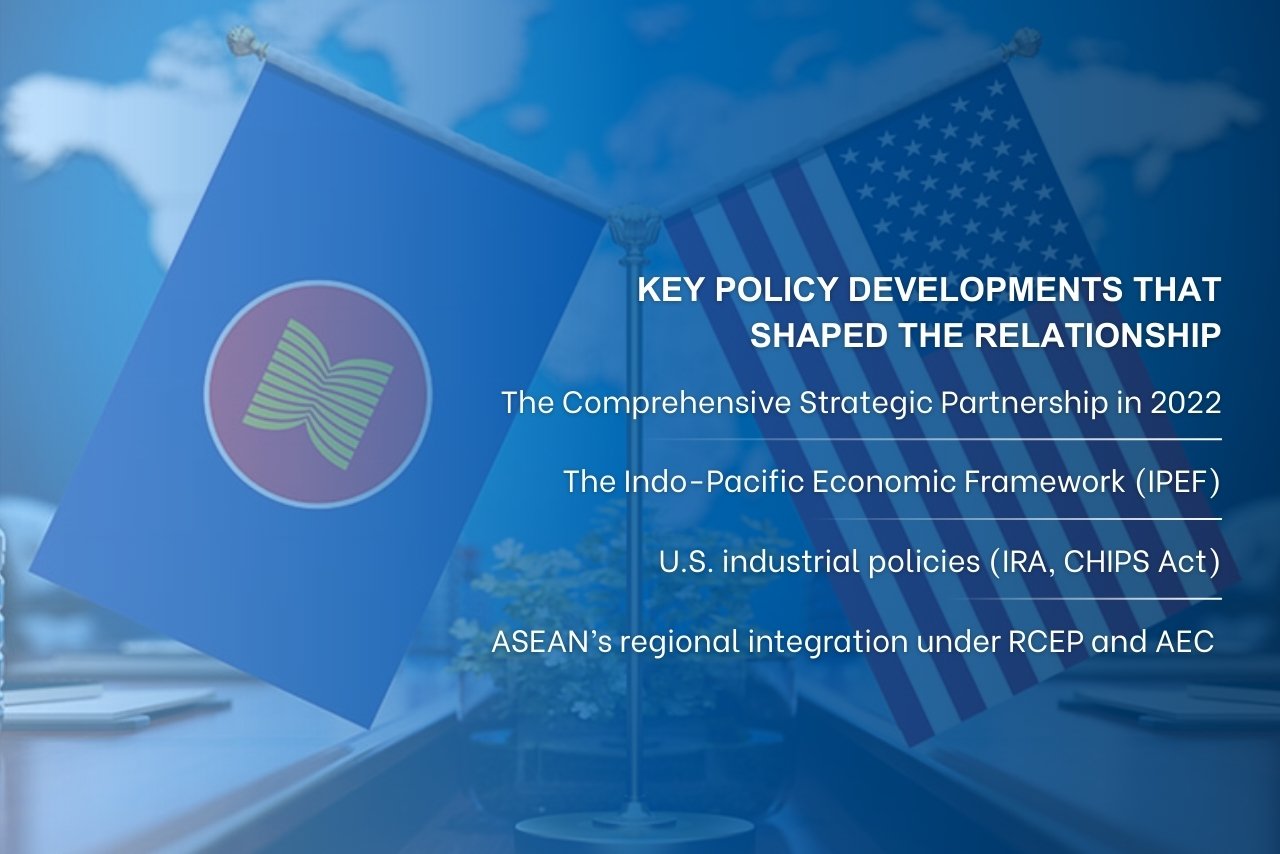
Key Policy Developments That Shaped The ASEAN-U.S. Relationship
Where the ASEAN-U.S. relations stand in 2026
In 2026, ASEAN is the United States’ fourth-largest trading partner, with two-way trade nearing $500 billion. U.S. companies are also among the largest cumulative investors in Southeast Asia, with investments spanning manufacturing, technology, logistics, and energy sectors. Now, the relationship rests on three pillars:
- Trade integration
- Investment flows
- Technology and policy coordination
Moreover, ASEAN governments are aligning industrial policy with sustainability goals, creating a more structured and long-term framework for engagement.
ASEAN–U.S. Relations Shift From Trade Volumes To Strategic Engagement
The US ASEAN relations is no longer defined only by how much goods move between markets. The focus has shifted toward how countries and companies coordinate strategy, manage risk, and build long-term resilience.
Why The ASEAN–U.S. relations Is No Longer Just About Trade
In recent years, trade has remained important, but companies are more focused on supply chain stability, regulatory compliance, and geopolitical risk management. Since 2018, tariff changes and stricter origin rules have encouraged firms to diversify production footprints, and many have expanded into ASEAN under China+1 strategies.
Today, the key issue is how deeply firms are embedded in local supplier networks, infrastructure systems, and policy frameworks. Increasingly, competitiveness depends on integration into regional supply chains rather than export volumes alone.
Sectors Driving Strategic Engagement
This deeper engagement is most visible in sectors where market demand and policy incentives align. Key areas include:
- Semiconductors and advanced electronics
- Clean energy, including solar and biofuels
- Carbon capture and decarbonization technologies
- Medical devices and healthcare infrastructure
- Digital services and cloud infrastructure
These industries benefit from regulatory support, targeted incentives, and regional coordination, which reduce entry barriers and improve execution certainty.
Why ASEAN–U.S. Relations Matter for U.S. Companies
ASEAN is becoming a practical priority for U.S. firms looking to balance growth with risk management. The ASEAN-U.S. relations now shapes where companies expand, manufacture, and allocate long-term capital.
The Opportunity Side
From a business standpoint, ASEAN offers several clear advantages:
- A fast-growing consumer base
- Competitive manufacturing locations
- Expanding digital economies
- Ongoing investment in energy and logistics infrastructure
Beyond growth potential, the region provides a platform to diversify supply chains and reduce overdependence on a single country. As global uncertainty increases, maintaining a multi-country ASEAN footprint helps companies improve flexibility and protect long-term stability.
The Execution Side
Opportunities must be evaluated alongside execution of realities on the ground, which differ significantly by country. Companies should examine:
- Licensing and approval timelines
- Incentive eligibility and disbursement mechanisms
- Infrastructure readiness at the local level
- Workforce depth and technical capacity
Two countries may promote similar incentives on paper, yet approval processes, agency coordination, and operational readiness can vary in practice.
These execution conditions can differ significantly across ASEAN markets.
Thus, our ASEAN–U.S. Business Outlook 2026–2030 booklet provides side-by-side comparisons of investment frameworks, incentive mechanisms, and policy environments across the region.
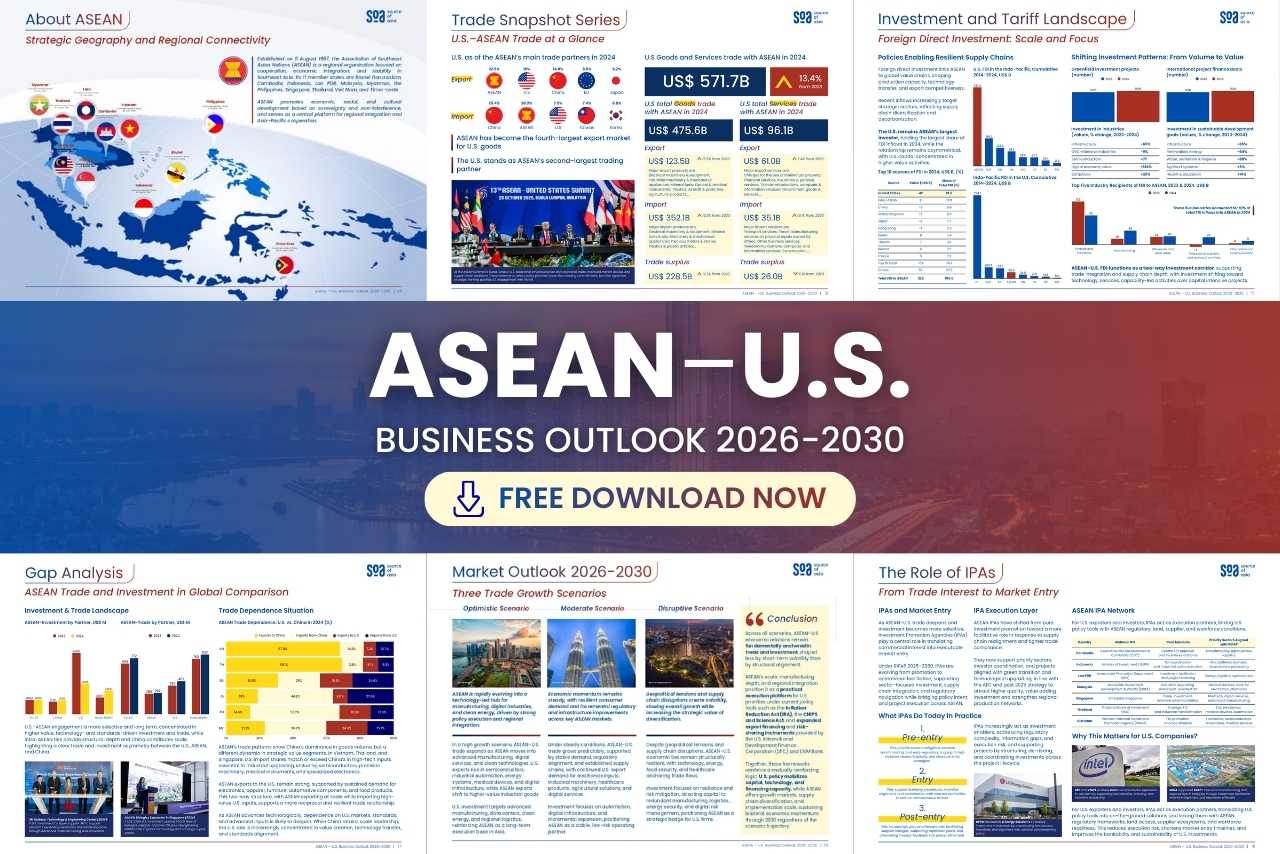
Download booklet to explore ASEAN–U.S. Relations
What U.S. Companies Should Monitor
As ASEAN–U.S. relations continue to deepen, companies should monitor:
- Changes in tariff and origin rules
- Evolution of digital and data regulations
- Carbon pricing and sustainability standards
- Infrastructure expansion under regional connectivity plans
- Policy coordination under IPEF and ASEAN frameworks
These factors directly affect compliance costs, market access, and project timelines, making careful monitoring essential between 2026 and 2030.
Conclusion
ASEAN–U.S. relations in 2026 are defined by strategic alignment rather than short-term trade gains. The partnership now supports technology transfer, capital deployment, and supply chain resilience.
For U.S. companies evaluating expansion in Southeast Asia, understanding policy alignment, sector incentives, and execution conditions across ASEAN markets is critical.
The ASEAN–U.S. Business Outlook 2026–2030 booklet provides a structured overview of these factors across the region.
If you are evaluating expansion in Southeast Asia, this comparative framework can support more grounded, strategic decision-making.
Download the booklet for a structured view of ASEAN–U.S. relations, including sector priorities, policy alignment, and execution conditions across ASEAN markets.
Access the full ASEAN–U.S. investment and policy analysis now!
Frequently Asked Questions
ASEAN–U.S. relations operate under a Comprehensive Strategic Partnership, combining strong trade and investment ties with deeper cooperation in digital policy, clean energy, and supply chain resilience. The relationship is stable, policy-driven, and strategically aligned.
It shapes supply chain diversification, sector incentives, compliance standards, and investment planning. Companies align expansion strategies with policy priorities in areas like semiconductors, renewable energy, and digital infrastructure.
Singapore, Vietnam, Malaysia, Indonesia, and Thailand align strongly in sectors such as semiconductors, clean energy, digital services, advanced manufacturing, and logistics, depending on industry focus and project scope.