Introduction
What is the real average salary in Vietnam, and how do you know if your current income matches the market? For many employees, salary information is inconsistent and difficult to interpret because pay varies by profession, job level, and location. This makes it hard to assess your position, compare opportunities, or plan the next career step with confidence.
To address this, we – Source of Asia, provide a structured view of the average salary in Vietnam by profession, job level, and regional differences, helping you understand how salaries are formed in practice and where you stand in the current market.
Key Insights
- Salary in Vietnam varies widely by profession, experience level, and geographic location.
- IT and export-driven sectors offer the strongest salary growth and highest earning potential.
- Mid-level roles experience the most significant salary increases across all industries.
- Multinational companies typically pay higher salaries than local Vietnamese firms.
- Skills, not tenure, are the main driver of long-term salary progression in Vietnam.
Average Salary by Profession in Vietnam
Average salary levels in Vietnam vary significantly by profession, shaped by differences in talent demand, skill specialization, and business impact. Understanding these variations helps clarify how pay evolves across key sectors and experience levels.
Information Technology
The Vietnam IT market (2025–2026) is moving beyond low-cost outsourcing and increasingly positioning itself as a regional digital and R&D hub, supported by ICT contributing around 31.8% of sectoral GDP.
For employees, this shift creates both opportunity and pressure. Demand for skilled talent is rising faster than supply, making salary levels more competitive but also more uneven across roles and experience levels. Below is an overview of the average salary in Vietnam’s IT sector by experience level:
- <3 years of experience: USD 500–1,200
- 3–5 years of experience: USD 800–1,500
- Over 5 years of experience: USD 1,500–3,000
In 2026, demand is strongest in AI/ML, Cloud & DevOps, Cybersecurity, and Data Engineering, where skills directly affect system performance and scalability. In practice, roles such as Cybersecurity and Project Management reach higher salary ceilings, while Backend and Full-stack developers see faster growth after 5+ years.

Vietnam’s 2026 tech workforce shows clear demand concentration in advanced digital domains, with compensation levels closely tied to specialization depth and career progression.
Manufacturing and supply chain
Vietnam’s manufacturing and supply chain sector continues to grow, supported by strong FDI and the “China+1” strategy. This creates steady hiring demand but also makes salaries harder to benchmark. Many employees are unsure if their pay reflects real market value, especially as responsibilities can differ widely across roles and companies.
A simplified view of the average salary in Vietnam for this sector shows a clear progression by experience:
- <3 years of experience: USD 400–800
- 3–5 years of experience: USD 700–1,400
- 5–10 years of experience: USD 1,000–2,200
- >10 years of experience: USD 1,500–6,000
Salary growth increases as roles move toward operational control and business impact. Positions like Factory Manager often reach higher ranges due to responsibility for output and cost efficiency, while skills in automation, data, and digital supply chains are becoming key drivers of salary growth.
Sales and marketing
Sales and Marketing roles play a key role in revenue growth, especially as companies shift toward data-driven marketing, e-commerce, and customer experience strategies. However, salary levels in this field are often unclear because income depends not only on experience but also on performance and business impact.
A general salary progression in this sector is as follows:
- <3 years of experience: USD 400–800
- 3–5 years of experience: USD 700–1,300
- 5–10 years of experience: USD 1,000–3,000
- >10 years of experience: USD 2,000–6,000
In practice, total income can be higher due to commission structures, which typically add 20–40% of base salary annually. Roles with broader responsibilities, regional exposure, or direct revenue ownership often exceed standard ranges. Looking ahead, skills in data analysis, digital marketing, and customer strategy are increasingly linked to higher earning potential.
Administration
The Administration sector in Vietnam is undergoing a clear shift as automation reduces routine tasks, especially in early-career roles. At the same time, demand for effective office coordination remains stable as companies expand operations. This creates a common challenge: many employees are unsure how their salary compares, as pay depends more on responsibilities than job titles.
A general salary range in this field is as follows:
- <3 years of experience: USD 350–550
- 3–5 years of experience: USD 500–600
- >5 years of experience: USD 600–950
In practice, higher income is often linked to a broader role of scope, such as supporting executives or managing office operations. Language ability and experience in multinational environments also play an important role. As the function evolves, skills in digital tools, coordination, and problem-solving are becoming key factors for career progression.
These ranges offer a general benchmark, but actual salaries vary by role, skills, and company. To see detailed breakdowns by job title and level, download the Vietnam Salary Guide 2026 for a more precise and practical reference.
Download the full Vietnam Salary Guide 2026
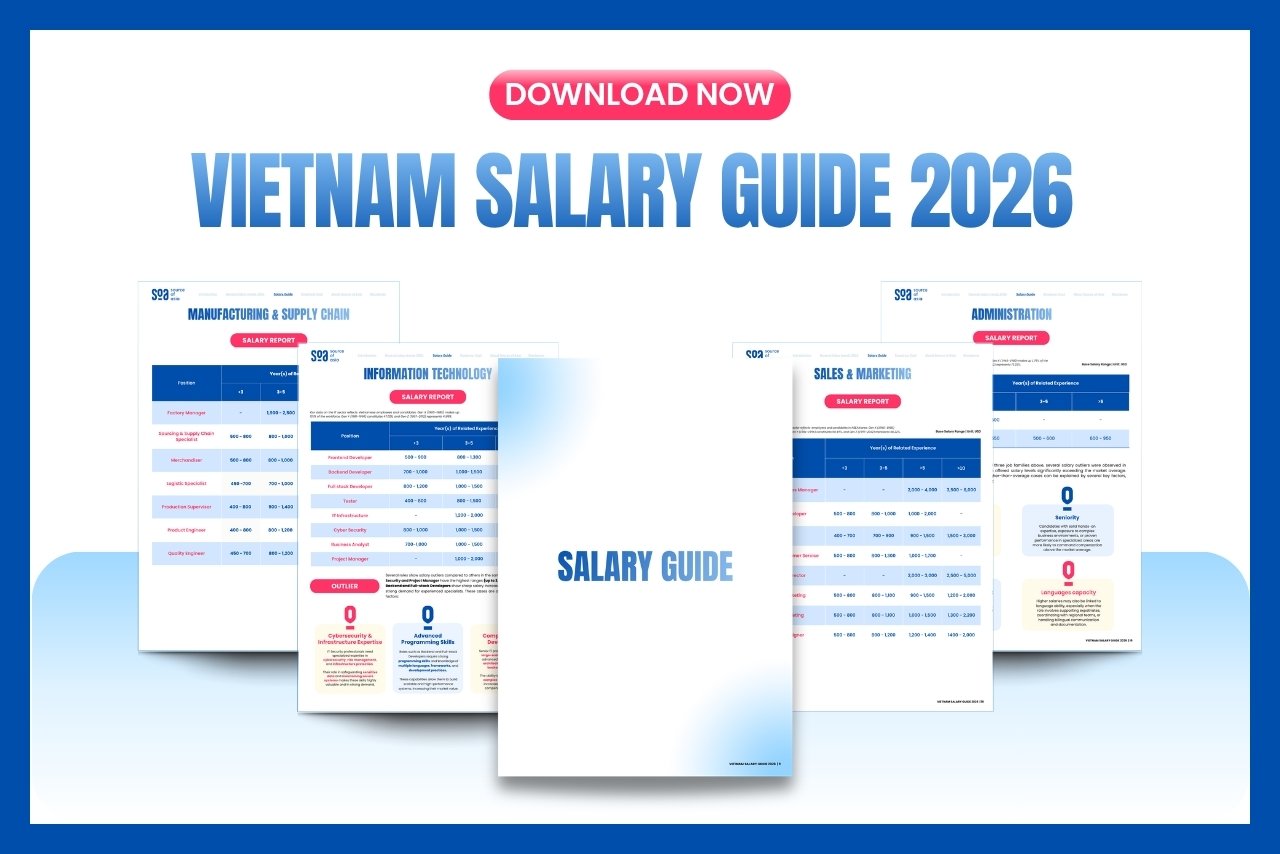
Vietnam Salary Guide 2026 by SOA, provides a general benchmark, with actual compensation varying by role, skills, and company.
How Salary Changes by Job Level and Experience
Salary progression in Vietnam is shaped more by job level than by job title. While salary ranges vary by role, the biggest changes happen when scope and responsibility increase.
| Level | Typical Salary Trend | What It Reflects |
| Entry-level | Low to moderate | Basic execution, high talent supply |
| Mid-level | Strong growth | Independent work, specialized skills |
| Senior-level | High | Team leadership, accountability |
| Executive | Very high | Strategic and business impact |
The largest salary jump typically occurs at mid-level, where employees begin to deliver clear business value. Compensation continues to increase with management scope and international exposure. In practice, many companies underestimate mid-level expectations, which often leads to longer hiring cycles and difficulty closing candidates.
Salary Differences by Location and Market in Vietnam
Location is a key variable when assessing the average salary in Vietnam. Salary levels are not uniform, as each market reflects different cost structures, industry presence, and talent availability.
- Ho Chi Minh City: Highest salary benchmarks, supported by strong commercial activity and a high concentration of foreign-invested companies
- Hanoi: Stable demand across government-linked sectors and a growing technology base
- Industrial zones (e.g., Binh Duong, Dong Nai): Competitive compensation for technical, engineering, and operational roles tied to manufacturing
- Secondary cities: Lower salary levels, typically aligned with lower living costs and a smaller talent pool
These differences are shaped by several underlying factors:
- Cost of living, particularly housing and transportation
- Industry concentration and type of economic activity
- Depth and quality of the local talent pool
- Presence and hiring practices of multinational companies
For businesses, location strategy directly affects both salary cost and access to talent. Misalignment between the two can impact hiring speed and long-term workforce stability.
What Affects Salary by Profession in Vietnam
Salary differences across roles in Vietnam are shaped by a combination of market conditions and business decisions. Understanding these factors helps you benchmark accurately and avoid common hiring inefficiencies.
- Industry demand: High-growth sectors, such as technology and export-driven industries, tend to push salaries upward
- Skill scarcity: Specialized or hard-to-find skills command premium compensation, especially in technical roles
- Company type: Multinational firms typically offer higher salaries and more structured benefits than local companies
- Education and certifications: Still relevant, but increasingly secondary to proven skills and practical experience
- Language ability: English proficiency expands access to higher-paying roles in international environments
- Market entry stage: New market entrants often misprice roles due to limited benchmarking, affecting hiring outcomes
Salary should be treated as a strategic lever, directly impacting your ability to attract and retain qualified talent.
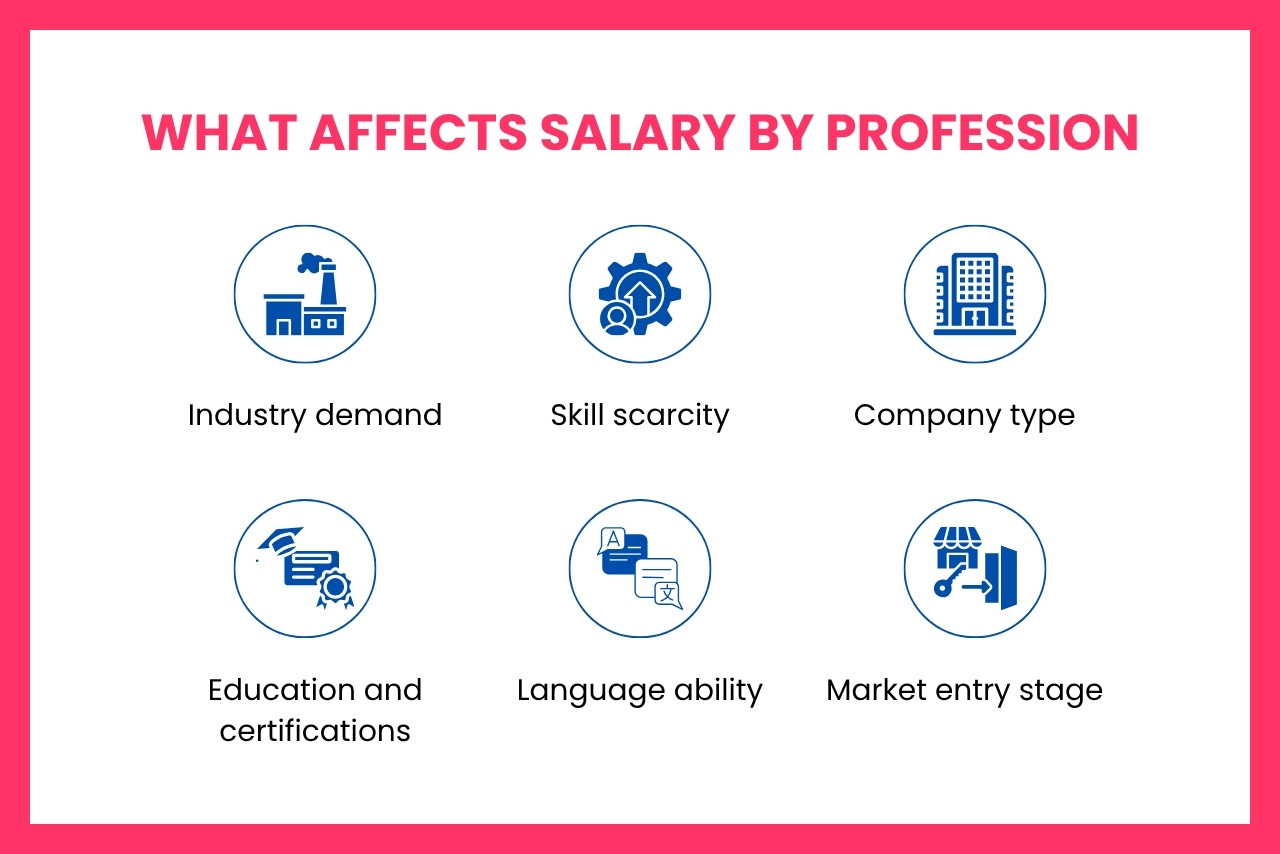
Salary outcomes in Vietnam are shaped by industry demand, skill scarcity, company type, education, language ability, etc.
What Employees Can Do to Increase Their Salary
Salary growth in Vietnam is increasingly linked to skills, role choice, and market awareness rather than tenure alone. Employees who align with market demand tend to see faster and more consistent increases in their career average salary.
- Build in-demand skills: Focus on capabilities that businesses actively seek. For example, in IT, this includes AI, data, cloud, and cybersecurity, etc. Commercial roles benefit from digital marketing, CRM, and data-driven decision-making.
- Move strategically between roles: Salary increases are often higher when changing companies rather than relying only on internal promotions, especially at mid-level.
- Strengthen language ability: English, and in some cases Chinese, expands access to multinational environments where compensation is typically higher.
- Target high-growth sectors: Technology, export manufacturing, and logistics continue to offer stronger salary progression due to sustained demand.
- Understand market benchmarks: Knowing the average pay by profession helps employees position themselves correctly and negotiate with more
In practice, salary progression depends on how skills, experience, and market demand come together. A more detailed breakdown is typically required to assess where real opportunities exist.
To understand which skills are most in demand in each industry and how they impact salary levels, you can refer to our full salary guide.
Final Thoughts
The average salary in Vietnam differs across industries, job levels, and locations. For employees, understanding these benchmarks helps you evaluate your current position, set realistic expectations for growth, and improve your negotiation outcomes when changing roles or advancing in your career.
The Vietnam Salary Guide 2026 from Source of Asia compiles structured salary data by sector and job level, helping you compare your role against market standards and identify skills that influence higher pay. It supports more informed, data-based career decisions.
Frequently Asked Questions
The average salary in Vietnam varies widely by profession, with IT and manufacturing roles typically higher than administration and entry-level positions. Differences depend on skills, experience, and company type.
Fresh graduates usually start at entry-level salaries that are lower to moderate, depending on industry, location, and English proficiency. Technical and digital roles often offer higher starting pay.
Yes. Ho Chi Minh City and Hanoi generally offer higher salaries due to stronger economic activity, while industrial zones and smaller cities tend to have lower salary levels.