Introduction
Choosing the right B2B marketing channels usually starts with a simple question: where should your company focus its efforts first? Many businesses first try different platforms to increase visibility. Soon after, they realize the real challenge is whether each channel can support their target buyers, sales process, and long-term growth.
For companies entering new markets or selling complex solutions, the right channel mix creates a stronger foundation for credibility and business opportunities. Still, not every channel delivers the same value, and early choices can affect resources, customer reach, and sales performance.
In this guide, we – Source of Asia, explain how to choose B2B marketing channels, what to prioritize at each business stage, and what to review before expanding.
Key Insights
- Channel selection should follow business stage, not trends or competitor activity.
- Businesses entering a new market must prioritize credibility-building assets such as websites, LinkedIn, SEO, and networking.
- Companies with limited resources achieve better results by focusing on fewer channels with consistent and disciplined execution.
- Businesses selling complex B2B solutions rely on structured content such as case studies, educational materials, and nurturing flows to support decisions.
- Channel performance should be evaluated through qualified leads, opportunities, and conversions instead of vanity metrics like traffic or followers.
| 👉 If you need a clearer overview first, explore our guide to B2B marketing channels by business stage to see how each channel supports credibility, visibility, and opportunity generation before building your channel strategy. |
How To Choose B2B Marketing Channels At Each Stage
Channel selection depends on business maturity and available resources. Each stage requires a different focus, from building foundational presence to supporting evaluation and conversion processes across longer B2B sales cycles.
Channels for companies entering a new market
Entering a new market requires companies to build trust before generating demand. Buyers are often unfamiliar with a new provider, so they first need clarity on who the company is, what it offers, and whether it can support their requirements.
Early-stage companies should first establish credibility through the following:
- Website: Provide a clear place for buyers to review your services, expertise, and market capabilities.
- Company profile and sales materials: Help prospects and partners quickly evaluate your experience and solutions.
- LinkedIn presence: Allow decision-makers to verify your company and build initial awareness.
- SEO content: Improve discoverability when buyers search for relevant solutions or industry information.
- Networking: Build relationships with local stakeholders, partners, and industry communities.
At this stage, the primary objective is visibility and trust-building rather than immediate conversion. A credible foundation ensures that later marketing and sales activities can perform more effectively.
These channels are most useful for companies building initial market presence. They are less suitable for teams expecting immediate lead generation before buyers understand the brand.
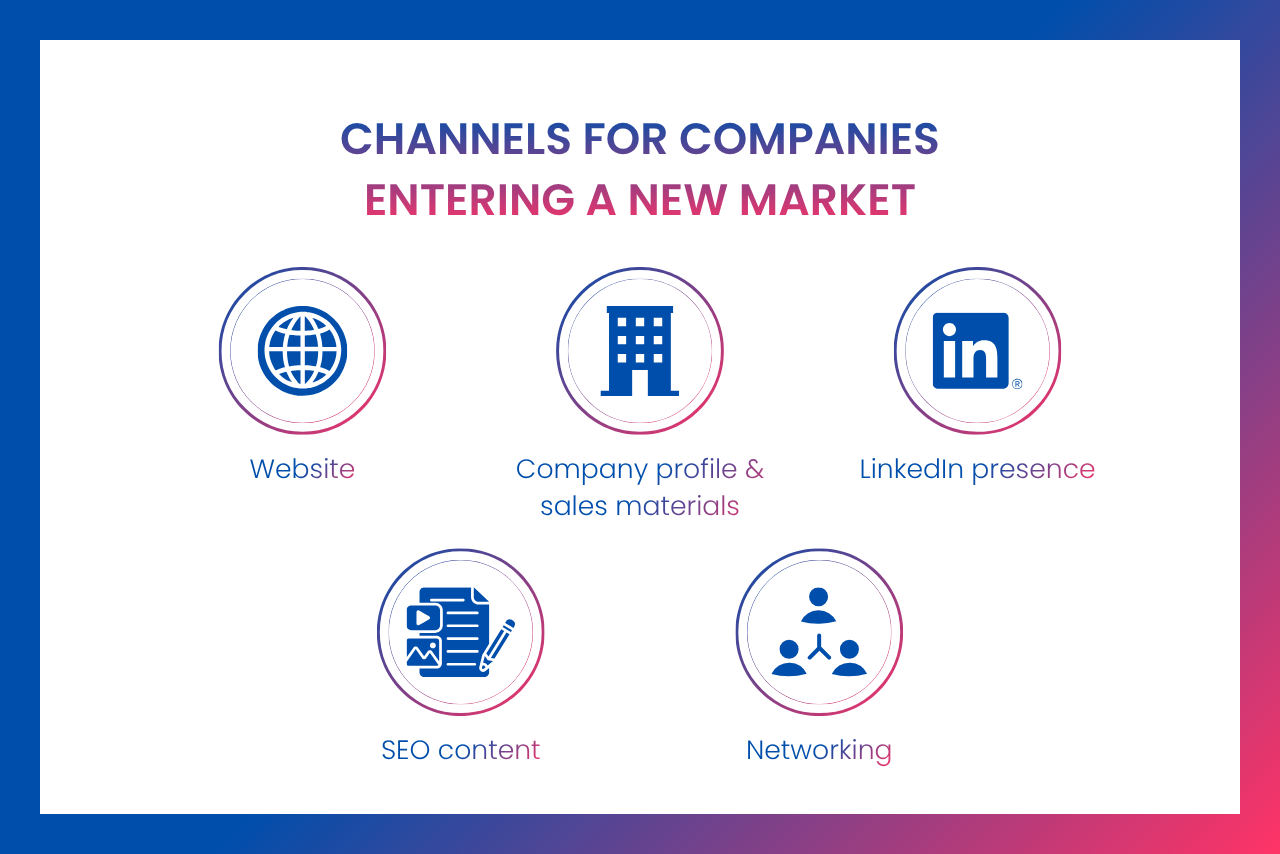
Companies entering new markets should prioritize credibility through websites, LinkedIn, SEO, and relationship-building activities.
Channels for companies with limited budget and resources
Limited resources require companies to be selective when they choose B2B marketing channels that match both execution capacity and revenue potential. The key challenge is not reducing channels, but identifying which channels can be sustained consistently. Trying to manage too many platforms at once often leads to inconsistent content, weak execution, and limited business impact.
When resources are constrained, the focus naturally shifts toward:
- SEO articles: Continue attracting relevant traffic over time and support buyers who are actively searching for solutions.
- LinkedIn content: Help reach decision-makers, build visibility, and maintain professional relationships without relying heavily on paid promotion.
- Referrals: Leverage existing customers, partners, and trusted networks to create higher-quality opportunities.
- Existing relationships: Use established connections where trust has already been developed.
Yet, limited resources also require realistic expectations. A channel still needs consistent effort, relevant content, and proper follow-up to deliver results.
A focused approach is usually more effective than being present everywhere. Companies that manage a smaller number of channels well can often build stronger visibility and more sustainable growth than those spreading resources too widely.
Channels for companies selling complex B2B solutions
Gartner reports that B2B buying decisions typically involve multiple stakeholders and extended evaluation cycles, requiring consistent multi-touch engagement across channels. Buyers need structured information, proof of outcomes, and clarity on implementation risk before moving forward.
In this context, when companies choose B2B marketing channels, the focus should shift toward structured evaluation and decision support:
- Case studies: Provide concrete evidence of results and reduce uncertainty around expected outcomes.
- Educational content: Help buyers understand the problem space, available approaches, and trade-offs between solutions.
- Webinars: Enable deeper discussions with prospects and allow real-time clarification of technical or operational questions.
- Email nurturing: Maintain structured communication across longer sales cycles and support multi-step decision processes.
However, these channels are not isolated tools. They depend on consistent alignment between messaging, sales input, and customer insights. The objective is not only to generate interest but also to support decision-making by reducing perceived risk and helping buyers compare options in a structured way.
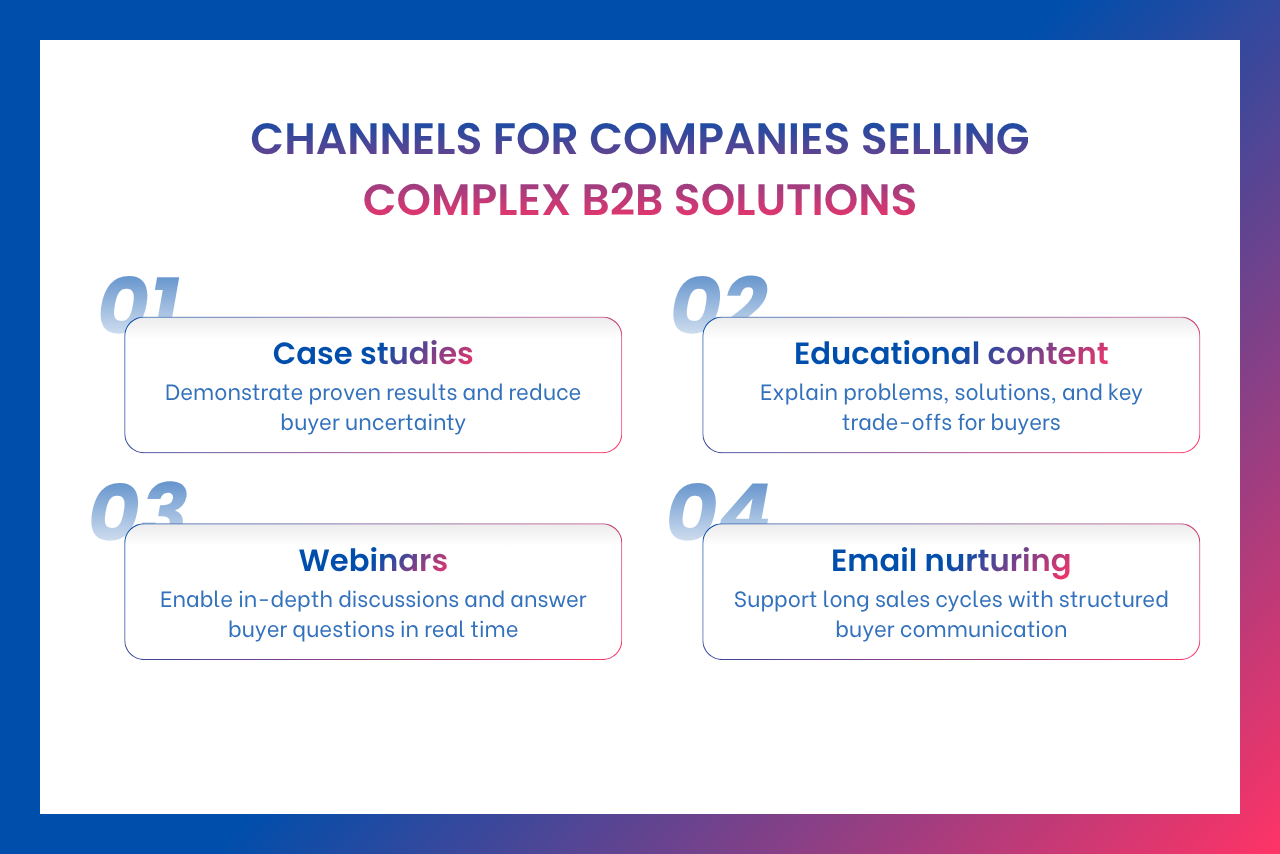
Complex B2B sales require educational content, proof of results, and ongoing buyer engagement throughout longer evaluation processes.
Check resource readiness and channel dependency before expanding
Before selecting new channels, companies should assess whether they have the internal capacity to manage them effectively.
Compare channel priorities and business fit
The table below summarizes the role, priority, and key metrics of each channel to help companies compare channel fit before expanding their marketing mix.
| Marketing Channel | Priority | Best Stage | Primary Objective | Key Metrics |
| Website | High | Stage 1 | Build credibility and provide a central information hub | Conversion rate, contact clicks, time on page |
| Company Profile & Pitch Deck | High | Stage 1 | Communicate capabilities and support buyer evaluation | Downloads, sales usage, buyer feedback |
| Sales Collateral | High | Stage 1 | Support sales conversations and explain solutions clearly | Sales engagement, conversion support |
| Case Studies | Medium | Stage 2 | Demonstrate experience and reduce buyer uncertainty | Views, engagement, influenced opportunities |
| LinkedIn Presence | High | Stage 2 | Build visibility and reach relevant decision-makers | Reach, engagement, profile visits, inbound inquiries |
| SEO Articles | High | Stage 2 | Capture search demand and educate potential buyers | Rankings, organic traffic, assisted conversions |
| Newsletter | Medium | Stage 2 | Maintain engagement and nurture long-term relationships | Open rate, CTR, subscriber growth |
| PR, Media & Partner Content | Low | Stage 2 | Increase external credibility and market awareness | Mentions, referral traffic, brand visibility |
| Networking & Referrals | High | Stage 3 | Generate trust-based opportunities through relationships | Meetings, referrals, qualified leads |
| Events, Webinars & Tradeshows | Medium | Stage 3 | Create direct interactions and generate qualified leads | Registrations, meetings booked, SQLs |
| Email Marketing | Medium | Stage 3 | Nurture prospects and support longer buying cycles | Open rate, CTR, replies, meetings booked |
| Retargeting Ads | Low | Stage 3 | Re-engage interested audiences and support conversions | CTR, conversions, cost per lead |
Assess operational readiness before adding new channels
Besides, companies need to assess whether they have the right resources to manage each channel consistently.
For example, a website requires UX, copywriting, analytics, and conversion setup. SEO articles require keyword strategy, writing capacity, and technical SEO support. LinkedIn needs a content calendar, spokesperson alignment, and community engagement. Events and webinars require planning, speaker preparation, and sales follow-up. Email marketing needs a qualified database, segmentation, relevant content, and automation.
Before expanding the channel mix, companies should confirm that each selected channel has the right operational foundation to perform.
Common Mistakes When Choosing B2B Marketing Channels
Even companies with a clear B2B marketing strategy can lose efficiency when channel selection and execution are not aligned. The issues below are the most common mistakes that reduce consistency, performance, and overall business impact across stages.
Activating too many channels too early
Being present across multiple B2B marketing channels at the same time can reduce consistency and weaken execution quality. This happens because each channel competes for the same limited content, management, and optimization capacity. Thus, each channel requires ongoing content production, active management, and regular performance measurement to remain effective in practice.
When companies distribute limited resources across too many channels, execution depth decreases across all areas. Content becomes less consistent, optimization cycles slow down, and performance data becomes harder to interpret. A more controlled approach is to prioritize essential channels first, maintain execution quality, and expand only when capacity and results can support additional complexity.
Choosing channels without internal resources
Different B2B marketing channels require different operational capabilities. In practice, each channel functions like a system that depends on skills, time, and consistent execution. For example:
- SEO requires structured content planning and ongoing optimization to maintain rankings.
- LinkedIn depends on regular thought leadership and engagement with decision-makers.
- Email marketing needs a qualified database and clear messaging to stay relevant.
- Events require preparation, coordination, and strong follow-up to convert interest into opportunities.
Therefore, before investing, companies should assess internal capacity realistically. In many cases, a smaller number of well-managed channels performs better than multiple channels that cannot be maintained consistently.
Measuring activity instead of business impact
Many companies still rely on vanity metrics such as traffic, impressions, or follower growth to evaluate marketing performance. While these numbers reflect activity, they do not always represent real business value or contribution to revenue. In B2B contexts, this creates a gap between perceived performance and actual sales outcomes.
A more reliable approach is to focus on indicators linked to growth, including qualified leads, sales opportunities, and conversion rates. These metrics show whether a channel is moving prospects through the buying process. Therefore, performance should be reviewed before increasing investment, ensuring decisions are based on impact rather than surface-level activity.
Launching channels without the right support system
A marketing channel only delivers results when its supporting conditions are in place. Without these foundations, execution often becomes fragmented, even if the channel itself is strategically relevant. For instance:
- Retargeting only works when there is sufficient website traffic or a well-structured landing page to capture and re-engage visitors.
- Email marketing requires both a qualified database and consistent content to maintain engagement.
- Events depend on prepared sales collateral, relevant case studies, and structured follow-up emails to convert interest into opportunities.
- SEO needs a clear website structure and a defined conversion path.
- LinkedIn requires clear positioning and consistent content pillars to build credibility.
Therefore, channels should not be launched in isolation. Each one must be supported by the right system to ensure it can contribute effectively to the broader customer journey.
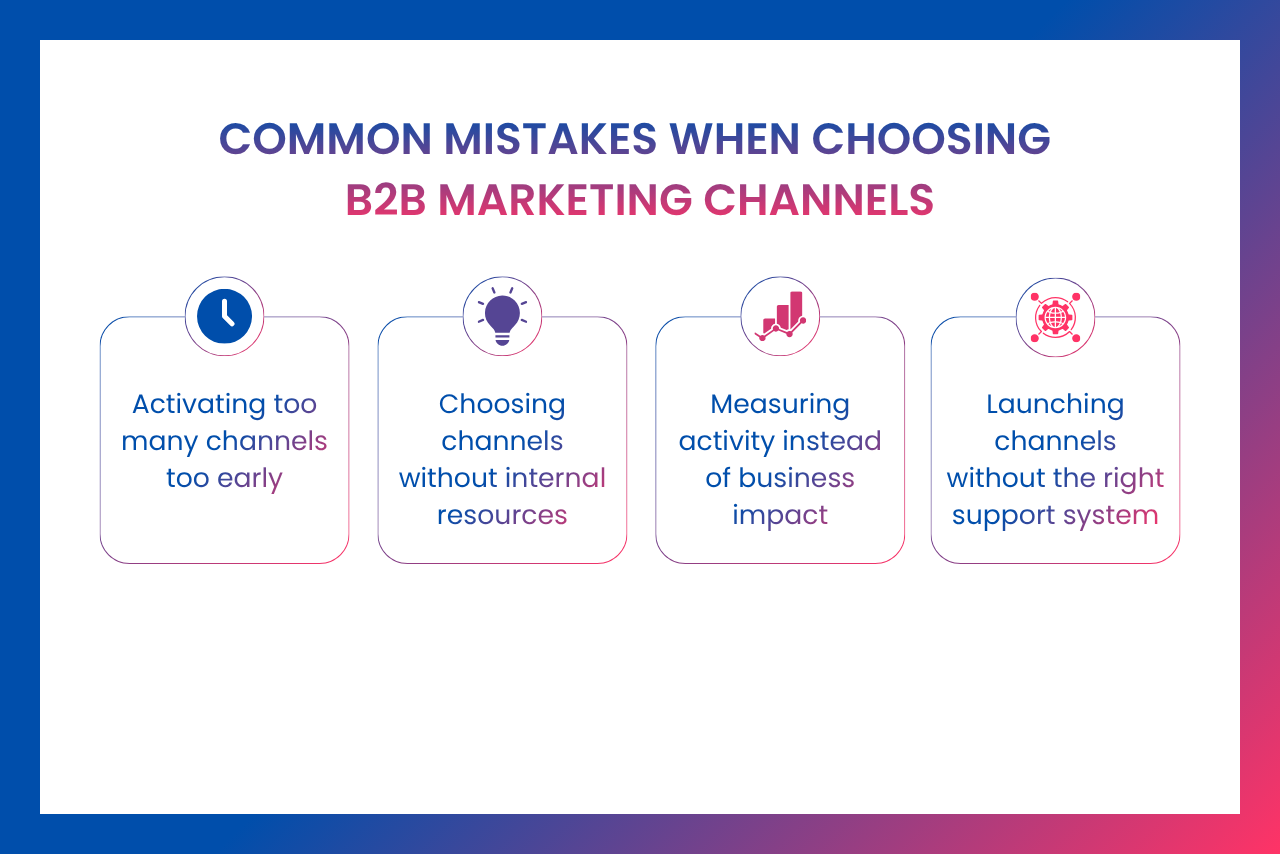
Successful channel selection depends on matching business goals with execution capacity.
Conclusion
Choosing B2B marketing channels depends on business stage, internal resources, and sales complexity. Companies should align channels with execution capacity and buyer behavior. Early stages focus on credibility, while complex sales require structured content. Performance must be measured through qualified leads, opportunities, and conversions, not vanity metrics.
At Source of Asia, we support companies through our Marketing Services:
- Brand audit & strategic visibility
- Website development & audit
- Social media management
- Content marketing & SEO
- Creative design (brand & visuals)
- Event management & activation
Our approach focuses on aligning each channel with your business stage, ensuring consistent execution and measurable contribution to visibility, leads, and market entry outcomes.
|
👉 Not sure which channels fit your business stage? Contact our experts to design your focused B2B marketing channel strategy. |
Frequently Asked Questions
Companies entering Southeast Asia should prioritize foundational assets and referrals early. Relationship-based introductions carry significant weight across ASEAN markets, so a strong local network, combined with a credible website and case studies, tends to open doors faster than paid advertising alone.
Prioritize channels that deliver long-term efficiency, such as SEO, LinkedIn, referrals, and existing relationships. Limit scope to channels your team can execute consistently, then track performance through qualified leads and conversions instead of activity metrics.
Start from campaign goals and buyer behavior, then map channels to each stage of the decision process. Use channels that support awareness, education, and conversion, ensuring internal capacity exists to maintain content, follow-up, and measurement across the full campaign cycle.