Introduction
B2B marketing channels play a central role in how buyers discover, evaluate, and compare vendors, partners, and solution providers. From websites and LinkedIn to SEO, events, and email, each channel contributes differently to visibility, credibility, and lead generation.
Still, many companies choose B2B marketing channels based on trends rather than their market position. Investing in too many activities too early can create inconsistent communication, weak execution, and difficulty measuring real business impact.
In this guide, we – Source of Asia – explain how different channels support each business stage, helping companies build strong foundations, increase market visibility, and create qualified opportunities through a more structured approach.
Key Insights
- B2B marketing channels should be selected based on business stage, buyer behavior, and available resources.
- Companies entering a new market should build foundational assets before investing heavily in demand generation.
- Visibility channels such as LinkedIn, SEO, newsletters, and PR help build trust before direct sales engagement.
- Opportunity-generation channels such as referrals, events, webinars, email, and retargeting work best when supported by clear follow-up.
- The best channel mix is not the largest one, but the one a company can execute consistently and measure properly.
 Add Source of Asia as a preferred source on Google
Why B2B Marketing Channels Should Be Mapped by Stage
Many companies start by selecting channels based on market trends or competitor activity. However, the most effective B2B marketing channels depend on your business stage, target buyers, and ability to execute consistently. There are three common problems:
- Activating too many channels before understanding the buyer journey
Each channel supports a different stage of customer decision-making. Websites and SEO build credibility, while events, referrals, and email support relationship development. Using all channels at once without a clear priority can reduce focus and weaken execution.
- Choosing channels based on trends instead of business priorities
A channel that works for one company may not deliver the same results for another. Market, customer behavior, sales cycle, and available resources all influence which channels should receive investment first.
- Investing in channels without enough resources to maintain them
Each channel requires time, budget, skills, and consistent execution. Investing in a channel without enough internal resources or budget can lead to inconsistent activity, wasted investment, and limited results.
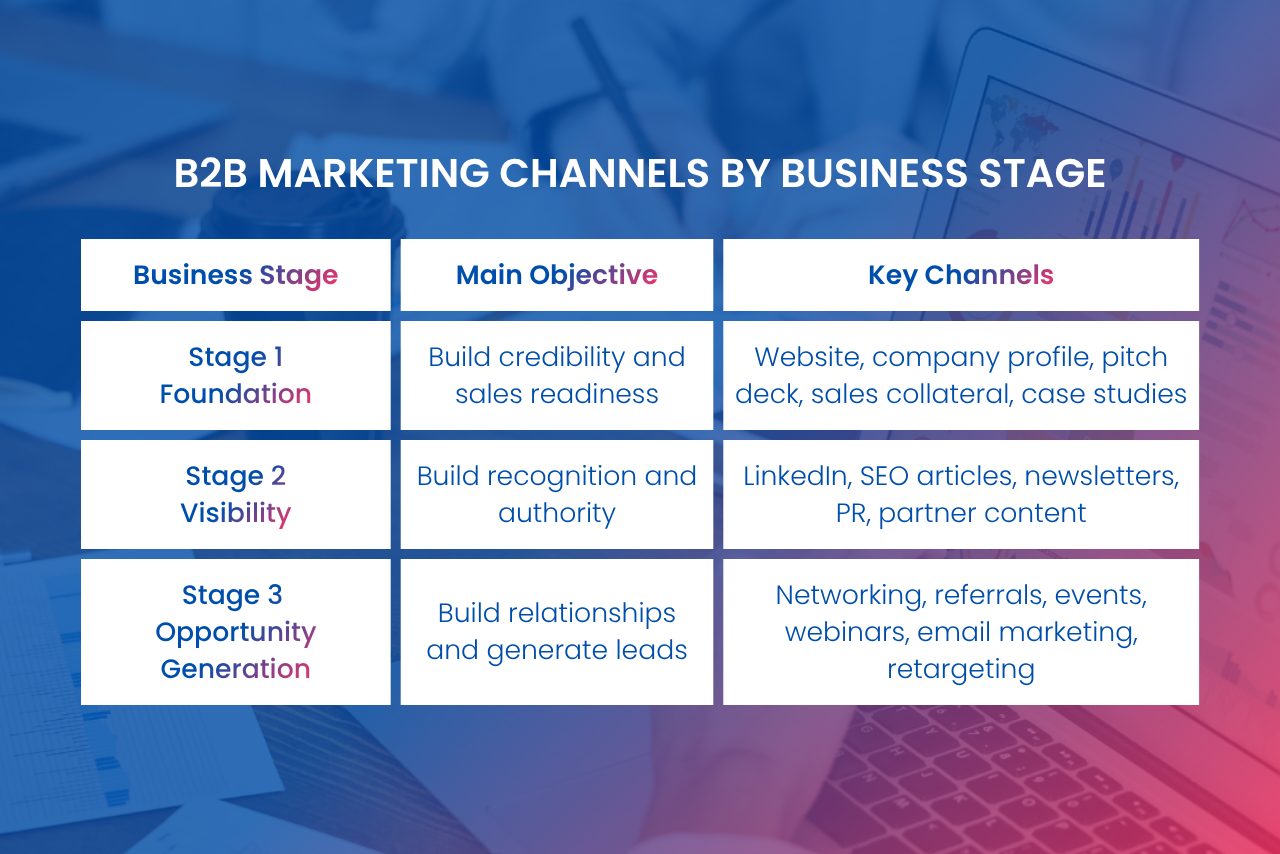
B2B marketing channels mapped by business stage and marketing objectives
Stage 1: Build Foundational Assets and Owned Channels Before Market Expansion
Building effective B2B marketing channels starts with establishing core owned assets that define how the company is perceived in the market. These elements form the basis for credibility, information clarity, and early buyer evaluation before any active demand generation begins.
Website
A website acts as the central information hub where prospects validate a company’s credibility, services, expertise, and market position before engaging with sales. This becomes the first validation point before any direct engagement. A strong B2B website should clearly show:
- Target industries and buyer profiles you focus on
- Core solutions and the problems you solve in each market
- Your capabilities, experience, and industry knowledge
- Clear conversion paths that guide visitors toward the next step
The website supports all other B2B marketing channels because buyers often research a company online before starting a conversation. According to Gartner, 75% of B2B buyers prefer a rep-free sales experience, highlighting the importance of providing clear and reliable information throughout the early evaluation stage.
Company profile and pitch deck
A company profile and pitch deck help communicate your capabilities clearly during early business discussions, such as partnership meetings, sales conversations, or market entry opportunities.
These materials should provide a structured overview of:
- Company background and business focus
- Services and solutions offered
- Market coverage and industry expertise
- Relevant experience and previous projects
For companies entering a new market, these documents become especially important because potential partners and customers may not know the brand yet. A well-prepared profile helps prospects understand your value, evaluate your capabilities, and build confidence before moving to the next stage.
Sales collateral
Sales collateral gives prospects supporting information to better understand your products, services, or solutions outside of direct conversations. Common formats include brochures, service sheets, presentations, and solution documents that explain key offerings and business value in a clear format.
Good collateral helps sales teams deliver consistent information throughout the buying process, ensuring prospects receive the same core message across different touchpoints. It also allows buyers to review important details independently when comparing options and evaluating solutions.
Case studies
Case studies demonstrate proven experience and help reduce buyer uncertainty during the evaluation process. A strong case study clearly explains three elements: the customer’s original challenge, the solution approach taken, and the measurable outcome achieved. This structure helps prospects quickly understand how a solution works in real business conditions.
Case studies are especially important for complex B2B marketing solutions or services, where trust influences decisions more than price. When buyers enter a new or unfamiliar market, they look for proof of similar problem-solving experience rather than relying on claims alone.
Stage 2: Build Visibility And Authority In Your Target Market
After establishing foundational assets, companies move to visibility-building activities that strengthen recognition and credibility in the market. This stage focuses on consistent presence across key B2B marketing channels to support early trust and ongoing engagement.
LinkedIn presence
LinkedIn is an important B2B digital marketing channel for reaching professional audiences and decision-makers. It is often used in the early and mid stages of market engagement, when companies need to establish credibility before active sales conversations.
Typical content includes:
- Industry insights, reflect market trends and practical observations
- Company updates, show ongoing activities and market presence
- Expert perspectives, communicate how the company interprets its sector
- Market knowledge, supports positioning in specific industries or regions
LinkedIn remains one of the strongest platforms for B2B visibility, especially as search and social media continue to attract a large share of B2B marketing budgets. Therefore, regular posting and structured messaging are required to maintain visibility and support long-term trust-building across B2B digital marketing channels.
SEO articles
Search Engine Optimization (SEO) is a key B2B digital marketing channel for capturing demand when prospects actively search for problems, solutions, suppliers, and market options. It works best when content aligns with real buyer intent rather than promotional messaging.
A strong SEO approach typically focuses on:
- Buyer questions and how they are evaluated
- Industry challenges and operational pain points
- Practical business insights that support decision-making
Unlike short-term campaigns, SEO builds long-term visibility, but it requires time and consistency. SEO often requires several months of consistent publishing and optimization before showing clearer ranking and traffic signals. It could be around 3 to 6 months or longer. For companies entering new markets, SEO also helps explain local conditions and improves early discoverability among relevant buyers.
Newsletter and email updates
A newsletter helps companies stay visible to prospects who already know the brand but are not ready to make a purchase decision. In practice, B2B sales cycles can be long, often last around 6-12 months or more, so early interest does not always lead to immediate conversion.
It is commonly used to share industry updates, company insights, new services, and market information. What matters most is maintaining a steady rhythm rather than sending emails in bursts. A consistent monthly newsletter is usually more effective than irregular spikes, because it helps build recall and familiarity over time.
PR, media and partner content
When a company enters a market where its brand is still unknown, third-party validation builds credibility faster than self-published communication. A mention in a respected industry publication often carries more weight for a new prospect than the same claim presented on the company’s own website.
Industry media, trade publications, partner blogs, and association newsletters provide a strong balance of low cost and high credibility per placement, especially when compared with paid advertising targeting the same audience. These channels help companies establish early trust and visibility across B2B digital marketing channels without relying solely on direct promotion.
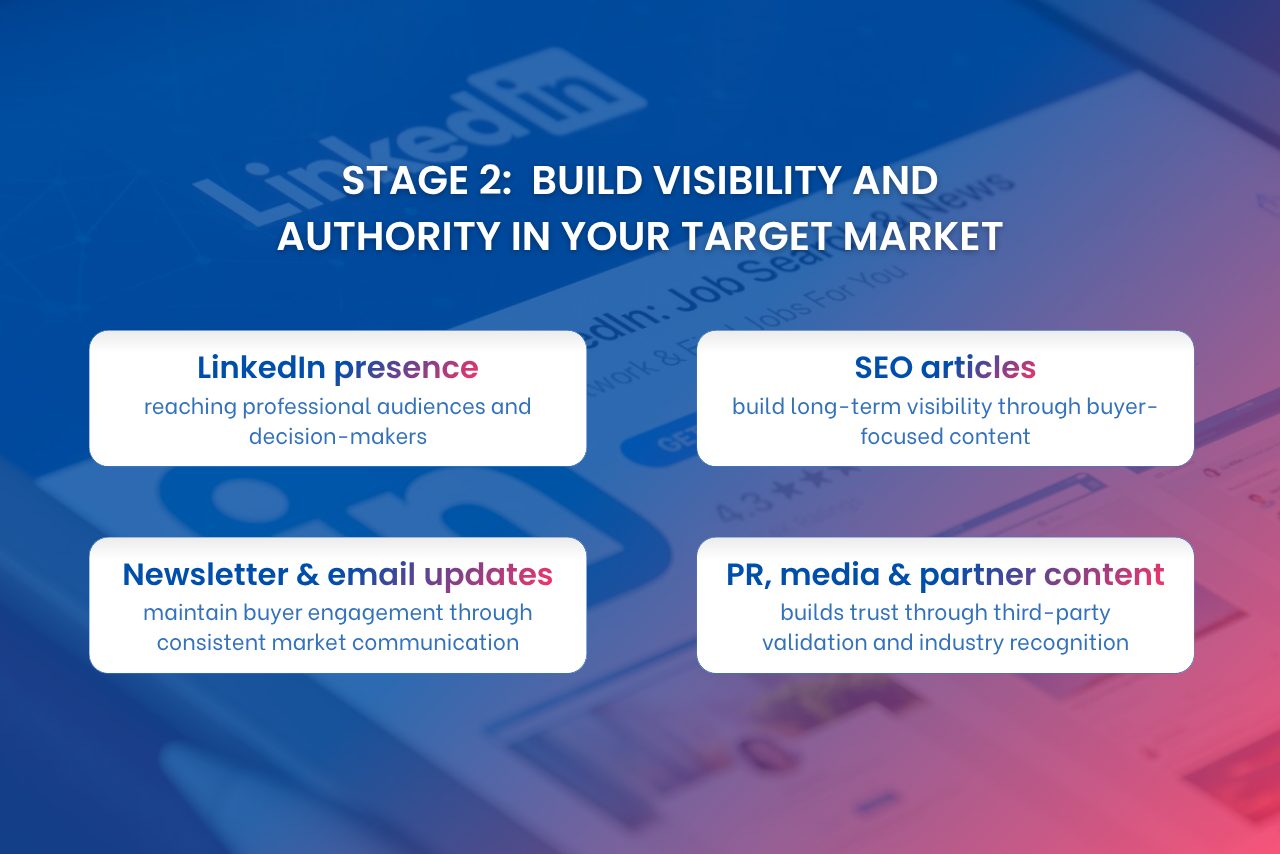
Build B2B visibility and market authority through LinkedIn, SEO, Newsletters, and PR channels
Stage 3: Generate Opportunities And Build Buyer Relationships
Once visibility and credibility are established, companies can focus on channels that generate opportunities, strengthen buyer relationships, and support conversion through ongoing engagement and follow-up.
Networking and referrals
Networking and referrals are among the most effective B2B marketing channels because they transfer trust through existing relationships. A warm referral reduces the time needed to build credibility, since prospects usually enter the conversation with prior validation and fewer doubts than they would in a cold outreach scenario.
This channel is especially important in Southeast Asia, where relationship-based business culture often influences decision-making alongside pricing and capabilities. For companies entering ASEAN markets, early network building can improve access to opportunities and support stronger commercial conversations from the start.
Events, webinars, and trade shows
Events, webinars, and trade shows are widely used in B2B marketing, particularly in Southeast Asia, where relationship-based engagement often shapes deal formation. In many cases, high-value B2B opportunities often benefit from direct interaction, especially when trust, local relationships, and long-term cooperation are important.
These channels typically support different objectives:
- Events and trade shows: Enable direct meetings with decision-makers, support partnership development, and accelerate market entry through in-person trust building.
- Webinars: Provide a lower-cost format for educating prospects, maintaining pipeline engagement, and nurturing early-stage interest.
Email marketing
Email marketing helps companies maintain communication with prospects after initial engagement. It supports longer B2B decision cycles by keeping potential buyers informed while they evaluate solutions and consider internal priorities.
It is commonly used for:
- Lead nurturing: Maintaining relationships with prospects over longer decision cycles
- Follow-up communication: Continuing conversations after meetings, events, or content engagement
- Educational content sharing: Providing useful insights that support buyer decisions
- Sales coordination: Helping sales teams communicate with better context and timing
Because B2B audiences have different needs and timelines, effective email marketing depends on adapting messages based on industry, buyer role, and level of interest.
Retargeting ads
Retargeting helps companies stay visible after prospects interact with their website, content, or campaigns. It supports the buyer journey by keeping solutions in front of audiences who have already shown interest.
It usually focuses on:
- Reconnecting with website visitors after they leave without taking action
- Reinforcing awareness among audiences who engaged with content
- Maintaining visibility while buyers compare different options
Retargeting works best as part of a broader B2B digital marketing channels strategy. It strengthens existing demand generation efforts but usually cannot create demand without strong content, positioning, and other supporting activities.
| After understanding each B2B marketing channel by stage, the next question is how to choose the right channel 👉 Explore our guide on choosing marketing channels by stage. |
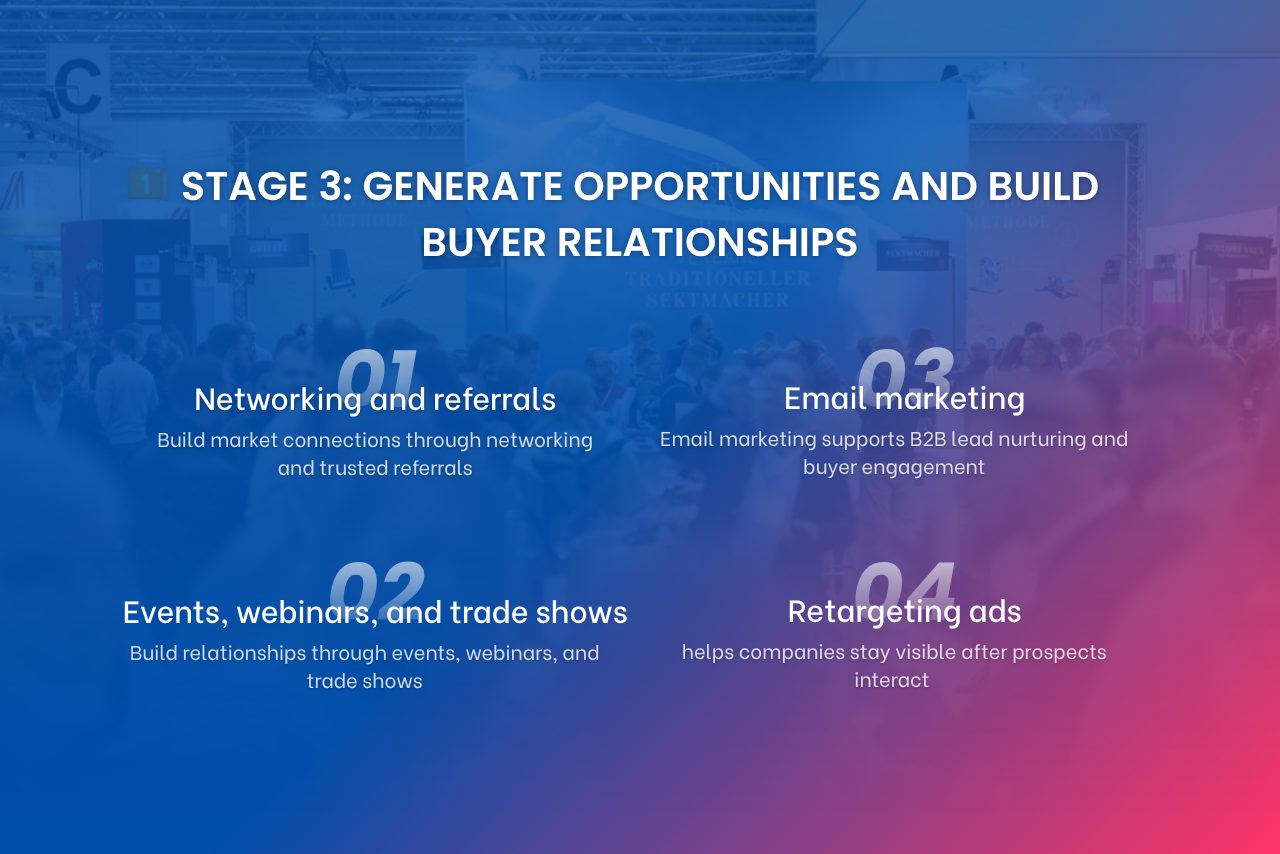
Generate B2B opportunities and build stronger buyer relationships through targeted marketing channels
Conclusion
To sum up, B2B marketing channels work differently at each business stage. Companies need to build foundational assets first, increase market visibility, and then focus on relationship-building channels that support lead generation and long-term growth. Choosing the right channel mix helps avoid wasted resources and improves execution.
At Source of Asia, we help international companies develop and manage B2B marketing activities across different stages of market expansion in Southeast Asia. Our marketing services cover brand strategy, website development, SEO, content marketing, social media, creative assets, and event activation to help businesses build credibility and connect with the right audiences.
| 👉 Explore how SOA’s Marketing Services can help your business build visibility, credibility, and qualified engagement in Southeast Asia. |
Frequently Asked Questions
A B2B marketing channel is a touchpoint companies use to reach, educate, engage, or convert business buyers. Common examples include websites, SEO, LinkedIn, email, events, referrals, PR, and sales collateral.
The most important channels depend on business stage. A company just starting out needs a strong website, company profile, and case studies before anything else. Once that foundation exists, LinkedIn, SEO, and PR build visibility. Referrals, events, and email marketing then turn that visibility into real opportunities.
There is no fixed number. The right count depends on team size and available resources. A small team is usually better served running two or three channels consistently than spreading thin across six. Consistency and measurement matter more than the total number of channels active at once.