Introduction
Many buyers start sourcing in Malaysia because they want to reduce dependency on a single supply market or explore new supplier options in ASEAN. Malaysia can offer relevant opportunities across electronics, rubber and plastic products, furniture, food, packaging, textiles, machinery, and selected industrial goods.
However, a supplier list alone is not enough to make a good sourcing decision. Buyers need to understand which categories are suitable for Malaysia, how suppliers differ in capability, and what risks may appear during quotation, sampling, production, or export.
In this article, Source of Asia outlines the key factors to check when choosing a supplier in Malaysia and which product categories are worth exploring.
Key insights:
- Sourcing in Malaysia can support supplier diversification across industrial and consumer product categories.
- Malaysia is relevant for buyers exploring electronics, rubber and plastic products, furniture, food, packaging, machinery, and selected consumer goods.
- Supplier selection should be based on product quality, manufacturing fit, compliance readiness, pricing, export experience, and communication quality.
- Buyers should avoid relying only on supplier directories without further verification.
- Local business culture, bilingual communication, and compliance expectations can influence sourcing success in Malaysia.
 Add Source of Asia as a preferred source on Google
Why Consider Malaysia for Sourcing?
Malaysia can be a relevant sourcing destination for companies exploring supplier diversification in ASEAN. Recent 2026 indicators continue to support this view, with Malaysia’s economy growing 5.3% year-on-year in Q1 2026 and manufacturing remaining a key contributor to growth.
For international buyers, this context reinforces Malaysia’s position as an export-oriented economy with established industrial capacity. Still, the decision to source from Malaysia should depend on product category fit, supplier capability, compliance readiness, and commercial requirements.
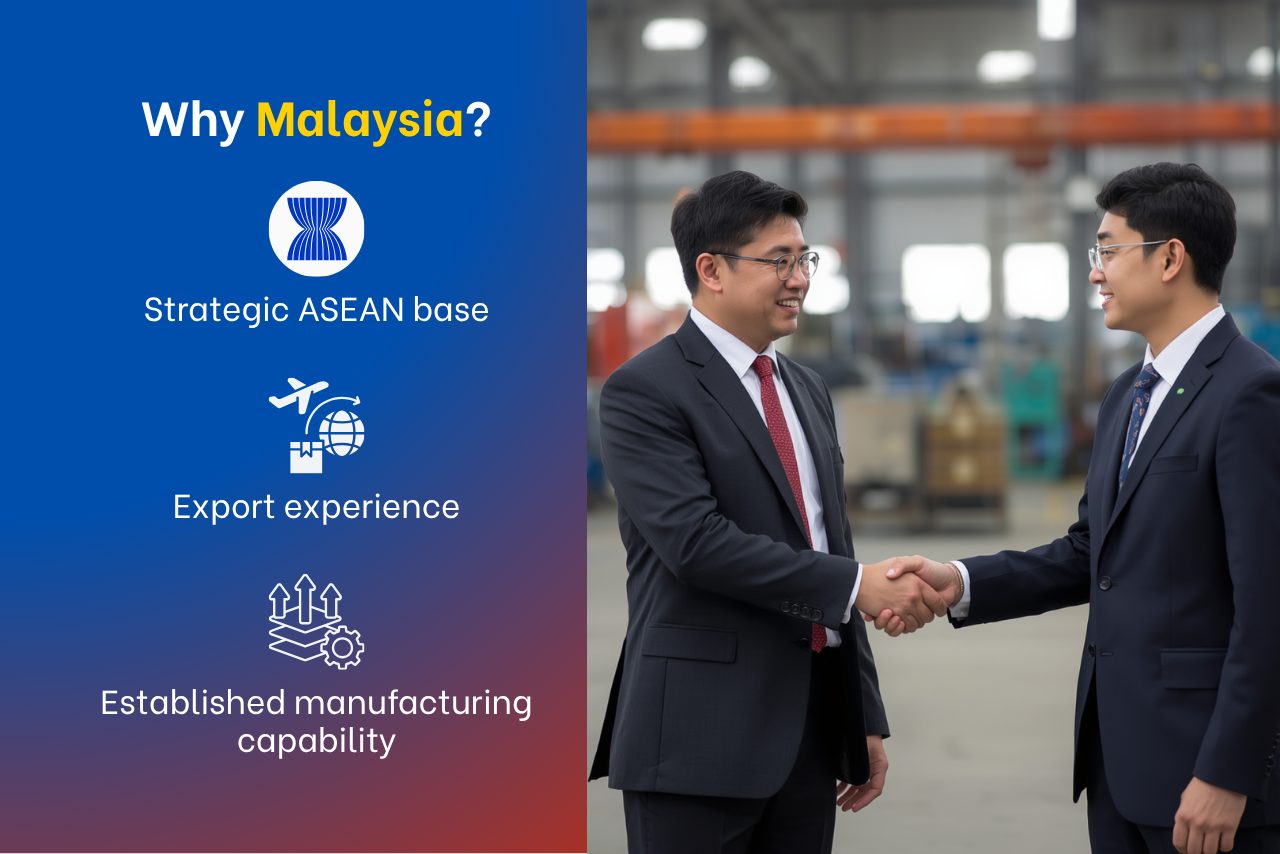
Malaysia’s sourcing appeal comes from its ASEAN position, export experience, and established manufacturing capabilities.
A strategic sourcing base in ASEAN
Malaysia is well-positioned for companies looking to diversify their sourcing within Southeast Asia. The country is connected to regional and global supply chains, with strong trade links across ASEAN, China, the United States, Europe, and other international markets.
For buyers that want to reduce dependency on one sourcing market, Malaysia can be part of a broader ASEAN supplier diversification strategy. It may not replace every sourcing destination, but it can offer relevant alternatives for selected product categories.
Malaysia also benefits from developed ports, industrial zones, and export-oriented manufacturing ecosystems. These advantages can help international buyers access suppliers with experience in documentation, shipping, and regional trade.
Established manufacturing and export capabilities
Malaysia has experience across both industrial and consumer manufacturing. The country is especially known for electrical and electronic products, rubber-based goods, palm-based products, machinery, chemicals, furniture, food products, and packaging-related categories.
This gives buyers a broad base to explore. However, supplier capability still needs to be checked at the factory level. A country may be strong in a category, but each supplier will differ in production scale, quality control, certifications, export experience, and flexibility.
For this reason, buyers should compare suppliers based on product fit and execution capability, rather than country reputation alone.
A business environment familiar to international buyers
Malaysia is often easier to approach than some sourcing markets because English is widely used in business, especially among export-oriented suppliers and urban business teams. This can make early communication, quotation discussions, and documentation exchange smoother.
At the same time, buyers should still understand the local business culture. Relationship-building, clear follow-up, and respectful communication can help create stronger supplier engagement. A good sourcing process in Malaysia combines professional documentation with steady communication and practical relationship management.
Top Product Categories for Sourcing in Malaysia
Malaysia offers sourcing opportunities across both industrial and consumer product categories. Some sectors have strong manufacturing capacity, while others are suitable for buyers seeking diversification or export-ready suppliers.
The following categories highlight areas where Malaysia has established production capabilities or export relevance for international buyers.
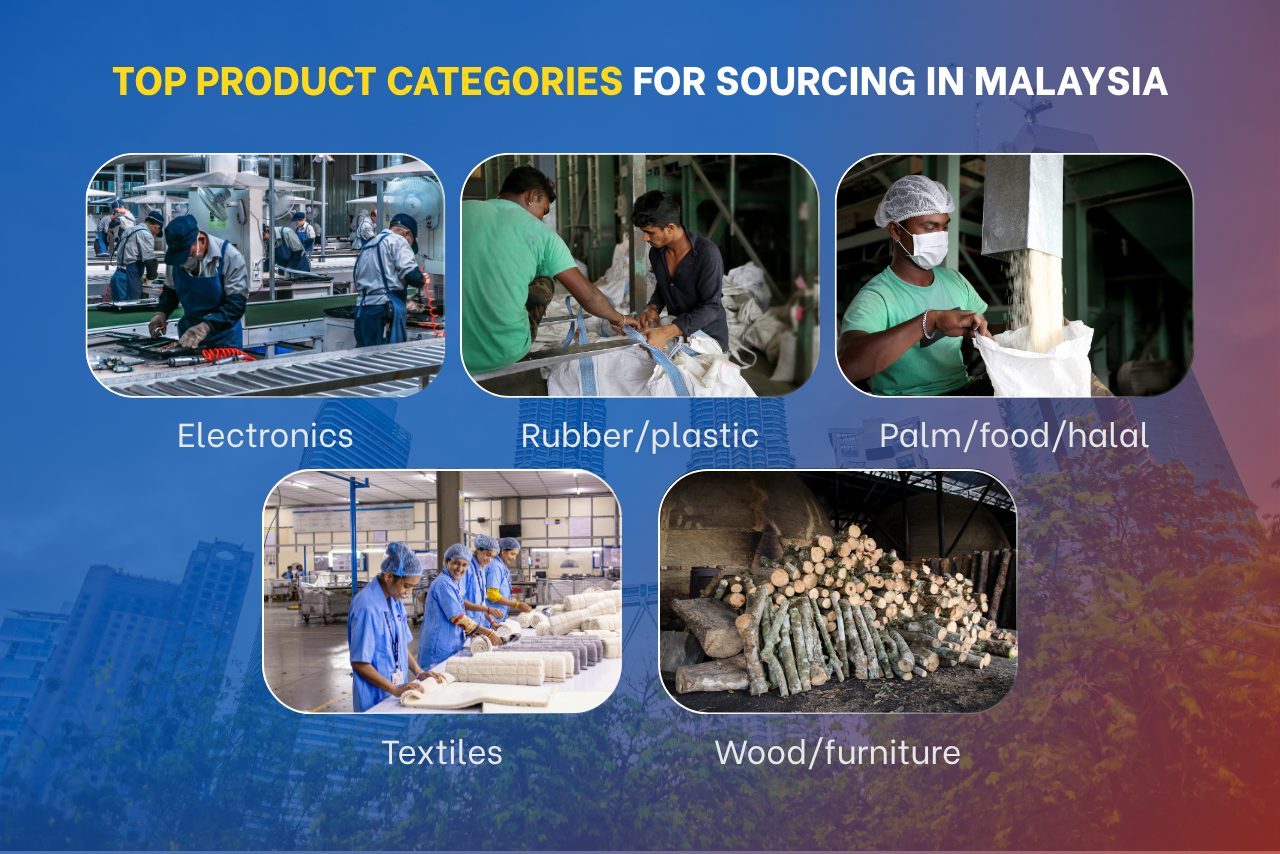
Malaysia sourcing covers several categories, from electronics and rubber to food, textiles, furniture, and wood-based products.
Electrical and electronic products
Malaysia has strong capabilities in electrical and electronics-related manufacturing. Relevant sourcing areas may include electronic components, assemblies, industrial parts, testing-related equipment, and selected finished electronic products.
Buyers in this category should pay close attention to technical capability, quality systems, testing standards, certifications, and export experience. Product specifications need to be detailed from the beginning, as small technical differences can affect price, feasibility, and production quality.
Rubber and plastic products
Common sourcing categories may include gloves, industrial rubber products, rubber components, and selected medical-related supplies. Plastic products are also available, including packaging materials, household goods, components, and industrial parts.
For these categories, key checks include material standards, production capacity, quality certifications, and documentation. If products are used in regulated or safety-sensitive applications, testing and compliance documents should be requested early.
Palm-based, food, and halal products
Malaysia may also remain relevant for buyers comparing palm-based supply options, especially as some buyers review sourcing strategies to reduce exposure to export or logistics disruptions in the region. The country has a strong reputation in halal-related production, which can be valuable for buyers serving Muslim-majority markets or retailers with halal requirements.
Before sourcing these products, companies need to confirm food safety standards, halal certification where relevant, shelf life, labeling, packaging, and export readiness. Documentation is especially important because food and personal care-related products often face specific requirements in destination markets.
Furniture, home décor, and wood-based products
Malaysia can be considered for furniture, home décor, rattan products, wooden furniture, and wood-based lifestyle products. These categories may suit buyers looking for indoor furniture, outdoor furniture, home accessories, and decorative items.
Supplier evaluation should cover material quality, finishing standards, product durability, packaging, and compliance with the destination market. For wood-based products, buyers may also need to review material traceability, certification needs, and environmental requirements.
Textiles, apparel, and accessories
Malaysia also offers sourcing opportunities in textiles, apparel, fabrics, garments, accessories, and selected private label products. Some suppliers may provide customization support for fashion, sportswear, uniforms, or industrial textile applications.
In this category, buyers should review fabric quality, stitching, sizing consistency, customization options, MOQ, and production timelines. Sample validation is important before confirming larger orders, especially when products require specific fit, colors, or performance standards.
Machinery, chemicals, and selected medical devices
Malaysia also has suppliers in machinery, industrial equipment, chemicals, and selected medical-related products. These categories usually require more technical verification before order confirmation.
Buyers should prepare clear technical specifications, safety requirements, testing expectations, and documentation needs. For machinery and chemicals, compliance with destination market rules should be checked before production or shipment.
Source of Asia now strengthens its ASEAN coverage with a local presence in Malaysia, helping companies access local insight, supplier networks, and practical business coordination on the ground.
Learn more about SOA’s Malaysia presence!
5 Key Factors to Consider When Choosing a Supplier in Malaysia
Using clear evaluation criteria to make better sourcing decisions. The following five factors can guide your selection in Malaysia.
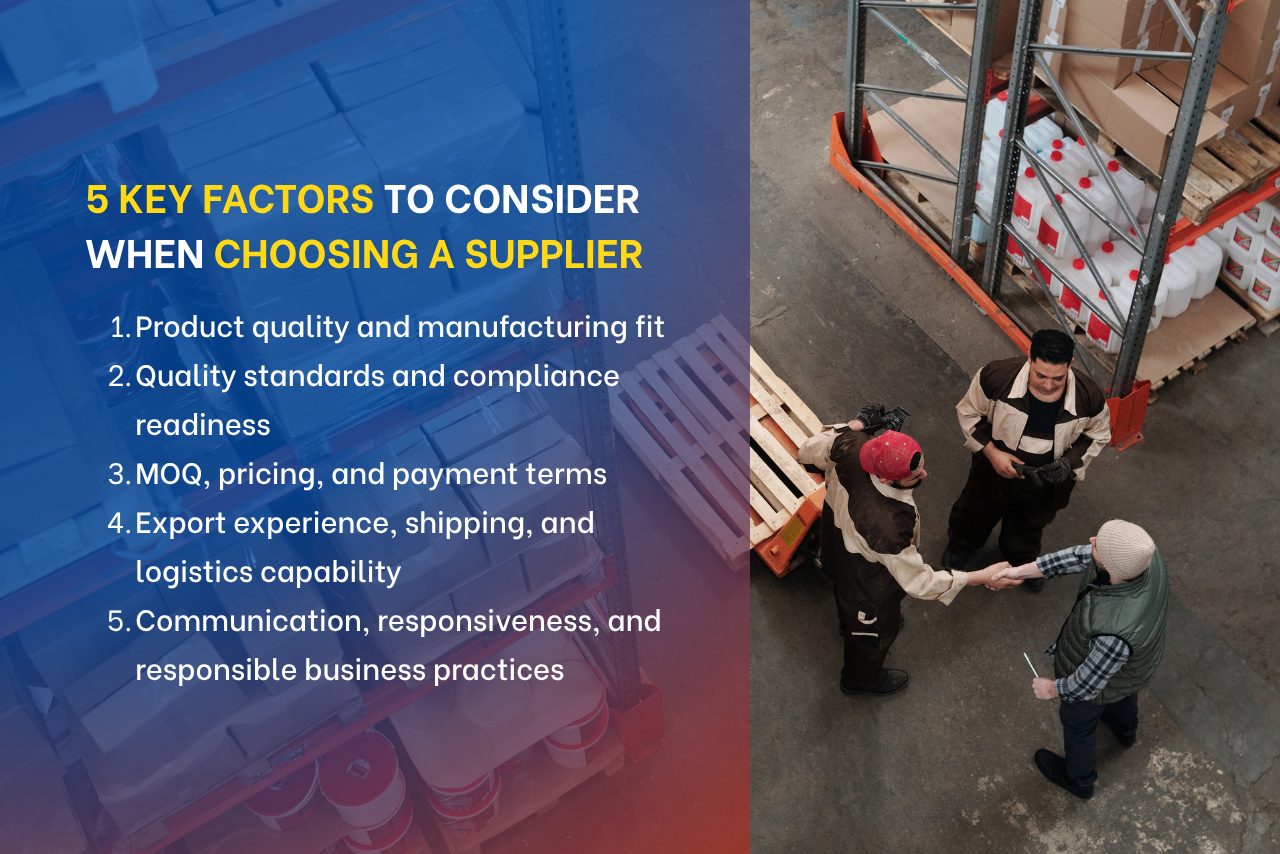
Choosing the right supplier in Malaysia requires checking quality, compliance, pricing, logistics, and communication.
1. Product quality and manufacturing fit
Product quality should be one of the first criteria when choosing a supplier in Malaysia. Buyers should request samples, inspect materials, test product performance, and compare results with their original requirements. Manufacturing fit is equally important. A supplier may produce the right product category but still be unsuitable for your project due to volume, customization limits, equipment, or production process.
Before moving forward, buyers should check:
- Previous products or projects in the same category
- Production equipment and technical capability
- Sample quality and consistency
- Ability to meet product specifications
- Capacity to support expected order volume
The right supplier should match your product, quality level, timeline, and commercial expectations.
2. Quality standards and compliance readiness
Quality and compliance should be checked before production, not after the order is placed. This is especially important for regulated products, safety-sensitive goods, food products, medical-related supplies, electronics, and products sold through international retailers.
Buyers should ask suppliers for relevant certifications, test reports, lab results, quality control procedures, and product documentation. The required documents will depend on the product category and destination market.
For example, furniture buyers may need material and finishing information. Food buyers may need safety, halal, labeling, or shelf-life documents. Electronics buyers may need technical testing and conformity documents.
A supplier with strong compliance readiness can help reduce delays, rework, and shipment risks.
3. MOQ, pricing, and payment terms
Pricing is important, but it should be reviewed together with MOQ, payment terms, sample costs, tooling costs, packaging costs, and logistics expenses. A low unit price may become less attractive if the MOQ is too high or if extra costs appear later.
Minimum order quantity (MOQ) is especially important for smaller buyers or companies testing a new product. High MOQs can increase inventory pressure and tie up working capital. On the other hand, very low MOQs may lead to higher unit costs or limited customization.
Buyers should also clarify payment terms early. Depending on the supplier and order value, payment options may include deposits, balance payments before shipment, letters of credit, or other agreed structures. The goal is to reduce financial risk while keeping the order commercially realistic.
4. Export experience, shipping, and logistics capability
A reliable supplier should understand export documentation, packaging requirements, Incoterms, delivery timelines, and customs procedures. This is especially important for buyers sourcing from Malaysia for the first time.
Export-ready suppliers are usually better prepared to manage packing standards, shipping coordination, commercial invoices, certificates, and buyer documentation requests. They may also be more familiar with quality expectations in international markets.
Before confirming cooperation, buyers should ask:
- Which countries does the supplier export to?
- Which Incoterms do they usually work with?
- What documents can they provide?
- How do they manage packaging and shipment preparation?
- Can they support delivery timelines realistically?
Strong logistics capability helps reduce delays and improves the overall sourcing experience.
5. Communication, responsiveness, and responsible business practices
Communication quality can strongly influence supplier performance. A supplier that responds clearly, answers technical questions, and follows up on timelines is usually easier to work with during quotation, sampling, production, and issue resolution. Buyers should evaluate how suppliers communicate from the first inquiry. Slow or unclear responses during the early stage may indicate future coordination challenges.
Responsible business practices are also increasingly important. Buyers should review whether suppliers follow fair labor practices, workplace safety standards, environmental requirements, and ethical business conduct. This is especially relevant for brands with ESG commitments, retailer requirements, or responsible sourcing policies. A good supplier should be able to support both commercial needs and responsible sourcing expectations.
Bonus Tips for Successful Sourcing in Malaysia
Sourcing success depends not only on supplier capability and pricing, but also on communication and local understanding. These tips can help reduce misunderstandings and improve collaboration with Malaysian suppliers.
- Leverage of bilingual communication
English is widely used in business communication in Malaysia, especially with export-oriented suppliers. This can help international buyers manage early discussions more smoothly. Still, Bahasa Malaysia may be useful in some local supplier conversations, factory-level communication, or administrative follow-up.
Working with bilingual or experienced teams can help reduce misunderstandings, especially when discussing technical details, negotiations, and production timelines.
- Understand local business culture
Supplier relationships in Malaysia often benefit from trust-building and consistent communication. Buyers should avoid treating supplier selection as a quick transactional process. Clear expectations, polite follow-up, and realistic timelines can improve cooperation quality.
When suppliers understand your business goals and long-term potential, they may be more willing to support sampling, customization, and flexible problem-solving.
- Check labor and environmental compliance
Labor and environmental compliance should be reviewed early, especially for buyers working with retailers, regulated industries, or ESG-driven sourcing policies. Depending on the product category, buyers may need to check workplace conditions, safety practices, environmental permits, waste management, material traceability, or certification documents.
For higher-risk products or strategic suppliers, document checks, supplier visits, or third-party audits may be useful. This step helps buyers reduce reputation risks and build a more responsible sourcing process.
- Match sourcing expectations with local supplier realities
Not every supplier is suitable for small orders, urgent timelines, heavy customization, or complex documentation. Buyers should clarify expectations early to avoid unnecessary delays.
A clear sourcing brief should include product specifications, target price, MOQ expectations, packaging needs, compliance requirements, destination market, and timeline. This helps suppliers respond more accurately and allows buyers to compare options more fairly. When expectations are clear from the beginning, supplier matching becomes faster and more reliable.
Conclusion
Sourcing in Malaysia can offer strong opportunities for international buyers exploring supplier diversification in ASEAN. For companies at the early stage of supplier exploration, the right first step is to understand which product categories fit Malaysia and which criteria should guide supplier comparison.
At the same time, buyers should review product quality, manufacturing fit, compliance readiness, MOQ, pricing, export experience, communication quality, and responsible business practices before deciding.
If you are comparing sourcing options across ASEAN, Source of Asia Malaysia can help you explore the right markets and supplier categories.
Frequently Asked Questions
Malaysia is relevant for several sourcing categories, including electrical and electronic products, rubber and plastic products, palm-based goods, food and halal products, furniture, home décor, textiles, apparel, machinery, chemicals, packaging, and selected industrial components.
Yes, Malaysia can be a good sourcing destination for international buyers looking to diversify suppliers in ASEAN. The country has established manufacturing capabilities, export experience, and supplier ecosystems across several product categories. However, buyers still need to evaluate each supplier carefully before placing orders.
English is widely used in many Malaysian business environments, especially among export-oriented suppliers. However, Bahasa Malaysia may still be useful in some local supplier discussions. Bilingual support can help improve communication during technical clarification, negotiation, and supplier follow-up.
Malaysia wholesale suppliers can help buyers discover initial product options, but supplier lists should not replace qualification. Buyers still need to check product quality, MOQ, export experience, documentation, and communication reliability before placing orders.