Introduction
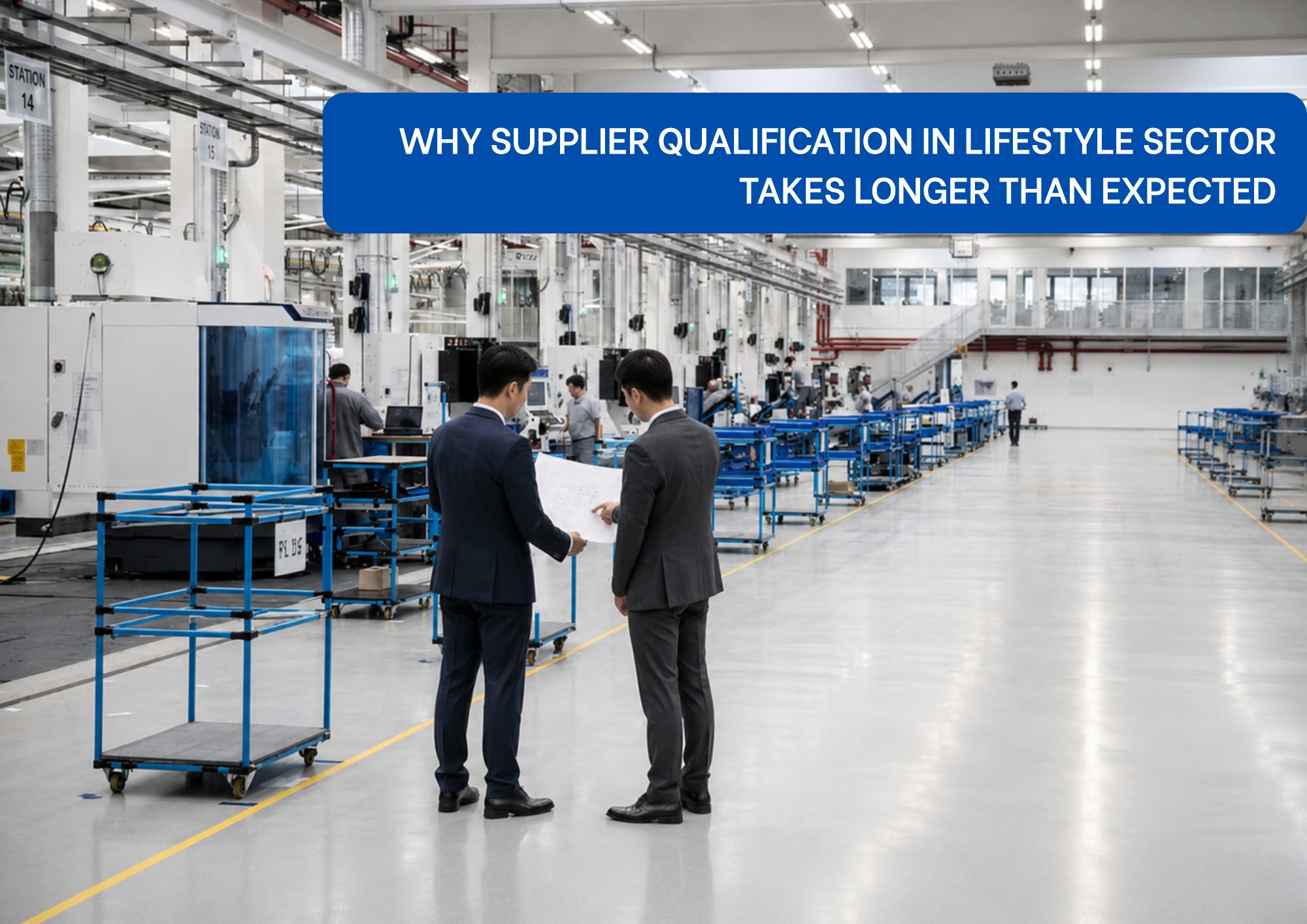
Supplier qualification is a critical step before onboarding a new supplier, particularly in the lifestyle sector. As companies expand sourcing networks, launch new products, or enter new markets, they often find that supplier approval takes longer than expected due to product customization, material validation, quality requirements, and compliance reviews.
Many businesses encounter delays during sample development, product testing, and internal approvals. Multiple sample revisions, evolving specifications, and coordination between sourcing, product development, quality, and compliance teams can significantly extend qualification timelines and affect production schedules.
In this article, the lifestyle sector refers to consumer-facing categories such as fashion, footwear, accessories, beauty products, home décor, packaging-led lifestyle goods, and other products where design, materials, finishing, and brand perception strongly influence supplier approval. Knowing this, we – Source of Asia, explain what supplier qualification involves, why it often takes longer in lifestyle sectors, which stages commonly create delays, and how businesses can accelerate the process while managing sourcing risks effectively.
Key Insights
- Sample validation, documentation gaps, factory audits, and pilot production complexity drive supplier qualification delays.
- Lifestyle sourcing increases qualification time due to subjective quality standards and material variability across production batches.
- Buyer-side uncertainty and cross-functional misalignment significantly extend revision cycles and decision timelines.
- Compliance differences across markets require repeated testing, documentation, and verification before approval.
- Structured processes and risk-based evaluation help reduce delays and improve the efficiency of supplier selection.
What Is Supplier Qualification in Sourcing?
Before examining the factors that cause qualification delays, it is important to understand how supplier qualification works in practice. In sourcing, supplier qualification serves as a risk management process that helps businesses evaluate supplier capability, quality, compliance, and long-term operational reliability.
Definition of supplier qualification
Supplier qualification is the process of evaluating whether a supplier can reliably meet your business requirements before commercial production begins. It is an important part of sourcing because choosing the wrong supplier can result in quality issues, compliance risks, delivery delays, and higher operational costs.
To make this assessment, companies typically review a supplier’s capabilities, quality systems, compliance status, production capacity, and operational readiness. More importantly, supplier qualification helps businesses determine whether a supplier can consistently support long-term sourcing needs while meeting expectations for quality, compliance, and delivery performance.
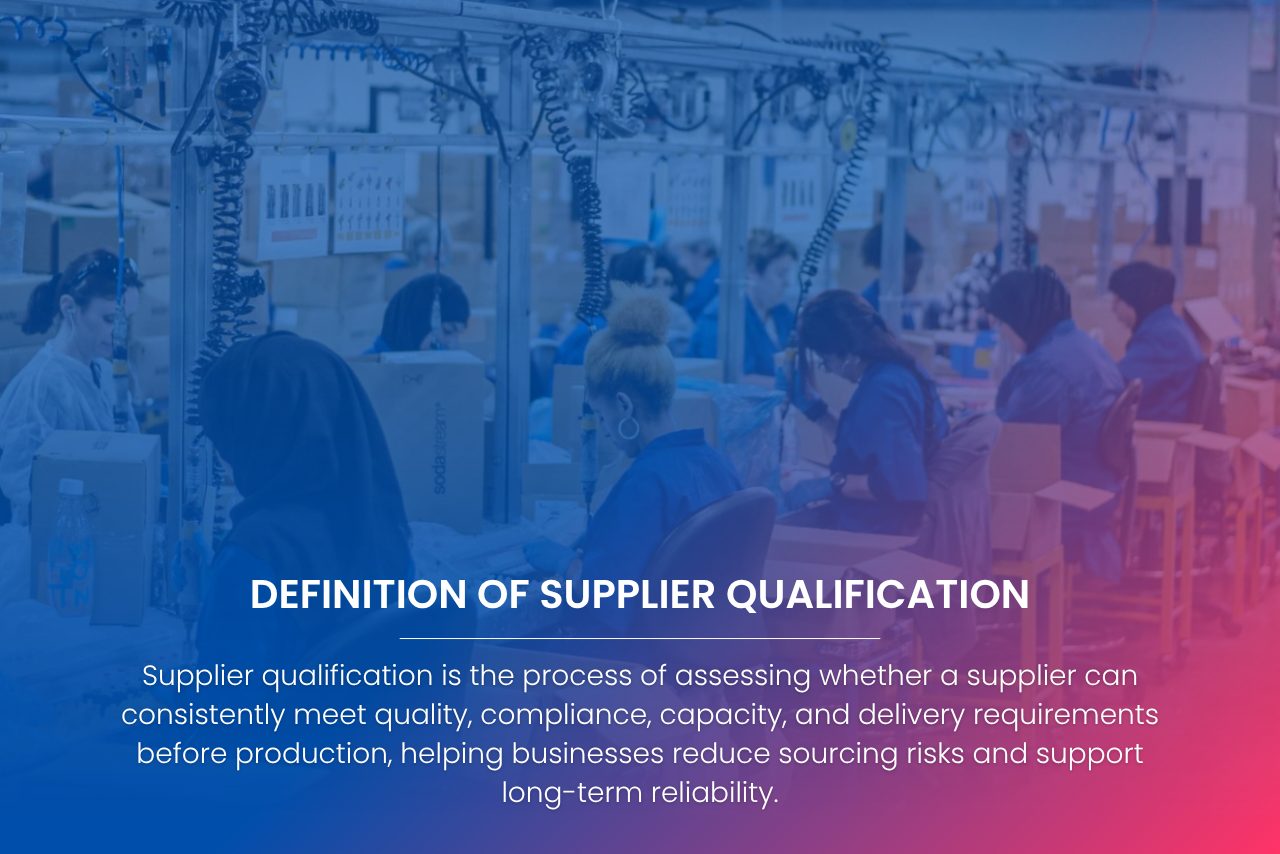
Supplier qualification evaluates whether a supplier can meet quality, compliance, and operational requirements before onboarding.
Why supplier qualification matters for lifestyle brands
For lifestyle brands, supplier qualification plays an important role in protecting product quality, customer experience, and brand reputation. A supplier may meet technical requirements but still struggle to deliver consistent materials, finishing, packaging, or product quality.
Therefore, supplier qualification helps businesses:
- Reduce sourcing risks before production
- Maintain consistent product quality
- Verify compliance with market requirements
- Build a more resilient supply chain
Moreover, for brands operating across multiple markets, a structured qualification process can help reduce the risk of customer complaints, product recalls, and supply disruptions that may affect business performance.
Key evaluation criteria in supplier qualification
Although qualification requirements vary by company and product category, most businesses evaluate several core criteria to determine whether a supplier can support long-term sourcing requirements. Key evaluation areas typically include:
- Quality management: Quality control systems, inspection procedures, and defect management practices
- Financial stability: Business continuity capability and long-term operational sustainability
- Operational capacity: Production capability, equipment, workforce availability, and capacity planning
- Legal and ESG compliance: egulatory compliance, labor standards, environmental requirements, and business licenses
Together, these criteria provide a broader view of a supplier’s reliability, capability, and readiness to support future business operations.
Why Supplier Qualification Takes Longer in the Lifestyle Sector
Supplier qualification in the lifestyle sector often takes longer because product variability, cross-functional approvals, and production constraints all increase validation complexity.
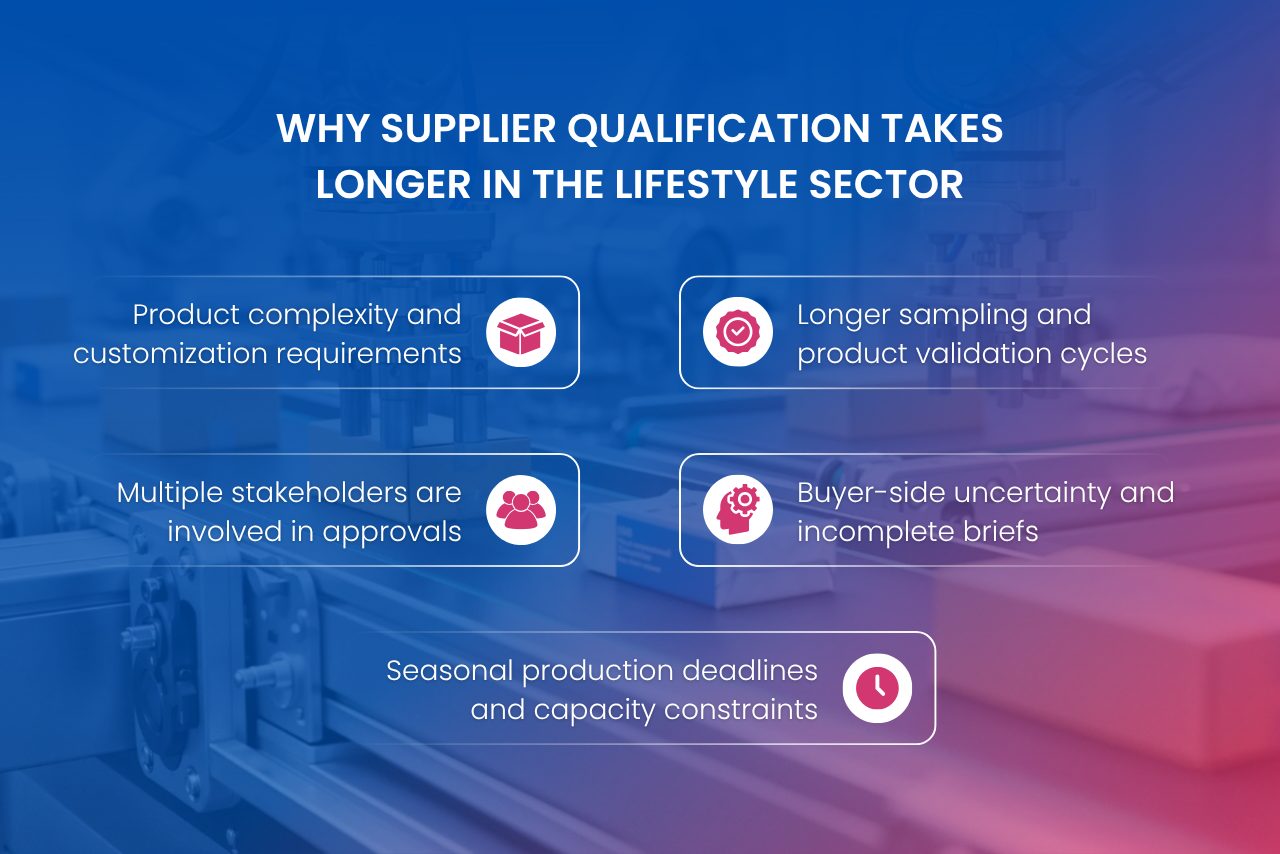
Supplier qualification takes longer in the lifestyle sector because customization, approvals, and validation increase complexity.
Product complexity and customization requirements
Lifestyle products often require a higher level of customization, making supplier qualification more complex and time-consuming. Unlike standardized products, suppliers may need to demonstrate their ability to meet specific requirements for materials, design details, finishing, packaging, and brand standards before approval can be granted.
For example, a qualification may involve validating custom fabrics, specialized formulations, or unique packaging specifications. As customization increases, additional sample reviews, material assessments, and validation activities are often required. Consequently, businesses need more time to verify whether a supplier can consistently deliver the expected quality, product specifications, and brand requirements at production scale.
Multiple stakeholders are involved in approvals
In lifestyle sectors, supplier qualification often involves multiple stakeholders rather than a single approval decision. Different teams review different aspects of supplier capability and product readiness, which can extend qualification timelines.
Common stakeholders include:
- Sourcing teams assessing supplier capability and commercial fit
- Product development teams reviewing samples and specifications
- Quality teams evaluating product consistency and performance
- Compliance specialists verifying regulatory requirements
Because reviews and approvals may occur at different stages, progress often depends on coordination across multiple departments. Thus, qualification timelines can extend when feedback cycles or approval requirements are not fully aligned.
Longer sampling and product validation cycles
For many lifestyle products, sampling and product validation are often the most time-consuming stages of supplier qualification. Before approval, businesses typically need to confirm that a supplier can consistently meet product specifications, quality standards, and brand requirements under actual production conditions.
This process may include prototype reviews, material approvals, packaging validation, and product performance testing. In practice, samples often go through multiple revision rounds as businesses refine materials, colors, dimensions, or finishing details. Moreover, testing results may reveal issues that require corrective actions before the next review can begin.
As a result, qualification timelines can extend significantly because each revision creates additional validation, feedback, and approval requirements.
Seasonal production deadlines and capacity constraints
Seasonal demand can also affect how quickly suppliers move through the qualification process. Many lifestyle sectors operate around fixed commercial calendars, including fashion collections, holiday merchandise, back-to-school products, and seasonal home décor launches, where production schedules are often planned months in advance.
During peak manufacturing periods, suppliers often prioritize confirmed production orders. Sample development, factory audits, trial runs, and capacity checks may therefore take longer to complete. Even highly capable suppliers can face scheduling constraints during these periods, which may extend qualification timelines despite meeting the required quality and compliance standards.
Buyer-side uncertainty and incomplete briefs
Not all supplier qualification delays originate from the supplier. In many sourcing projects, buyer-side uncertainty can significantly extend timelines, particularly when requirements are not clearly defined at the beginning of the process.
Common challenges include:
- Incomplete product specifications
- Frequent design or material changes
- Unclear quality expectations
- Delayed sample feedback
- Changing commercial requirements
When requirements continue to evolve during qualification, suppliers may need to revise samples, repeat testing, or update production plans. Thus, parts of the validation process often need to be repeated, creating additional review cycles and extending the time required to reach final supplier approval.
What Makes Supplier Qualification More Complex In The Lifestyle Sector
Supplier qualification in lifestyle sectors is shaped by non-standardized quality expectations, material variability, and multi-market compliance requirements, making evaluation more nuanced than in technical or industrial sourcing contexts.
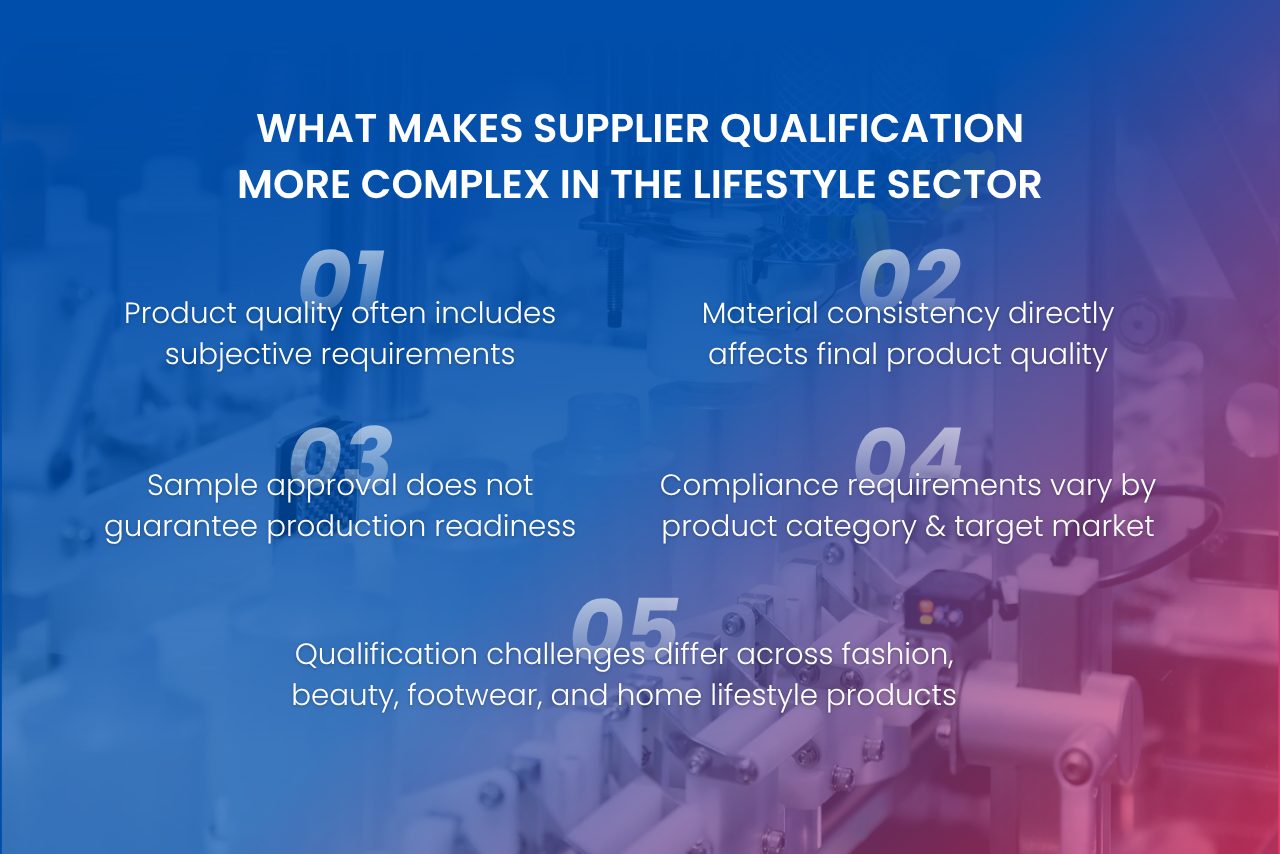
Supplier qualification becomes more complex when quality expectations, material consistency, and compliance vary widely.
Product quality often includes subjective requirements
Product quality in lifestyle categories often involves subjective evaluation, making qualification less standardized than in industrial components with measurable specifications.
Assessment typically goes beyond technical compliance and covers:
- Aesthetic appearance, aligned with brand positioning
- Color consistency across materials and production batches
- Surface finishing quality, including texture and defect control
- Craftsmanship standards, reflecting production precision
- Brand perception alignment, based on market interpretation
This means two products may meet identical technical specifications but still receive different approval decisions. Final qualification depends on whether the product reflects the intended brand expression and meets the required perceived quality threshold.
Material consistency directly affects final product quality
Material consistency directly affects final product quality in lifestyle sourcing, where small variations can shift both appearance and performance outcomes. In practice, suppliers with limited control systems often show instability across batches, especially when materials are sourced from multiple vendors.
Typical variations appear in:
- Fabric texture stability, impacting feel and drape
- Leather shade variation, driven by dyeing and tanning differences
- Cosmetic ingredient uniformity, affecting product performance
- Wood grain differences, influencing visual consistency
- Packaging material strength, affecting durability and presentation
Therefore, supplier evaluation extends beyond production capability. It also requires assessment of material sourcing practices, incoming inspection processes, traceability systems, and internal quality controls to ensure repeatable output at scale.
Sample approval does not guarantee production readiness
Sample approval is often interpreted as confirmation that production capability has been validated. However, in practice, sample quality is typically achieved under controlled, low-volume conditions that do not fully reflect mass production environments.
This is where many sourcing projects slow down. A supplier may produce a strong showroom sample, but struggle to reproduce the same color, finish, packaging, or stitching consistency once production volume increases.
Operational readiness is usually assessed through multiple dimensions, including production scalability, process stability, workforce capability, quality consistency, and capacity availability. These factors determine whether performance can be sustained beyond prototype-level output.
Because of this gap, sample approval is treated as an early-stage validation point rather than a final decision. Further supplier verification is required to confirm stable performance under real production conditions.
Compliance requirements vary by product category and target market
Compliance requirements are increasingly shaping supplier qualification across product categories and export markets. These requirements differ by region and are embedded in regulatory frameworks covering product safety, chemical control, and labeling standards.
For example, lifestyle products sold in the European Union may need to comply with REACH restrictions on hazardous substances. Children’s products may require additional safety testing, while beauty products, food-contact homeware, footwear, packaging, and textile products can each face different labeling, chemical, material, or safety requirements depending on the destination market. In many cases, buyers may also request ISO 9001 certification or equivalent quality management evidence to assess supplier process control.
Thus, supplier qualification must account for regulatory divergence across destinations. This is driving more structured compliance screening before final supplier onboarding and production approval.
| 👉 Learn how local sourcing support in ASEAN helps manage supplier qualification and operational complexity. |
Qualification challenges differ across fashion, beauty, footwear, and home lifestyle products
Qualification challenges differ significantly across lifestyle product categories, as each group is governed by distinct material, performance, and compliance requirements. For example:
- Fashion: Focus is placed on fabric consistency across production batches, color accuracy under different dye lots and lighting conditions, and sizing stability across grading systems, where small deviations can impact fit reliability and market acceptance.
- Beauty: Qualification is driven by formula stability under temperature and storage conditions, ingredient compliance with destination market regulations, and mandatory safety testing for skin contact or usage sensitivity, ensuring both regulatory and product integrity requirements are met.
- Footwear: Assessment centers on material durability under repeated wear stress, fit consistency across size ranges, and construction quality, including stitching strength and bonding reliability affecting product lifespan.
- Home lifestyle: Evaluation emphasizes finishing consistency, packaging protection during logistics, and control of material variability, ensuring both aesthetic and functional stability across distribution.
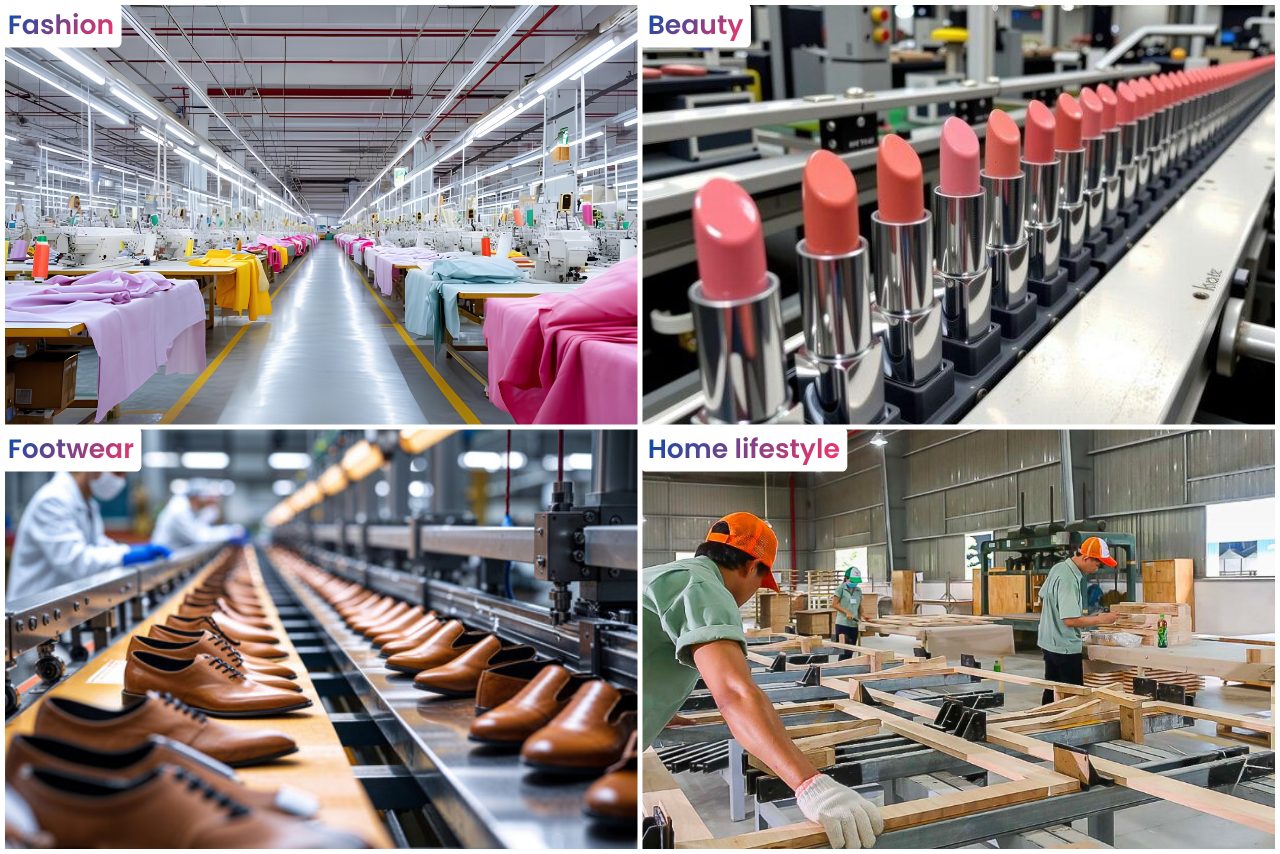
Supplier qualification varies across fashion, beauty, footwear, and home lifestyle products due to different quality and compliance requirements.
Which Stages of the Supplier Qualification Process Usually Cause Delays?
Supplier qualification delays are typically concentrated in stages that require iterative validation, cross-functional alignment, and external verification. The following sections outline where bottlenecks most commonly occur and why they extend overall timelines.
Sample development and product validation
Sample development and product validation are often the longest stages in supplier qualification process, particularly in lifestyle sourcing, where technical requirements and subjective expectations must be aligned. At this point, teams must ensure design intent is fully translated into manufacturable output before moving forward.
Based on our project observations, delays typically result from 2–5 sample revision cycles, material substitutions due to sourcing constraints, and iterative design adjustments. In addition, product testing and multi-stakeholder approval processes can extend timelines. Overall, sample development can account for around 20–40% of total pre-production lead time, especially in complex or highly customized product categories.
Compliance and documentation verification
Companies often perceive compliance and documentation verification as straightforward administrative steps. In practice, they can become a key bottleneck in supplier qualification. At this stage, suppliers must ensure that all required documents are accurate, valid, and aligned with market-specific regulatory expectations before approval can proceed.
Common issues include missing or expired certificates, such as ISO records or product safety declarations, incomplete testing files, and gaps in traceability documentation. In addition, cross-checking third-party lab results and certification records often reveals inconsistencies that slow final approval decisions.
Factory assessment and operational validation
Factory assessment and operational validation focus on confirming whether a supplier can sustain reliable production performance under real operating conditions, beyond declared capability. The evaluation is structured to identify execution gaps that may not appear during sample development but emerge at scale.
Key dimensions include:
- Capability audits to verify production capacity, equipment readiness, and resource alignment
- Process evaluation to assess workflow stability, quality control discipline, and operational consistency
- Corrective action requirements to address deviations in execution, standardization, or system control
This approach ensures qualification decisions are based on verified operational reliability, not assumed production capability or isolated performance results.
Pilot production and final approval
Pilot production and final approval are the last verification steps before full-scale manufacturing, ensuring supplier capability is proven under controlled production conditions. The focus moves from sample validation to real production consistency and operational readiness, where output must remain stable across runs.
Pilot runs assess production consistency, quality performance, process stability, and manufacturing readiness. In parallel, output is monitored to detect deviations that may not appear during sampling. When gaps emerge, suppliers must implement corrective actions and undergo further validation. Companies only grant final approval once suppliers demonstrate stable execution under scaled operating conditions.
|
Stage |
Typical Duration* |
Why It Can Take Longer |
|
Sample validation |
2–8 weeks |
Multiple revisions, material changes, and design feedback |
|
Compliance review |
2–6 weeks |
Missing certificates, market-specific testing |
|
Factory assessment |
1–3 weeks |
Scheduling, audit findings, and corrective actions |
|
Pilot production |
2–6 weeks |
Quality, consistency, and production readiness checks |
*Timelines vary depending on product category, supplier readiness, testing requirements, and buyer approval speed.
| When pilot production confirms readiness, execution often depends on local coordination across suppliers. 👉 Explore how sourcing agents in ASEAN support supplier qualification and execution. |
Common Factors That Delay Supplier Qualification
Supplier-side gaps and buyer-side process instability typically drive supplier qualification process delays, often accumulating across stages and extending overall validation timelines.
- Incomplete supplier documentation: Missing, expired, or inconsistent records, such as certificates, test reports, or traceability files, prevent verification from progressing.
- Failed product testing results: Non-compliance with performance, safety, or durability requirements, leading to redesign, re-sampling, or additional validation cycles.
- Market-specific compliance requirements: Different regulatory frameworks across destination markets require additional testing, documentation alignment, or certification updates.
- Capacity and production capability mismatches: Supplier limitations in scaling output due to equipment constraints, workforce instability, or insufficient process control.
- Buyer-side uncertainty: Unclear product briefs, frequent specification changes, delayed feedback loops, lack of benchmark samples, cross-functional misalignment between sourcing, design, QA, and compliance teams, unrealistic pricing targets, and undefined MOQ or timeline expectations.
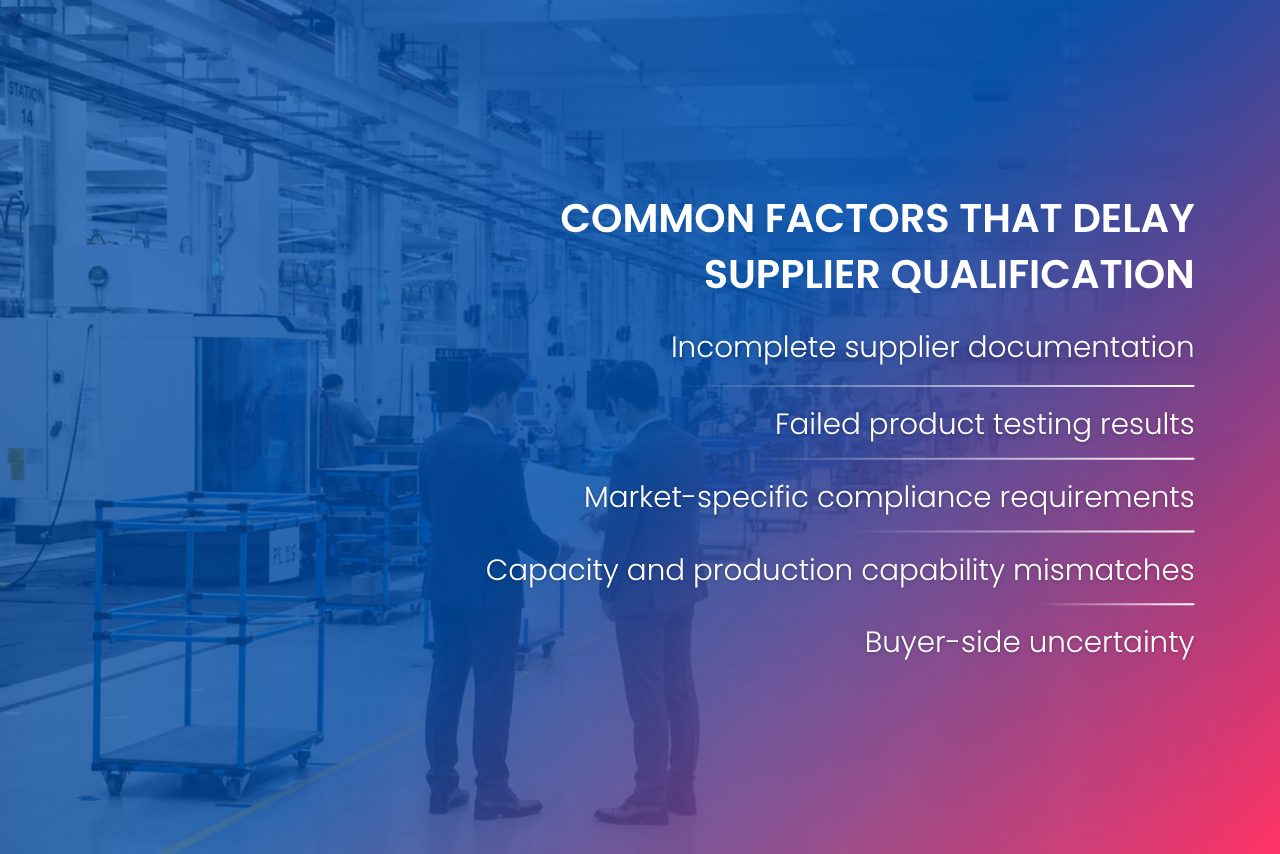
Common supplier qualification delays often result from documentation gaps, testing issues, and approval bottlenecks.
How To Accelerate The Supplier Qualification Process
To accelerate the supplier qualification process, companies need a structured approach that reduces uncertainty, avoids rework, and improves decision speed across stakeholders.
- Define qualification requirements early: Establish clear product specifications, quality standards, compliance expectations, documentation scope, and approval responsibilities to ensure alignment from the start and reduce revision cycles.
- Standardize supplier evaluation criteria: Apply a consistent assessment framework to reduce subjective judgment, improve supplier comparability, and support faster multi-stakeholder decision-making.
- Conduct pre-audit assessments: Review documentation readiness, production capability, quality systems, and compliance status before formal audits to identify risks early and prioritize qualified suppliers.
- Use local sourcing and quality experts: Leverage on-the-ground expertise for factory visits, supplier communication, and local regulatory understanding to accelerate issue resolution and improve validation accuracy.
- Implement risk-based qualification strategies: Allocate evaluation depth based on product complexity, supplier maturity, and market requirements, ensuring resources are focused on suppliers with the highest operational and compliance risk.
→ Learn more about how to build strong supplier relationships in lifestyle sourcing!
Final Thoughts
Supplier qualification in the lifestyle sector takes longer than expected due to subjective quality standards, material variability, and multi-stage validation requirements. Delays often arise across sample development, documentation review, factory assessment, and pilot production, where iterative feedback and cross-functional alignment are required before final approval. This is where local sourcing support becomes valuable. It helps buyers validate suppliers on the ground, reduce communication gaps, and move from supplier interest to production readiness with stronger control.
At Source of Asia, we support companies across the full supplier qualification cycle through a structured, on-the-ground approach across Southeast Asia, helping reduce sourcing risks and improve evaluation consistency for long-term reliability. Our experts help with:
- Supplier mapping and pre-screening
- Factory visits and operational validation
- Sample follow-up and supplier communication
- Quality, compliance, and production readiness checks
| 👉 Facing challenges in supplier qualification or sourcing in ASEAN? Contact us to discuss your requirements. |
Frequently Asked Questions
Supplier qualification is a structured process to evaluate and verify supplier capability, including production capacity, quality systems, compliance readiness, and operational stability, ensuring they can consistently meet sourcing and manufacturing requirements before approval.
It covers sample development, documentation review, factory audits, production capability assessment, compliance checks, and pilot production validation to confirm both technical and operational readiness before scaling.
It usually ranges from several weeks to a few months, depending on product complexity, number of sample revisions, documentation readiness, and the extent of factory and production validation required.
Companies can reduce delays by setting clear requirements early, standardizing evaluation criteria, conducting pre-audits, improving cross-team alignment, and applying risk-based qualification to focus on high-impact suppliers.
Local experts are highly useful for faster factory access, clearer supplier communication, and accurate interpretation of regional compliance and production practices, helping reduce validation time and improve decision quality.