Introduction
ASEAN continues to strengthen its position as a global manufacturing hub as companies diversify supply chains and expand production across the region. As competition increases, smart manufacturing is becoming an important strategy for improving productivity, strengthening operational resilience, and supporting long-term manufacturing growth.
Many companies recognize the need for smart manufacturing but struggle to identify where digital transformation should begin. Some invest in new technologies without addressing their biggest operational challenges, while others hesitate because they are unsure which solutions deliver measurable ROI or how adoption differs across ASEAN markets.
In this guide, Source of Asia explains what smart manufacturing is, where it creates value first, and what is driving adoption across ASEAN to help manufacturers navigate this transition
Key Insights
- Smart manufacturing connects machines, people, systems, and supply chain data to improve operational visibility and decision-making.
- The strongest early ROI typically comes from production visibility, predictive maintenance, quality control, and connected supply chain data.
- Pilot projects help manufacturers validate business value, reduce implementation risks, and build a practical roadmap before scaling.
- Each ASEAN market supports smart manufacturing differently, making local industrial strengths and digital readiness critical investment factors.
- Long-term success depends on combining technology, skilled people, measurable KPIs, and the right regional execution strategy.
 Add Source of Asia as a preferred source on Google
What Is Smart Manufacturing?
Smart manufacturing refers to a manufacturing approach that uses connected digital technologies to improve how factories operate and make decisions. By doing so, manufacturers connect data across machines, production lines, quality systems, and supply chains, manufacturers gain real-time visibility, improve operational efficiency, and respond more quickly to production issues and changing business demands.
Common technologies behind smart manufacturing include:
- Industrial Internet of Things (IIoT)
- Artificial Intelligence & Machine Learning (AI/ML)
- Digital Twins
- Cloud & Edge Computing
- Industrial Robotics & Automation
Together, these tools allow manufacturers to connect machines, people, systems, and data across the production environment.
As a result, the main difference from traditional manufacturing is that smart manufacturing uses connected data to optimize operations continuously rather than relying on isolated systems and manual decision-making.
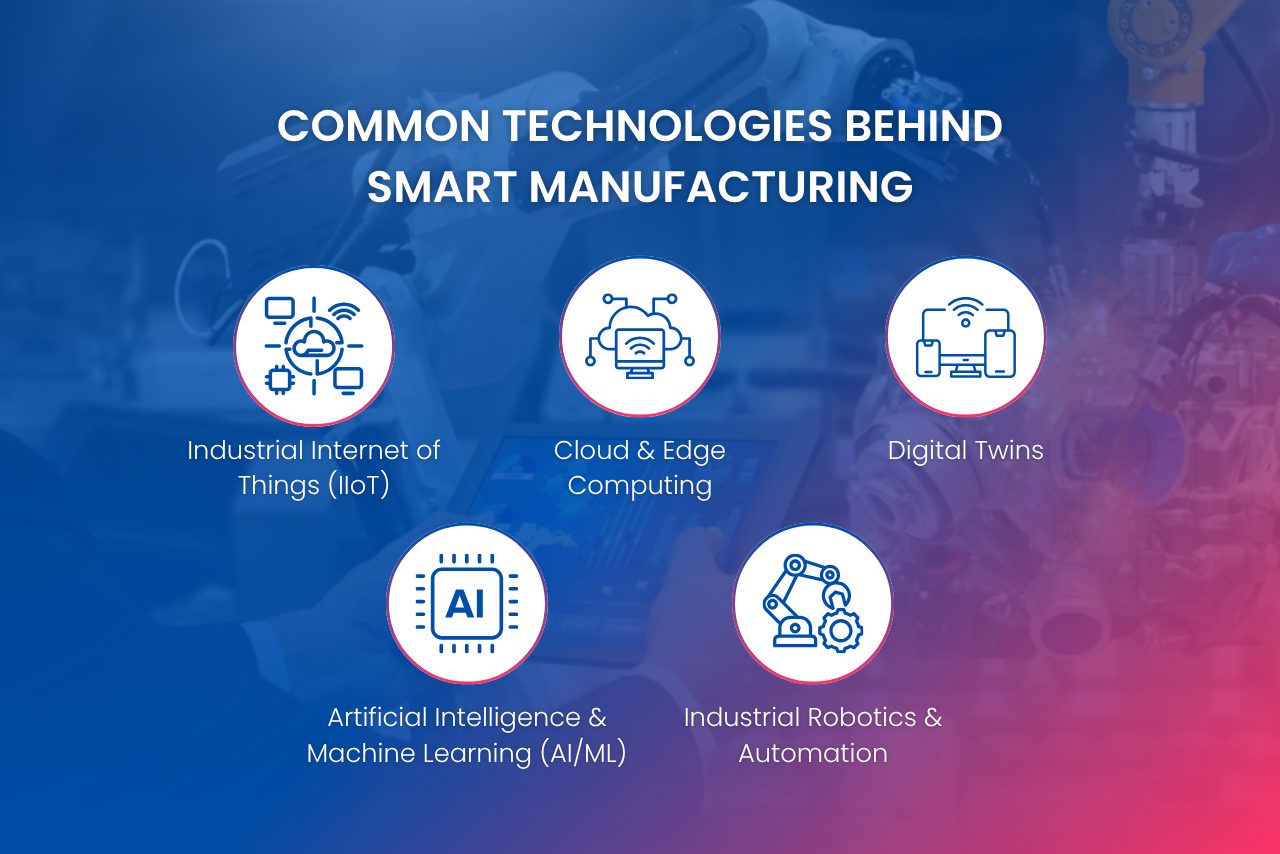
IIoT, AI, digital twins, cloud computing, and robotics work together to create connected, data-driven manufacturing operations.
Where Smart Manufacturing Creates Value First
Many manufacturers assume smart manufacturing requires a complete factory transformation. However, the greatest value often comes from improving a few high-impact operational areas first. For example, smart manufacturing typically creates value through:
- Real-time production monitoring: Monitor production, equipment performance, and downtime as they happen, enabling faster responses to bottlenecks and operational disruptions.
- Predictive maintenance: Use machine data to identify potential equipment failures early, reducing unplanned downtime and improving maintenance efficiency.
- Quality control and defect detection: Detect production issues earlier through connected data and automated inspection, helping reduce scrap, rework, and quality inconsistencies.
- Inventory, supplier, and supply chain visibility: Connect production with inventory and supplier data to improve material planning, coordination, and supply chain responsiveness.
- Energy, resource, and process efficiency: Monitor energy consumption and production performance to reduce waste, optimize resource usage, and lower operating costs.
What Is Driving Smart Manufacturing Adoption in ASEAN?
Smart manufacturing adoption in ASEAN is driven by rising operational pressures, supply chain diversification, and stronger government support. Consequently, manufacturers are accelerating modernization efforts to improve operations and strengthen long-term competitiveness.
Rising labor costs and operational complexity
For many years, ASEAN attracted manufacturers through competitive labor costs. Today, cost competitiveness is only one part of the equation. As wages continue to rise across major manufacturing markets, businesses are therefore placing greater emphasis on productivity, operational efficiency, and manufacturing capabilities to remain competitive.
At the same time, production has become more complex, with higher expectations for quality, flexibility, and shorter lead times. In response, smart manufacturing helps businesses improve production visibility, automate repetitive tasks, and make faster data-driven decisions, enabling manufacturers to increase productivity and scale operations more efficiently.
Supply chain resilience after global disruptions
Recent global disruptions highlighted the risks of concentrating production in a single market. In response, many manufacturers have adopted multi-country production strategies, such as China+1, to diversify operations and strengthen supply chain resilience while maintaining existing manufacturing bases.
However, expanding across multiple markets also makes operations more difficult to coordinate. Manufacturers need real-time visibility across production, suppliers, inventory, and logistics to respond quickly when disruptions occur. Smart manufacturing enables this by connecting operational data across the supply chain, helping businesses improve coordination, make faster decisions, and build more resilient manufacturing networks across ASEAN.
Government initiatives supporting industry 4.0
Governments across ASEAN continue to accelerate industrial digitalization through national Industry 4.0 strategies, workforce development programs, investment incentives, and technology adoption initiatives. According to ASEAN’s Economic Community Strategic Plan 2026–2030, ASEAN’s latest regional economic strategy continues to prioritize digital transformation, supply chain integration, and industrial competitiveness, reinforcing member states’ efforts to modernize manufacturing.
As a result, these initiatives help lower adoption barriers by improving access to funding, technology partnerships, and digital skills. However, successful implementation still depends on a clear operational roadmap, well-defined business priorities, and technologies that deliver measurable operational value rather than simply adding digital tools.
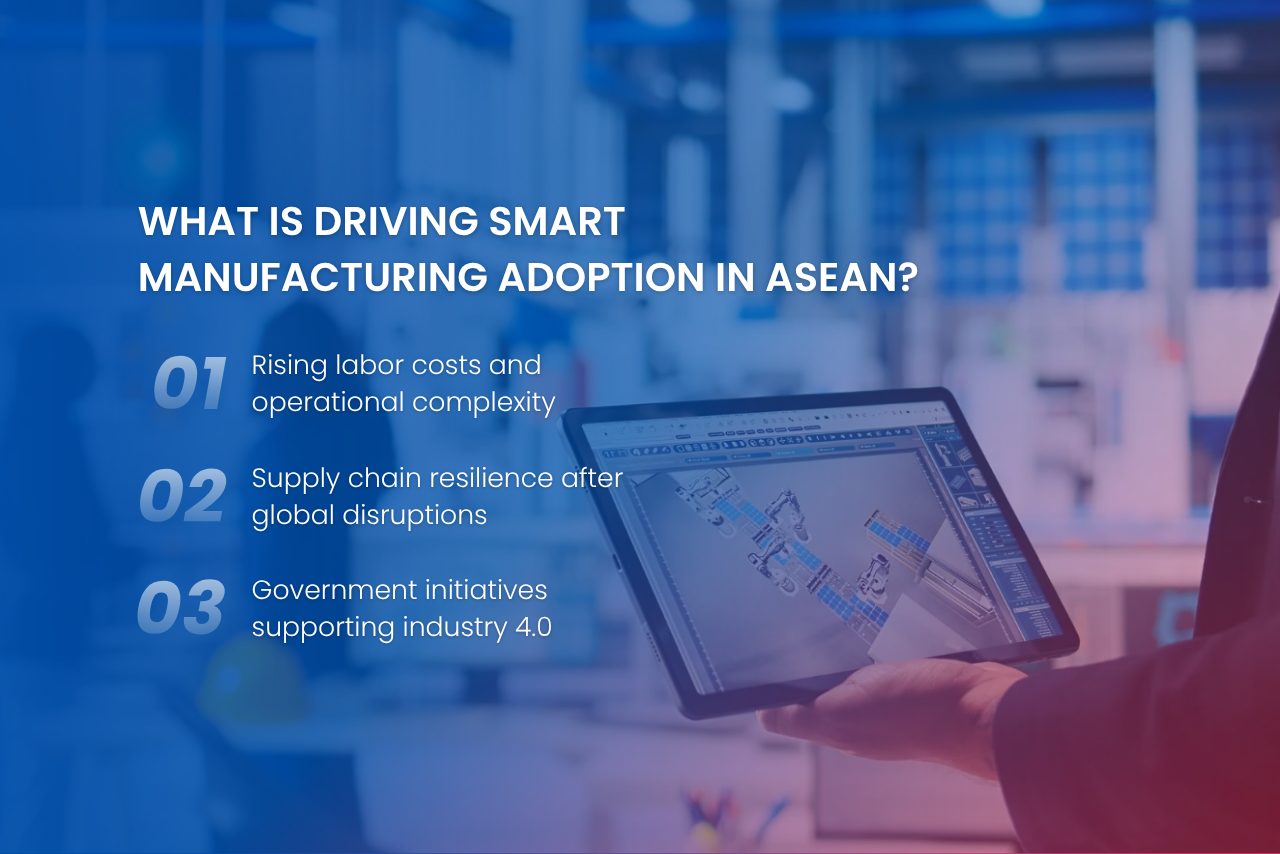
Key drivers accelerating smart manufacturing adoption across ASEAN manufacturing industries.
What Actually Works When Adopting Smart Manufacturing
Many smart manufacturing projects fail due to unclear objectives rather than technology limitations. Instead, successful adoption requires a practical, step-by-step approach focused on measurable improvements and long-term scalability.
Start with operational problems, not technology trends
Smart manufacturing adoption should begin with identifying operational challenges, not selecting the latest technologies. Manufacturers need to understand where inefficiencies occur before deciding which solutions to implement:
- Production bottlenecks reduce efficiency, making it important to identify issues such as machine downtime, slow processes, or limited production visibility.
- Quality challenges increase costs, as recurring defects and rework often indicate areas where better data and monitoring can create value.
- Disconnected systems limit decision-making, preventing manufacturers from gaining a complete view of operations.
By focusing on specific business problems first, companies can select suitable technologies, avoid unnecessary investments, and build a more practical smart manufacturing roadmap.
Build from pilots before scaling across facilities
Large-scale smart manufacturing projects often involve significant investment, complex system integration, and potential disruption to existing operations. Therefore, manufacturers should begin with targeted pilot projects to evaluate whether a solution can deliver measurable value before expanding further.
A pilot on a single production line or facility allows companies to measure real outcomes such as downtime reduction, quality improvement, productivity gains, and implementation costs. For example, a manufacturer may test predictive maintenance on a critical machine group before applying it across the entire factory network. These early insights help reduce risks, improve internal adoption, and create a practical roadmap for broader smart manufacturing deployment.
Connect factory data with supply chain systems
Smart manufacturing delivers greater value when factory data extends beyond the production floor and connects with wider supply chain operations. Manufacturing performance depends on multiple factors, including:
- Supplier coordination, as delays or capacity issues can directly affect production schedules.
- Inventory and logistics visibility, which helps manufacturers manage materials, reduce shortages, and respond faster to disruptions.
- Integrated business systems, such as ERP, MES, and warehouse platforms, that create a more complete operational view.
A connected data environment enables manufacturers to make faster decisions, optimize production planning, and strengthen supply chain resilience, particularly for companies managing multi-country operations across ASEAN.
Measure success through operational KPIs and ROI
Smart manufacturing projects should be measured through business performance improvements, not simply the adoption of new technologies. Before implementation, manufacturers need to define clear KPIs that reflect their operational goals and expected outcomes.
Key performance indicators may include:
- Overall Equipment Effectiveness (OEE) and machine downtime: Measuring production efficiency and identifying opportunities to reduce unplanned interruptions.
- First-pass yield and defect rates: Tracking quality performance and minimizing waste caused by rework or production errors.
- Production throughput and lead time: Evaluating whether processes become faster and more responsive.
- Energy consumption and maintenance costs: Assessing improvements in resource efficiency and operational expenses.
- Inventory accuracy and ROI: Measuring supply chain performance and the overall financial impact of smart manufacturing investments.
Tracking these metrics helps manufacturers identify whether smart manufacturing investments are delivering measurable value and supporting continuous improvement.
Develop internal capabilities over time
Technology alone does not transform a factory. Successful smart manufacturing depends on employees who can understand data, improve processes, and apply digital tools in daily operations. Production supervisors, maintenance teams, and quality staff need the right skills to interpret insights and respond effectively to operational changes.
Therefore, manufacturers should invest in workforce training alongside technology implementation. Building capabilities in areas such as data analysis, automation, and systems integration helps companies maximize the value of their investments. Combining internal development with external expertise during early stages can also reduce risks and support long-term operational improvement.
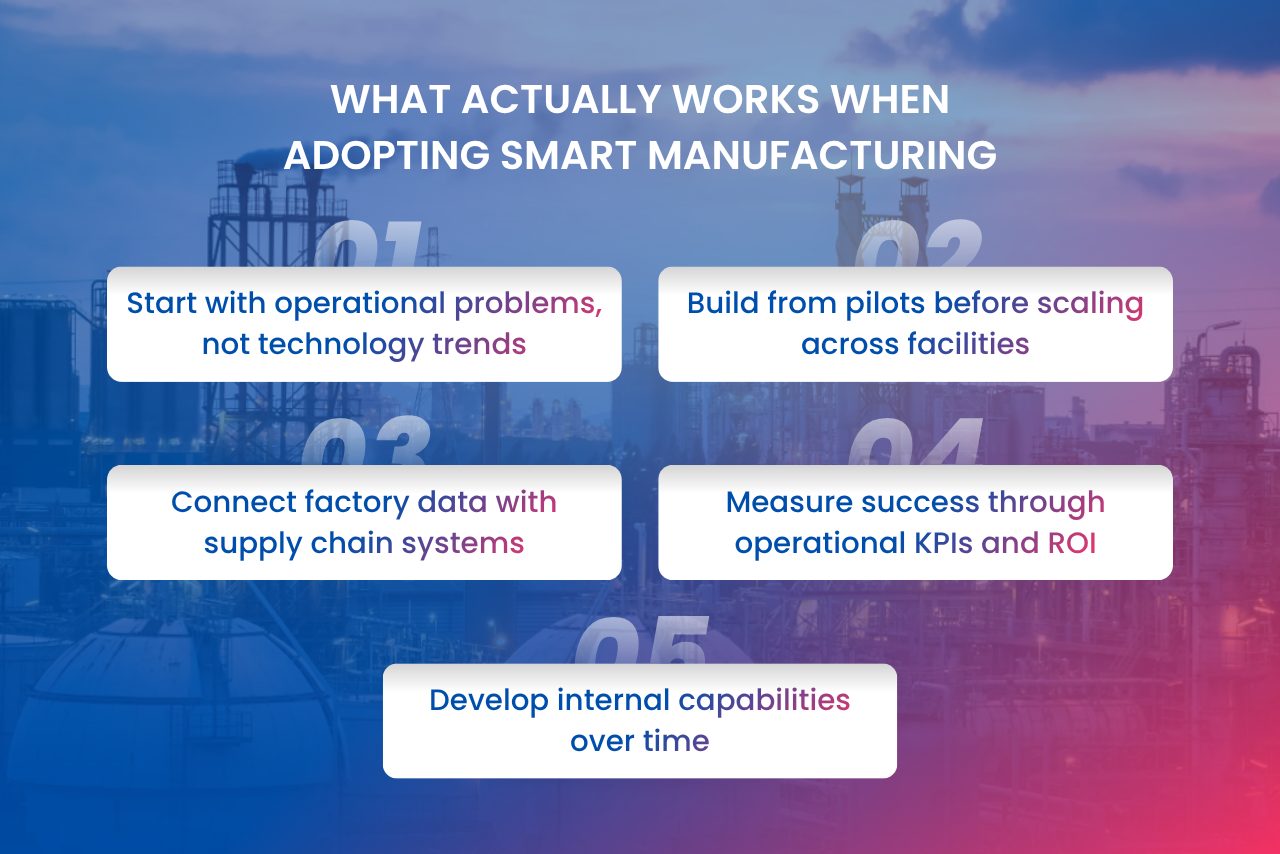
Successful smart manufacturing begins with operational priorities, pilot projects, connected data, measurable KPIs, and workforce capability development.
Which Key ASEAN Markets Are Ready for Smart Manufacturing?
ASEAN’s manufacturing landscape varies widely across countries, with differences in industrial maturity, digital infrastructure, workforce capabilities, and Industry 4.0 readiness. Therefore, evaluating these factors helps manufacturers choose suitable markets and develop practical smart manufacturing strategies.
| 👉 Discover our Manufacturing Industry in Southeast Asia sectorial notes for a broader view of the region’s manufacturing landscape. |
*This section focuses on five priority manufacturing markets in ASEAN: Singapore, Malaysia, Thailand, Vietnam, and Indonesia.

ASEAN markets differ in industrial strengths, digital maturity, and sector focus, shaping smart manufacturing opportunities across the region.
Singapore
Singapore is one of ASEAN’s most advanced smart manufacturing markets, supported by strong digital infrastructure, skilled talent, and a mature industrial ecosystem. The country focuses on high-value manufacturing where technology improves precision, efficiency, and innovation.
- Market readiness: Manufacturers benefit from advanced automation adoption, Industry 4.0 programs, and strong research capabilities.
- Best-fit sectors: Semiconductors, precision engineering, biomedical manufacturing, and electronics industries.
- Adoption angle: Companies mainly apply smart manufacturing to improve quality control, production accuracy, yield optimization, and connected factory operations.
- Watchpoint: Higher operating costs make Singapore more suitable for advanced manufacturing and innovation rather than labor-intensive production.
Malaysia
Malaysia has one of ASEAN’s strongest electronics and semiconductor manufacturing ecosystems, with smart manufacturing adoption focused on modernizing existing industrial capabilities and improving digital readiness.
- Market readiness: Export-oriented manufacturers are increasingly adopting automation, digital systems, and Industry 4.0 solutions, supported by industrial clusters and government initiatives.
- Best-fit sectors: Electronics, electrical & electronics (E&E), semiconductors, and medical devices.
- Adoption angle: Smart manufacturing is commonly used to improve factory modernization, productivity, quality control, and process visibility, while also supporting digital upgrades among SMEs.
- Watchpoint: Adoption maturity differs across industries and suppliers, making workforce capabilities, technology readiness, and existing system integration important factors to evaluate.
Thailand
Thailand’s manufacturing strength is built around automotive, electronics, and industrial production, making it well suited for automation-driven smart manufacturing adoption.
- Market readiness: Manufacturers benefit from established industrial infrastructure, existing automation use, and government support through Thailand 4.0 initiatives.
- Best-fit sectors: Automotive, electronics, industrial machinery, and component manufacturing.
- Adoption angle: Companies often apply smart manufacturing to improve high-volume production efficiency, robotics integration, predictive maintenance, and process optimization.
- Watchpoint: Older production facilities may face challenges when integrating legacy equipment with newer digital systems, increasing implementation complexity and costs.
Vietnam
Vietnam’s manufacturing growth is increasingly supported by FDI-driven production and export-oriented supply chains, creating strong demand for digital transformation and smart manufacturing solutions.
- Market readiness: Digital adoption is accelerating among foreign-invested manufacturers and larger domestic companies seeking higher productivity and global competitiveness.
- Best-fit sectors: Electronics, consumer products, industrial manufacturing, textiles, and supporting industries.
- Adoption angle: Manufacturers often start with production monitoring, quality management, and factory digitization before moving toward advanced automation and data-driven operations.
- Watchpoint: Digital maturity varies across regions and suppliers, making workforce capabilities, system integration, and supplier readiness important factors to assess.
Indonesia
Indonesia’s large domestic market and diverse manufacturing base create strong opportunities for industrial digital transformation, particularly among companies seeking greater efficiency and competitiveness.
- Market readiness: Manufacturing modernization is expanding through initiatives such as Making Indonesia 4.0 and increasing investment in digital capabilities.
- Best-fit sectors: Food and beverage, automotive, electronics, chemicals, and textiles.
- Adoption angle: Companies often focus on operational efficiency, production visibility, and supply chain coordination to support both domestic demand and export activities.
- Watchpoint: Differences in infrastructure, factory locations, and digital maturity across regions require market-specific implementation strategies.
The level of smart manufacturing readiness varies across ASEAN markets, depending on industrial strengths, digital maturity, and sector priorities. The table below provides a quick comparison of each country’s key advantages and best-fit applications:
| Country | Strongest sectors | Best fit for smart manufacturing |
| Singapore | Semiconductors, precision engineering, biomedical manufacturing, electronics | High-value manufacturing, advanced automation, R&D-intensive production |
| Malaysia | Electronics, electrical & electronics (E&E), semiconductors, medical devices | Manufacturing modernization, SME digital transformation, smart factory upgrades |
| Thailand | Automotive, electronics, industrial machinery | Automation-driven production, high-volume manufacturing, industrial robotics |
| Vietnam | Electronics, consumer products, industrial manufacturing, textiles | Export-oriented manufacturing, FDI-driven production, digital capability scaling |
| Indonesia | Food & beverage, automotive, electronics, chemicals, textiles | Large-scale manufacturing, industrial digital transformation, domestic market expansion |
How Source of Asia Supports Smart Manufacturing Projects Across ASEAN
Successful smart manufacturing projects require more than selecting the right technology. Instead, long-term success depends on operational readiness, the right partner ecosystem, and effective execution across different ASEAN markets.
At Source of Asia, manufacturers receive end-to-end support throughout the smart manufacturing journey. In particular, this includes:
- Manufacturing readiness assessment: Assess production processes, operational bottlenecks, digital maturity, workforce capabilities, and existing systems to identify improvement opportunities, prioritize investments, and develop a practical roadmap for smart manufacturing adoption.
- Partner identification: Identify qualified manufacturers, suppliers, and technology providers that match production requirements, industry standards, scalability needs, and long-term business objectives, helping reduce sourcing and implementation risks.
- Supply chain coordination: Improve visibility across production, suppliers, inventory, procurement, and logistics to strengthen coordination, support faster operational decisions, and build a more resilient manufacturing network.
- Regional execution support: Navigate differences in regulations, industrial ecosystems, supplier capabilities, and implementation requirements across ASEAN markets to support smoother execution and more consistent project outcomes.
| 👉 Explore our Sourcing Services to support your smart manufacturing projects across ASEAN from strategy to execution. |
Final Considerations
Smart manufacturing delivers the greatest value when it is driven by business priorities rather than technology alone. Manufacturers can improve long-term results by addressing operational challenges first, validating solutions through pilot projects, measuring progress with clear KPIs, and adapting implementation strategies to each ASEAN market’s industrial strengths and digital maturity.
At Source of Asia, we support manufacturers with sourcing and supply chain solutions across Southeast Asia. Whether you are evaluating opportunities or preparing for implementation, our experts help identify qualified partners, assess operational readiness, strengthen supply chains, and support practical smart manufacturing project planning, partner identification, and regional execution support across ASEAN.
| 👉 Talk to our team to explore the right smart manufacturing approach for your business. |
Frequently Asked Questions
Smart manufacturing connects technologies such as IIoT, AI, automation, and real-time data to optimize production. It helps manufacturers improve visibility, reduce downtime, increase quality, and make faster operational decisions across factories and supply chains.
Yes. SMEs can adopt smart manufacturing by starting with targeted use cases such as production monitoring or predictive maintenance. A phased approach reduces investment risk, delivers measurable ROI, and builds capabilities before expanding across operations.
Singapore leads ASEAN in advanced smart manufacturing, while Malaysia and Thailand have strong capabilities in electronics and automotive. Vietnam and Indonesia are rapidly expanding adoption through industrial modernization, export growth, and government-supported digital transformation initiatives.