Introduction
In 2026, South Korea remains one of Asia’s leading business destinations for foreign companies. Its mature industrial ecosystem, innovation-driven economy, and strategic position in Northeast Asia continue to attract businesses looking to expand manufacturing, technology, and regional operations.
Still, doing business in South Korea requires looking beyond market potential. Every opportunity comes with trade-offs. Companies should evaluate not only the advantages of entering the market but also the operational, regulatory, and cultural challenges that could affect long-term success. Understanding both sides helps businesses make more informed investment decisions.
In this guide, we – Source of Asia – examine the key pros and cons of doing business in South Korea, identify which businesses are best suited for the market, and outline practical considerations to help you plan your market entry with greater confidence.
Key Insights
- Advanced manufacturers, technology providers, and premium brands are among the businesses best suited for South Korea.
- South Korea’s strong economy and regional trade connections create opportunities for foreign companies expanding in Asia.
- Skilled talent and advanced infrastructure support technology-driven and high-value business operations.
- Relationship-based business practices can affect partnerships, negotiations, and market entry timelines.
- Regulatory complexity and strong local competition require careful preparation before entering South Korea.
 Add Source of Asia as a preferred source on Google
Pros and Cons of Doing Business in South Korea at a Glance
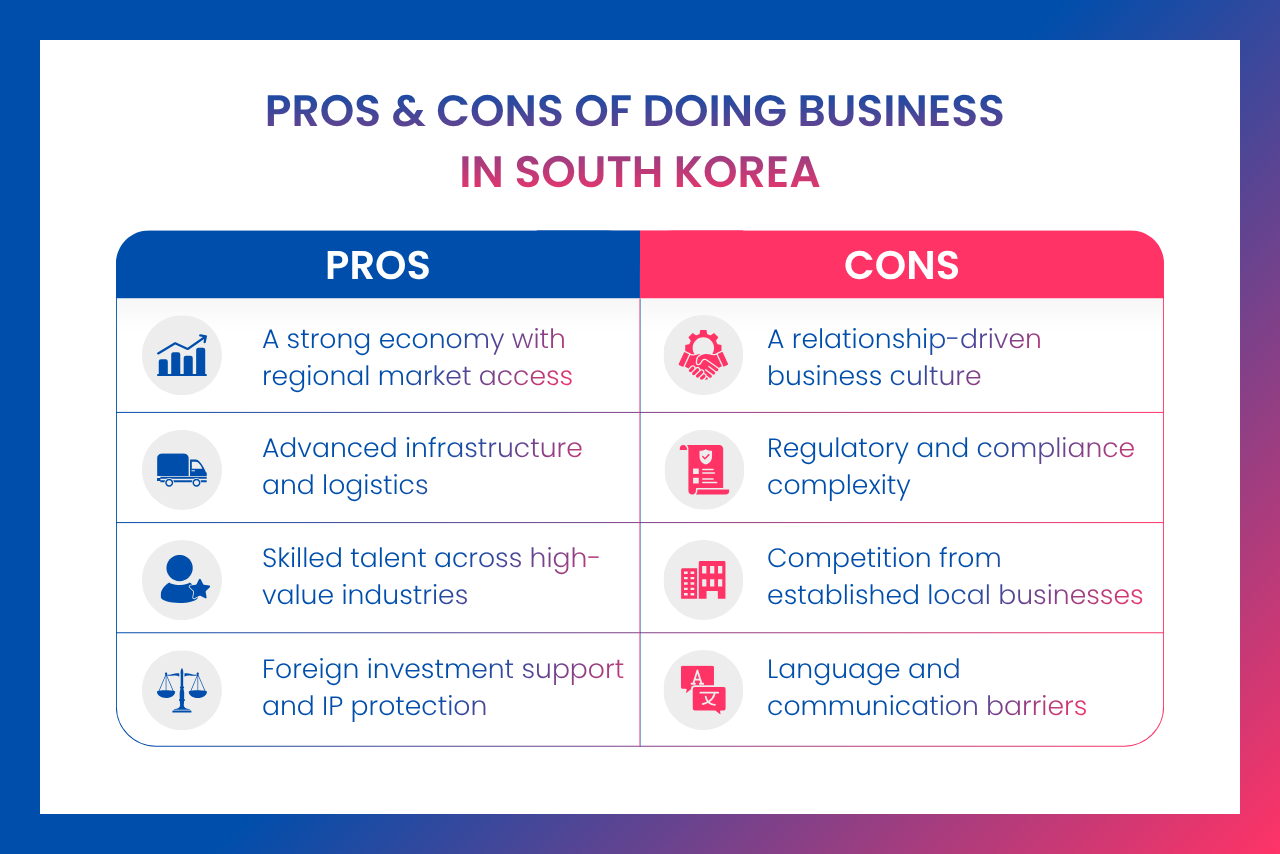
Entering a new market often starts with understanding what makes it attractive and what challenges may arise later. For foreign companies, South Korea offers key advantages, including a strong economy, advanced infrastructure, skilled talent, and investment support for business expansion.
However, market opportunities also come with practical considerations. Companies entering South Korea may need to adapt to relationship-based business practices, meet complex regulatory requirements, compete with established local players, and manage language differences in daily operations.
The table below summarizes the main pros and cons of doing business in South Korea before exploring each factor in more detail. This overview helps companies evaluate market fit and prepare better entry strategies from the beginning.
| Pros of doing business in South Korea | Cons of doing business in South Korea |
|
|
4 Key Advantages of Doing Business in South Korea
South Korea offers several advantages that can support foreign companies throughout their expansion journey. From market access and infrastructure readiness to talent availability and investment protection, these factors create a strong foundation for businesses entering the market.
A strong economy with regional market access
South Korea provides foreign companies with a strong foundation for expansion through its large economy, advanced industries, and global trade connections. In 2025, it ranked as the 10th-largest economy in the world and the 4th-largest in Asia by nominal GDP, following China, Japan, and India.
Several factors make South Korea an attractive market for businesses:
- Export-driven economy: According to government data reported by Reuters, South Korea’s total exports reached USD 709.7 billion, up 3.8 percent year-on-year. Key growth areas include semiconductors, advanced manufacturing, AI-related technologies, biotechnology, and defense industries.
- Strong regional connectivity: South Korea has signed 23 Free Trade Agreements (FTAs) covering 60 countries, including the United States, China, the European Union and ASEAN, supporting international trade and supply chain strategies.
- Strategic market position: Beyond serving domestic demand, South Korea can act as a base for companies looking to connect with Northeast Asian markets and expand regional operations.
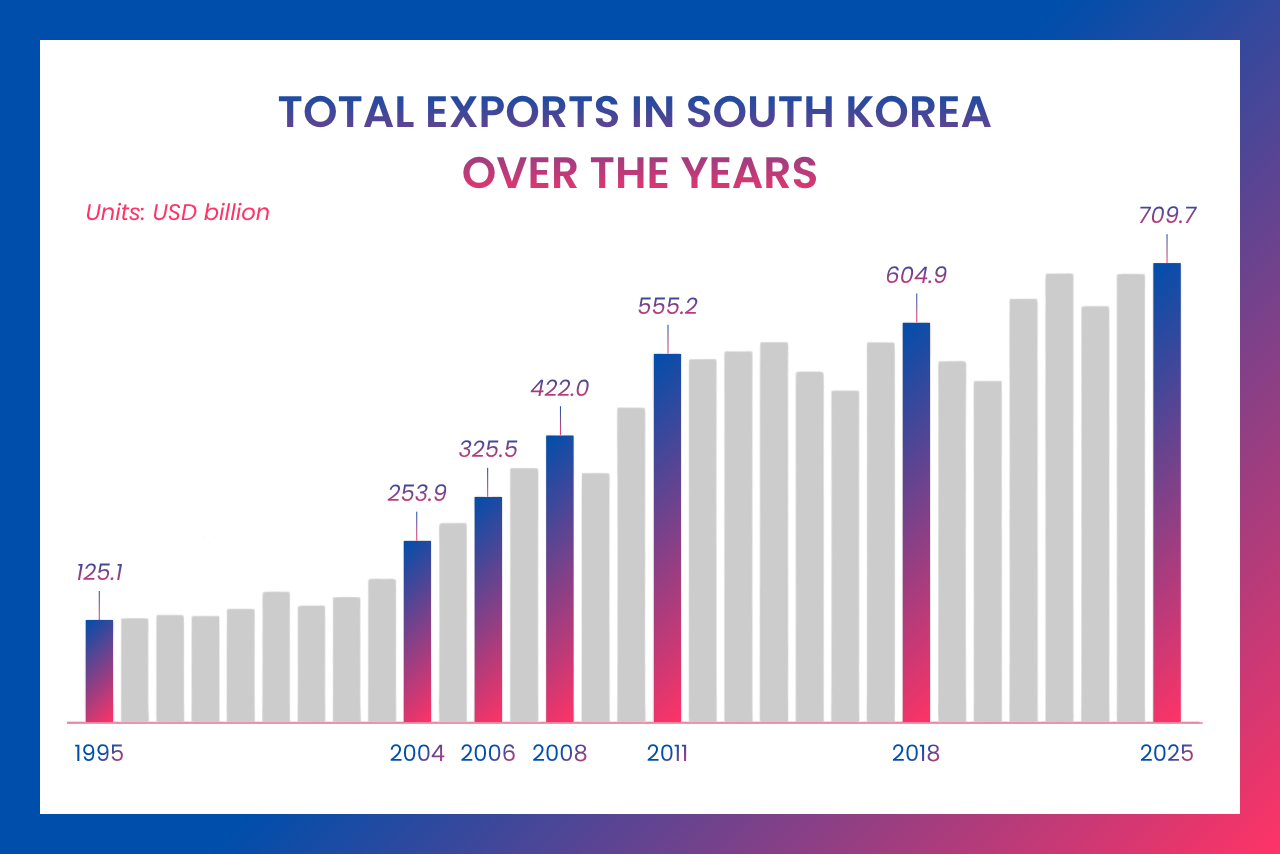
South Korea’s total export in 2025 reached $700 billion for the first time
Advanced infrastructure and logistics
South Korea’s infrastructure reduces many operational barriers that foreign companies often face when entering a new market. The country’s widespread broadband coverage and advanced 5G networks support reliable connectivity, digital transformation, and technology adoption across industries.
For companies involved in manufacturing and international trade, physical logistics infrastructure is a key advantage. Major hubs such as the Port of Busan and Incheon International Airport enable efficient movement of goods while supporting both domestic distribution and cross-border supply chains.
These infrastructure capabilities are particularly valuable for businesses that depend on real-time data, reliable transportation, and efficient supply chain management, helping reduce delays and improve operational consistency.
Skilled talent across high-value industries
South Korea’s workforce is a key advantage for companies operating in technology-intensive and specialized sectors. The country has one of the highest tertiary education attainment rates among OECD countries, with 71% of people aged 25–34 completing tertiary education. This creates a strong foundation of technical knowledge and professional skills.
This talent advantage is reflected in several areas:
- Strong technical capabilities: Engineering, technology, research, and advanced manufacturing sectors benefit from a highly educated workforce.
- Industry-relevant expertise: Local talent supports innovation-driven industries, including semiconductors, electronics, and advanced production.
- Specialized workforce availability: Companies can access qualified professionals for complex operations and high-value activities.
Foreign investment support and IP protection
Investment incentives remain an important factor influencing foreign companies when entering South Korea. Through organizations such as Invest Korea, overseas investors can access guidance and support programs.
Depending on investment conditions, companies operating in Free Economic Zones (FEZs) may benefit from tax incentives, administrative assistance, and other support measures. South Korea recorded approximately USD 36.05 billion in FDI commitments in 2025, showing continued foreign investor interest.
Legal protection also plays a role in reducing investment risks, especially for innovation-driven businesses. South Korea’s intellectual property system follows international standards, supported by WTO/TRIPS commitments and enforcement mechanisms that protect patents, trademarks, and proprietary technologies.
4 Common Challenges of Doing Business in South Korea
Although South Korea offers many advantages for foreign investors, market entry also involves challenges that should not be underestimated, such as adapting to relationship-driven business practices, navigating sector-specific regulations, managing language barriers, and competing with established local players. Understanding these issues early allows businesses to prepare appropriate market entry strategies, allocate resources effectively, and reduce operational risks.
A relationship-driven business culture
Building strong business relationships is often an important step before securing long-term partnerships in South Korea. Trust, consistency, and long-term commitment can influence business decisions alongside product quality and pricing, especially in B2B industries. For this reason, companies should expect to spend time building credibility with customers and partners.
Decision-making may also move more slowly than in other markets. Many organizations require multiple levels of management approval, which can extend negotiation and implementation timelines. Therefore, planning for longer sales cycles and taking a relationship-focused approach can help foreign companies collaborate more effectively and reduce friction during market entry.
| 👉 To better understand how business etiquette, hierarchy, and communication styles affect market entry, read our guide to South Korean business culture. |
Regulatory and compliance complexity
Regulatory requirements in South Korea vary by industry and should be reviewed before market entry. Foreign companies may need to complete business registration, licensing procedures, product approvals, and other administrative requirements depending on their activities. The scope of compliance often differs across sectors, making early planning an important part of the entry process.
For example, financial services are regulated by the Financial Services Commission (FSC), digital businesses must comply with the Personal Information Protection Act (PIPA), while food, healthcare, and pharmaceutical products are subject to approvals and standards administered by the Ministry of Food and Drug Safety (MFDS). Understanding these requirements early helps businesses reduce delays, avoid unexpected compliance costs, and lower operational risks during market entry.
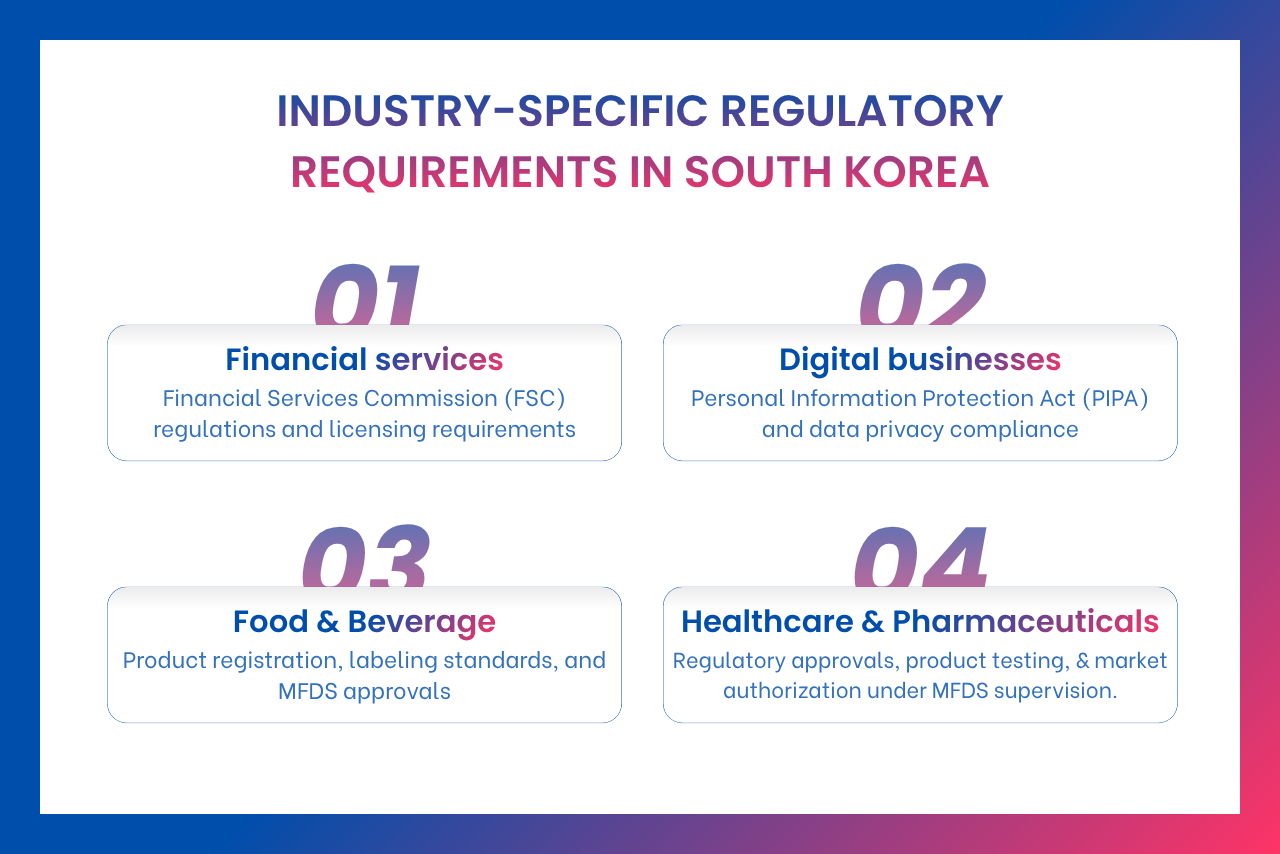
Foreign companies should understand industry-specific regulations before entering the South Korean market.
Competition from established local businesses
South Korea is a mature and highly competitive market, where many industries are dominated by established domestic companies. Large Korean corporations have built strong positions through years of investment, making it more difficult for new foreign entrants to compete directly.
Their competitive advantages often include:
- Strong brand recognition and customer loyalty.
- Well-established supplier and distribution networks.
- Integrated capabilities across manufacturing, R&D, logistics, and after-sales services.
Thus, competing on price alone is rarely effective. Foreign companies are generally more successful when they differentiate through specialized technologies, product quality, industry expertise, or unique customer value, allowing them to address market needs that are not fully served by existing local competitors.
Language and communication barriers
Although English is increasingly used in multinational companies, Korean remains the primary language for business communication, government procedures, legal documentation, and daily operations. As a result, foreign companies may encounter communication challenges when working with local authorities, suppliers, customers, and business partners.
Common areas where language differences can affect operations include:
- Contract negotiations and commercial discussions.
- Regulatory filings and official documentation.
- Supplier coordination and day-to-day communication.
In addition, Korean business communication is often more indirect than in many Western markets, making misunderstandings more likely during negotiations. Working with bilingual professionals or experienced local advisors can help improve communication, reduce operational risks, and support smoother market entry.
Which Foreign Companies Are Best Suited for South Korea?
South Korea is a highly competitive market, so not every business model will achieve the same level of success. Companies with the right capabilities, clear value propositions, and the ability to adapt to local business requirements are more likely to build long-term operations.
Several types of businesses are best suited for South Korea, including:
- Advanced manufacturing and industrial suppliers
South Korea’s industrial ecosystem creates opportunities for suppliers that can provide specialized products and technical solutions. Companies offering precision components, industrial equipment, automation technologies, or advanced materials may find potential partnerships with local manufacturers. However, success often requires meeting strict quality standards, technical specifications, and supplier expectations.
- Technology and digital solution providers
Technology companies with solutions in areas such as AI, SaaS, cybersecurity, and enterprise software may find opportunities in South Korea. To enter the market effectively, businesses need to adapt their solutions to local customer needs, language requirements, and industry-specific regulations.
- Premium consumer brands
Foreign brands with unique positioning and strong product differentiation may have opportunities in South Korea’s lifestyle market. Categories such as beauty, food & beverage, and consumer goods often require more than product quality alone. Local distribution partners, market understanding, and brand adaptation play an important role in building customer acceptance.
| For companies entering South Korea’s beauty and cosmetics market, finding the right manufacturing partner is a critical step. 👉 Explore how to find trusted cosmetic manufacturers in South Korea. |
- Businesses committed to long-term expansion
South Korea is better suited for companies with a long-term market strategy rather than short-term entry goals. Building relationships, understanding local practices, and gradually developing market presence are important steps for companies looking to establish sustainable operations.
How to Prepare Before Doing Business in South Korea
Successful market entry depends not only on identifying opportunities but also on preparing for the practical requirements of operating in South Korea. Before establishing a local presence, businesses should evaluate their legal structure, workforce plans, and local execution strategy to reduce risks during expansion.
- Choosing the right business structure and registration
Foreign companies can establish a local corporation, branch office, or liaison office, depending on their business objectives and operational scope. Each structure differs in terms of legal liability, permitted business activities, taxation, and compliance obligations. Selecting the right setup early helps avoid unnecessary restructuring as the business grows.
- Planning visa and work permit requirements
Companies employing foreign staff should review immigration requirements before launching operations. Common visa categories include investment-related visas and specialized work visas, with eligibility depending on the employee’s role and purpose of stay. Early workforce planning helps align hiring with business registration and operational timelines.
- Working with a local partner to reduce entry risks
Many foreign companies work with local partners to bridge knowledge gaps during market entry. Local expertise can support regulatory compliance, market research, partner sourcing, customer introductions, and business negotiations. Choosing the right partner also helps businesses reduce execution risks and adapt more efficiently to South Korea’s business environment.
Look Forward
South Korea offers significant opportunities for foreign companies through its advanced economy, strong industrial capabilities, skilled workforce, and regional market connections. However, long-term success depends on more than market potential. Businesses must also evaluate regulatory requirements, local competition, relationship-based practices, and operational challenges before committing resources.
At Source of Asia, we help businesses capture the advantages of the South Korean market while overcoming entry challenges through:
- Market assessment and opportunity evaluation
- Local partner identification and B2B matchmaking
- Market entry strategy and regulatory advisory
- On-the-ground operational support
For businesses evaluating when local support becomes valuable during market entry, working with experienced advisors can help reduce execution risks, accelerate decision-making, and navigate the Korean business environment with greater confidence.
If South Korea is one of your shortlisted markets, explore Source of Asia’s South Korea presence to understand how local market knowledge and on-the-ground support can help you prepare your next step.
| For companies that need local validation or partner support, Source of Asia can help assess market fit and build a practical entry roadmap. 👉 Contact us to share your project now! |
Frequently Asked Questions
Yes. South Korea is a strong market for foreign companies due to its advanced industries, skilled workforce, and regional connectivity. However, businesses should evaluate competition, regulations, and localization needs before entering.
The main challenges include relationship-driven business practices, complex sector-specific regulations, competition from established Korean companies, and communication barriers that may affect partnerships, negotiations, and daily operations.
A local partner is not mandatory, but it can help foreign companies access market knowledge, navigate regulations, build relationships, and manage operational challenges during the early stages of market entry.
Industries with strong potential include advanced manufacturing, semiconductors, AI, digital solutions, biotechnology, and premium consumer brands where foreign companies can provide specialized expertise or differentiated products.