Supply chain relocation is becoming a strategic priority for companies reassessing cost, risk, compliance, and market access across Asia. As global manufacturers move from single-country dependency toward more diversified footprints, ASEAN is increasingly being considered as a practical relocation and sourcing base.
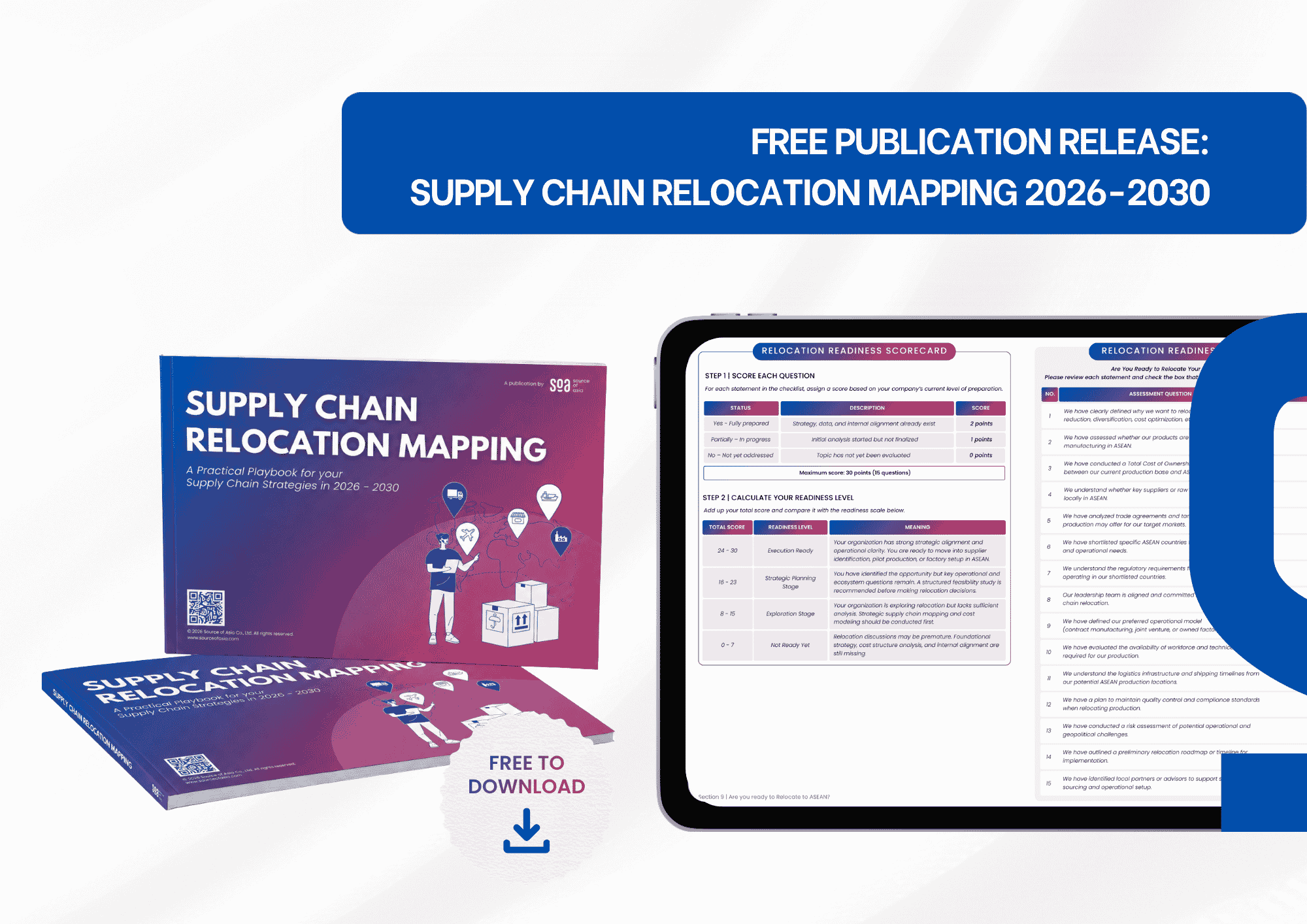
To support business leaders, sourcing teams, and operations decision-makers, Source of Asia is pleased to release its latest publication: Supply Chain Relocation Mapping: A Practical Playbook for Your Supply Chain Strategies in 2026-2030.
This free playbook provides a structured overview of the forces reshaping supply chains, ASEAN-6 industrial clusters, future compliance requirements, and the practical steps companies should consider before relocating production or supplier networks to Southeast Asia.
Download the free playbook and start assessing where ASEAN fits in your next supply chain strategy.
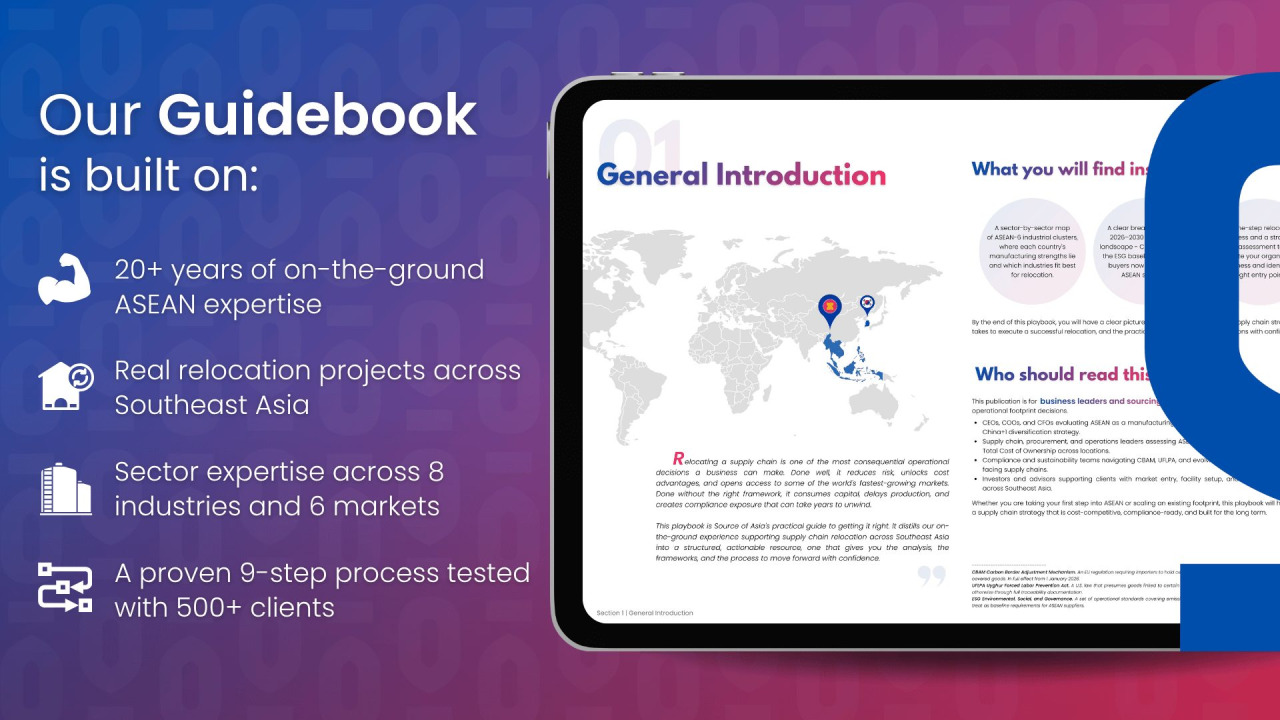
Built from SOA’s on-the-ground ASEAN experience, this guidebook helps companies approach supply chain relocation with clearer market, sector, and execution insights.
What Is Driving Supply Chain Relocation in the Future
Supply chain relocation is now driven by more than labor cost. Across 2026-2030, companies are reassessing production footprints through a wider lens: trade exposure, geopolitical risk, supplier resilience, compliance readiness, and access to regional growth markets.
For exporters serving the EU and U.S. markets, topics such as CBAM, UFLPA, traceability, ESG documentation, and supplier transparency are becoming part of everyday sourcing decisions.
At the same time, ASEAN-6 markets offer different industrial strengths. Vietnam, Thailand, Malaysia, Indonesia, the Philippines, and Singapore each play a distinct role in regional supply chains. Choosing the right location depends on the country’s popularity. It requires a clear understanding of cluster fit, supplier depth, workforce readiness, logistics, and Total Cost of Ownership.
That is why this publication was created: to help companies move from broad relocation discussions to a clearer decision-making framework.
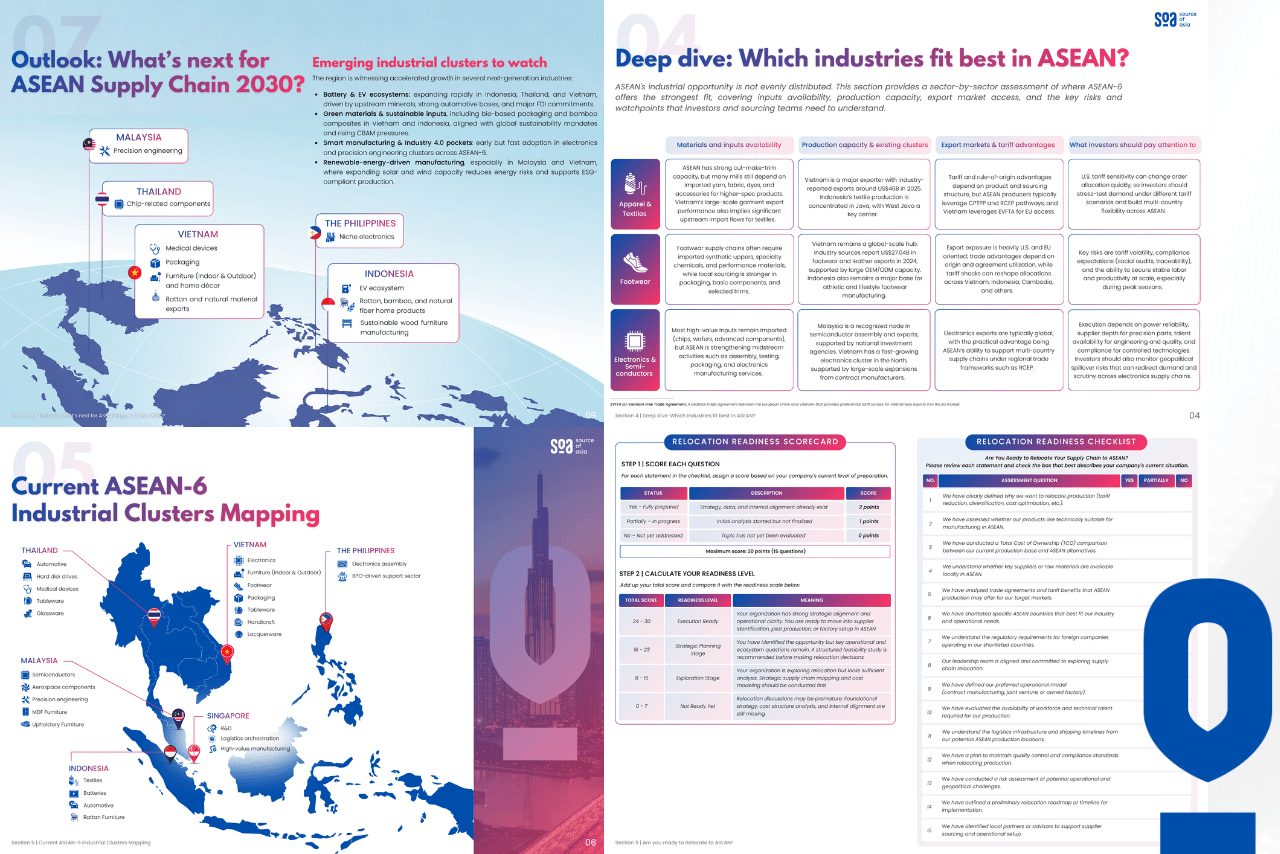
Inside the publication, readers can explore ASEAN industrial clusters, industry relocation fit, supply chain outlook, and a relocation readiness checklist.
Get the ASEAN Relocation Guide
A Quick Look Inside the Supply Chain Relocation Mapping Playbook
The playbook opens by framing supply chain relocation as a strategic business decision. It explains why companies need to evaluate risk exposure, supplier ecosystems, compliance requirements, logistics, and market access before relocating production or sourcing activities.
It then looks at the forces reshaping supply chains from 2026 to 2030, including trade pressure, geopolitical uncertainty, supply chain due diligence, and the shift toward multi-country sourcing strategies.
The next sections focus on ASEAN’s relocation potential. Readers will find an ASEAN-6 industrial clusters map covering Vietnam, Thailand, Malaysia, Indonesia, the Philippines, and Singapore, along with sector-by-sector insights for apparel, footwear, electronics, food and agriculture, medical devices, packaging, automotive and EV, furniture, and home products.
The playbook also covers ESG and future compliance requirements, including CBAM, UFLPA, FSC, EUDR, PPWR, PFAS, MRSL/RSL, ZDHC, and VOCs. These topics are becoming essential for supplier qualification, export readiness, and long-term sourcing decisions.
Finally, the publication provides a 9-step supply chain relocation process and a relocation readiness checklist. These tools help companies assess whether they are ready to move from early discussion to feasibility study, supplier validation, pilot production, or implementation.
The playbook also includes Source of Asia’s case studies showing how companies approach supplier mapping, factory assessment, sourcing diversification, and operational decision-making across ASEAN.
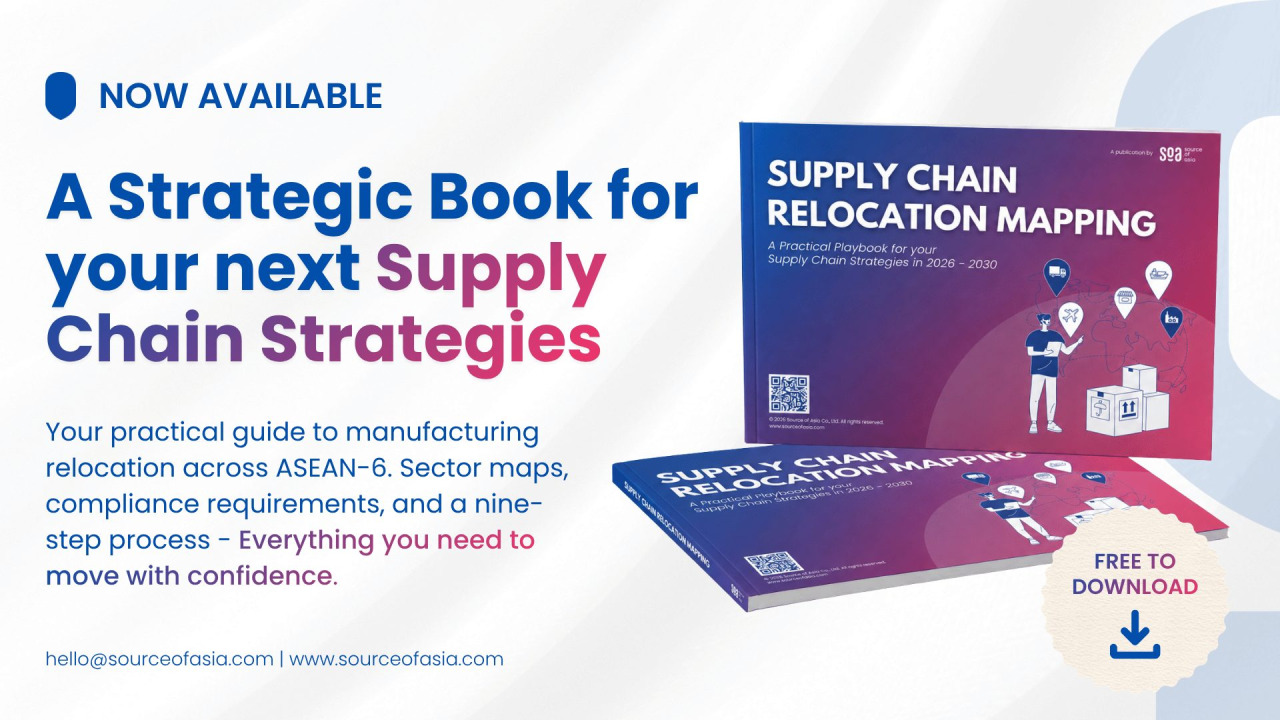
The Supply Chain Relocation Mapping playbook provides practical guidance on ASEAN-6 sector maps, compliance requirements, and relocation planning.
Access the Supply Chain Playbook
Who Should Download This Playbook?
This publication is designed for companies that need practical guidance before making supply chain relocation decisions. It is especially relevant for:
- CEOs, COOs, and CFOs evaluating ASEAN as a manufacturing or sourcing base
- Supply chain, procurement, and operations leaders reviewing supplier ecosystems
- Companies exploring China+1 or multi-country Asia strategies
- Compliance and sustainability teams preparing for ESG and traceability requirements
- Investors and advisors support clients with market entry, factory setup, or sourcing development in Southeast Asia
Whether your company is taking its first step into ASEAN or reviewing an existing footprint, this playbook can help you structure the discussion with better data, clearer criteria, and a more realistic view of execution.
Download the Free Supply Chain Relocation Mapping Playbook
Supply chain relocation can create major advantages, but only when the decision is built on the right market understanding. The wrong framework can lead to delays, hidden costs, weak supplier fit, and compliance exposure.
With Supply Chain Relocation Mapping 2026-2030, Source of Asia provides a practical starting point for companies that want to assess ASEAN opportunities with more confidence.
Download the free publication today to explore ASEAN-6 industrial clusters, relocation drivers, compliance requirements, and SOA’s step-by-step relocation process.
Get your free copy and start mapping your next supply chain move in ASEAN.