Introduction
The Vietnam consumer market continues to grow in 2026, supported by rising retail activity, expanding e-commerce platforms, and changing shopping habits. However, Vietnamese consumers are becoming more selective about where they shop, which brands they trust, and how much they are willing to pay.
For foreign brands, Vietnam offers opportunities across fast-moving consumer goods (FMCG), beauty, fashion, electronics, and other consumer products. Yet success depends on more than market growth. Companies must understand local demand, choose suitable sales channels, and build a pricing strategy that works in a competitive environment.
In this guide, Source of Asia (International Business Accelerator) examines Vietnam’s retail and e-commerce landscape in 2026, how consumer behavior is changing, and what international businesses should assess before entering or expanding in the market.
Quick Answer
What should foreign brands know about the Vietnam consumer market in 2026?
Vietnam remains an attractive consumer market, with growing retail sales and strong activity across online marketplaces. However, shoppers increasingly compare prices, check product quality, and look for trusted sellers before buying.
Five factors are shaping retail and e-commerce opportunities:
- Growing retail demand: Consumer spending continues to support market growth, although price pressure remains.
- Multiple sales channels: Traditional stores, modern retailers, and e-commerce platforms serve different customer needs.
- Value-conscious consumers: Product quality, price, and brand trust influence purchasing decisions.
- Strong marketplace competition: Shopee and TikTok Shop are major online sales channels, while Lazada and Tiki remain part of the market.
- Rising execution costs: Brands must manage distribution, marketing, platform fees, and fulfillment carefully.
For foreign companies, the most suitable approach depends on their product category, target consumers, pricing, and ability to manage local operations.
What Does the Vietnam Consumer Market Look Like in 2026?
Vietnam offers a large domestic market with established retail networks and growing digital commerce. However, total market growth does not reflect demand equally across every consumer segment or product category.
Consumer Spending and Retail Market Growth
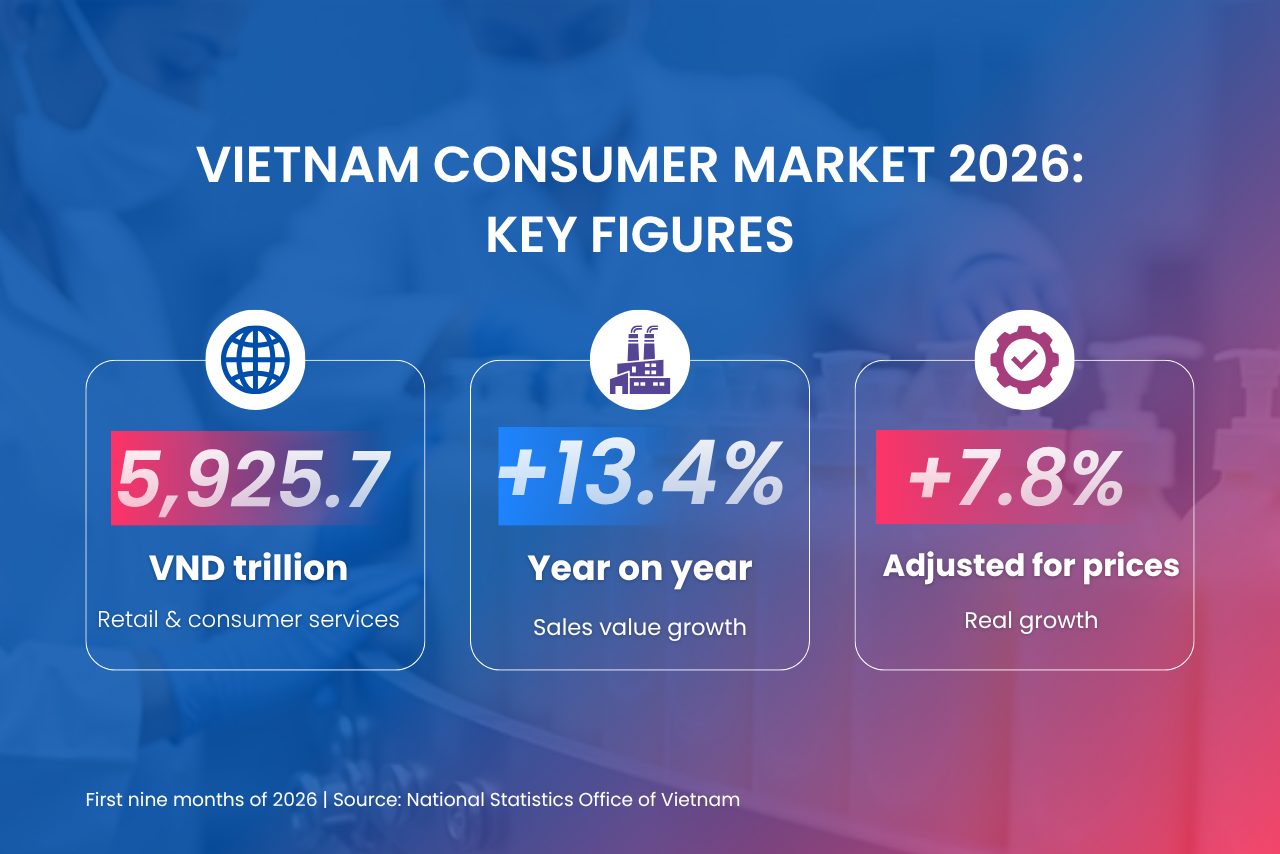
Vietnam’s retail and consumer services sales grew in the first nine months of 2026
According to Vietnam’s National Statistics Office, total retail sales of goods and consumer services reached approximately VND 5,925.7 trillion in the first nine months of 2026, an increase of 13.4% year on year.
After adjusting for price changes, growth stood at 7.8%. Therefore, while consumer activity expanded, part of the increase in sales value reflected higher prices. For foreign brands, these figures provide useful market context. However, they do not confirm demand for a specific product.
A premium skincare company, for example, must assess whether consumers in its target segment can afford its products and see enough value to choose them over established alternatives. Similarly, FMCG brands should examine purchase frequency, pack sizes, and expected retail prices before estimating sales potential.
Traditional Trade, Modern Retail, and E-commerce
Vietnam’s retail market includes traditional stores, modern retail chains, and digital channels. Traditional trade, including wet markets and neighborhood shops, remains important for daily purchases. These outlets offer convenience, familiar shopping habits, and access to consumers across different locations.
Meanwhile, supermarkets, convenience stores, specialty retailers, and shopping malls serve customers seeking organized shopping environments, product variety, and reliable quality. E-commerce adds another route to market through online marketplaces, social commerce, and brand websites.
These channels often serve different purchasing occasions. For example, consumers may buy everyday food from a nearby shop, purchase household products at a supermarket, and order beauty products through an online marketplace. As a result, foreign brands should evaluate channel suitability rather than assume that a single sales model can reach the entire market.
How Is Vietnamese Consumer Behavior Changing?
Vietnamese consumers are becoming more informed and selective. Although price remains important, purchasing decisions also reflect product quality, trust, convenience, and shopping experience.
Understanding these factors is essential for brands developing their local positioning and sales strategies.
Price Sensitivity, Product Quality, and Brand Trust
Price competition remains an important feature of the Vietnam retail market. Consumers can easily compare offers across stores and online platforms. In addition, frequent promotions have made many shoppers more aware of discounts and expected prices.
However, low prices alone do not guarantee a purchase. Research published by YouNet ECI in October 2026 found that 74% of consumers surveyed in Q3 considered product quality when shopping online, while 67% considered price.
This suggests that brands need to communicate both value and reliability. For example, an imported personal care brand may justify a higher price through clear product information, verified quality, and consistent customer service.
However, if consumers cannot understand what makes the product different, they may prefer a cheaper alternative. Therefore, foreign brands should test acceptable price ranges and identify the product benefits that matter most to local buyers.
Social Media, Product Reviews, and Online Shopping Behavior
Shoppers may first encounter a product through a short video, livestream, influencer recommendation, or social media advertisement. Before purchasing, many then check product reviews, ratings, seller information, and prices across different platforms.
This creates a shopping journey that moves between content, research, and transactions. For example, a beauty product may gain attention through a creator’s demonstration. However, the final purchase may depend on customer reviews, product authenticity, delivery options, and available promotions.
As a result, brands need consistent product information and reliable customer service across their online channels. Influencer partnerships can support awareness, but brands should evaluate whether content generates qualified traffic, conversions, and repeat purchases rather than focusing only on views.
Regional Differences in Consumer Preferences and Purchasing Power
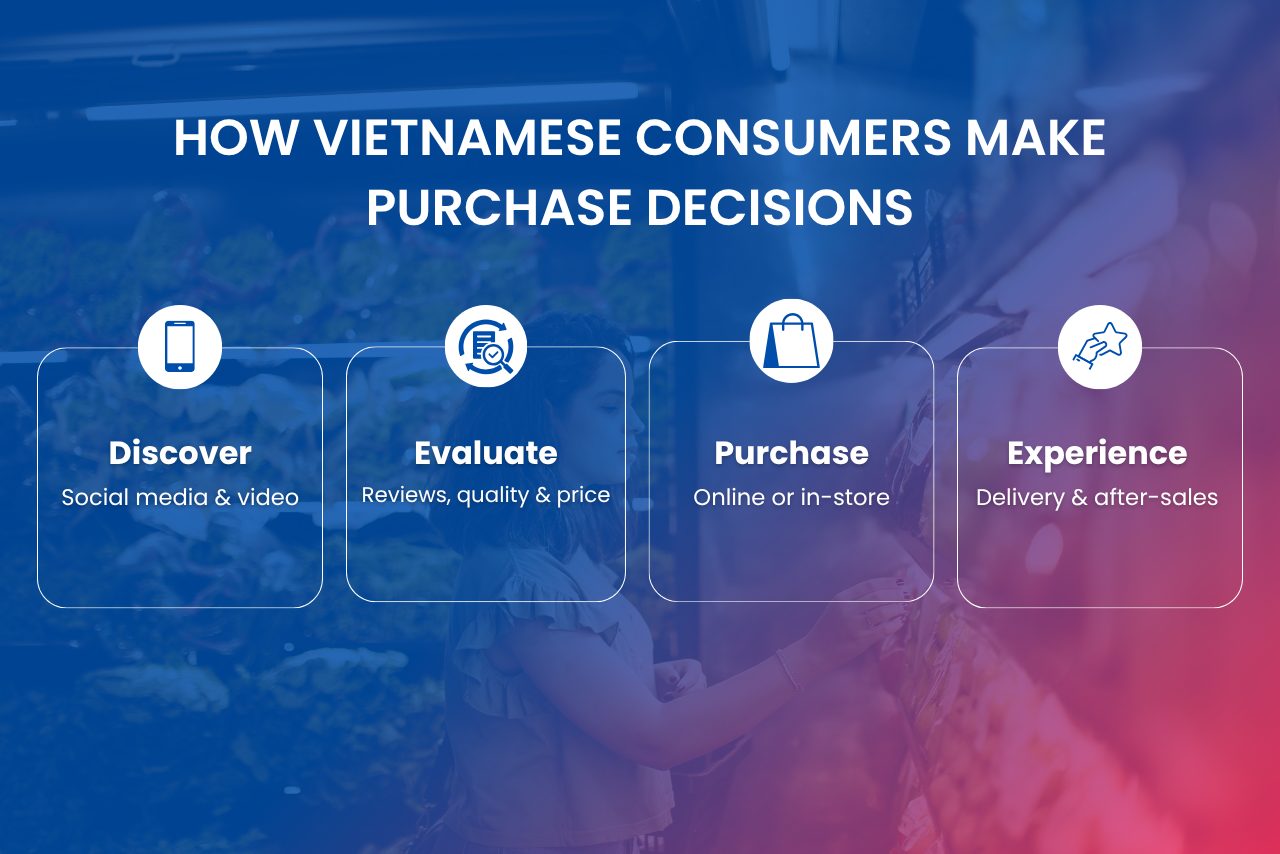
Vietnamese consumer shopping journey infographic showing product discovery, reviews, purchases, and after-sales experience.
Ho Chi Minh City and Hanoi are major consumer markets with established modern retail networks, diverse product offerings, and strong online shopping activity. However, consumers in other urban areas and smaller cities may have different spending priorities, preferred brands, and retail access.
For example, a premium lifestyle brand may find stronger initial demand in selected urban districts, while a mass-market household product may require wider regional distribution. Climate, local tastes, shopping habits, and available retail channels can also affect product selection.
Therefore, brands should avoid treating Vietnam as one uniform consumer market. Instead, they should assess specific locations, consumer groups, and price segments before choosing where to launch.
What Are the Key Trends in Vietnam’s E-commerce Market in 2026?
The Vietnam e-commerce market continues to expand, although competition between platforms and sellers is becoming more intense.
According to YouNet ECI’s Q3 2026 report, gross merchandise value (GMV) across the marketplaces it tracks reached approximately VND 411.8 trillion during the first nine months of 2026, up 22% year on year.
This figure measures sales across the platforms covered by the report. It should not be confused with total national e-commerce revenue, which may include other online channels.
For a broader regional perspective, see our guide to the e-commerce market in Southeast Asia.
Marketplace Competition: Shopee, TikTok Shop, Lazada, and Tiki
Shopee and TikTok Shop are central to Vietnam’s marketplace competition. In the first nine months of 2026, YouNet ECI estimated that Shopee accounted for 53% of tracked marketplace GMV, compared with 45% for TikTok Shop.
During the same period, Shopee’s GMV grew by 12% year on year, while TikTok Shop grew by 38%. These figures show how quickly competition between the two platforms is developing.
However, the platforms offer different shopping experiences.
| Platform | Main characteristics | Considerations for foreign brands |
| Shopee | Broad product selection, search, promotions, marketplace shopping | Product visibility, pricing, reviews, seller performance |
| TikTok Shop | Content-driven discovery, short videos, livestream commerce | Content production, creator partnerships, conversion |
| Lazada | Marketplace shopping and branded storefronts | Brand presentation, product trust, customer service |
| Tiki | Established Vietnamese e-commerce platform | Category fit, audience relevance, sales potential |
For international brands, the right platform depends on where target consumers shop and how they discover products.
A brand may benefit from several platforms. However, spreading resources too widely before confirming demand can increase costs without improving results.
Social Commerce, Livestream Shopping, and Official Brand Stores
Social commerce combines product discovery, entertainment, and online purchasing. Livestream shopping allows sellers and creators to demonstrate products, answer questions, and offer promotions during live broadcasts.
This format can be relevant for categories where product demonstrations help consumers make decisions, such as beauty, fashion, and household goods. Meanwhile, official brand stores offer a way to present verified product information and build buyer confidence.
For foreign brands, authenticity is particularly important when consumers are concerned about counterfeit products or unreliable sellers. However, managing a successful online store requires more than opening an account.
Brands need suitable product listings, customer support, inventory planning, content production, and promotional management. Therefore, marketplace performance should be measured through sales, margins, repeat purchases, and customer satisfaction, not simply follower counts or campaign traffic.
Omnichannel Retail, Digital Payments, and Delivery Expectations
Consumers increasingly move between online and offline channels before making purchases. A shopper may discover a product on social media, compare prices online, and then visit a physical store. Alternatively, they may examine a product in-store before ordering it through a marketplace.
This creates demand for omnichannel retail, where businesses coordinate product information, inventory, pricing, and customer service across channels. Digital payments also support more convenient transactions. However, brands should understand which payment methods their customers prefer and whether checkout options are reliable.
Delivery is another key part of the shopping experience. Customers may consider shipping fees, expected delivery times, product condition, and return policies when choosing between sellers.
As a result, brands need to treat logistics and after-sales service as part of their customer experience. A strong marketing campaign can attract buyers, but poor fulfillment can reduce repeat purchases and damage brand trust.
Where Are the Retail and E-commerce Opportunities for Foreign Companies?
Vietnam creates opportunities for international consumer brands across several product categories and sales channels. However, market attractiveness should be assessed at the product and customer-segment level rather than based on national growth alone.
FMCG, Beauty, and Personal Care Products
FMCG products offer opportunities through repeat purchases and established retail networks. Potential categories include packaged food, beverages, household care, and daily-use personal products.
However, these categories are competitive. Brands must understand local preferences, acceptable prices, pack sizes, and retailer requirements. Beauty and personal care products also offer opportunities for differentiation through product quality, ingredients, performance, and brand positioning.
For example, a specialized skincare brand may focus on a clearly defined consumer need rather than compete across the entire beauty market. In addition, online marketplaces and creator-led content can help consumers discover new products. SOA’s beauty market validation case study illustrates how store checks, pricing analysis, and partner feedback can help foreign brands validate product-market fit before expanding distribution in Vietnam.
However, foreign brands must review relevant product registration, labeling, import, and advertising requirements before selling.
Fashion, Lifestyle, and Consumer Electronics
Fashion and lifestyle brands can reach consumers through modern retail, online marketplaces, and social commerce. Product design, quality, brand identity, and price positioning all influence purchasing decisions. For a real-world example, our Tory Burch luxury retail market entry case study shows how consumer research and local partner selection can support the expansion of an international fashion brand in Vietnam.
For example, a lifestyle brand may test selected products online before expanding into specialty retail stores. Consumer electronics and accessories also present opportunities, particularly where brands can offer clear functionality and reliable support.
However, customers may compare technical specifications, warranty terms, and prices closely. Therefore, companies should assess after-sales capabilities and product return costs alongside sales potential. Across these categories, brands with a clear target segment and a suitable local offer are often better placed to compete than those entering with a broad, untested product range.
Modern Retail Partnerships and Cross-Border E-commerce
Foreign companies can access Vietnam through several commercial models. These include local distributors, retail chains, specialty stores, marketplace partners, and cross-border e-commerce arrangements.
For example, a consumer goods brand may work with a distributor that already supplies supermarkets and specialty retailers. Another brand may begin with a selected marketplace channel to test pricing and customer demand. SOA’s D’Aucy retail expansion case study demonstrates how distributor screening, buyer meetings, and local sales follow-up can help consumer brands develop retail presence in Vietnam.
Cross-border e-commerce can provide another route for certain products and business models. However, it does not remove the need to review import, tax, product, and e-commerce requirements. The right approach depends on product characteristics, available investment, customer access, and long-term control.
For further guidance, read SOA’s overview of Vietnam market entry options.
What Challenges Should Foreign Brands Consider in Vietnam?
Vietnam offers attractive retail opportunities, but foreign brands may face several commercial and operational challenges.
- Strong competition: Local and international brands compete for retail space, online visibility, and customer attention.
- Price pressure: Frequent discounts and promotions can reduce margins and make premium positioning harder to maintain.
- Platform costs: Marketplace fees, advertising, promotions, and fulfillment costs can affect online profitability.
- Distribution gaps: A partner may have strong coverage in one region but limited access to other markets.
- Product compliance: Import, labeling, product-specific rules, and advertising requirements can vary by category.
- Customer trust: Counterfeit products, inconsistent product information, and poor service can affect purchase decisions.
In addition, Vietnam’s Law on E-commerce took effect on July 1, 2026, alongside implementing rules covering relevant online business activities. Foreign brands and marketplace operators should therefore review how these requirements apply to their chosen model.
Rather than addressing these issues after launch, companies should include them in their initial market assessment, financial planning, and partner selection process.
How Can Foreign Companies Evaluate Opportunities in the Vietnam Consumer Market?
Entering the Vietnam consumer market requires a structured approach to customer research, channel selection, and commercial testing. The following three steps help foreign brands move from general market interest to practical decisions.
Identify Target Consumer Segments and Product-Market Fit
First, define the consumers most likely to purchase the product. Consider factors such as income, lifestyle, location, age group, purchasing habits, and product needs.
For example, a premium skincare brand may target consumers who prioritize specific ingredients and product quality. Meanwhile, a household goods brand may focus on practical benefits, affordability, and repeat purchase potential.
Next, assess competing products, common retail prices, packaging, and consumer feedback. Customer interviews, store visits, and online reviews can help reveal which product features matter most.
This research should also test whether the product needs changes to its size, packaging, instructions, or positioning. For a broader approach, see SOA’s guide to market intelligence in Vietnam.
Expected outcome: Clearly defined consumer segments, product positioning, and initial evidence of demand.
Select the Right Retail Channels and Local Distribution Partners
Once target customers are identified, companies should determine where and how those consumers prefer to shop. Compare traditional retail, modern trade, specialty stores, marketplaces, and social commerce based on customer access and costs.
For example, a premium beauty product may require specialist retailers and official online stores. In contrast, a mass-market FMCG product may depend on broader retail distribution. If a local partner is needed, assess its customer network, category knowledge, regional coverage, logistics, and sales resources.
Brands should also clarify responsibilities for marketing, inventory, customer service, and sales reporting. Importantly, having a distributor does not guarantee effective retail placement or sell-through. Our premium home linen sales representation case study illustrates how local sales follow-up and distributor development can support longer-term retail growth.
SOA’s guide to finding and qualifying a distributor in Vietnam explains how foreign businesses can assess partners before committing.
Expected outcome: A suitable route-to-market plan and a shortlist of qualified sales partners.
Test Pricing, Unit Economics, and Market Demand Before Scaling
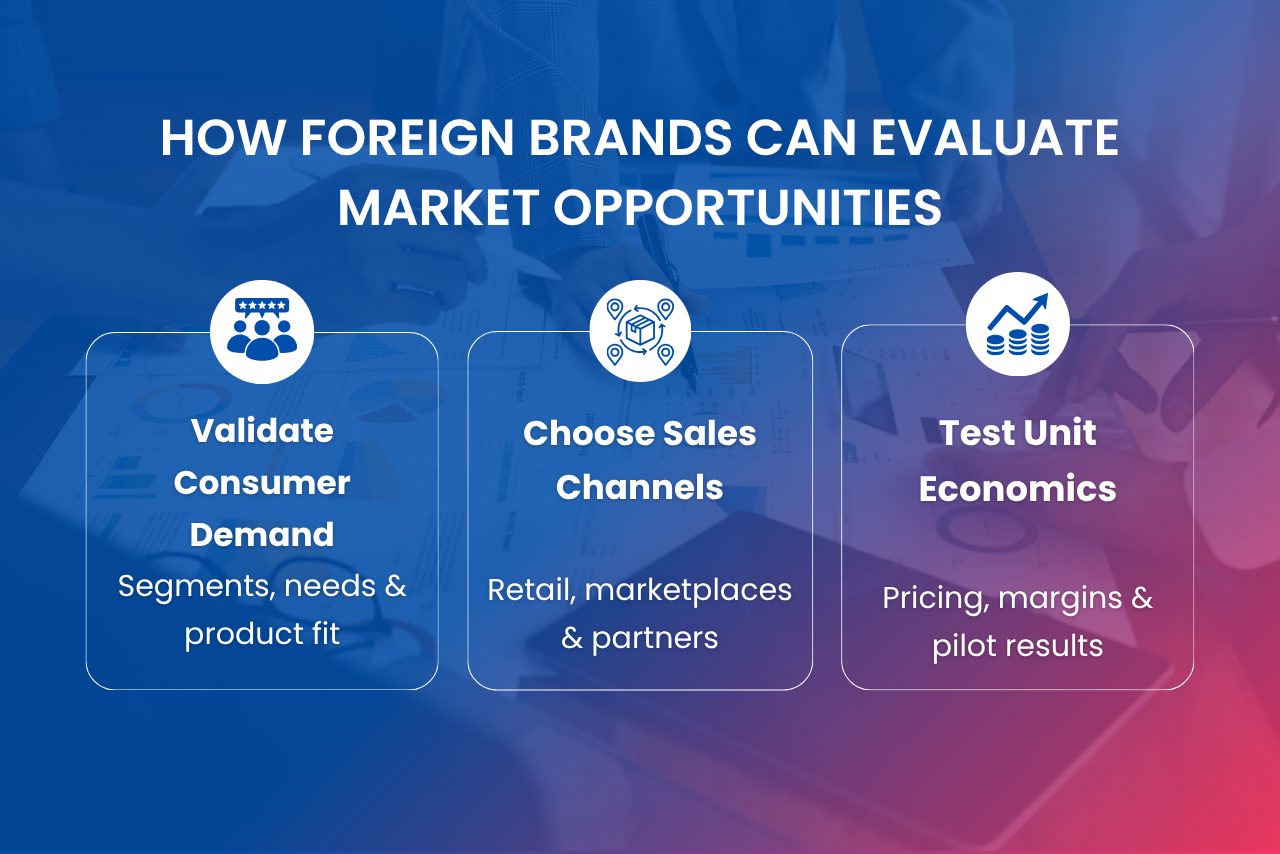
Three-step framework for entering the Vietnam consumer market, covering demand validation, channel selection, and pricing tests.
Before expanding distribution, companies should test whether their commercial model is financially sustainable. Start by calculating the expected selling price, including relevant import costs, taxes, distributor margins, platform fees, marketing, and delivery expenses.
Then, compare that price with competing products and consumer expectations. For e-commerce, important indicators include conversion rate, average order value, advertising costs, return rates, and repeat purchases.
For physical retail, brands may track sales per store, stock turnover, retailer margins, and reorder frequency. A limited launch can help test these assumptions before larger investments.
For example, a brand may begin with a small product range and selected channels to understand which products sell consistently. If results are promising, it can expand gradually while monitoring profitability and customer feedback.
Expected outcome: Evidence of product demand, workable pricing, and a clearer basis for expanding sales.
How Source of Asia Supports Consumer Brands Entering Vietnam
Source of Asia supports international companies assessing and developing business opportunities in Vietnam.
For consumer brands, this includes market research, retail channel assessment, partner development, and local commercial support.
Consumer Market Research and Retail Channel Assessment
SOA helps companies assess market demand, competitor positioning, customer segments, pricing, and potential sales channels. For consumer products, this can include understanding retail networks, comparing competing brands, and identifying suitable routes to market.
The goal is to help businesses focus their resources on relevant customer groups and realistic commercial opportunities. Rather than relying only on broad market reports, SOA connects market findings with practical recommendations for local business development.
Distributor Search, E-commerce Partner Development, and Local Support
SOA supports foreign brands in identifying distributors, retailers, e-commerce partners, and other relevant business contacts. Depending on client needs, this may include partner screening, introductions, commercial follow-up, and local coordination. For example, SOA supported European cosmeceutical company Actessens in assessing the Vietnamese market and developing its partner network.
The project included outreach to 30 e-commerce enablers, engagement with 45 qualified B2B prospects, and development of a two-year market expansion roadmap. The Actessens case study illustrates how targeted research and partner development can support a specialized consumer brand entering Vietnam.
Final Considerations
The Vietnam consumer market in 2026 offers opportunities across physical retail, e-commerce, and consumer product categories. However, market growth alone is not enough to support an investment decision.
Foreign brands need to understand local shopping habits, build a suitable price and product offer, and choose sales channels that match their target customers. They should also test demand, review operating costs, and assess local partners before expanding.
Source of Asia helps international businesses turn market insights into practical market-entry and commercial development plans. Considering retail or e-commerce expansion in Vietnam? Contact our team to discuss your target market, sales channels, and next steps.
Frequently Asked Questions
What Are the Most Popular E-commerce Platforms in Vietnam?
Shopee and TikTok Shop are major e-commerce platforms in Vietnam, while Lazada and Tiki also serve online shoppers. The most suitable platform depends on the brand’s target consumers, product category, pricing, and sales strategy.
How Do Vietnamese Consumers Shop Online and Offline?
Vietnamese consumers use traditional stores, supermarkets, specialty retailers, and online platforms. They may discover products through social media, compare prices and reviews online, and purchase through either physical or digital channels. Shopping preferences vary by product category, location, and consumer needs.
Which Consumer Product Categories Offer Opportunities in Vietnam?
Potential opportunities include FMCG, beauty and personal care, fashion, lifestyle products, and consumer electronics. However, each category has different competitive conditions, consumer expectations, and operating requirements. Brands should assess product-market fit and profitability before committing to expansion.