Introduction
Vietnam attracts international companies seeking new customers, manufacturing opportunities, and a stronger presence in Southeast Asia. However, a successful Vietnam market entry requires a clear understanding of local demand, a suitable business model, and careful planning for daily operations.
Foreign businesses may face unfamiliar buying habits, strong local competitors, or challenges in finding distributors. In addition, shipping costs and local market conditions can affect their pricing and sales plans.
This Source of Asia (SOA) guide explains what companies should assess before entering Vietnam, which entry options are available, and how to turn initial research into a practical commercial plan.
Quick Answer
What should foreign businesses understand before entering Vietnam?
Companies should first confirm demand for their products or services, assess competitors and pricing, and identify the customers and regions worth targeting.
A practical Vietnam market entry strategy follows five stages:
- Define business objectives: Set clear goals and identify priority markets.
- Validate market demand: Research customer needs, competitors, and pricing.
- Choose an entry model and partners: Select a suitable business structure and local partners.
- Prepare local operations: Review relevant requirements and assign responsibilities.
- Launch and measure results: Track performance and adjust the strategy as needed.
Ultimately, the right approach depends on the company’s industry, budget, business activities, and need for local control.
Why Vietnam Is an Attractive Market for Foreign Businesses
Vietnam offers opportunities across domestic consumption, manufacturing, and regional supply chains. According to the National Statistics Office of Vietnam, GDP grew by 8.02% in 2025, while manufacturing value added increased by 9.97%. Disbursed foreign direct investment (FDI) also reached approximately US$27.62 billion.
With a population of more than 100 million, Vietnam offers a large domestic consumer market. Meanwhile, its established industrial clusters create demand for equipment, components, technical services, and logistics.
Trade agreements, including the EVFTA, CPTPP, and RCEP, also support international trade. Companies can review the relevant terms through the Vietnam Free Trade Agreement Portal.
However, strong national growth does not guarantee success for every business. Before entering Vietnam, companies need to confirm whether target customers need their products, accept their prices, and can be served profitably.
What Should Foreign Businesses Assess Before Entering Vietnam?
Before entering the market, companies should assess where demand exists, how customers make buying decisions, and whether their proposed sales channels are suitable.
This research should also highlight information gaps. Companies can then use customer interviews, partner meetings, and further research to make better decisions before committing significant resources.
Market Demand, Target Customers, and Competition
Start by defining the target customer group. For example, a machinery supplier should identify factories with relevant equipment, investment plans, and buying needs instead of contacting manufacturers at random.
Next, examine competing products, prices, technical needs, and after-sales support. Customer interviews can also help confirm whether the proposed product solves a real problem.
In B2B markets, both product users and purchasing decision-makers matter. Since these groups may have different needs, companies should understand each one’s role in the buying process.
For a more detailed research framework, see SOA’s guide to market intelligence in Vietnam.
Regional Differences and Business Opportunities
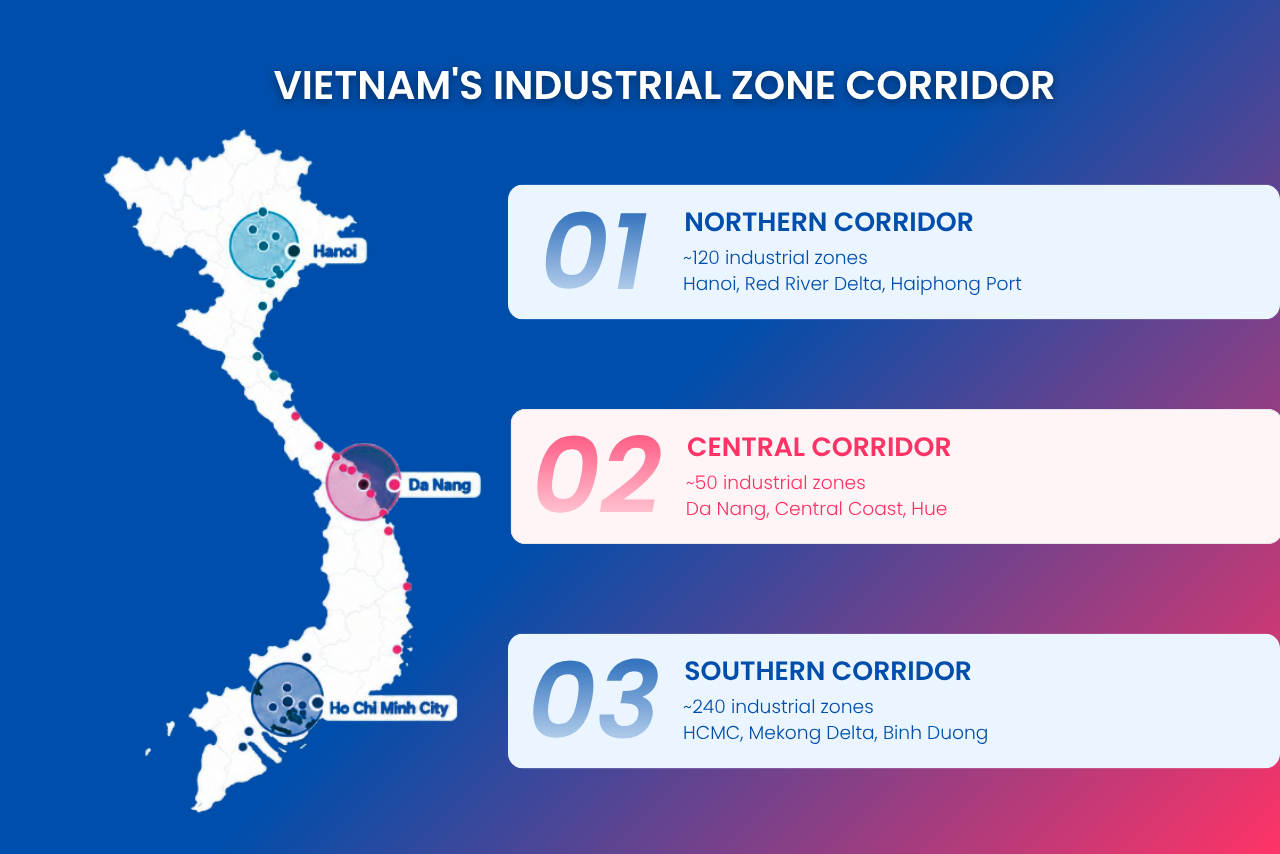
Vietnam’s three industrial zone corridors offer different business opportunities
Business activity varies across Vietnam. In the North, Hanoi, Hai Phong, and Bac Ninh have important electronics and manufacturing clusters.
Meanwhile, Central Vietnam offers opportunities in industrial production, logistics, and services. Ho Chi Minh City and nearby Southern industrial areas are major centers for commerce, distribution, and manufacturing.
Therefore, location decisions should reflect where customers are based and what the business needs to operate.
For example, manufacturers choosing a production site should assess supplier access, transport links, utilities, and available facilities.
Our article on how manufacturers choose industrial park locations in Vietnam explains these factors in more detail.
Pricing, Distribution Channels, and Commercial Feasibility
A competitive international price may become less attractive after freight, applicable taxes, distributor margins, localization, and customer support are included. Companies should calculate the expected selling price and margin for each proposed channel.
They should also compare distributors, sales agents, direct sales, retail, and digital channels where relevant. The key questions are who reaches the intended buyer, who manages the relationship, and whether the arrangement supports a sustainable business.
An attractive distributor margin is of limited value if the distributor cannot offer adequate product demonstrations, technical support, or follow-up.
What Are the Main Options for Market Entry in Vietnam?
Foreign businesses can test demand through commercial partners or establish a more permanent presence. Each option carries different costs, responsibilities, and levels of control.
Exporting Through Local Distributors or Sales Agents
A distributor can provide access to established customer networks and may handle local sales, warehousing, or delivery. A sales agent typically helps identify customers and develop transactions under an agreed arrangement. Both can support initial market testing without immediately establishing a local company.
Partner selection matters. Review industry experience, customer coverage, sales resources, technical knowledge, and financial reliability. For specialized B2B products, companies should also clarify who will provide training, handle technical questions, and support customers after delivery.
Agree on responsibilities, performance expectations, and the terms of any exclusivity. For a deeper assessment framework, read SOA’s guide to finding and qualifying a distributor in Vietnam.
Establishing a Representative Office
A representative office can support permitted liaison activities, market research, and coordination with local contacts. It may suit a foreign company seeking a formal presence while studying the market or supporting relationships with partners.
However, a representative office cannot independently generate commercial revenue in Vietnam. Businesses intending to conduct direct local sales should assess whether a different structure is required for those activities.
Setting Up a Wholly Foreign-Owned Company or Joint Venture
A wholly foreign-owned enterprise (WFOE) may suit a business seeking long-term control over local operations, employees, and customer relationships, where foreign investment conditions permit. Establishing a company also brings ongoing administrative and operational responsibilities.
A joint venture (JV) involves investment alongside a local partner. It can offer access to complementary market knowledge, relationships, or operational resources. Partner due diligence, governance, decision-making rights, and strategic alignment are essential.
The right choice depends on the activity, ownership conditions, investment plans, and desired control. Neither option removes the need to test market demand or build relationships with relevant customers.
Entering Vietnam Through Mergers & Acquisitions (M&A)
Acquiring or investing in an existing Vietnamese business can provide access to its customers, employees, distribution channels, or operating assets. This route may suit companies seeking an established local platform.
An acquisition requires careful commercial, financial, and operational due diligence. Buyers should examine liabilities, contracts, business performance, and the practical challenges of integration, alongside any applicable investment conditions.
The value of an established customer base also depends on whether those customers and key employees remain after the transaction.
Building an Initial Local Team Through Sales Representation or EOR Support
Some businesses need people on the ground before deciding on a permanent office. Local sales representation can support prospecting, meetings, partner discussions, and follow-up. Suitable Employer of Record (EOR) or wage-hosting arrangements may help with employment administration, depending on their legal structure and scope.
These are operational support arrangements, not equivalent to establishing a business entity or obtaining authorization to conduct commercial activities. Companies should verify the permitted activities and responsibilities involved.
SOA’s phased market entry case study using EOR and IOR support illustrates how local support can develop alongside business needs
Comparing Vietnam Market Entry Options
| Entry option | Potential fit | Main consideration |
| Distributor or sales agent | Testing sales and reaching local customers | Partner capability and control |
| Representative office | Research and liaison activities | No independent revenue generation |
| Wholly foreign-owned company | Longer-term local operations | Setup and ongoing administration |
| Joint venture | Shared investment and local capabilities | Governance and partner alignment |
| M&A | Entry through an existing business | Due diligence and integration |
| Sales representation or EOR support | Phased local staffing and development | Scope and legal limitations |
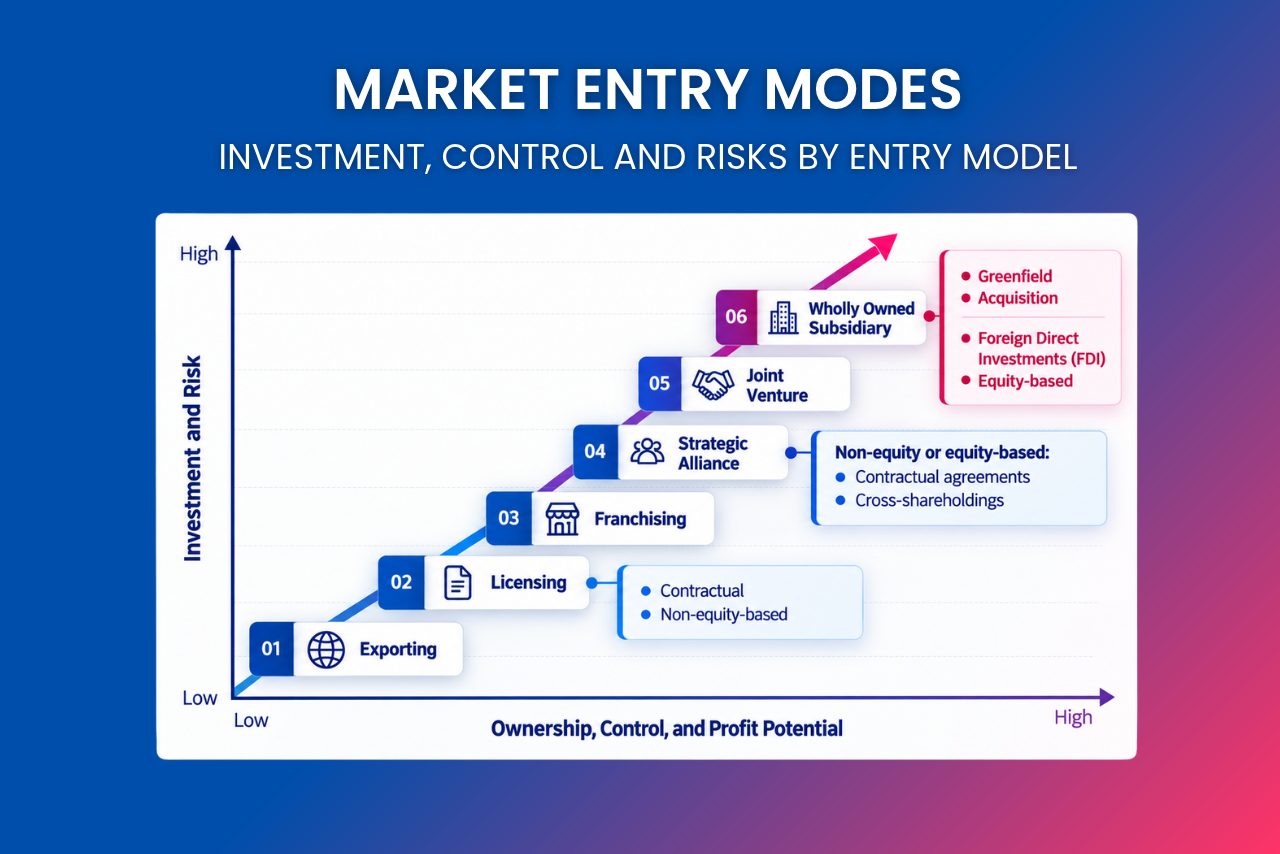
Vietnam market entry options involve different levels of investment, risk, ownership, and control
What Legal and Operational Requirements Should Foreign Companies Understand?
Legal and operational requirements for entering Vietnam vary by industry, business activities, and chosen entry model. Working through a local distributor, opening a representative office, or establishing a local company involves different responsibilities and levels of preparation.
Before entering the market, foreign businesses should consider several key areas:
- Business and investment requirements: Understand the conditions, registrations, or licenses that may apply to the intended activities.
- Taxation and trade procedures: Review relevant tax obligations, import requirements, and customs procedures, particularly for companies selling physical products.
- Employment and staffing: Consider local hiring arrangements, employment responsibilities, and administrative support needs.
- Operational readiness: Plan how to manage accounting, logistics, customer service, supplier coordination, and daily business activities.
These considerations also affect the overall cost of market entry. For example, a company working through a distributor may rely on its partner for local logistics, while a business establishing its own operations will need to manage more functions directly.
Companies should therefore account for both initial setup expenses and ongoing operating costs. As requirements can vary and change over time, seeking guidance from qualified local professionals can help businesses prepare appropriately and avoid unnecessary delays.
How to Build a Vietnam Market Entry Strategy Step by Step
An effective market entry strategy for Vietnam connects research to decisions, implementation, and performance review.
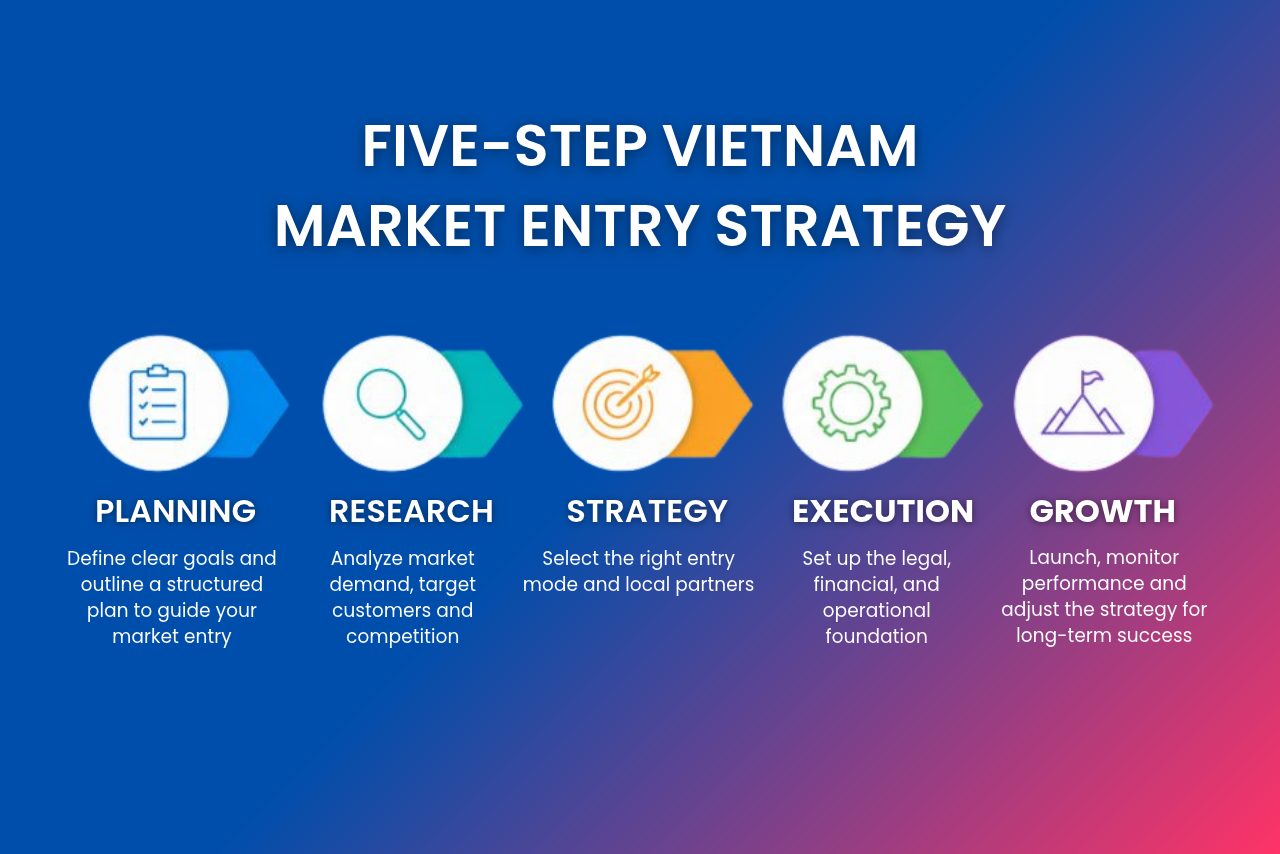
A five-step Vietnam market entry strategy helps foreign businesses assess opportunities, choose suitable entry models, prepare operations, and plan for long-term growth
Step 1: Define Market Entry Objectives and Business Priorities
Identify what Vietnam should contribute to the business: new sales, distribution, manufacturing, sourcing, or regional operations. Specify the target products, customer segments, available budget, and desired level of local control.
A foreign equipment supplier seeking its first customers may prioritize distributor development; a manufacturer building a facility will need a different plan.
Expected outcome: A focused brief defining objectives, priorities, resources, and the measures of success.
Step 2: Validate Market Demand and Identify Target Customers
Build an ideal customer profile, identify relevant companies, assess competitors, and test the offer through interviews or introductory meetings. Research purchasing processes, technical requirements, pricing expectations, and competing products.
For example, an automation supplier should establish which manufacturers have a suitable production need and who controls purchasing decisions. This is more useful than a broad directory of factories.
SOA’s article on market intelligence vs. market research explains how these approaches support different decisions.
Expected outcome: Prioritized customer segments, initial market feedback, and a realistic view of commercial potential.
Step 3: Select the Right Entry Model and Local Partners
Compare entry options based on intended activities, investment, control, and ability to serve customers. A distributor may suit a product test, while a local company may better support established operations.
Consider how easily the model can change as sales develop: an initial sales partner may be appropriate for testing, but the company may later require its own customer-facing team.
If partners are necessary, assess their relevant customers, staff, financial position, and capacity to deliver. Define who is responsible for sales, follow-up, support, and reporting before committing.
Expected outcome: A justified entry model and a shortlist of suitable partners where needed.
Step 4: Prepare the Legal, Financial, and Operational Plan
Translate the strategy into a practical implementation plan. Identify which local requirements need professional review, estimate initial and recurring costs, and assign ownership for staffing, logistics, customer service, reporting, and administration.
A service provider may prioritize commercial recruitment and customer management; a manufacturer may need supplier and site preparation.
Keep milestones, budgets, and operational dependencies visible so decisions are made before delays become expensive. Identify which tasks depend on partners or professional advisers, and build review points into the plan rather than assuming every activity will progress at the same speed.
Expected outcome: A budget, responsibilities, implementation milestones, and a plan for managing key risks
Step 5: Launch, Monitor Performance, and Adjust the Strategy
Start with measurable activity and review what the market reveals. B2B indicators can include qualified prospects, meetings held, active opportunities, proposal conversion, and distributor performance. For an operational project, supplier readiness and delivery performance may be more relevant.
If customer interest is high but orders remain limited, investigate pricing, technical fit, purchasing timelines, and after-sales expectations before expanding investment.
Sales meetings alone are not a reliable measure of traction; decision-makers should distinguish early activity from qualified opportunities and actual purchasing commitments.
Expected outcome: Evidence to maintain, refine, expand, or reconsider the initial strategy.
Common Mistakes Foreign Companies Should Avoid When Entering Vietnam
- Relying on broad growth figures. Strong national indicators cannot confirm demand for a specific product. Validate needs with reachable target customers.
- Choosing an entry structure prematurely. Establishing a company before testing a commercial model may create avoidable costs. Match the structure to intended activities and realistic demand.
- Selecting partners mainly for their connections. Industry knowledge, resources, customer fit, and follow-through matter more than the size of a contact list.
- Underestimating total costs. Evaluate freight, margins, staffing, support, and recurring expenses before committing to prices or budgets.
- Treating Vietnam as one uniform market. Regional industries, customers, and infrastructure differ. Prioritize locations based on business needs.
- Losing momentum after initial meetings. Assign ownership of follow-up, maintain a pipeline, and review progress consistently.
How Source of Asia Supports Foreign Businesses Entering Vietnam
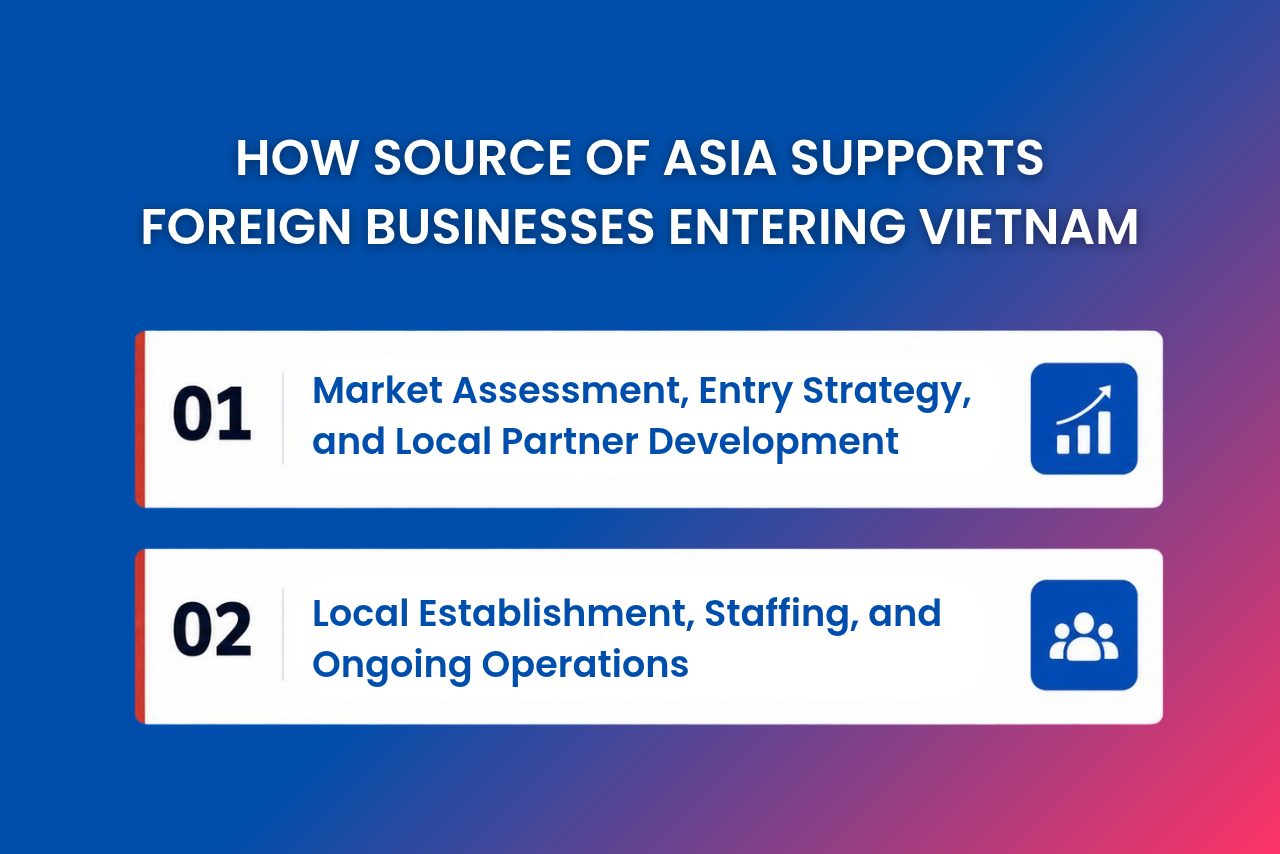
Source of Asia supports foreign businesses entering Vietnam through market research, partner development, local staffing, and ongoing operational support
Source of Asia’s Market Expansion services help international businesses connect early market assessment with local commercial development and operational preparation.
Market Assessment, Entry Strategy, and Local Partner Development
SOA supports market diagnosis, customer segmentation, competitor analysis, business matchmaking, distributor qualification, and local sales development. The objective is to help companies focus resources on relevant opportunities and commercial relationships.
This can include moving from a broad industry landscape to a workable shortlist of target accounts and commercial partners, with agreed follow-up actions.
In a project for European cosmeceutical company Actessens, SOA’s research and partner-development work identified 30 e-commerce enablers and 45 qualified B2B leads, alongside a two-year expansion roadmap. The example shows how market research can be translated into practical target lists and next steps.
Local Establishment, Staffing, and Ongoing Operations
As activities develop, SOA can support recruitment, employment administration, payroll, local establishment, and selected operational functions according to client needs.
For a footwear materials company expanding in Vietnam, SOA provided phased EOR and IOR support, recruitment, and operational coordination. This allowed the business to develop its local team while evaluating its longer-term operating requirements.
Final Considerations
A well-planned Vietnam market entry starts with validated customer demand and a clear business objective. Companies then need to choose a workable commercial model, prepare appropriate local resources, and measure performance before scaling.
Source of Asia supports this process through market assessment, partner development, local sales activities, and operational services.
Planning to enter Vietnam? Speak with our team about the next steps for your business.
Frequently Asked Questions
Can a Foreign Company Enter Vietnam Without Establishing a Local Entity?
Yes. Depending on the activities involved, foreign businesses may work with distributors, sales agents, or other business partners without immediately establishing a local company.
However, relevant import, product, tax, and business rules still apply. Some activities may also require a formal local presence.
Can Foreign Investors Own 100% of a Company in Vietnam?
Foreign investors may own 100% of companies in many sectors, subject to the conditions that apply to each business activity.
However, some industries have ownership limits or additional rules. Therefore, companies should review the proposed ownership structure with qualified local professionals before investing.
How Much Does It Cost to Enter the Vietnam Market?
There is no single figure. Costs depend on the entry model, industry, team size, facilities, and intended activities. A realistic budget includes market assessment, partner development, setup where applicable, staffing, logistics, and ongoing operations. Local quotations are needed for reliable estimates.
How Long Does Market Entry in Vietnam Typically Take?
The timeline varies by business model. Research and partner development may take weeks or months, while establishing operations can involve additional preparation and approvals. The time required to become operational should be assessed separately from the time needed to generate sustainable sales.
What Is the Best Market Entry Strategy for Foreign SMEs?
Many SMEs can benefit from testing demand through focused research, customer meetings, and suitable local partners before increasing investment. Others may need a formal presence earlier because of their intended activities. The best approach reflects industry requirements, commercial potential, resources, and long-term objectives.