Introduction
Sooner or later, many companies in Southeast Asia face a strategic question: Should we keep a local entity, sell it, scale it back, or close it? The answer may follow a new regional strategy, a shift in investment priorities, or weak performance in a particular market. Whatever the reason, business exit strategies go beyond simply ending operations. Unresolved tax matters, employee obligations, contracts, assets, and regulatory filings can delay the process and create liabilities even after operations have stopped.
A clear exit strategy helps companies compare available options, understand the implications of each route, and plan the transition in the right order. In this article, Source of Asia covers 10 common exit routes, their pros and cons, and the key considerations.
Quick Recap
The table below summarizes the 10 business exit strategies, with a quick view of the best fit and the main trade-off for each option.
| Strategy | Best for | Main trade-off |
|---|---|---|
| Sale to a strategic buyer | Entities with value to a related company | Fewer buyers and longer process |
| Sale to a private equity firm | Profitable entities with growth potential | Investor demands after sale |
| Sale to an individual buyer | Smaller, simpler entities | Limited funds and higher deal risk |
| Management buyout | Entities with a strong local team | Financing can be difficult |
| Employee buyout or ESOP | Businesses with a loyal workforce | Complex setup and limited support |
| Family business succession | Family-owned businesses | Family conflict and skill gaps |
| Merger with another company | Companies seeking scale or shared resources | Loss of control and culture clashes |
| Partial sale or recapitalization | Owners seeking cash without a full exit | Shared decisions with a new investor |
| Initial public offering | Large, mature companies | High cost and strict rules |
| Liquidation or orderly wind-down | Entities with no buyer or no future | Little or no return on value |
What Is a Business Exit Strategy in ASEAN
Before you compare options, it helps to agree on what a business exit strategy actually covers. It also helps to know why the ASEAN context changes the plan.
Understanding a business exit strategy in ASEAN
A business exit strategy is a planned approach to transfer ownership, reduce operations, or close a business when a company changes or ends its presence in a market. Depending on the situation, the process may involve a share transfer, asset sale, merger, restructuring, or formal closure.
In ASEAN, the right exit route can vary by country because corporate, tax, employment, foreign investment, and regulatory rules are not standardized across the region. Therefore, companies should assess local requirements first. For example, a foreign-owned entity may need specific approvals, tax reviews, and employee arrangements before a transfer or closure can proceed.
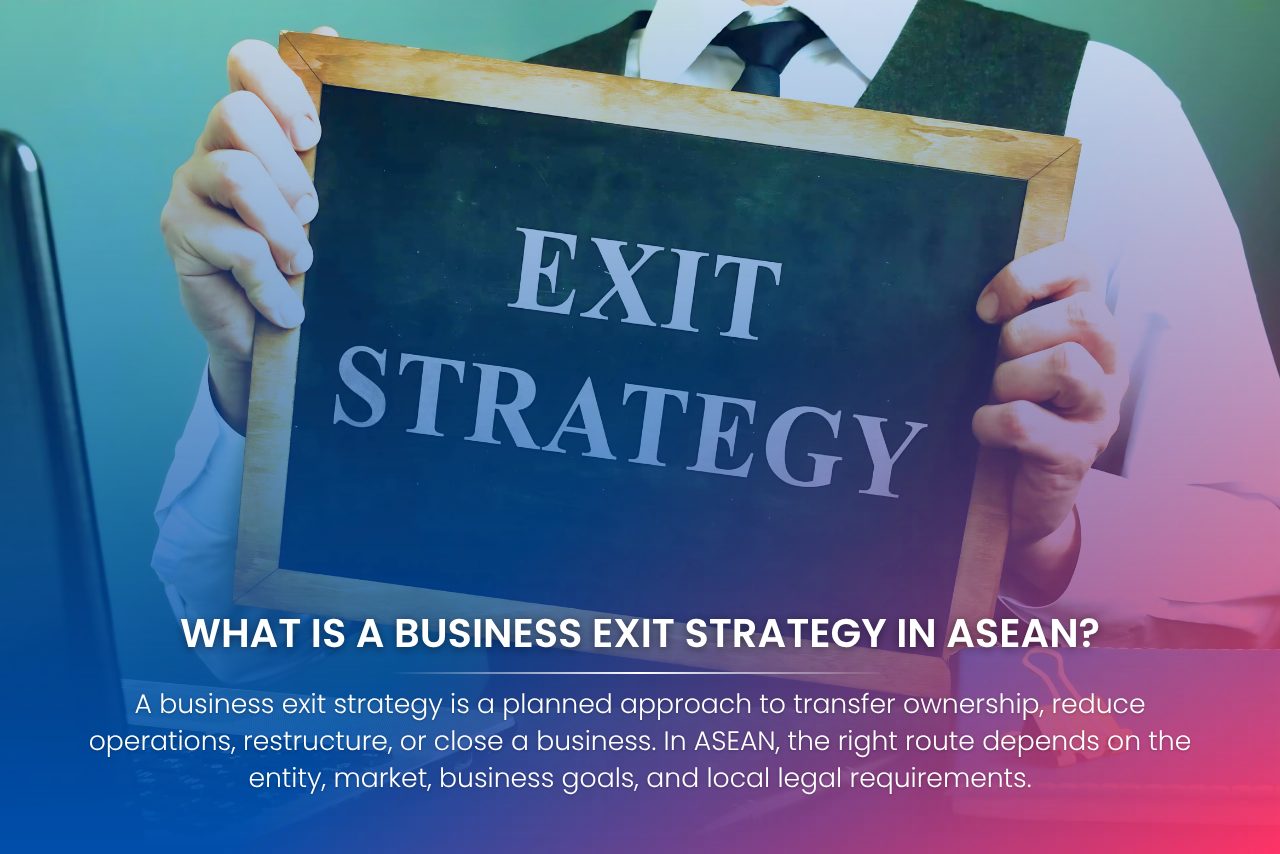
A business exit can involve ownership transfer, reduced operations, restructuring, or formal closure.
Why companies choose to exit or close an ASEAN entity
Companies may exit an ASEAN entity for strategic, financial, or operational reasons. In fact, the decision does not always reflect business failure.
Common reasons include:
- Regional strategy or investment priorities may change.
- Persistent losses or high operating costs may weaken the case for staying.
- Mergers, acquisitions, or consolidation may make an entity redundant.
- Companies may leave one country while remaining active elsewhere.
In some cases, a full exit is not necessary. Instead, companies may choose different business exit strategies, such as reducing operations, moving production, or retaining selected sales and distribution activities.
When companies should start planning a business exit
The best time to plan is before financial or operational pressure makes the decision urgent. Early preparation gives companies more time to compare business exit strategies, resolve issues, and organize key records. In practice, a planned sale may take 12–18 months or more when valuation, due diligence, and negotiations are involved.
For an ASEAN entity, timing also depends on the country, entity structure, outstanding obligations, and required approvals. Tax, employee, ownership, or asset-related issues can add further steps. Therefore, starting early gives companies more flexibility and reduces the risk of last-minute delays.
Top 10 Common Business Exit Strategies
Each option comes with different pros, cons, and key considerations. Therefore, compare the business exit strategies based on your business goals, entity structure, local requirements, and exit timeline. Use these points to identify the routes that best fit your situation.
Sale to a strategic buyer
A strategic buyer is usually a company in the same or a related industry, such as a competitor, supplier, customer, or regional player. Because the buyer may value market access, customers, or local operations, this route can suit an established entity.
Pros:
- Potentially higher value due to strategic synergies.
- The buyer may understand the market and business model.
- Operations, employees, and contracts may continue with less disruption.
Cons:
- The buyer pool is often limited.
- Competitor involvement creates confidentiality risks.
- The deal may slow if priorities change.
Key considerations:
- Share sensitive information gradually during due diligence.
- Check change-of-control clauses and local approval requirements.
- Review whether a share or asset sale fits the exit plan.
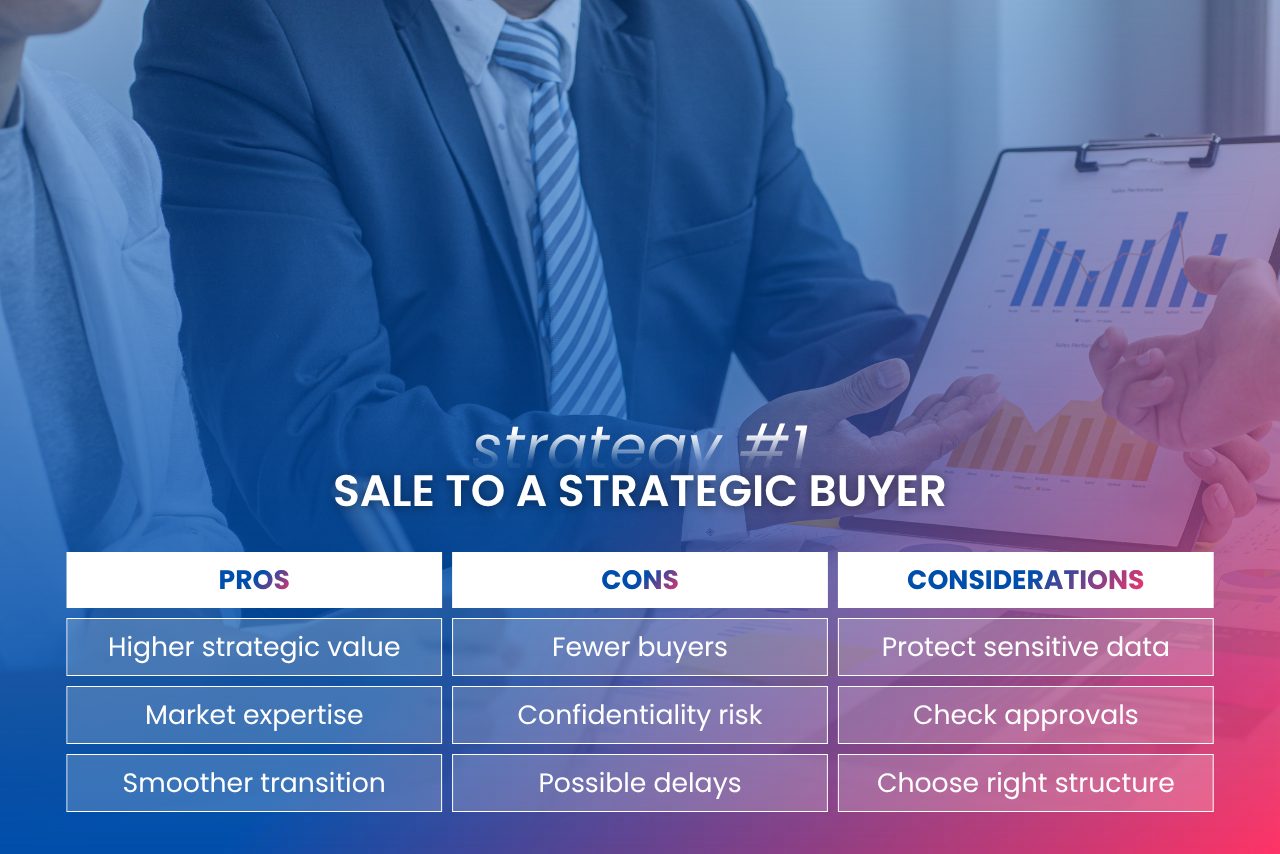
A strategic buyer may acquire an ASEAN business for customers, market access, or capabilities.
Sale to a private equity firm
Private equity firms invest in businesses they believe can grow and create value over time. This can suit profitable entities with solid records and clear growth potential, especially when the owner wants liquidity but may remain involved.
Pros:
- Access to capital and experienced management support.
- Potential for a strong valuation when performance is consistent.
- Owners may retain a minority stake after the deal.
Cons:
- Investors usually require strong reporting and governance.
- Due diligence can be detailed and time-consuming.
- Smaller or loss-making entities may receive limited interest.
Key considerations:
Prepare reliable financial records, review the investor’s expected level of control, and confirm whether local ownership rules or licenses affect the transaction.
Sale to an individual buyer
An individual buyer may be an entrepreneur, local investor, industry professional, or former business partner. This route often suits smaller entities with straightforward operations, especially when the buyer already understands the market.
Pros:
- Negotiations can be more direct and faster with fewer decision-makers involved.
- A simpler deal may allow a more flexible handover.
Cons:
- Limited funding may lead to staged payments.
- Financing problems can delay or stop the deal.
- Ownership rules or licenses may restrict the buyer.
Key considerations:
- Check the buyer’s funding and ability to run the business.
- Define payment, default, and handover terms clearly.
- Confirm the buyer can legally acquire and operate the entity.
Management buyout (MBO)
An MBO allows the existing management team to take ownership of the business. Since they already understand the customers, suppliers, employees, and daily operations, the transition may involve less disruption than an external sale.
Pros:
- Operational knowledge stays within the business.
- Customers and employees may have greater continuity.
Cons:
- Management teams may lack the funds needed to complete the purchase.
- The seller may need to provide financing or remain involved temporarily.
- The deal may achieve a lower value than a broader buyer search.
Key considerations:
- Use an independent valuation to support a fair purchase price.
- Agree early on funding, decision rights, and how shared services or technology will work after the transfer.
Employee buyout or ESOP
An employee buyout or Employee Stock Ownership Plan (ESOP) transfers part or all of a business to its workforce. This route can support continuity when employees have strong knowledge of the company and a long-term interest in its future.
Pros:
- Existing employees can preserve local knowledge and company culture.
- Ownership may be transferred gradually.
Cons:
- Employees may lack the funds for a large purchase.
- Legal and tax treatment can vary across ASEAN markets.
Key considerations:
- Check whether the structure is practical in the target country.
- Define how shares, voting rights, funding, and employee departures will work.
- Make sure employees understand the financial risks and responsibilities of ownership.
Family business succession
Family succession transfers ownership, and often management, to the next generation. It is common in family-owned businesses and can be planned over several years rather than as a single transaction.
Pros:
- Keeps ownership and company values within the family.
- A gradual handover gives the successor time to build skills and relationships.
- Existing customers and partners may value continuity.
Cons:
- The successor may lack the skills or interest to lead the business.
- Family disagreements can affect both ownership and operations.
- The current owner may receive limited cash.
Key considerations:
- Define ownership, management roles, voting rights, and responsibilities clearly.
- Put the succession plan in writing and review relevant tax and share transfer rules.
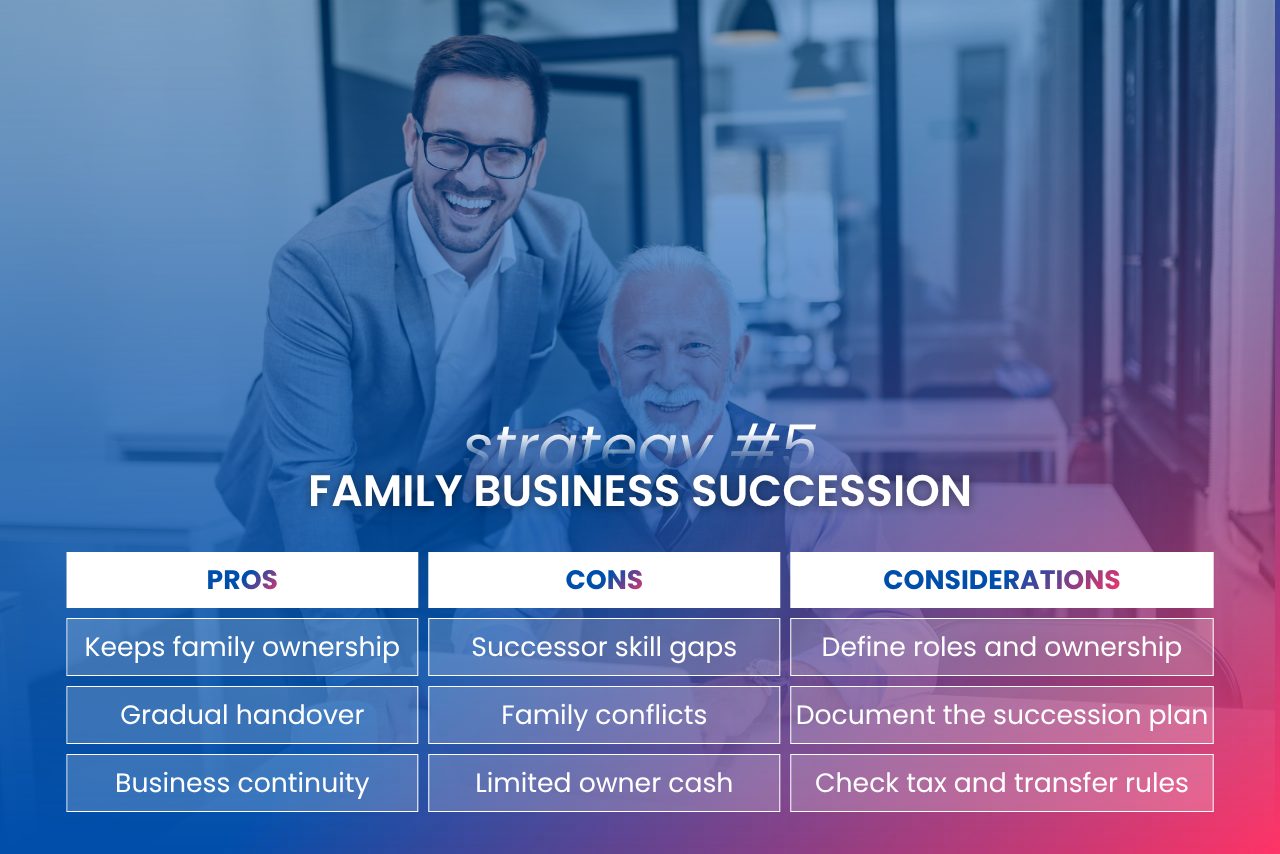
Family succession can preserve ownership, values, and business continuity across generations.
Merger with another company
A merger combines two businesses into one structure. For an ASEAN group, it can consolidate entities, share resources, and simplify regional operations while allowing the current owner to retain a stake.
Pros:
- Gain scale, customers, capabilities, or shared costs.
- Reduce duplicated administration and operating functions.
- Continue participating in the combined business.
Cons:
- Control and decision-making may be shared or reduced.
- Different systems, cultures, and management styles can slow integration.
- The final value may depend on the merged company’s future performance.
Key considerations:
- Review contracts, employees, assets, licenses, taxes, and intercompany balances.
- Agree on leadership, ownership, branding, and staff arrangements before closing.
- Plan employee and stakeholder communication early to reduce uncertainty.
Partial sale or recapitalization
A partial sale or recapitalization lets an owner release capital while keeping a stake in the business. It can suit companies that want to reduce their exposure without leaving the market completely.
Pros:
- Provides liquidity while keeping a share of future growth.
- Brings in new capital, expertise, or a strategic partner.
- Offers a gradual alternative to a full exit.
Cons:
- Decision-making becomes shared with the new investor.
- Different priorities may create disputes later.
- A second transaction may be needed for a full exit.
Key considerations:
- Agree on voting, exit, and future share-sale rights.
- Check foreign ownership limits and other local requirements.
- Define how the remaining shares can be transferred later.
Initial public offering (IPO)
An initial public offering (IPO) allows a company to list shares on a stock exchange and raise capital from public investors. It generally suits large, mature businesses with strong governance and reporting systems. For most ASEAN subsidiaries, an IPO is unlikely to be a standalone exit route.
Pros:
- Access to public capital and potential shareholder liquidity.
- Greater visibility with customers, partners, and investors.
Cons:
- The process is costly, lengthy, and highly regulated.
- Ongoing reporting and disclosure requirements increase.
- Market conditions can affect timing and valuation.
Key considerations:
Review the exchange’s listing rules, audit requirements, and disclosure standards. Also, assess whether the local entity has enough scale to support a listing or whether consolidation would be more suitable.
Liquidation or orderly wind-down
Liquidation or an orderly wind-down is used when a company decides to stop operations rather than transfer the business to a new owner. It involves settling obligations, disposing of assets, completing tax steps, and closing the entity.
Pros:
- Provides an end point when no buyer is available.
- Lets companies manage staff, customers, and assets in a planned way.
Cons:
- The business may have little or no recoverable value.
- Unresolved obligations can delay closure.
Key considerations:
Map tax, employee, lease, and contract obligations first. Then follow the required filing sequence. In Singapore, eligible debt-free companies may apply for striking off. Across ASEAN, the process varies by country and entity structure.
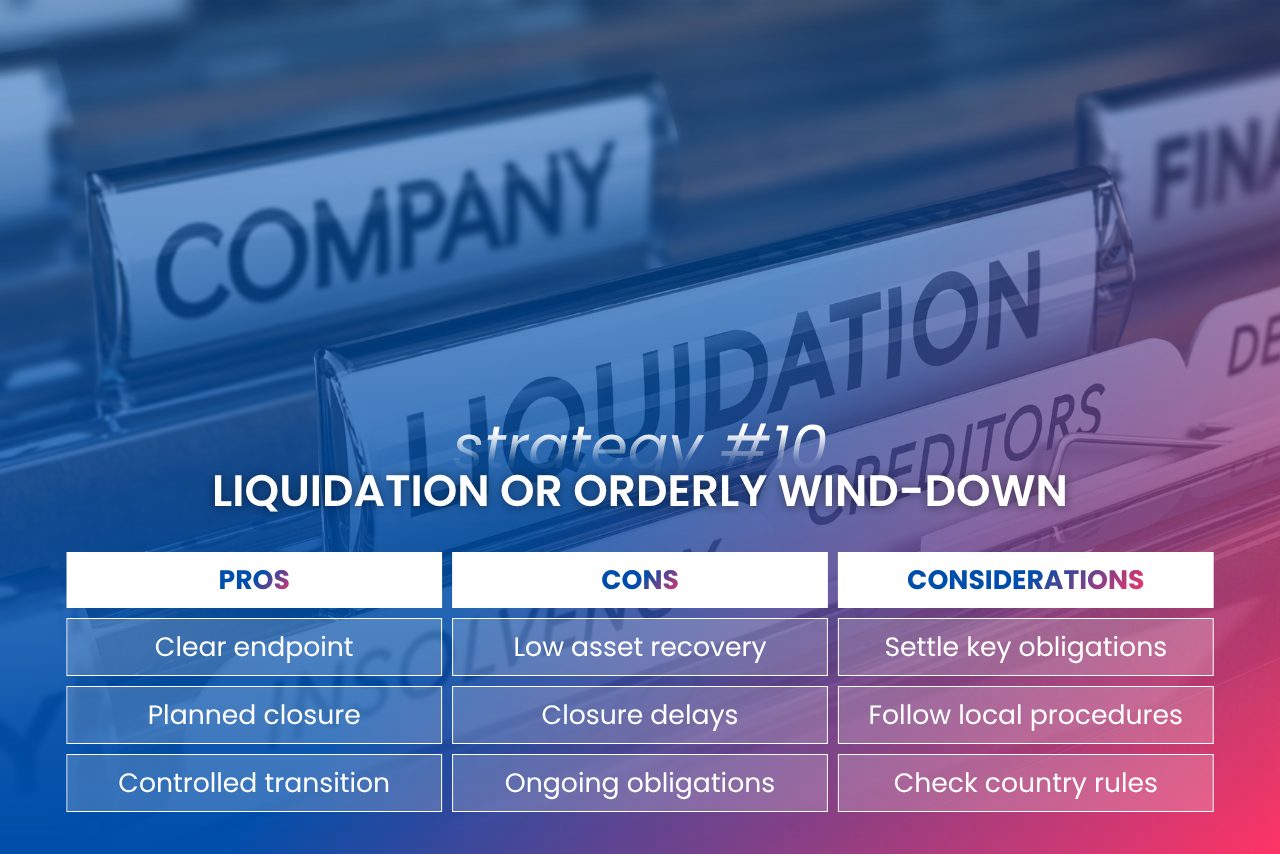
An orderly wind-down allows companies to settle obligations, dispose of assets, and close an ASEAN entity.
What Should Companies Prepare for a Business Exit?
Good preparation can affect the timeline, transaction value, and risk of different business exit strategies. Before selling, restructuring, or closing an ASEAN entity, companies should build a clear picture of the business and resolve issues that could create delays later.
- Review the entity’s legal and financial status
Start by checking where the entity stands today. Buyers, regulators, and internal teams will need accurate records, so identify gaps before they become a closing issue.
Key items to review include:
- Ownership and corporate registration records
- Financial statements, tax filings, and bank accounts
- Licenses, leases, assets, and pending disputes
- Intercompany balances and other outstanding commitments
This review also helps companies understand what can be transferred, what must be settled, and what may affect their choice of business exit strategies.
- Resolve contracts, employees, taxes, and liabilities
Next, unresolved obligations can quickly slow an exit. Review customer and supplier contracts, leases, loans, and employee agreements. Then confirm that taxes and other liabilities are properly addressed. Employee notices, severance, and social contributions should also follow local requirements.
- Prepare corporate and regulatory documents
In addition, keep shareholder decisions, corporate records, tax documents, licenses, financial files, and transaction papers complete and up to date. Missing or outdated documents can delay approvals and due diligence.
- Plan the exit timeline and communication
Finally, build a realistic timeline with clear responsibilities from preparation through post-closing. Then coordinate communication with employees, customers, suppliers, partners, regulators, and regional headquarters. Clear timing and consistent messaging can reduce disruption and keep the transition under control.
How Source of Asia Can Support Your Business Exit Strategy
An ASEAN exit can create practical issues around the sale, local operations, employees, or the next location for the business. We at Source of Asia help companies address these challenges with local execution and regional coordination.
- Finding a suitable buyer: Identify potential buyers, prepare buyer materials, coordinate meetings, support due diligence, and assist with negotiations and deal execution.
- Managing local administration: Support company registration and licensing, payroll, accounting, and ongoing corporate administration, helping keep local requirements organized during a transition.
- Handling workforce changes: Recruitment, staffing, payroll, EOR, wage hosting, and HR audit support when an exit involves employee transfers or workforce changes.
- Moving operations to another market: When companies relocate production or sourcing after an exit, we help assess supplier ecosystems, production locations, logistics, and operational requirements across ASEAN.
| 👉 See how Source of Asia supported a strategic acquisition in Southeast Asia and a successful divestiture in Vietnam. |
Final Considerations
Business exit strategies help companies decide whether to sell, restructure, consolidate, or close an ASEAN entity. The right route depends on the entity’s value, ownership structure, outstanding obligations, local requirements, and long-term regional plans. Early preparation also gives companies more time to address financial, contractual, employee, and regulatory issues.
At Source of Asia, we support companies beyond the transaction itself, from assessing whether to sell or close an operation to coordinating M&A execution, corporate administration, and workforce requirements. Our M&A Services and Corporate & HR Solutions help companies manage both deal-related and local operational needs during an ASEAN transition.
| 👉 Planning an exit or reviewing options for an ASEAN entity? Speak with Source of Asia to discuss the appropriate route and local support needed. |