Introduction
Vietnam has a large workforce and growing professional skills, making it a practical place for foreign companies to build a local team in Vietnam. These conditions can help businesses develop local capabilities, understand customer needs, and manage operations closer to the market.
Still, building a local team requires clear roles, a suitable employment model, effective communication, and an understanding of local HR practices. Without these elements, companies may face delayed decisions, overlapping responsibilities, and employee turnover.
This guide explains how to build a local team in Vietnam, from identifying talent and selecting an employment model to managing performance and meeting employment requirements. It also covers issues foreign companies should address before and after hiring.
Quick Recap
The process of building a local team in Vietnam can be summarized in four key steps:
- Define the team structure and hiring priorities
- Choose the right employment model for the team
- Find, assess, and hire local talent
- Onboard new hires and establish clear responsibilities
Building a local team is not only about hiring the right people. You also need the right employment structure, a clear management approach, and a basic understanding of local HR practices. Your first hires will also shape how partners and customers see your company, so it pays to get them right.
If you are still deciding how to set up and structure a local team, read our guide to build a local team in ASEAN for a broader regional view.
 Add Source of Asia as a preferred source on Google
Why Vietnam Is an Attractive Talent Market for Foreign Companies
Vietnam offers a broad talent pool, competitive labor costs, and established business hubs. Understanding these factors helps foreign companies make informed hiring decisions based on their business needs and target location.
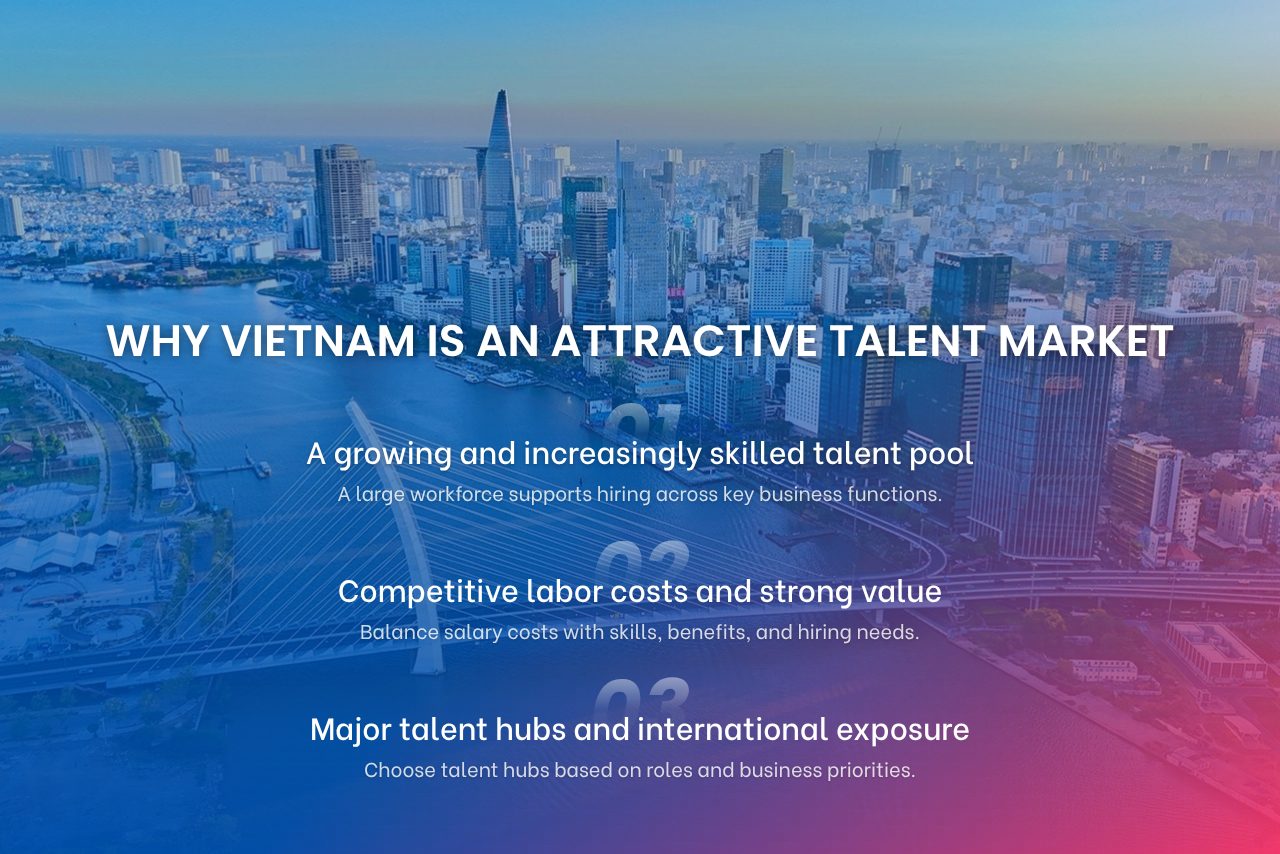
Vietnam offers talent across business functions, with hiring opportunities shaped by local skills, labor costs, and regional talent hubs.
A growing and increasingly skilled talent pool
Vietnam offers a broad talent pool for foreign companies looking to hire across sales, operations, finance, engineering, and business support. In Q1 2026, the labor force reached 53.6 million people, with 29.6% holding a degree or professional certificate. However, the availability of qualified candidates varies by role and location, so companies need to consider their specific hiring needs.
At the same time, digital skills are becoming increasingly relevant in the workplace. According to PwC’s Global Workforce Hopes and Fears Survey 2025, 38% of surveyed employees in Vietnam used generative AI daily, compared with 14% globally. While this points to growing use of digital tools, companies should still assess candidates’ actual skills and experience before deciding where to recruit.
Competitive labor costs and strong value
Vietnam offers competitive labor costs, but salaries vary by role, industry, and location. In the first nine months of 2026, average income was about VND 9.1 million, compared with VND 10.7 million in urban areas and VND 8 million in rural areas. These figures provide context, not benchmarks for professional positions.
When setting a hiring budget, companies should compare pay for similar roles and include statutory insurance, recruitment, onboarding, and benefits. A lower offer may reduce initial costs but make it harder to attract candidates. Comparing total employment costs with role requirements and local market rates helps companies budget realistically.
Major talent hubs and international exposure
Ho Chi Minh City and Hanoi are major employment hubs, offering talent across sales, finance, technology, and business services. Da Nang is another option for technology and service-oriented roles. However, salary levels, hiring competition, and candidate availability vary by location.
For manufacturing or supplier operations, areas such as Bac Ninh and Dong Nai may suit roles linked to production and supply chains. Meanwhile, companies hiring commercial or regional management teams may benefit from the wider talent networks in major cities. The best hiring location depends on the roles required and how the team supports business operations.
How to Build a Local Team in Vietnam Step-By-Step
Building a local team in Vietnam starts with clear hiring priorities and the right employment model. These four steps help foreign companies recruit suitable talent, define responsibilities, and prepare the team to support local operations.
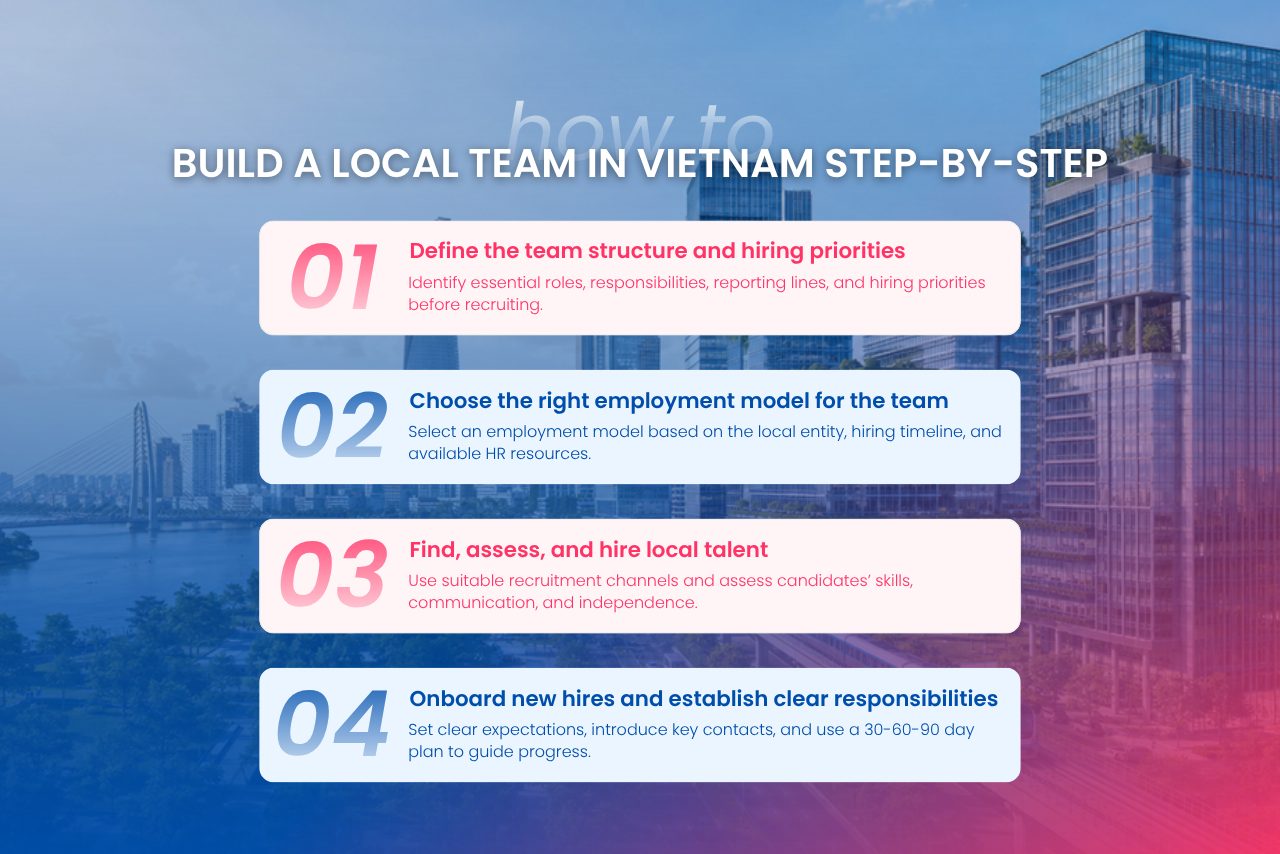
Building a local team involves defining roles, choosing an employment model, recruiting suitable candidates, and setting clear onboarding expectations.
Step 1: Define the team structure and hiring priorities
Before recruiting, identify the roles your Vietnam operation needs and define each employee’s responsibilities, reporting lines, and decision-making authority. For example, a company building a local supplier network may need sourcing and quality control staff before hiring a larger administrative team.
To avoid duplicated work and delays caused by unclear approval processes:
- Define role ownership so each task has a clear responsible person
- Set reporting lines to clarify who manages each employee
- Separate local and HQ responsibilities to prevent overlapping work
- Prioritize essential hires and expand the team as business needs grow
Step 2: Choose the right employment model for the team
Choose an employment model based on your legal presence in Vietnam, hiring timeline, and HR capacity. Common options include:
- Direct employment: For companies with a local entity managing contracts, payroll, insurance, and compliance.
- EOR or wage hosting: Supports hiring and administration, but requires checking the provider’s legal structure and responsibilities.
- Recruitment and HR support: Helps source candidates or manage selected HR tasks while the company remains the employer.
Before signing, confirm who handles contracts, salary payments, and statutory contributions. Also, avoid classifying a worker as a freelancer if the arrangement functions like employment; Vietnamese law considers the actual working relationship, not only the contract title.
Step 3: Find, assess, and hire local talent
Use several recruitment channels, including local job boards, professional networks, referrals, and recruitment agencies. For specialist or senior roles, a sector-specific recruiter can help reach suitable candidates.
A clear job description should outline responsibilities, required skills, reporting lines, and language needs. During selection, assess candidates against consistent criteria:
- Practical skills: Use a role-based task or case study.
- Communication: Check the language skills required for the role.
- Ownership: Ask how candidates solve problems and work independently.
For HQ-facing roles, also test written updates and remote collaboration. This helps identify candidates who can manage the work effectively, not simply perform well in interviews.
Step 4: Onboard new hires and establish clear responsibilities
Effective onboarding helps new employees understand their roles and start contributing sooner. Explain the team structure, reporting lines, decision-making authority, and performance expectations from day one. For cross-border roles, introduce key headquarters contacts early to reduce confusion over communication and approvals.
A 30-60-90 day plan gives managers and new hires clear milestones:
- First 30 days: Learn company processes, meet key stakeholders, and understand the role.
- Days 31–60: Take ownership of routine tasks and follow agreed procedures.
- Days 61–90: Work more independently, deliver agreed targets, and identify improvements.
How to Manage a Local Team in Vietnam Effectively
Managing a local team requires clear responsibilities, consistent communication, and measurable goals. Foreign companies should align local operations with headquarters’ priorities while giving employees enough authority to make day-to-day decisions.
- Appoint a trusted local leader
Without clear local leadership, routine decisions may depend too heavily on headquarters. Appoint a manager who can coordinate daily work, guide employees, and address local operational issues. Define which decisions they can make independently and which require HQ approval.
- Improve communication between headquarters and Vietnam
Remote teams can lose time when instructions are unclear or approvals are delayed. Set regular team meetings and one-to-one check-ins, and document key decisions, deadlines, and responsibilities. For sensitive issues, provide private channels where employees can raise concerns and give feedback.
- Set clear goals and track team performance
Translate business objectives into role-specific KPIs or OKRs with clear owners and deadlines. For example, sales teams can track qualified leads and revenue, while operations teams focus on delivery time and process accuracy. Review results regularly and check whether missed targets stem from individual performance, limited resources, or slow approvals.
- Develop local talent and retain key employees
High turnover can disrupt operations and increase recruitment costs. Support retention through training, career development, recognition, and competitive pay. PwC’s 2025 Vietnam workforce survey found that 51% of surveyed employees expected to request a salary increase in 2026. Regular salary reviews and clear progression paths can help companies respond to employee expectations and retain experienced staff.
What Foreign Companies Should Consider When Hiring in Vietnam
Hiring in Vietnam requires a clear understanding of local talent expectations, employment regulations, and HR costs. These factors help foreign companies set realistic hiring budgets, avoid compliance risks, and manage employees effectively from recruitment onward.

Foreign companies should consider local hiring practices, employment contracts, insurance contributions, compensation, and workplace expectations when recruiting in Vietnam.
Local hiring practices and talent expectations
Candidates in Vietnam often compare salary, benefits, career growth, and work-life balance when assessing job offers. Foreign companies without an established local presence may also need to build trust by explaining the business, team structure, and role clearly. To make recruitment more effective:
- Benchmark salaries locally by role, seniority, and city instead of relying on national averages.
- Set clear job expectations by outlining responsibilities, reporting lines, required skills, and career opportunities.
- Explain the full offer including salary, benefits, working arrangements, and development opportunities.
- Keep recruitment moving by agreeing on interview stages and approval timelines. Delays can cause qualified candidates to accept other offers.
Labor contracts, probation, and employee rights
Employment contracts in Vietnam must comply with local labor laws and clearly state salary, job duties, working conditions, benefits, and other required terms. Foreign companies should also understand probation limits and termination rules.
| Employment Item | Key Rule |
|---|---|
| Probation, director-level roles | Up to 180 days |
| Probation, degree or technical roles | Up to 60 days |
| Probation, vocational or skilled staff | Up to 30 days |
| Probation, other jobs | Up to 6 working days |
| Notice, indefinite contract | 45 days |
| Notice, 12 to 36 month contract | 30 days |
| Notice, under 12 months | 3 working days |
These are general rules, and exceptions may apply. Reviewing contract templates and termination procedures with a local HR or legal advisor can help companies reduce compliance risks.
Insurance, working hours, leave, and compensation
When budgeting for a local team, foreign companies should account for statutory insurance, working hours, overtime, annual leave, and public holidays. From January 1, 2026, monthly minimum wages range from VND 3.7 million to VND 5.31 million, depending on the region. The standard mandatory insurance contribution rates are:
| Contribution | Employer | Employee |
|---|---|---|
| Social insurance | 17.5% | 8% |
| Health insurance | 3% | 1.5% |
| Unemployment insurance | 1% | 1% |
| Total mandatory insurance | 21.5% | 10.5% |
Employer contributions are additional employment costs, while employee contributions are deducted from salary. Include these costs in hiring budgets to estimate total employment expenses accurately.
Hierarchy, feedback, and workplace culture
When managing a team in Vietnam, foreign companies should account for local communication practices, reporting structures, and holiday schedules. The following steps can help:
- Respect reporting lines: Clarify who employees report to and which decisions require manager or headquarters approval.
- Give sensitive feedback privately: Discuss performance gaps one-to-one and agree on specific improvements rather than criticizing employees in group meetings.
- Create channels for employee input: Use regular one-to-one meetings to encourage employees to raise concerns, especially when they may hesitate to challenge a manager openly.
Clear expectations and culturally aware communication help teams work effectively without relying on stereotypes about Vietnamese employees.
Final Thoughts
Building a local team in Vietnam requires more than recruiting qualified employees. Foreign companies need to define hiring priorities, choose a suitable employment model, onboard employees effectively, and establish clear management practices. Understanding local employment regulations, compensation, and workplace expectations also helps control costs and reduce operational risks.
At Source of Asia, we support foreign companies in building and managing local teams in Vietnam through our Corporate Services & HR Solutions, including:
- Recruitment and coaching
- EOR and wage hosting
- Payroll management
- Personal income tax and social insurance administration
- Other HR and employment support
| 👉 Planning to build a local team in Vietnam? Speak with Source of Asia to discuss the right hiring and HR support model for your business. |
Frequently Asked Questions
Start by identifying the roles needed to support local operations, then assess talent availability, salary expectations, and reporting structures. Choose a suitable employment model and establish clear hiring, onboarding, and performance management processes.
Hiring a small team may take several weeks to a few months, depending on role complexity, candidate availability, and approval processes. Establishing a local entity can add time if the company does not yet have a legal presence.
Total costs include gross salary, employer-paid insurance contributions, recruitment, onboarding, and benefits. Salary expectations vary by role, seniority, and location, so companies should benchmark comparable positions and budget for statutory employment costs.
A local partner is not mandatory, but working with one can help foreign companies navigate local hiring practices, understand labor regulations, and build relationships with candidates and service providers. The right support can reduce operational challenges during market entry.