Introduction
Setting up a company in Malaysia can look straightforward on paper. But in reality, foreign investors may face several requirements beyond the initial SSM filing. A common mistake is focusing only on incorporation without planning the right structure, required documents, resident director, or business licences from the start. This can lead to unexpected costs, repeated paperwork, and delays before the company is ready to operate, making it important to understand how to register a company in Malaysia from the start.
In this guide, Source of Asia walks you through a practical 9-step process for foreigners, covering key requirements, business structures, documents, the registration process, costs, and post-registration considerations for establishing a company in Malaysia.
Quick Recap
The process to register a company in Malaysia can be broken down into nine main steps:
- Choose the business structure and capital
- Reserve a company name
- Prepare the required documents
- Submit the application via MyCoID
- Pay SSM registration fees
- Receive the notice of registration
- Appoint a company secretary
- Open a corporate bank account
- Register for taxes, employment funds, and licences
(These steps focus primarily on the Sdn Bhd registration process through SSM’s MyCoID. Other structures, such as LLPs, branch offices, and Representative Offices, follow different registration or approval procedures)
 Add Source of Asia as a preferred source on Google
| 👉 For a broader overview of the Malaysian market, see our Malaysia country profile before planning a local business presence. |
What Types of Business Entities Can Be Registered in Malaysia?
Before registering a company in Malaysia, companies should first determine which legal structure best fits their intended local presence. To help with this decision, the table below provides an overview of the main business structures available to foreign businesses in Malaysia.
| Criteria | Private Limited Company (Sdn Bhd) | Branch Office | Representative Office | Limited Liability Partnership (LLP) |
|---|---|---|---|---|
| Legal Status | Separate legal entity; limited liability for shareholders | Not a separate legal entity; parent bears full liability | Not a separate legal entity; parent remains responsible | Separate legal entity; limited liability for partners |
| Number of Owners | 1–50 members | One foreign parent company | One foreign parent company | At least 2 partners |
| Foreign Ownership | Up to 100% in many sectors* | Foreign parent-controlled | Foreign parent-controlled; MIDA approval required | Foreign partners permitted |
| Financial Requirement | RM1 minimum paid-up capital* | No separate Malaysian paid-up capital | No Malaysian paid-up capital | No statutory minimum; partner contributions apply |
| Company Secretary | Qualified company | Resident agent in Malaysia | No company secretary; MIDA | Compliance officer required |
*Sector-specific rules may limit foreign ownership. Certain foreign-involved distributive trade activities may also require RM1 million in shareholders’ funds.
Choosing the right structure is an important part of company registration Malaysia, as each entity follows different requirements and procedures.
Preparing for Company Registration
Good preparation can help reduce delays and avoid unnecessary costs during the registration process. Before filing, foreign investors should confirm the company structure, capital, business activities, proposed name, and required documents to ensure the application is complete and consistent.
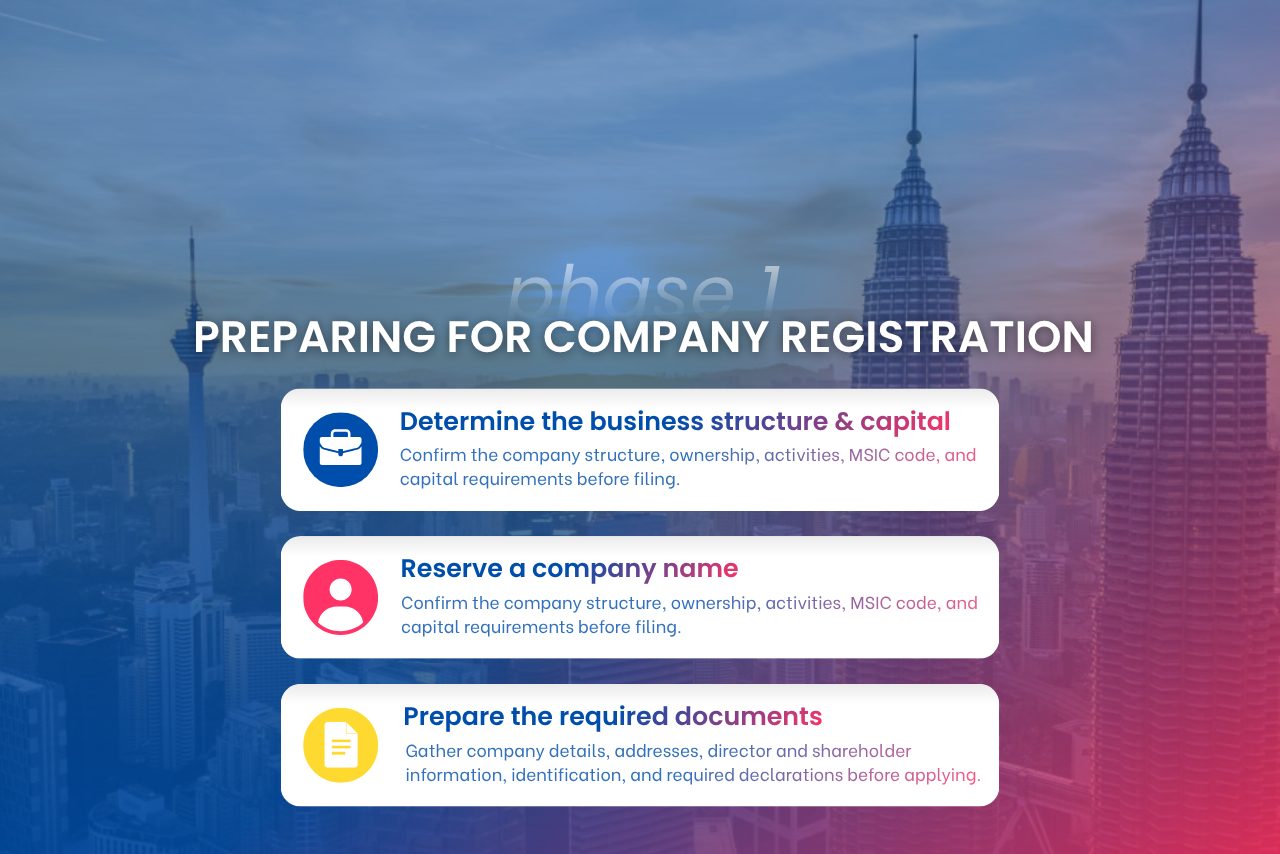
Key preparations before registering a company in Malaysia
Step 1: Determine the business structure and capital
Before filing, confirm the business structure, ownership, directors or partners, business activities, and MSIC code based on the planned presence in Malaysia. Each structure has different requirements:
- Sdn Bhd: For companies planning long-term commercial operations and local expansion.
- Branch office: For companies operating under the foreign parent’s legal identity.
- Representative office: For companies focused on market research and non-commercial activities.
- LLP: For professional services, SMEs, and joint ventures using a partnership model.
Capital requirements depend on the business structure and activity. For example, an Sdn Bhd can generally be incorporated with RM1 paid-up capital, while certain regulated activities may require substantially higher capital or additional approvals. Check these requirements before filing to avoid restructuring later.
| 👉 For companies planning to source from Malaysian suppliers, explore our guide on sourcing in Malaysia for practical considerations when building a local supply chain. |
Step 2: Reserve a company name
Next, search the proposed name through SSM’s MyCoID system and check that it follows Malaysia’s company naming rules. The name should be distinct from existing entities and should not contain restricted or controlled words without the required approval. Preparing one or two alternatives can help avoid delays if the first choice is rejected.
According to SSM, companies can either reserve the name first or use Direct Incorporation, which combines name reservation and incorporation in one application. A separate name reservation costs RM50 and is valid for 30 days, with extensions available up to 180 days in total.
Step 3: Prepare the required documents
Gather the key information and documents before starting the application. The exact requirements vary by business structure, but commonly include:
- Proposed company name
- Business activities and MSIC code
- Registered office and business address
- Director and shareholder details
- Shareholding or partnership information
- Identification and residence details
- Lodger information and required declarations
Foreign shareholders or corporate entities may need additional supporting documents, especially for regulated activities. Notarisation is not a universal requirement, so check the applicable certification rules before preparing or certifying documents.
Registering the Company With SSM
Once the required information is ready, the next step is to register the company with SSM, Malaysia’s Companies Commission. The filing is mainly completed online through MyCoID, but some applicants may still need to complete account verification or other administrative steps before the application can be processed.
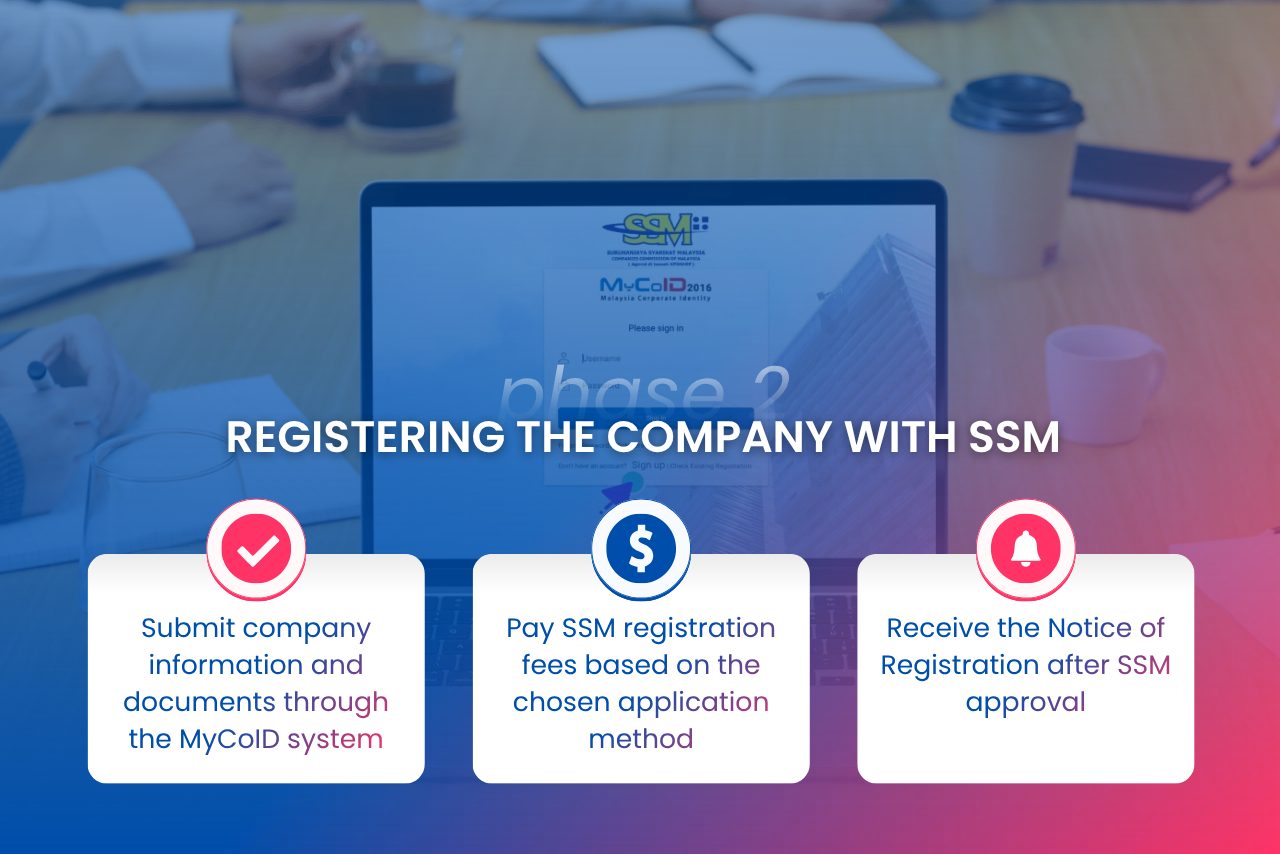
Step-by-step process for registering a company with SSM in Malaysia
Step 4: Submit the application via MyCoID
Create and activate a MyCoID account, then choose either name reservation or direct incorporation. Complete the Super Form with the information required for the selected business structure. Key details typically include:
- Company information: Name, addresses, and business activities
- Ownership details: Shareholders or members and their interests
- Management details: Directors or partners and personal details
- Business activity: Main activities and the relevant MSIC code
- Lodger information: Details of the person submitting the application
- Supporting documents: Identification and other documents required
The application is submitted online, but new MyCoID users may need to verify their account at an SSM office. Before submitting, check that names, ownership, addresses, and business activities match the supporting information. Errors at this stage can create additional work during incorporation, banking, or licensing.
Step 5: Pay SSM registration fees
SSM charges a RM1,000 registration fee for Direct Registration of a company limited by shares, which covers both name reservation and incorporation in one step. If a company reserves the name separately first, that adds RM50 on top of the RM1,000 incorporation fee, bringing the total to RM1,050. These are only the official registration charges. Foreign investors should also budget for:
- Company secretary and professional fees
- Registered office and banking costs
- Business licences and permits
- Tax and accounting setup
- Employment and operational costs
The total cost to register a company in Malaysia can therefore vary significantly. Planning for these additional expenses early helps avoid budget gaps during the wider company setup process.
Step 6: Receive the notice of registration
Once SSM approves the application, the company is officially registered and receives a Notice of Registration with its company registration number. This notice serves as the official proof of registration. A Certificate of Incorporation is not issued automatically but can be requested separately under Section 17 of the Companies Act 2016.
SSM’s 2026 client charter sets a 1-day service standard for new company incorporation and name approval. However, this only covers SSM’s processing time. The full setup may take longer to complete, including banking, licences, tax, and employment registrations before operations can begin.
Completing Post-Registration Requirements
Many foreign owners think the work ends when the certificate arrives. In reality, companies still need to complete corporate compliance, banking, tax, employment registrations, and business licences before operations can run smoothly.
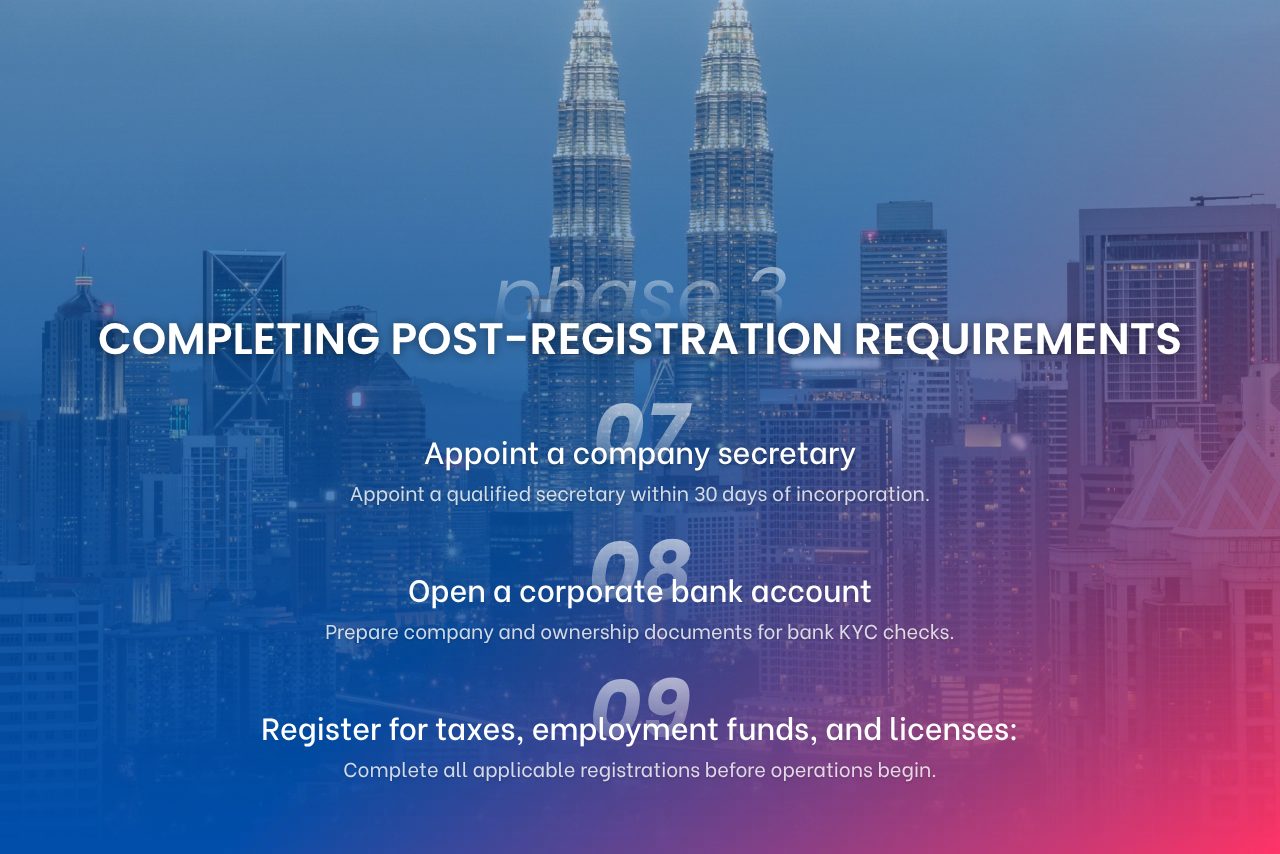
Essential post-registration steps after registering a company in Malaysia
Step 7: Appoint a company secretary
The required compliance role depends on the business structure. For example, an Sdn Bhd must appoint a qualified company secretary within 30 days of incorporation to manage statutory records and corporate filings. For an LLP, a compliance officer is required instead, while a registered foreign company must appoint a resident agent in Malaysia.
These roles support ongoing compliance after registration, including maintaining records and handling required filings with the relevant authorities. Appointing the right person early helps companies avoid gaps in their statutory obligations as they move into local operations.
Step 8: Open a corporate bank account
Banking can become a practical bottleneck after incorporation, especially for foreign-owned companies. Banks typically review the company’s ownership, directors, business activities, and source of funds as part of their KYC and due diligence checks. Commonly requested documents include:
- Notice of Registration and company details
- Directors’ passports or identification
- Shareholding information
- Board resolution
- Business information and supporting documents
Requirements vary by bank and company profile. Starting early can help companies avoid delays that may affect supplier payments, payroll, and other local transactions once operations begin.
Step 9: Register for taxes, employment funds, and licenses
Company registration does not automatically give a business all the approvals needed to operate. The requirements depend on the business structure, activities, and whether the company employs staff.
- Taxes: For companies incorporated online through MyCoID, LHDN states that TIN registration is automatic. Companies should confirm their tax details and complete SST registration with Customs where applicable
- Employment: Companies with employees may need to register for EPF (KWSP), SOCSO (PERKESO), and EIS.
- Licences: Check sector-specific approvals before starting operations. For example, certain foreign-involved distributive trade activities may require a WRT licence and RM1 million in shareholders’ funds.
Reviewing these requirements early helps companies avoid delays after incorporation and plan the cost of becoming operational in Malaysia.
| 👉 Beyond registration and compliance, understanding business culture in Malaysia can also help companies prepare for local operations and business relationships. |
How Source of Asia Supports Company Setup in Malaysia
Although much of the company registration process in Malaysia can be handled remotely, foreign companies may still face practical challenges with local requirements, banking, licensing, and on-the-ground coordination. Working with a local partner can help connect these steps and keep the setup moving.
With an established presence in Malaysia, Source of Asia can support foreign companies from initial planning through registration and the start of local operations. Our services include:
- Market entry and setup planning: Assess business objectives, activities, and entry options to build a practical Malaysia setup plan.
- Company registration and regulatory support: Coordinate entity setup, SSM registration, company secretary, tax registration, and applicable licences.
- Operational and HR setup: Support office setup, business relocation, HR processes, hiring, payroll, and banking for starting local operations.
- Post-registration support: Provide ongoing corporate compliance, accounting, tax, and administrative support after setup.
Final Thoughts
Registering a company in Malaysia involves more than completing the SSM filing. Foreign investors need to handle structure, documents, costs, banking, tax, employment, and licensing, and missing one requirement can cause delays or extra work. Having the right local support can make it easier to coordinate these steps and move from incorporation to actual operations.
At Source of Asia, we support foreign companies throughout the setup journey in Malaysia through our Market Expansion Services and Corporate Services. Our team helps with market-entry planning, company registration, licensing, HR and payroll, office setup, compliance, and ongoing local support as businesses establish and grow in Malaysia.
| 👉 Planning to register a company in Malaysia? Contact our experts to discuss the setup requirements and next steps. |
Frequently Asked Questions
Most Sdn Bhd companies have no general legal minimum for paid-up capital. Some sectors, however, require higher capital or shareholders’ funds. For example, certain foreign-involved distributive trade activities may require RM1 million. Check your sector rules before you decide on your capital amount.
The SSM fee for Direct Registration is RM1,000 for a company limited by shares. A separate name reservation costs RM50. Your total budget should also include professional fees, company secretary fees, banking costs, and any licence costs. These extra costs often add up to more than the government fee.
Yes, much of the process can be done online through MyCoID. However, new MyCoID users may need to verify their account at an SSM office. You also need a local director for a Sdn Bhd, and banks may ask for directors’ passports and other documents. Plan for some in-person steps, even if most of the work is remote.
SSM’s 2026 client charter sets a 1-day service standard for new company incorporation and name approval. However, the full setup takes longer. Bank account opening, tax registrations, and any sector licences can add several weeks or more. A realistic plan considers the whole process, not only the SSM step.