Introduction
Malaysia continues to attract foreign businesses as one of Southeast Asia’s key commercial hubs, supported by its diverse workforce and multicultural business environment. This diversity influences how companies communicate, build trust, and approach business decisions. For foreign companies, understanding business culture in Malaysia goes beyond basic etiquette. Differences in communication, hierarchy, and decision-making can affect meetings, partnerships, and daily work. Without cultural awareness, even strong business opportunities can face unnecessary delays or misunderstandings.
In this guide, we at Source of Asia explain the key aspects of business culture in Malaysia, from business etiquette and meetings to communication, negotiation, and follow-up, helping companies work more effectively with Malaysian partners.
Key Insights
- Business culture in Malaysia is formal, relationship-oriented, and influenced by hierarchy, indirect communication, and multicultural norms.
- Foreign companies should show respect through proper greetings, patient communication, careful follow-up, and sensitivity to religious, cultural, and business expectations.
- Decision-making often requires internal discussion and senior approval, so longer timelines should not be read as a lack of interest.
- Building trust often takes time, and early meetings may focus as much on the relationship as on the commercial opportunity.
- Cultural awareness helps foreign companies avoid misunderstandings and build stronger local business relationships.
 Add Source of Asia as a preferred source on Google
Understanding Business Etiquette in Malaysia
Business etiquette is an important part of business culture in Malaysia. While Malaysian companies operate in an increasingly international environment, local expectations around respect and formality still matter, particularly during first meetings.
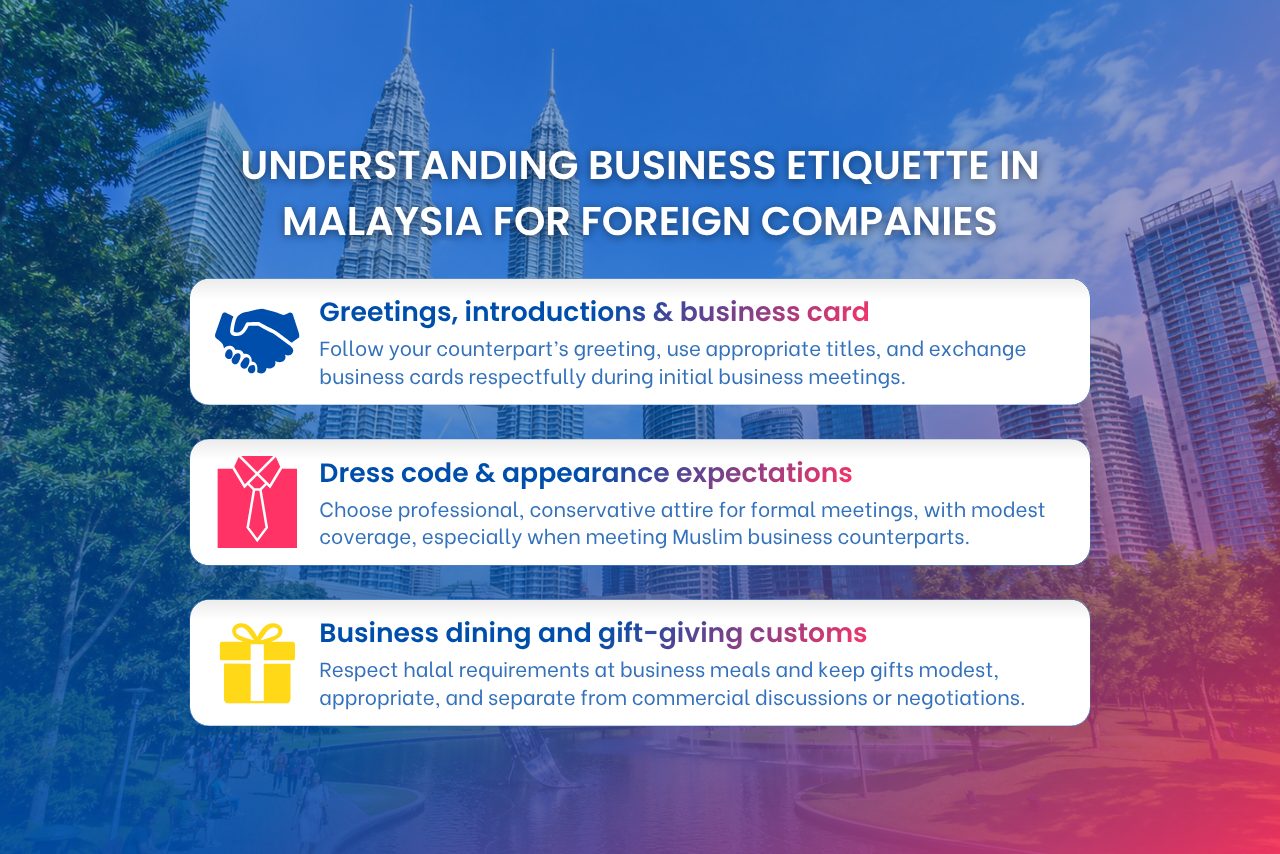
Business etiquette in Malaysia covers greetings, professional dress, dining, and gift-giving
Greetings, introductions, and business card etiquette
First impressions can shape how a business relationship develops. In Malaysia, respect and formality matter, particularly during initial meetings. Keep these points in mind:
- Follow your counterpart’s greeting: Handshakes are common, but some Muslim women may prefer a nod or hand over the heart when greeting men. When unsure, let your counterpart initiate and follow their lead.
- Handle business cards respectfully: Give and receive cards with both hands or the right hand, read the card briefly, and put it away carefully. Avoid pocketing it immediately or writing on it in front of the giver.
- Use appropriate titles: Address people as Mr., Ms., Dr., Datuk, or Tan Sri as introduced. Use first names only when invited to do so.
Professional dress code and appearance expectations
Professional appearance is an important part of business etiquette in Malaysia, particularly when meeting new partners or government representatives. While expectations vary by industry, conservative business attire is generally the safest choice for formal meetings.
- Men: For most business meetings, smart business attire is appropriate. For government meetings, formal settings, or first meetings with traditional industries, a dark or neutral business suit is safer.
- Women: Choose professional clothing with modest coverage, particularly around the shoulders and knees.
Especially for Muslim counterparts, avoid clothing that may be considered overly casual or revealing. When in doubt, it is better to dress slightly more formally for a first meeting and adjust based on the business culture.
Business dining etiquette and gift-giving customs
Business meals in Malaysia often provide an opportunity to build relationships before moving into detailed discussions. Commercial matters may be discussed before or after the meal rather than throughout it.
When hosting Muslim colleagues or partners, check dietary requirements in advance and choose a halal venue where appropriate. Avoid serving pork or alcohol to Muslim guests.
Gift-giving is generally a gesture of goodwill rather than part of the negotiation. Keep gifts modest and appropriate, especially during an initial business relationship. Avoid expensive gifts that may create discomfort or be perceived as an attempt to influence a business decision.
Communication Styles in Malaysian Business Culture
Communication styles in Malaysia reflect the country’s multicultural business environment, from indirect responses and non-verbal cues to differences in workplace communication and expectations.
Indirect communication and maintaining harmony
Malaysian business communication often emphasizes politeness and harmony. As a result, disagreement may be expressed indirectly rather than through a clear refusal.
For example, a response such as “We’ll consider it” may suggest that your proposal still needs internal discussion rather than indicate clear agreement.
Do not treat every positive or neutral response as a commitment. Instead:
- Ask open questions to clarify any concerns.
- Confirm the next step before ending the discussion.
- Allow time for internal discussion before expecting a decision.
- Follow up professionally without creating unnecessary pressure.
Non-verbal communication in business
In Malaysian business settings, tone, facial expressions, silence, and body language can influence how a message is understood. This is especially important when discussing sensitive issues or disagreeing with a proposal.
To maintain a professional atmosphere:
- Stay calm and composed when discussing disagreements.
- Avoid pointing aggressively, interrupting, or raising your voice.
- Keep frustration under control, particularly during negotiations.
- Avoid criticizing or correcting someone publicly.
Open confrontation can weaken trust and make future discussions more difficult. If a sensitive issue needs to be addressed, a private conversation is often a better approach than raising it in front of the wider group.
Communicating in a multicultural workplace
Data from the Demographic Statistics Malaysia First Quarter 2026 report shows that the citizen population was approximately 58.3% Malay, 12.3% other Bumiputera, 22.1% Chinese, and 6.5% Indian. Thus, Malaysian workplaces often bring together people with different cultural, religious, and linguistic backgrounds.
However, avoid assuming that communication styles are determined by ethnicity. Instead, consider the business context, including:
- Seniority and role within the organization.
- Company and industry culture.
- Language preference and communication style.
- Decision-making structure.
- Level of formality in the relationship.
The most effective approach is to remain respectful, patient, and clear, while adapting to how each counterpart prefers to communicate.
Business Meetings and Follow-Up Culture in Malaysia
Business meetings in Malaysia often combine practical discussion with relationship building. Good preparation, respectful communication, and patient follow-up can help foreign companies maintain momentum without creating unnecessary pressure.
Preparing for business meetings in Malaysia
Good preparation helps you avoid practical issues and make better use of meeting time. Before meeting a Malaysian business partner, consider several factors:
- Meeting logistics: Confirm the time, location, participants, and agenda. For Muslim counterparts, check prayer times and religious observances, and avoid Friday midday unless availability is confirmed.
- Meeting preparation: Send the agenda in advance, research the participants’ roles and seniority, bring business cards, and allow time for introductions and small talk.
Because initial meetings often focus on building rapport and assessing the potential relationship, do not assume that a first meeting will result in an immediate decision.
Following up after business meetings
A professional follow-up helps maintain momentum while giving your Malaysian counterpart time to review the discussion internally. Keep the message concise and focused on what was agreed.
After the meeting, summarize the key points, confirm responsibilities, and clarify the next step. If a decision requires internal approval, allow reasonable time before requesting an update. When there is no response, follow up consistently but avoid sending repeated messages too quickly.
In some cases, a slower response does not necessarily indicate a lack of interest. It may reflect internal consultation or approval processes, so patient and professional follow-up is often more effective than applying pressure.
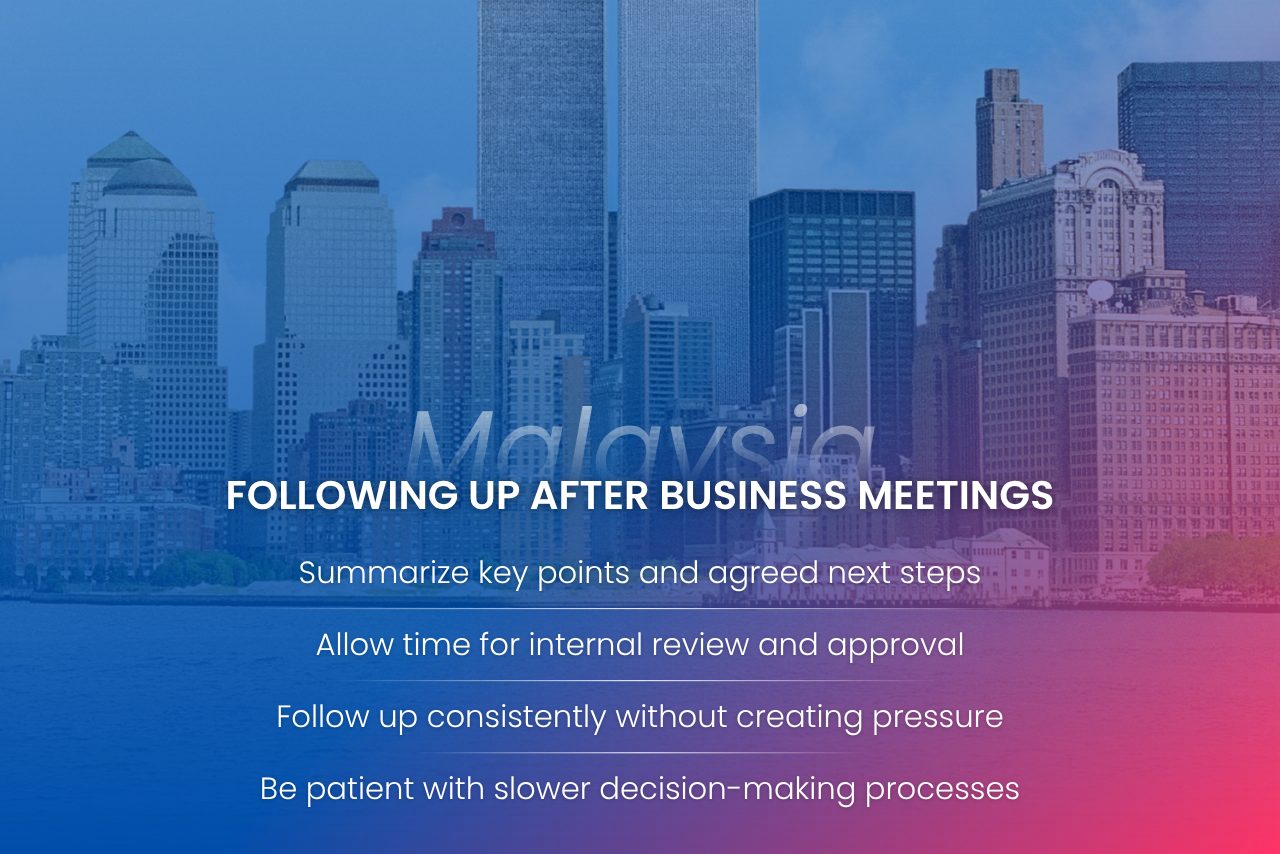
Following up after business meetings with Malaysian business partners
Decision-making and Negotiation in Malaysia
Decision-making and negotiation in Malaysia often involve multiple stakeholders, relationship considerations, and internal review. These factors can influence how proposals are assessed, negotiated, and ultimately approved.
How business decisions are typically made
Business decisions in Malaysia may involve several stages before a commitment is finalized, particularly in larger organizations. The person leading the discussion may assess the opportunity, while senior management reviews the commercial case before approval.
For foreign companies, it is useful to clarify the process early:
- Identify key stakeholders and their roles in the decision.
- Understand whether the proposal requires management or board approval.
- Ask about the expected timeline and decision criteria.
- Keep relevant information and proposals clear for internal review.
Negotiation styles and expectations
Negotiations in Malaysia often combine commercial discussions with relationship building. Before moving into sensitive terms such as pricing, contracts, or commitments, counterparts may first assess your company’s reliability and long-term intentions.
During negotiations, focus on the overall value of the proposal rather than price alone. Present your position clearly, allow time to consider different options, and address concerns through discussion rather than pressure.
In addition, silence can also be part of the negotiation process. Instead of immediately changing your offer or filling the gap, give your counterpart time to consider the proposal and respond.
Common cultural mistakes in negotiation
Several negotiation mistakes can create unnecessary friction or slow progress, even when the commercial proposal is strong. Foreign companies should avoid:
- Pushing for a fast decision: Asking for an immediate yes or no can create pressure when the proposal still needs internal review or approval.
- Negotiating only with junior staff: A contact may provide useful input but lack authority to approve the deal. Identify key decision-makers early.
- Showing visible frustration: Keep disagreements professional and address sensitive issues privately when appropriate.
- Assuming polite responses mean agreement: Confirm what has been agreed and clarify any points that still require discussion.
| Choosing the right local supplier also requires careful evaluation of capabilities, fit, and decision-making structure. 👉 See what to consider when choosing a supplier in Malaysia. |
Practical Do’s And Don’ts In Malaysian Business Culture
Knowing these expectations can help you avoid common mistakes when working with Malaysian partners. The table below highlights practical do’s and don’ts across key areas of business interaction.
| Topic | Do | Don’t |
|---|---|---|
| Greetings | Use titles and polite greetings | Be overly familiar |
| Business cards | Exchange respectfully | Pocket immediately |
| Communication | Be diplomatic and patient | Be overly direct |
| Meetings | Build rapport first | Rush into business |
| Decision-making | Respect hierarchy | Expect quick approvals |
| Negotiation | Focus on long-term value | Pressure for quick deals |
| Business dining | Respect halal customs | Ignore cultural norms |
| Follow-up | Follow up professionally | Chase excessively |
Overall, Malaysian business culture values professionalism, respect, patience, and relationship building throughout the business process. However, practices can vary across industries, companies, and individuals, so cultural awareness should guide your approach rather than fixed assumptions.
| For businesses considering Malaysia for sourcing, knowing which categories are most relevant can help shape early market discussions. 👉 Discover Malaysia sourcing categories. |
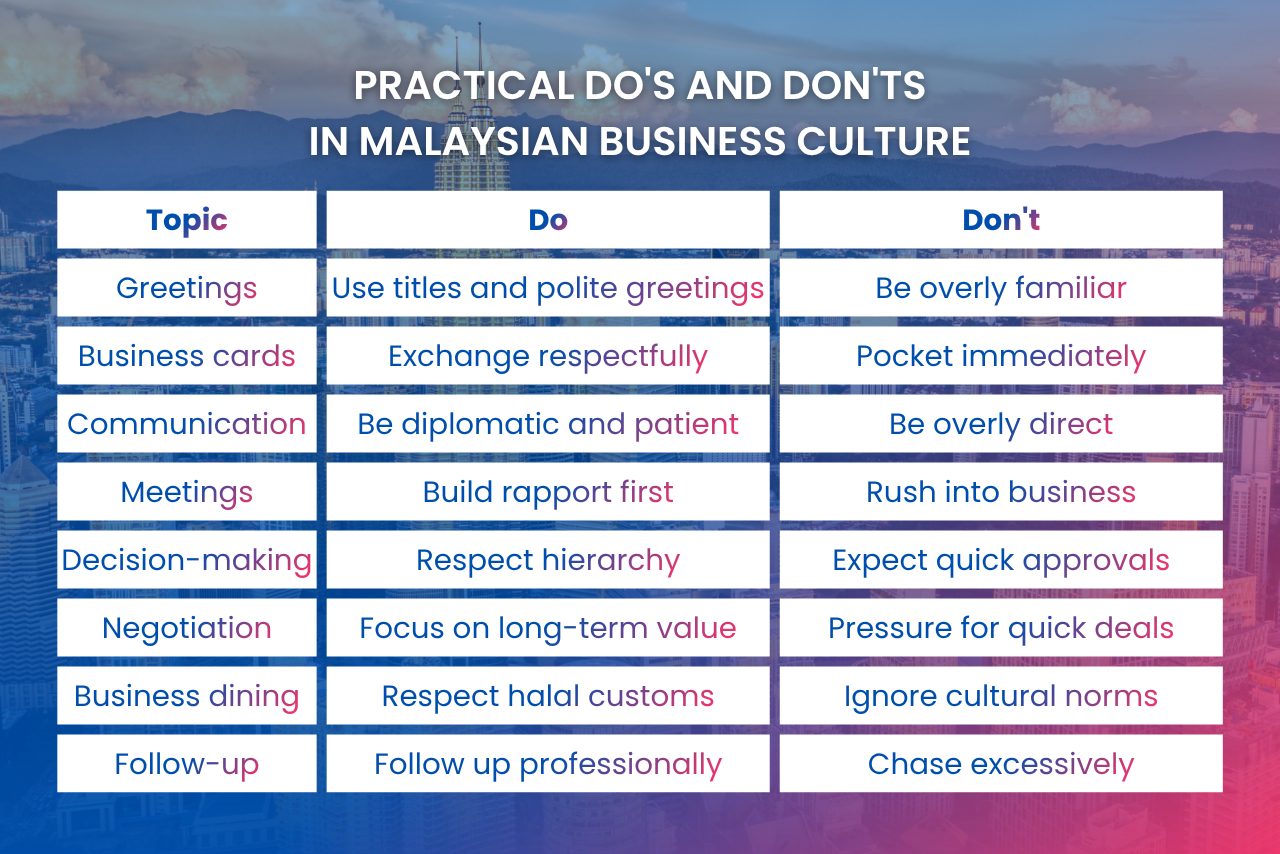
Practical do’s and don’ts in Malaysian business culture for foreign companies
When Cultural Understanding Becomes a Business Expansion Issue
Cultural misunderstandings can affect more than day-to-day communication. For foreign companies entering Malaysia, they can also create commercial and execution risks:
- Slower negotiations: Pushing for decisions before your counterpart is ready can create pressure and delay progress, especially when internal approval is needed.
- Loss of trust: Overly direct communication, visible frustration, or public disagreement may make counterparts less comfortable continuing the relationship.
- Misread responses: Follow-ups that feel urgent, or polite non-committal replies, can be misinterpreted—either as pressure or as agreement when no clear decision has been made.
- Wrong local partner: Not understanding a contact’s role, authority, or network can lead to working with someone who is not the right decision-maker or fit.
- Weak meeting momentum: Focusing too heavily on products, pricing, or transactions too early can reduce time for relationship building and limit future engagement.
| Once cultural risks are clear, the next step is preparing for practical market entry. 👉 Explore our guide to relocating your business to Malaysia. |
Final Considerations
Business culture in Malaysia shapes how foreign companies communicate, build relationships, manage meetings, negotiate, and follow up. Respect for hierarchy, indirect communication, and patience can help companies avoid misunderstandings and manage local business relationships more effectively. At the same time, practices vary across companies and industries, so local context should guide your approach.
At Source of Asia, our local presence in Malaysia enables us to support businesses throughout their market expansion journey by:
- Market validation and opportunity assessment.
- Local partner identification and business matching.
- On-the-ground representation and operational support.
- Business establishment for sustainable long-term growth.
| 👉 Facing cultural challenges when doing business in Malaysia? Speak with Source of Asia to get practical local guidance. |
Frequently Asked Questions
Yes. English is widely used in Malaysian business, particularly in professional and commercial settings. However, communication may still be indirect, so pay attention to tone, context, and how agreement or hesitation is expressed.
Use a polite greeting and appropriate professional titles. Handshakes are common, but when unsure, let your counterpart initiate physical contact. When exchanging business cards, use both hands or the right hand and review the card before putting it away.
Avoid being overly direct, rushing decisions, ignoring hierarchy, or showing frustration publicly. Also consider halal requirements, prayer times, and religious observances when planning meetings, business meals, or other professional activities.
Not necessarily. However, local support can help with partner identification, B2B meetings, market understanding, and on-the-ground execution. The right approach depends on your sector, entry model, and objectives in Malaysia.