Introduction
Malaysia continues to attract international businesses seeking opportunities in manufacturing, technology, trade, and services. In 2026, economic growth, new investment policies, and efforts to develop higher-value industries are shaping the country’s business environment.
However, a positive economic outlook does not guarantee success for every investor. Market demand, industry conditions, local partnerships, and operating costs can influence commercial results.
This SOA guide examines the Malaysia business outlook for 2026, including economic performance, key market trends, growth sectors, and investment locations. It also explains what foreign companies should assess before entering or expanding in Malaysia.
Quick Answer
What should foreign companies know about Malaysia’s business outlook in 2026?
Malaysia offers opportunities for foreign businesses in 2026, supported by domestic demand, investment activity, and government plans to develop high-value industries. The Malaysian government revised its 2026 GDP growth forecast to 4.8–5.3% in October. Meanwhile, approved investments reached RM218.5 billion in the first half of 2026.
Five factors are shaping the business outlook:
- Economic growth: Domestic consumption, investment, and trade continue to support business activity.
- Government priorities: The 13th Malaysia Plan promotes technology, productivity, and high-value investment.
- Growth sectors: Electronics, digital infrastructure, renewable energy, logistics, and services offer potential opportunities.
- Regional investment hubs: Different states provide distinct industry networks and operating conditions.
- Business challenges: Costs, talent availability, regulations, and global uncertainty require careful planning.
For foreign companies, the right opportunity depends on industry demand, investment objectives, and local execution capacity.
What Is Malaysia’s Economic Outlook for 2026?
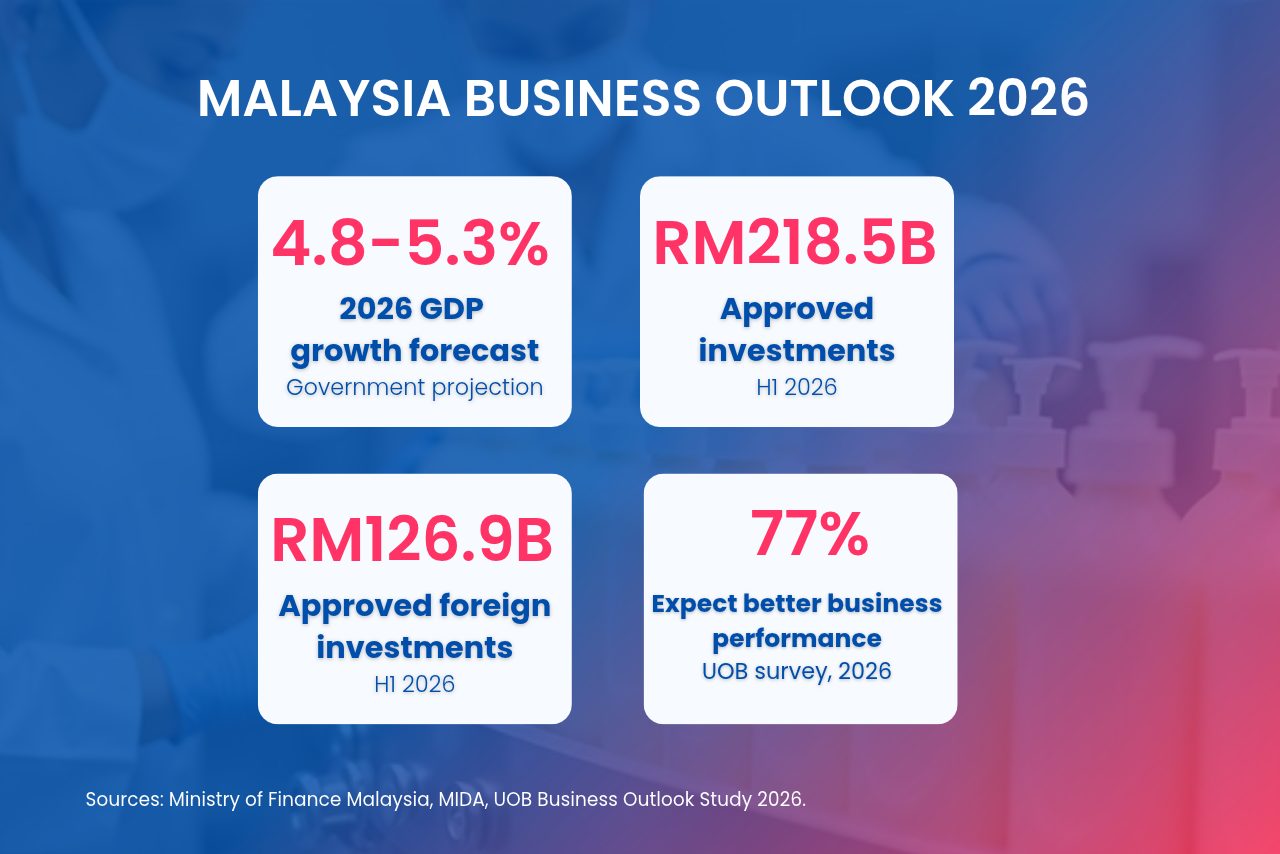
Malaysia’s 2026 growth outlook.
The Malaysia economic outlook 2026 reflects continued domestic growth alongside uncertainty in global trade and energy markets. Malaysia’s economy grew by 5.2% in 2025. As of October 2026, the government expects growth of 4.8–5.3% for the full year, supported by consumer demand and investment.
However, growth conditions vary across industries, making sector-level analysis important for foreign investors.
Consumer Spending and Retail Market Growth
Household spending remains an important driver of Malaysia’s economy. Private consumption grew by 4.8% in the second quarter of 2026, supported by spending on food, transport, restaurants, hotels, and communication services.
Retail activity also continued to expand. According to the Department of Statistics Malaysia (DOSM), retail trade sales grew by 6.6% year on year in June 2026. These trends create potential demand for consumer products, retail technology, distribution services, and related business solutions.
However, foreign brands should consider differences in household income, price sensitivity, and consumer preferences. Strong national spending does not necessarily translate into demand for every product category.
GDP Growth, Domestic Demand, and External Trade
Malaysia’s GDP grew by 5.2% in 2025, supported by private consumption, investment, and export activity. Growth continued into 2026, reaching 6.0% in the second quarter, compared with 5.4% in the first quarter.
In October 2026, the government updated its full-year forecast to 4.8-5.3%, reflecting stronger economic performance earlier in the year. This was higher than the 4.6% forecast published by ADB in April.
The revised outlook is detailed in the Malaysia Ministry of Finance’s Budget 2027 statement.
Domestic demand continues to provide support. At the same time, Malaysia’s exports remain closely linked to global demand for electrical and electronic products, machinery, and other manufactured goods. Therefore, foreign businesses should consider both domestic customers and international supply-chain conditions when evaluating opportunities.
Foreign Investment, Business Confidence, and Investment Trends
Investment activity provides another indicator of Malaysia’s business environment.
According to the Malaysian Investment Development Authority (MIDA), Malaysia recorded RM218.5 billion in approved investments during the first half of 2026, up 11.7% year on year.
Foreign investment accounted for RM126.9 billion, or 58.1% of the total. Meanwhile, domestic investment contributed RM91.6 billion. Services attracted RM149.6 billion, followed by manufacturing at RM51.3 billion and the primary sector at RM17.6 billion.
Importantly, these figures represent approved investments, not actual FDI inflows. Projects may take several years to reach full operation. Business confidence also remains positive. The UOB Business Outlook Study 2026 found that 77% of surveyed Malaysian businesses expected improved performance during the year. For a broader regional perspective on foreign investment flows and priority sectors, see our Invest in ASEAN 2026 guide.
However, confidence should not be treated as guaranteed growth. Companies still face higher operating costs, international trade risks, and pressure to improve productivity. To understand the broader regional factors shaping business conditions, read our analysis of ASEAN’s economic resilience.
How Is the 13th Malaysia Plan Shaping Business Opportunities?
The 13th Malaysia Plan (13MP) sets Malaysia’s development direction for 2026–2030. Its priorities include stronger productivity, technology adoption, higher-value industries, and more balanced regional development.
For foreign investors, the plan provides useful insight into where government policy and industrial investment are heading.
Malaysia’s 2026–2030 Development Priorities
The 13MP targets average annual GDP growth of 4.5–5.5% between 2026 and 2030.
A central objective is to move toward higher-value economic activities. Therefore, Malaysia is focusing on advanced manufacturing, digital technology, innovation, skilled employment, and more competitive domestic businesses. This shift also reflects a broader regional move toward higher-value manufacturing and stronger industrial capabilities, as discussed in our analysis of ASEAN’s changing cost competitiveness.
The plan also connects with existing national strategies, including the New Industrial Master Plan 2030 (NIMP 2030), the National Semiconductor Strategy, and the National Energy Transition Roadmap. Together, these policies support industrial development, technology investment, and energy transition.
However, policy priorities should be treated as indicators of market direction, not guarantees of demand or investment returns.
Investment Incentives and the Shift Toward Higher-Value Activities
Malaysia is also changing how investment incentives are assessed. The New Incentive Framework (NIF), introduced for manufacturing from March 1, 2026, places greater emphasis on measurable economic benefits.
These include skilled job creation, technology transfer, local supply chain development, and sustainability. For example, a manufacturing project that develops local suppliers and introduces advanced technology may align more closely with national investment priorities.
However, incentive eligibility depends on the project’s activities, location, and applicable conditions. Foreign businesses should therefore review the current requirements with qualified advisers before including potential incentives in financial forecasts.
What Are the Key Malaysia Market Trends in 2026?
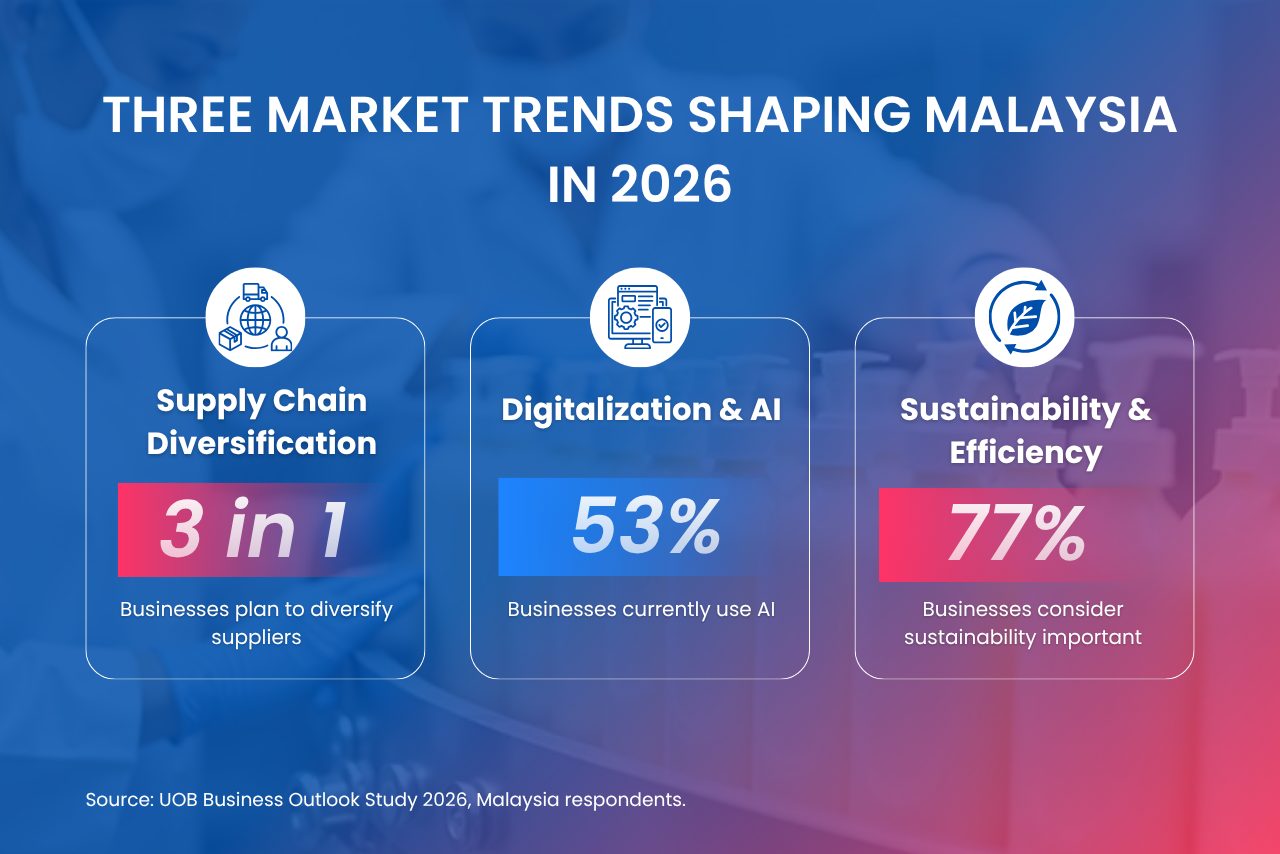
Malaysia market trends infographic.
Several Malaysia market trends are changing how companies manage production, technology, and operating costs. These trends are relevant not only to large investors but also to foreign suppliers and service providers seeking local customers.
Supply Chain Diversification and Regional Manufacturing Strategies
Global trade uncertainty is encouraging companies to review their sourcing and production networks. Malaysia offers an established manufacturing base, access to regional markets, and supplier networks in several industrial sectors.
SOA’s sourcing and supply chain services in Southeast Asia can help businesses identify potential suppliers, assess supplier capabilities, and improve supply chain reliability.
According to UOB’s 2026 survey, three in five businesses planned to further diversify their suppliers. For foreign companies, this may create opportunities in supplier development, industrial equipment, logistics, and production support. For example, SOA’s sustainable packaging case study across Vietnam and Malaysia demonstrates how supplier research and qualification can help businesses identify suitable sourcing partners in the region.
Copy câu đề xuất
However, companies should assess whether local suppliers can meet their requirements for quality, capacity, pricing, and delivery. SOA’s ASEAN Market Trends and Sectors 2026 webinar recap provides further context on regional sourcing and manufacturing opportunities.
Digitalization, AI Adoption, and Operational Efficiency
Digital technology is increasingly part of Malaysia’s business investment plans. UOB found that 53% of surveyed companies were using AI, while 71% planned to increase spending on digital solutions by 10–50% in 2026.
Common business applications include automated reporting, customer management, production monitoring, and data analysis. For technology providers, this creates potential demand for enterprise software, system integration, cybersecurity, and automation services.
However, companies may still face gaps in digital skills, data quality, and implementation budgets. As a result, solutions that address a specific operating problem and provide measurable returns may be more attractive than broad technology upgrades.
Energy Efficiency and Sustainability Pressures
Energy management has become another business priority. Companies are looking for ways to reduce electricity use, control operating costs, and maintain reliable production.
In UOB’s 2026 survey, nearly eight in ten businesses considered energy management and efficiency important. In addition, international customers may require suppliers to monitor environmental performance and improve resource efficiency.
These needs create potential opportunities for energy audits, efficient industrial equipment, solar systems, monitoring technology, and related services. However, investment decisions still depend on upfront costs, technical requirements, and the expected savings over time.
Which Malaysia Growth Sectors Offer Opportunities for Foreign Companies?
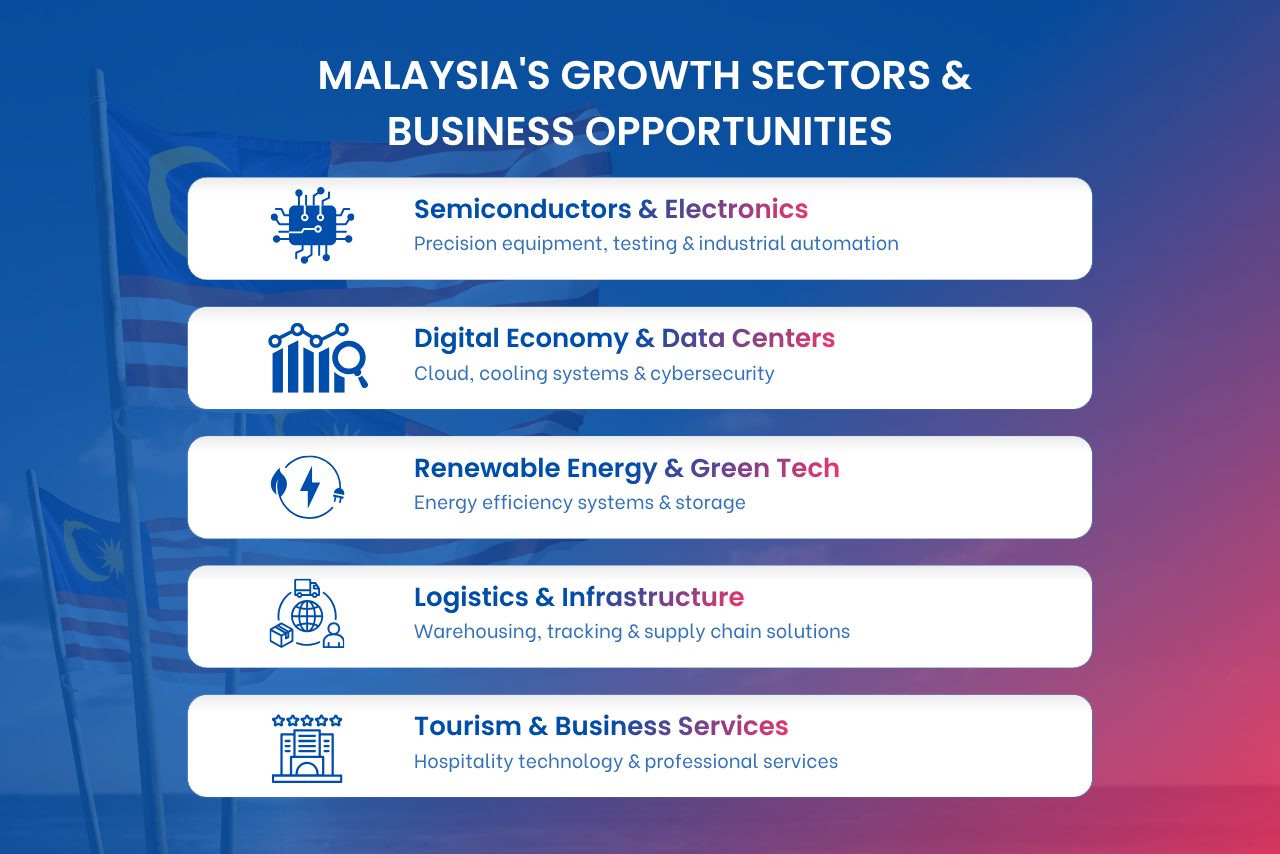
Malaysia growth sectors infographic.
The following Malaysia growth sectors are attracting policy support, investment activity, or business demand. However, foreign companies should assess specific customer needs and operating conditions before treating an industry as an attractive investment opportunity.
Semiconductors, Electronics, and Advanced Manufacturing
Malaysia has an established position in electrical and electronics (E&E) manufacturing, particularly semiconductor assembly, testing, and packaging. The country is now seeking to develop more higher-value activities, including integrated circuit (IC) design, advanced packaging, and specialized manufacturing equipment.
In the first half of 2026, E&E attracted RM16.6 billion in approved manufacturing investments, according to MIDA. This creates potential demand for production equipment, precision components, engineering services, industrial automation, and specialized suppliers.
However, entry requirements vary across the supply chain. A company offering equipment maintenance may need access to factory customers and technical staff, while a semiconductor design firm may prioritize engineering talent and technology partnerships. Therefore, understanding the specific industry segment is essential.
Digital Economy, AI, Cloud, and Data Centers
Malaysia is attracting investment in cloud computing, AI infrastructure, and data-related services. MIDA reported RM95.8 billion in approved data center and cloud-computing investments during the first half of 2026.
This activity may create demand for electrical systems, cooling equipment, network services, cybersecurity, engineering, and maintenance. However, data center development requires reliable power, water, connectivity, and suitable sites. Malaysia’s investment authorities have also placed greater attention on resource availability and environmental requirements.
For foreign suppliers, the opportunity may lie in supporting these projects rather than developing data centers directly. Companies should identify project owners, procurement requirements, technical standards, and local delivery partners before entering this market.
Renewable Energy, Green Technology, and Industrial Efficiency
Malaysia’s energy transition creates opportunities across renewable power, industrial efficiency, and supporting technologies. The National Energy Transition Roadmap and the 13th Malaysia Plan support greater investment in clean energy and energy infrastructure.
Potential opportunities include solar equipment, energy storage, building efficiency systems, industrial monitoring, and engineering services. For example, an equipment supplier may target manufacturers seeking to reduce electricity costs or improve energy performance.
However, renewable energy projects depend on technical feasibility, grid access, project approvals, and financing. Companies should therefore assess each application separately rather than assume that national energy targets will translate directly into sales.
Logistics, Infrastructure, and Regional Trade Connectivity
Malaysia’s ports, industrial areas, and transport links support regional trade and manufacturing. The Johor–Singapore Special Economic Zone (JS-SEZ) is particularly relevant to companies exploring cross-border operations.
The initiative aims to improve connectivity between Johor and Singapore and support investment across manufacturing, logistics, digital services, and other sectors. For example, a company may consider locating production or warehousing in Johor while maintaining regional commercial activities in Singapore. Companies comparing Malaysia with other production and sourcing locations can use our guide to relocating a business to Southeast Asia to assess supplier networks, logistics, and total operating costs.
However, such a model still requires analysis of customs, staffing, transport costs, and cross-border operations. Other logistics opportunities include warehouse systems, freight services, equipment, and supply-chain technology. The best location depends on customers, transport routes, and the nature of the business.
Tourism, Consumer Services, and Business Services
Malaysia’s services sector also offers opportunities beyond manufacturing and technology. The Visit Malaysia 2026 campaign supports the country’s tourism promotion efforts and may create demand for hospitality, transport, travel services, and related solutions.
Meanwhile, urban consumer markets support opportunities in retail, food services, healthcare, and business services. For foreign companies, the relevant approach depends on the customer segment.
A hospitality technology provider may target hotels and travel operators, while a consumer brand may need local distributors, modern retail partners, or digital sales channels. However, competition, consumer preferences, service quality, and local requirements should be evaluated before launching.
Where Are Malaysia’s Key Business and Investment Locations?
Malaysia’s investment opportunities vary by state and industrial cluster. In the first half of 2026, Selangor, Johor, Kuala Lumpur, Penang, and Sarawak were among the leading locations by approved investment value, according to MIDA. However, the best location depends on industry needs rather than investment rankings alone.
Greater Kuala Lumpur and Selangor: Services and Business Operations
Greater Kuala Lumpur and Selangor offer established business networks, transport links, and access to professional services. They may suit companies seeking commercial offices, regional management functions, digital services, or access to domestic customers.
Selangor also has industrial areas supporting manufacturing, logistics, and distribution. However, businesses should compare property costs, staffing needs, and customer access across specific locations.
Penang and Kedah: Electronics and Industrial Supply Chains
Penang is an important center for electronics and semiconductor-related activity. Its manufacturing ecosystem includes international companies, engineering capabilities, and supporting suppliers.
Meanwhile, nearby Kedah, including the Kulim industrial area, offers additional manufacturing opportunities. These locations may suit equipment suppliers, component manufacturers, and industrial service providers. However, investors should examine site availability, skilled labor, utilities, and proximity to target customers.
Johor and East Malaysia: Cross-Border Industry and Energy-Related Opportunities
Johor benefits from its connection to Singapore, industrial facilities, ports, and ongoing infrastructure development. The JS-SEZ adds opportunities for companies planning connected business activities across the two markets.
Meanwhile, Sarawak and other parts of East Malaysia offer different opportunities linked to energy, resources, infrastructure, and selected industries. However, investment conditions and logistics differ significantly by location. Companies should therefore compare infrastructure, operating costs, market access, and project requirements before selecting a site.
What Challenges Should Foreign Companies Consider in Malaysia?
Despite positive economic conditions, entering Malaysia involves several risks that foreign companies should assess early.
Common challenges include:
- External trade uncertainty: Changes in tariffs, export demand, and global supply chains can affect manufacturing and trade.
- Operating costs: Labor, utilities, property, logistics, and financing costs can influence profitability.
- Talent availability: Specialized engineering, digital, and technical roles may require additional recruitment and training.
- Regulatory requirements: Foreign ownership conditions, licenses, and investment approvals vary by activity.
- Tax and employment compliance: Companies must review applicable reporting, payroll, tax, and workforce obligations.
- Infrastructure readiness: Industrial and digital projects may depend on site availability, power, water, and connectivity.
In addition, government incentives should not be assumed when calculating investment returns. A company may qualify for certain forms of support only if its project meets the relevant conditions. Therefore, foreign businesses should complete commercial, financial, and regulatory assessments before committing to a local entity, property, or major investment. SOA’s guide on how to register a company in Malaysia provides further information about business structures and setup procedures.
How Can Foreign Companies Evaluate Business Opportunities in Malaysia?
A positive national outlook provides useful context, but foreign companies still need to determine whether a specific opportunity can generate sustainable business. A structured market assessment can help reduce uncertainty before investing. Our ASEAN market benchmarking case study illustrates how comparing Vietnam, Thailand, and Malaysia can help companies identify the most suitable market before committing investment and commercial resources.
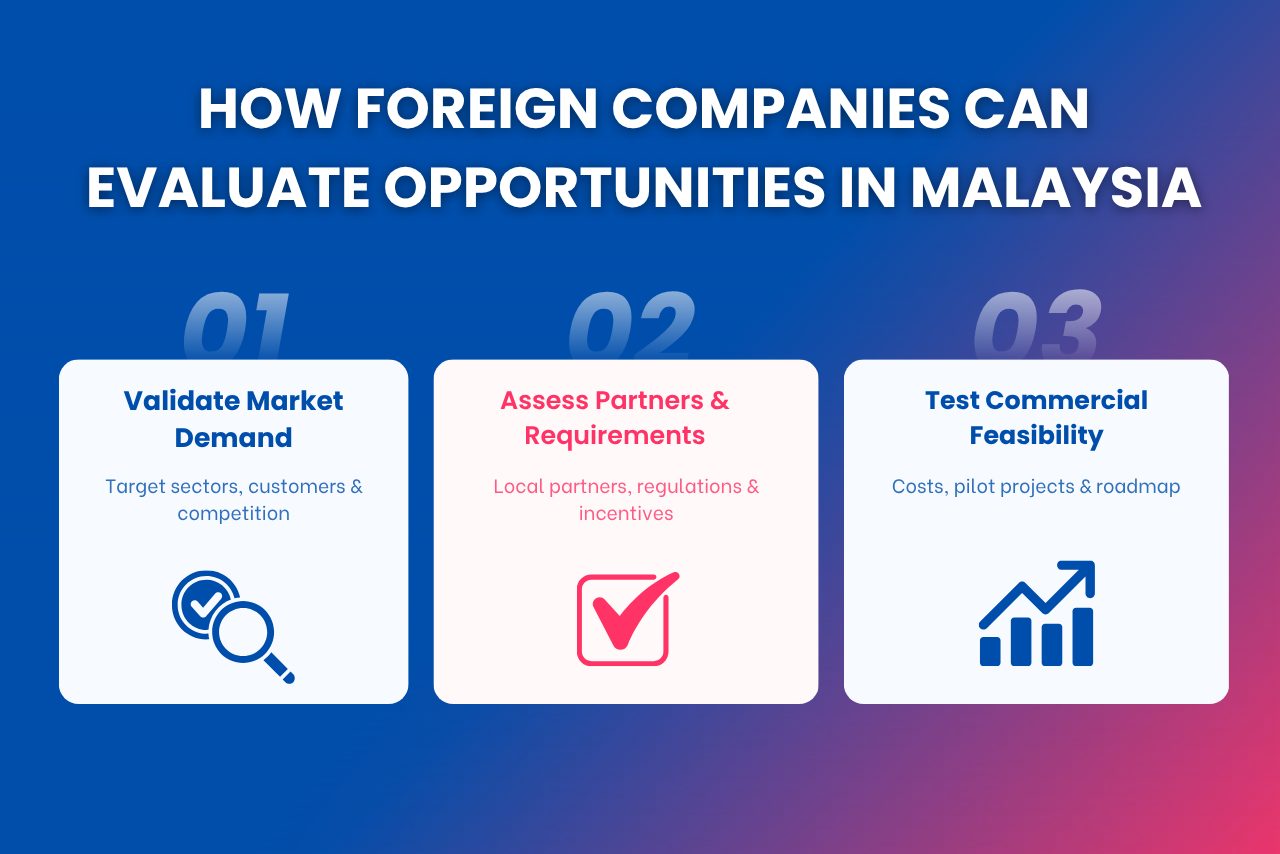
Three-step framework for evaluating business opportunities in Malaysia.
Step 1: Identify Priority Industries and Validate Market Demand
Start by identifying the industries and customer groups most relevant to the company’s products or services. Then, assess market demand, competitors, pricing, and customer purchasing processes.
For example, an industrial equipment supplier should identify manufacturers with suitable production needs rather than target every factory in Malaysia. Similarly, a consumer brand should examine its target price segment, shopping channels, and local preferences.
Customer interviews, competitor research, and discussions with industry contacts can help validate early assumptions. SOA’s article on building an ASEAN expansion strategy explains the importance of comparing markets and testing opportunities before making larger commitments.
Expected outcome: Priority customer segments, relevant business opportunities, and an initial view of commercial demand.
Step 2: Assess Local Partners, Regulations, and Investment Requirements
Next, compare the available routes to market. Some companies may begin through distributors, agents, or commercial partners. Others may require a local company to manage employees, contracts, or business operations.
If partners are involved, review their industry experience, customer coverage, technical capabilities, financial reliability, and service standards. At the same time, assess foreign investment conditions, relevant licenses, taxes, and any applicable incentives.
For example, a technology supplier working with a local system integrator will face different operating requirements from a manufacturer building a factory.
Expected outcome: A suitable entry model, a shortlist of potential partners, and a clear understanding of local requirements.
Test Commercial Feasibility and Build a Market Entry Roadmap
Once the preferred model is identified, estimate the resources needed to enter the market. Include initial investment, staffing, logistics, partner costs, customer acquisition, and ongoing operations.
Then, test key commercial assumptions through customer meetings, supplier assessments, pilot projects, or limited sales activity where appropriate. For example, a business may begin with local commercial representation before deciding whether a permanent office is justified.
As evidence develops, the company can adjust its investment plans and expansion timeline. For businesses considering a more permanent presence, SOA’s guide on relocating a business to Malaysia discusses preparation, local requirements, and operating considerations.
Expected outcome: A realistic market entry roadmap with defined costs, responsibilities, milestones, and key risks.
How Source of Asia Supports Foreign Businesses Exploring Malaysia
Source of Asia supports international businesses assessing market opportunities and developing commercial activities across Southeast Asia. Our approach combines market intelligence, business development, and practical execution support.
Market Intelligence, Sector Assessment, and Partner Development
We help businesses compare ASEAN markets, identify promising sectors, assess customer demand, and evaluate potential partners. For companies considering Malaysia, this can support early decisions about market priorities, customer segments, and routes to market. SOA’s market expansion services also support partner identification, B2B meetings, and go-to-market planning for companies developing their presence across Southeast Asia.
SOA has also shared regional market insights through initiatives such as its BNP Paribas ASEAN opportunities webinar, which examined opportunities in Malaysia, Vietnam, and Indonesia.
Regional Expansion, Sourcing, and Commercial Execution
Depending on project needs, SOA supports regional expansion planning, supplier research, partner qualification, and commercial development. This can include comparing locations, reviewing sourcing options, and developing practical market entry plans.
For Malaysia-specific activities, the scope of support should reflect the project’s requirements and the capabilities of relevant local partners. The objective is to help businesses move from initial market interest toward informed commercial decisions and a workable implementation plan. SOA’s local presence in Malaysia also helps connect international businesses with local market insights, supplier networks, and practical support for market expansion.
Final Considerations
The Malaysia business outlook in 2026 remains positive, supported by economic growth, investment activity, and policies focused on higher-value industries. Semiconductors, digital infrastructure, renewable energy, logistics, and selected services offer opportunities for foreign companies.
However, each sector has different customer needs, costs, regulations, and operating conditions. Before entering Malaysia, businesses should validate demand, assess potential partners, and build a realistic commercial plan.
Exploring business opportunities in Malaysia or across ASEAN? Contact SOA – International Business Accelerator to discuss market priorities and the next steps for international expansion.
Frequently Asked Questions
What Is Malaysia’s Economic Outlook for 2026?
Malaysia’s government revised its 2026 GDP growth forecast to 4.8–5.3% in October 2026, supported by domestic demand, investment, and trade. However, global economic conditions and operating costs may affect performance across different sectors.
Is Malaysia an Attractive Market for Foreign Investment in 2026?
Malaysia continues to attract foreign investment, particularly in services, manufacturing, and technology-related activities. MIDA recorded RM126.9 billion in approved foreign investments during the first half of 2026. However, companies should assess commercial demand, regulatory requirements, and project feasibility before investing.
Which Industries Offer the Best Business Opportunities in Malaysia?
Potential opportunities include semiconductors, electronics, advanced manufacturing, AI, cloud computing, renewable energy, logistics, and business services. However, the most suitable sector depends on the company’s expertise, target customers, available resources, and ability to compete.
How Does the 13th Malaysia Plan Affect Foreign Investors?
The 13th Malaysia Plan sets development priorities for 2026–2030, including industrial upgrading, productivity, innovation, and sustainability. These priorities may influence investment incentives and business opportunities. However, eligibility for specific incentives depends on each project’s characteristics and applicable rules.
What Should Foreign Companies Assess Before Entering Malaysia?
Foreign companies should evaluate market demand, competition, customer needs, business locations, operating costs, local partners, and regulatory requirements. They should also test commercial assumptions and compare market entry options before committing to a long-term investment.