Introduction
Malaysia continues to attract foreign companies seeking a regional base in ASEAN thanks to its strategic location, competitive operating costs, and business-friendly investment environment. Yet, when businesses start researching how to relocate to Malaysia, they often discover that the biggest challenge is not deciding whether to relocate but understanding what needs to happen before operations can legally begin.
From choosing the right company structure and obtaining industry licenses to relocating employees and selecting the right location, each decision affects implementation timelines, costs, and compliance.
In this guide, “business relocation” refers to establishing or moving business operations into Malaysia, including company setup, licensing, workforce planning, and operational readiness. So, at Source of Asia, we explain the relocation process step by step, covering the key requirements and practical considerations for a smooth business relocation.
Key Insights
- Malaysia’s strategic location, cost advantages, and trade access make it a practical base for regional expansion in ASEAN.
- The New Incentive Framework strengthens Malaysia’s appeal through performance-based support for qualifying foreign investments.
- Most foreign companies establish a Sdn. Bhd. structure through SSM as the foundation for market entry.
- Kuala Lumpur, Penang, and Johor offer different advantages based on headquarters, manufacturing, and supply chain needs.
- Relocation costs vary depending on company structure, location choice, compliance needs, and workforce requirements.
Why Foreign Companies Are Relocating to Malaysia
Malaysia remains a preferred destination for foreign companies relocating into ASEAN. Its strategic regional location, competitive operating costs, and government investment incentives continue to make it an attractive base for long-term business operations.
Strategic location within the ASEAN market
Malaysia sits at the center of ASEAN, connected by established sea and air routes to Singapore, Indonesia, Thailand, and Vietnam. This position enables companies to centralize regional operations at a single base while maintaining efficient access to key Southeast Asian markets. Thus, operational complexity across supply chains can be reduced when compared to multi-country setups.
In addition, Malaysia participates in ASEAN integration and maintains more than 15 free trade agreements, including with China, Japan, India, Australia, etc. This can support wider Asia-Pacific market access and cross-border trade planning, although entity requirements still depend on each company’s operating model and target market.
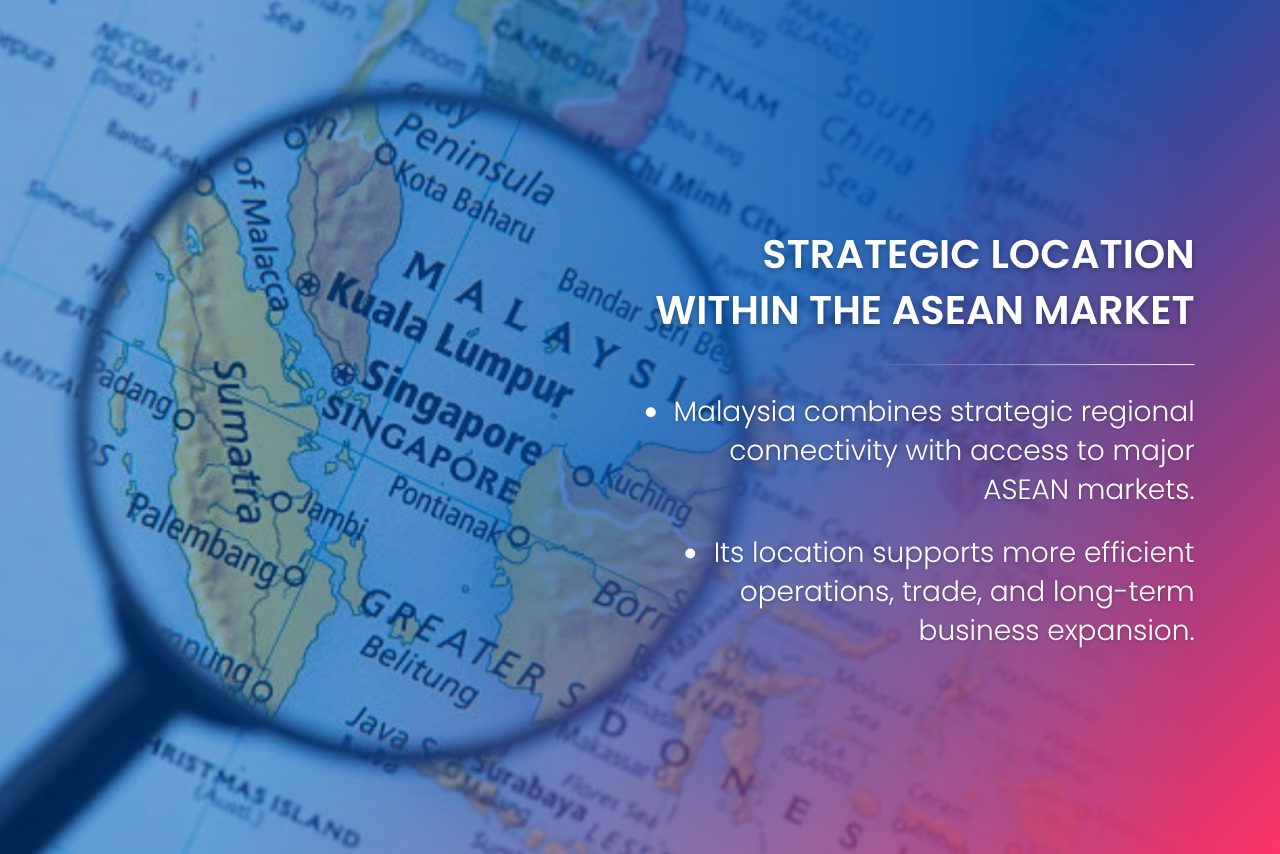
Malaysia’s strategic location connecting Singapore, Thailand, Indonesia, Vietnam, and major ASEAN trade routes.
Competitive operating costs compared to regional hubs
Malaysia offers a cost structure that is generally lower than those of regional hubs such as Singapore while still maintaining developed infrastructure and stable business services. The gap is most visible in labor costs, office leasing, industrial facilities, logistics, and supporting services, making Malaysia a practical option for companies seeking cost efficiency without sacrificing operational stability.
This cost advantage is one of the main reasons companies relocate regional back-office, manufacturing, and support functions to Malaysia. In many cases, businesses can maintain comparable operational standards while reducing fixed costs significantly. However, cost decisions still depend on industry requirements, talent availability, and location-specific conditions across different Malaysian states and industrial zones.
Government incentives through MIDA
The Malaysian Investment Development Authority (MIDA) provides a range of incentive programs designed to attract foreign investment. For companies relocating to Malaysia in 2026, three key schemes are particularly relevant.
- New Incentive Framework (NIF): A performance-based system that evaluates projects based on outcomes such as high-value job creation, technology transfer, ESG compliance, and strengthening of domestic supply chains. Incentives are linked to the quality and strategic value of investment.
- Pioneer Status (PS): Offers qualifying companies with a five-year partial income tax exemption. Companies are taxed on only 30% of statutory income during the incentive period, supporting investments in promoted activities and industries.
- Investment Tax Allowance (ITA): Provides a 60% allowance on qualifying capital expenditure, including factories, machinery, and equipment. The allowance can offset up to 70% of statutory income annually, helping reduce tax obligations during the investment phase.
How to Relocate to Malaysia: A Comprehensive Guide
Business relocation to Malaysia requires coordinated execution across legal setup, licensing, immigration, and operational readiness. The following steps outline the core process companies typically follow when establishing a compliant and scalable presence in the market.
Choose the right business structure
Most foreign companies entering Malaysia establish a Sendirian Berhad (Sdn. Bhd.), the country’s private limited company structure. It permits up to 100% foreign ownership in many sectors while providing a recognized legal framework for long-term business operations, subject to applicable industry regulations.
To incorporate a Sdn. Bhd., businesses need at least one shareholder and one Malaysian-resident director, although the same individual may serve both roles if eligible. The statutory minimum paid-up capital is RM1, but many regulated sectors or foreign participation rules require significantly higher capital before licenses or approvals are granted.
Register your company with SSM
Company registration is completed online through the Companies Commission of Malaysia (SSM) using the MyCoID portal. The process is straightforward but follows a defined sequence:
- Reserve your company name: Name approval is typically completed within 1 working day and remains valid for 30 days.
- Submit the incorporation documents: Once all required documents are ready, incorporation generally takes 3–7 working days.
After incorporation, every company must appoint a licensed company secretary within 30 days. The company secretary is responsible for statutory filings, corporate records, and ongoing compliance with Malaysian company law.
Apply for the necessary licenses and permits
Company incorporation does not automatically grant the right to operate. Licensing requirements vary by industry, so they should be reviewed before or alongside incorporation to avoid delays during market entry.
Depending on the business activity, approval may be required from different government authorities. For example:
- Manufacturing: Malaysian Investment Development Authority (MIDA)
- Digital economy and technology: Malaysia Digital Economy Corporation (MDEC)
- Distributive trade: Ministry of Domestic Trade (KPDN)
Some industries require regulatory approval before commercial operations can begin. Delaying licensing assessment until after incorporation is a common reason business relocation timelines are extended.
Secure employment passes for relocating staff
Foreign professionals relocating to Malaysia require an Employment Pass sponsored by the Malaysian entity, typically for managers, technical specialists, and key operational roles. Immigration processing often takes longer than company incorporation, so it becomes a critical factor in overall relocation timelines.
Applications generally involve:
- Employer eligibility assessment under the local entity
- Job role justification aligned with operational needs
- Employee qualification review (education, experience, contracts)
- Supporting corporate and regulatory documents
Therefore, applications should be prepared in parallel with incorporation, as delays in work authorization can slow down deployment, even when the company setup is already completed.
Set up your local office and operations
Operational setup in Malaysia focuses on building the core functions needed to support day-to-day business activity after incorporation and licensing progress.
Key components include the following:
- Corporate banking for local financial transactions
- Office premises for operational teams
- Accounting and payroll systems for financial control
- Tax registration and statutory compliance
- HR and employment frameworks for workforce management
In practice, many companies start with serviced offices or flexible workspaces to control costs and maintain flexibility during early expansion while supporting early hiring and location decisions. As operations grow, they typically transition into permanent offices or industrial facilities, ensuring compliance systems are fully established before scaling.
| 👉 Need help turning your Malaysia relocation plan into a clear roadmap? Source of Asia can support your team with market assessment, entity setup coordination, licensing review, workforce planning, and operational preparation. |
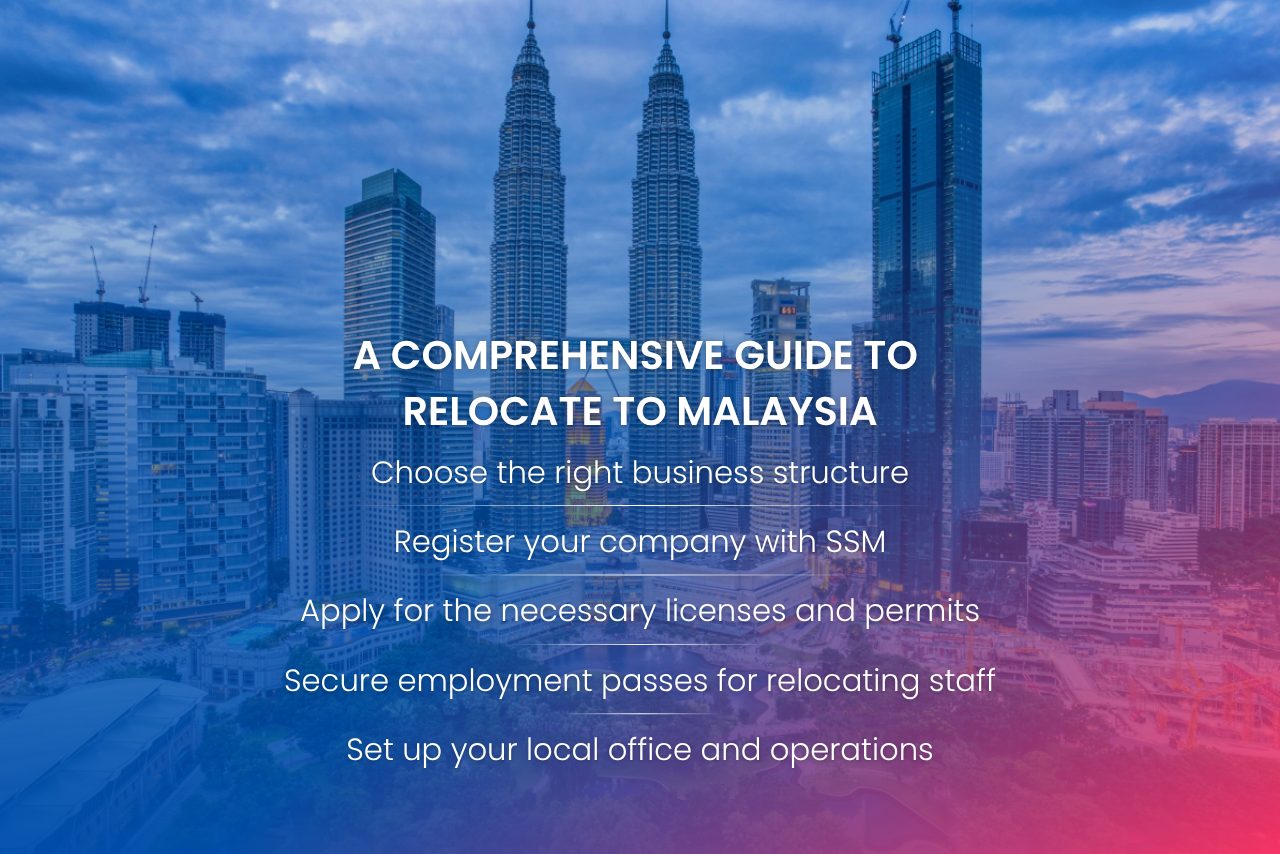
Business relocation to Malaysia involves company incorporation, licensing, immigration, and operational preparation before commercial activities begin.
Which Malaysian Location Fits Your Business Best
Choosing a location in Malaysia affects talent access, costs, and operations, so decisions should align with business needs, ecosystem strength, and proximity to customers and suppliers.
Kuala Lumpur for corporate headquarters
Kuala Lumpur serves as Malaysia’s primary financial and business hub, hosting the highest concentration of multinational corporations and professional service firms in the country. According to the World Bank, the city benefits from strong institutional access and developed business infrastructure, supporting regional management functions and headquarters operations.
It is particularly suitable for:
- Regional headquarters and management offices
- Finance, consulting, and professional services
- Technology and knowledge-based companies
Key advantages include deep talent availability, proximity to government agencies, and strong banking and advisory ecosystems. However, operating costs are higher than other Malaysian cities, so companies typically prioritize connectivity and capability over cost efficiency.
Penang for manufacturing and technology
Penang is one of Malaysia’s leading manufacturing and technology hubs, attracting companies that require a mature industrial ecosystem. Over decades, it has developed strong capabilities in high-value manufacturing, supported by experienced suppliers, engineering talent, and export-oriented infrastructure. As a result, businesses can integrate into established production networks more efficiently.
Major industries include:
- Electronics and semiconductors
- Medical devices
- Industrial automation
- Research and development
- Precision engineering
Moreover, supplier proximity, skilled workforce availability, and logistics connectivity help improve production efficiency and reduce supply chain complexity, making Penang a practical choice for manufacturing-focused investments.
| Beyond infrastructure and talent, businesses should also assess supplier readiness before building local production networks. 👉 Learn more about key considerations when sourcing in Malaysia. |
Johor for cross-border access to singapore
Johor is increasingly positioned as a cost-efficient base for companies serving the Singapore market while avoiding Singapore’s higher operating expenses. Its location directly across the border enables efficient movement of goods, services, and personnel, supporting integrated cross-border operations.
This location is suitable for:
- Logistics and warehousing providers
- Manufacturing and assembly operations
- Distribution and regional supply chain hubs
- Singapore-facing business services
Businesses benefit from lower operating costs than Singapore, proximity to a large consumer market, and access to ports, industrial parks, and established transport infrastructure. However, operational performance often depends on customs clearance efficiency and cross-border workforce mobility, which should be assessed during location planning.
| Location | Best For | Advantages | Considerations |
| Kuala Lumpur | HQ & Services | Talent, finance, business ecosystem | Higher office costs |
| Penang | Manufacturing & Tech | Supplier ecosystem, engineering talent | Limited office market |
| Johor | Logistics & Industry | Singapore access, lower costs | Depends on cross-border operations |
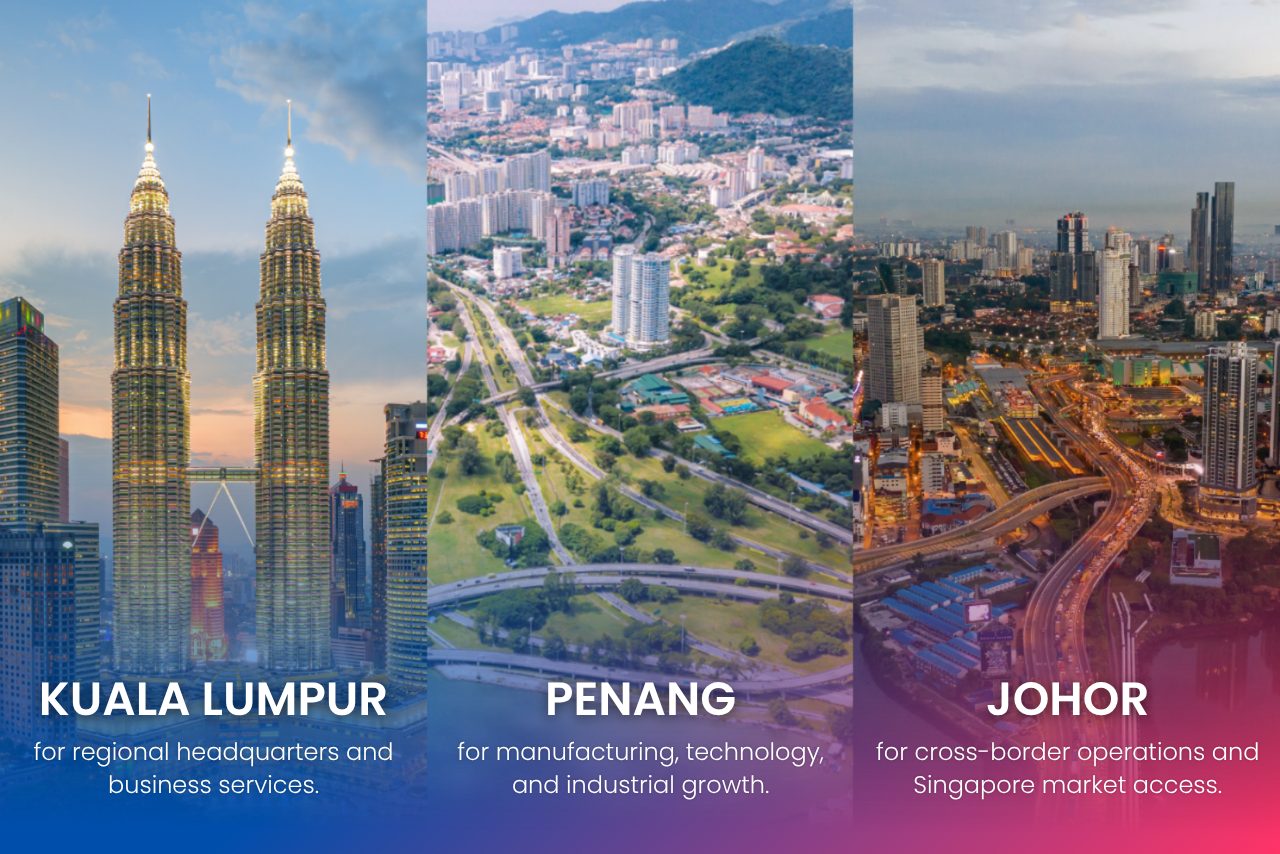
Different Malaysian business hubs support headquarters, manufacturing, and cross-border operations based on operational priorities.
How Much Does It Cost to Relocate a Business to Malaysia?
The cost of relocating to Malaysia extends beyond company registration. Businesses should evaluate incorporation, office, workforce, and compliance expenses to estimate the total investment required for market entry.
Company incorporation and compliance costs
Company incorporation costs in Malaysia extend beyond the initial registration. While the one-time setup fee is relatively modest, businesses should also plan for recurring statutory obligations to maintain compliance throughout the company’s lifecycle.
- One-time: SSM incorporation fee of RM1,010.
- Ongoing: Annual company secretary fees, annual return filing, maintenance of statutory records, annual financial statements, audit requirements (where applicable), and corporate tax filing.
Although these expenses are generally predictable, including them in long-term operating budgets helps businesses avoid compliance risks and supports more accurate financial planning from the outset.
Office space costs by city
Office rental costs in Malaysia vary by location, property grade, and business requirements. Beyond monthly rent, companies should also consider total occupancy costs when selecting a location.
For corporate offices:
- Kuala Lumpur: Highest rental rates, especially for Grade A offices in central business districts.
- Penang: More competitive costs with strong support for technology and engineering businesses.
- Johor: Generally lower office rental costs, making it attractive for cost-conscious operations.
Besides rent, businesses should budget for security deposits, fit-out works, furniture, IT infrastructure, utilities, and facility management. Many foreign companies begin with serviced offices or flexible workspaces to reduce upfront costs before moving into permanent premises.
Employment pass and workforce administration costs
Workforce costs extend beyond employee salaries and should be considered early in the relocation process. Both immigration requirements and ongoing employment compliance contribute to the total cost of establishing operations in Malaysia.
Common workforce expenses include:
- Initial: Employment Pass application fees, visa processing, employee relocation, and temporary accommodation where required.
- Ongoing: Payroll administration, employer statutory contributions, HR management, employment compliance, and local recruitment.
Rather than estimating salaries alone, businesses should budget for the full cost of workforce management to support compliant operations and avoid unexpected administrative expenses as the team grows.
How Source of Asia Supports Business Relocation to Malaysia
Relocating a business to Malaysia involves more than company registration. Market assessment, regulatory compliance, workforce planning, and operational setup all need to be coordinated to reduce implementation risks and keep expansion on schedule.
At Source of Asia, we support businesses throughout the relocation journey by combining market entry strategy with local execution. Our services include:
- Pre-relocation assessment and planning: Evaluate market opportunities, foreign ownership rules, investment incentives, business locations and develop a practical relocation roadmap before implementation.
- Business establishment and regulatory compliance: Support company incorporation, entity structuring, licensing, regulatory coordination, corporate governance, and ongoing statutory compliance.
- Operational readiness and workforce setup: Coordinate Employment Pass applications, payroll implementation, HR processes, corporate banking, office setup, accounting, and recruitment support.
- Post-establishment business support: Provide ongoing compliance, accounting, tax administration, payroll, HR advisory, operational optimization, and support for expansion into other ASEAN markets.
Conclusion
Relocating a business to Malaysia requires more than establishing a legal entity. Companies need to evaluate location strategy, regulatory requirements, workforce planning, operating costs, and long-term scalability before entering the market. With its ASEAN connectivity, investment incentives, and diverse business hubs, Malaysia provides different opportunities for companies seeking regional headquarters, manufacturing bases, or cross-border operations.
At Source of Asia, we support companies throughout the Malaysia relocation process, from pre-entry assessment and location evaluation to company setup coordination, compliance guidance, and operational preparation. Our local expertise helps businesses reduce market entry risks, navigate administrative complexity, and build a practical foundation for long-term operations in Malaysia.
| 👉 Planning to relocate your business operations to Malaysia? Speak with Source of Asia to assess your company structure, licensing needs, location options, workforce setup, and operational roadmap before entering the market. |
Frequently Asked Questions
Most foreign professionals relocating to Malaysia require an Employment Pass sponsored by the Malaysian company. The appropriate pass depends on factors such as the employee’s role, qualifications, salary, and the nature of the business.
Company registration typically takes 4–8 working days in total, including around 1 working day for name reservation and 3–7 working days for incorporation after documents are submitted. Industry licenses and Employment Pass approvals may require additional time.
Malaysia offers several investment incentives through MIDA, including the New Incentive Framework (NIF), Pioneer Status (PS), and Investment Tax Allowance (ITA). These programs provide tax incentives for qualifying projects based on their industry and expected economic contribution.
There is no fixed relocation cost, as budgets depend on the business model, location, industry, and workforce size. Companies should account for incorporation, licensing, office setup, Employment Passes, payroll, and ongoing compliance when estimating their total investment.