Introduction
Digital marketing has become a practical tool for companies evaluating international expansion opportunities. Through search data, digital channels, and customer insights, businesses can evaluate new opportunities, build market visibility, and engage potential customers before making major investments.
Yet many companies entering new markets face challenges in understanding whether real demand exists, whether their current website and content fit local buyers, and which channels can create meaningful results. Without the right approach, businesses may struggle to turn digital activities into clear market insights and expansion decisions.
In this guide, we at Source of Asia explain how global digital marketing supports market entry and sustainable growth. We cover how businesses can validate market potential, reach new audiences, measure readiness for expansion, and build scalable lead generation and customer engagement systems.
Key Insights
- Digital marketing helps businesses test demand and reduce uncertainty before building local operations.
- SEO, content, paid media, and CRM work together to generate visibility, validate demand, and convert leads in new markets.
- Market-specific content is essential because international buyers may search, compare, and evaluate solutions differently across countries.
- Measuring performance should be measured through visibility, qualified leads, and sales readiness.
- The right digital marketing partner should understand both digital execution and international expansion challenges.
Why is Digital Marketing Vital for International Business Expansion?
Digital marketing has become a critical part of international expansion strategies as businesses seek faster and more reliable ways to evaluate new markets. It helps companies build early visibility, understand buyer behavior, and identify which markets deserve deeper commercial attention.
Reaching new markets before building local operations
Expanding into a new market requires more than identifying a potential opportunity. Businesses need to understand whether customers are ready for their solutions before investing in local teams, offices, or operations.
Digital marketing provides an early way to test market interest. By using search data, targeted campaigns, and customer interactions, companies can:
- Measure demand through website traffic, keyword trends, and customer inquiries.
- Identify suitable markets by analyzing audience behavior and engagement.
- Build initial relationships with potential buyers before entering the market directly.
According to Gartner’s research (2024), 61% of B2B buyers prefer a rep-free buying experience, relying on digital channels to research and evaluate vendors independently. For companies entering new markets, this means a strong digital presence can reveal genuine buyer interest before local operations are established.
Understanding market demand through digital signals
Market demand in a new region is often difficult to evaluate from desk research alone. In contrast, digital signals add another layer of evidence by showing how potential buyers search, engage, and respond online.
Key signals typically include:
- Search demand trends, reflecting active user interest in specific solutions
- Website traffic by geography, showing where potential demand originates
- Content engagement behavior, indicating relevance and depth of interest
- Inquiry and conversion patterns, such as form fills or direct contacts
- Competitor search visibility, revealing existing market activity
Together, these signals help companies compare early market response across countries. They do not replace full market research. However, they provide a practical, evidence-based layer for prioritizing entry markets.
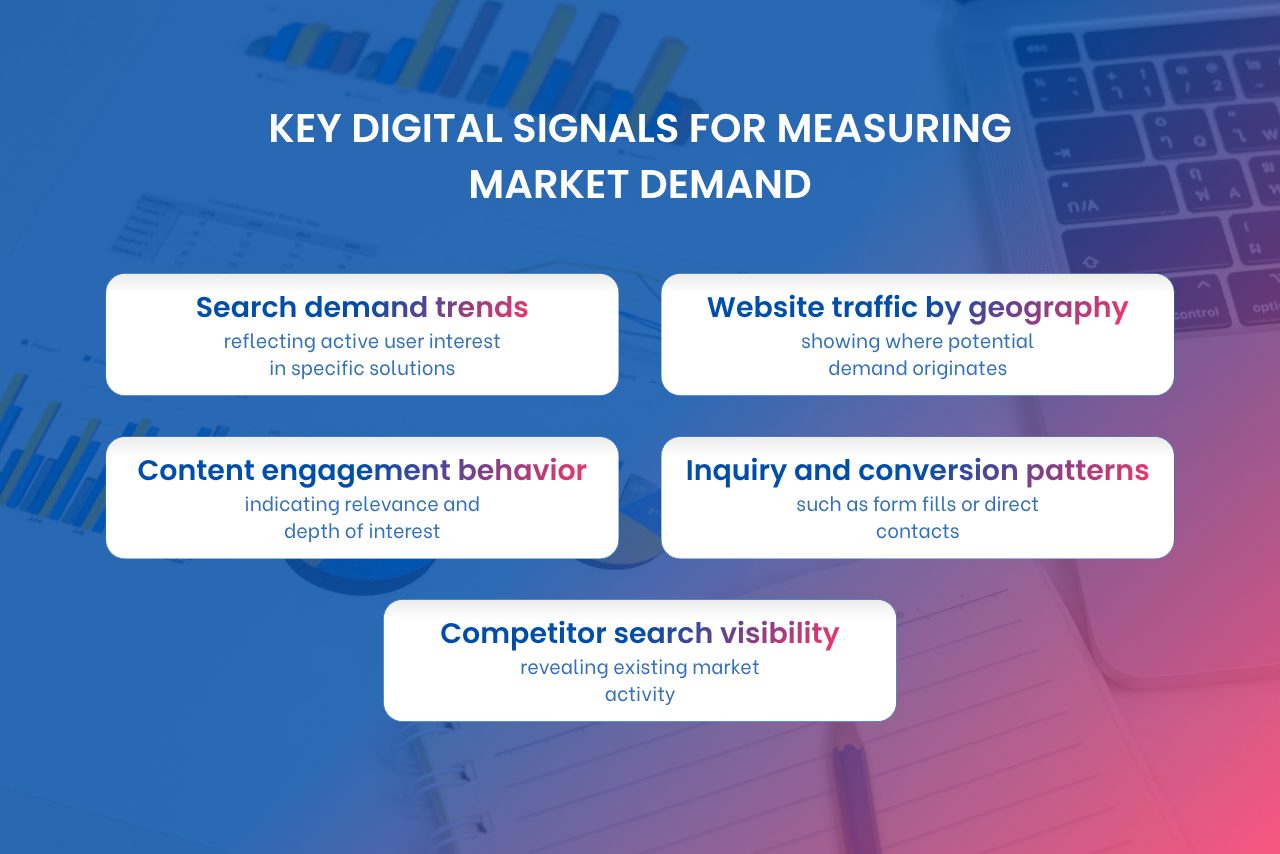
Digital signals help businesses evaluate customer interest and prioritize promising markets before expansion.
Turning digital insights into market entry decisions
Once businesses collect enough market signals, the next step is to translate them into practical decisions.
Several factors support this approach:
- Customer behavior analysis through search trends, website activity, and engagement data
- Market testing capabilities that allow companies to validate messages and channels with smaller campaigns
- Competitive intelligence through local search visibility and digital presence
Global digital marketing can show which market deserves more attention, which message needs adjustment, and which customer segment is more responsive. These insights can support decisions such as refining landing pages, adjusting campaign targeting, preparing localized sales materials, or prioritizing one market over another.
| To move from market evaluation to practical expansion planning, businesses need a clear entry strategy. 👉 Explore our guide to market expansion strategy. |
What B2B Digital Marketing Strategies Support Global Expansion?
B2B digital marketing channels such as SEO, content, paid media, and CRM help businesses build visibility, communicate with the right audience, and move qualified prospects into the sales pipeline. Together, they create a structured system that supports international expansion more efficiently and with lower market entry risk.
International SEO and market-specific content
International SEO is becoming essential for businesses entering new markets, as customers often search for products and services differently across regions. A website that ranks highly in one country may not achieve the same search visibility in another market without proper adaptation. Differences in language, search behavior, keywords, and customer expectations can directly influence SEO performance.
Effective international SEO focuses on several areas:
- Market-specific keyword research to understand local search intent
- Localized content creation based on customer needs and industry terms
- Website optimization for different languages, regions, and technical requirements
- Search performance improvements to support long-term visibility
For example, customers in different markets may use different keywords or platforms when looking for the same solution. Therefore, adapting SEO and content helps businesses establish early market visibility and demand presence in new regions.
Digital content solutions for market expansion
Although businesses may use the same products or services across regions, customer expectations and decision-making processes often differ between markets. These differences influence how companies communicate their value when expanding internationally.
Several factors typically shape digital content strategies:
- Customer expectations: Messaging, language, and information depth should align with local buyer preferences and communication styles
- Industry requirements: Content needs to address market-specific concerns, regulations, and purchasing criteria that influence decision-making
- Buyer journey: B2B customers often require detailed resources, case studies, and educational materials before engaging with a new supplier or partner
Paid media and campaign testing
Paid media helps businesses test specific audiences, messages, and offers in a controlled way before scaling activities in a new market. By running controlled campaigns, companies can identify which audiences, messages, and channels generate the strongest response.
In practice, three factors usually determine campaign testing effectiveness:
- Audience validation: Businesses can measure which customer segments engage most with their solutions and show stronger purchase intent
- Message optimization: Campaign performance reveals which value propositions, offers, and communication styles match local customer expectations
- Market and channel evaluation: Companies can compare regions and platforms to identify where demand is stronger and where qualified leads are generated
CRM, marketing automation, and lead nurturing
Generating leads is only the first step in international expansion. In B2B markets, buyers often need longer evaluation time, more information, and multiple interactions before making a decision. Therefore, managing leads consistently becomes critical.
CRM systems and marketing automation help businesses structure and control customer interactions across markets. They ensure that no opportunity is lost during the long buying cycle. Key functions include:
- Lead tracking and qualification to monitor sources, intent levels, and deal readiness across markets
- Automated follow-up workflows triggered by behavior such as downloads, visits, or inquiries
- Customer segmentation based on industry, geography, and buying intent
- Sales–marketing alignment to maintain visibility and ensure smooth pipeline management across teams
| Digital marketing strategies perform best when supported by the right channel mix 👉 Explore how to choose B2B marketing channels for each stage of business growth |
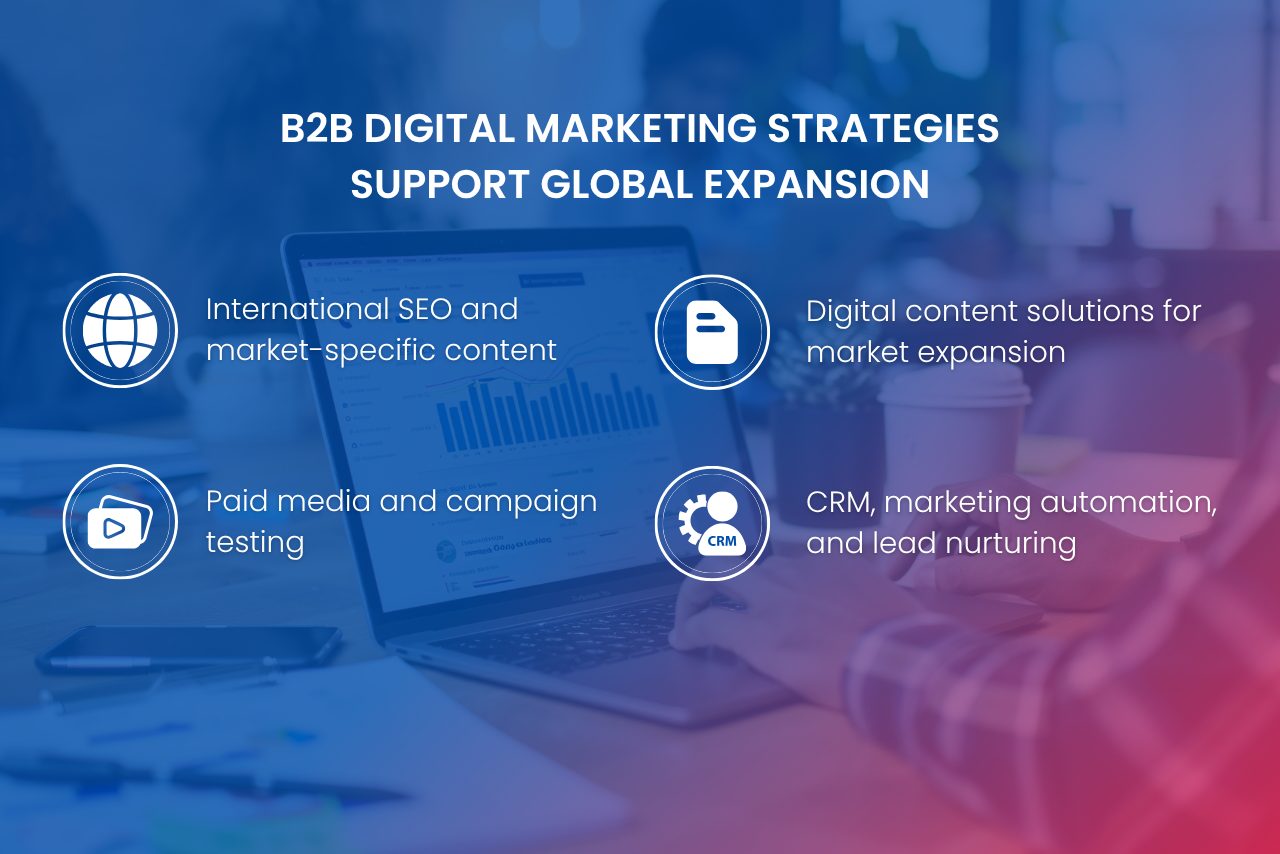
B2B digital strategies combine multiple channels to improve visibility, engagement, and lead generation across markets.
How Should Businesses Measure Digital Marketing Performance in New Markets?
In new markets, digital performance should be measured by business relevance instead of activity alone. The right metrics help companies understand whether visibility is growing, leads are qualified, and the market is ready for deeper investment. These metrics help evaluate market response and support better scaling decisions.
Market visibility indicators
Although digital channels help businesses reach international audiences, visibility levels often vary between markets. These differences show where brands are gaining awareness and where further validation may be needed.
Several indicators typically measure market visibility:
- Website traffic: Visitor sources from target countries reveal potential market interest.
- Search visibility: Keyword rankings indicate how easily customers discover relevant solutions.
- Brand awareness: Impressions and audience growth reflect market recognition.
- Content engagement: User interactions show whether messaging matches local interests.
These indicators help businesses track early market presence. However, visibility alone does not confirm demand, so companies should combine them with lead quality and conversion data.
Lead quality and business relevance
A high number of leads does not always indicate successful market expansion. For B2B businesses, the focus should be on whether prospects match the ideal customer profile (ICP) and have realistic conversion potential.
Key factors typically determine lead quality:
- Business fit: Industry, company size, location, and purchasing capability
- Engagement level: Website activity, content interaction, and response to campaigns
- Buying readiness: Customer needs, urgency, and stage in the decision process
- Conversion potential: Ability to move from inquiry to qualified sales opportunity
By using lead scoring and tracking conversion signals, businesses can prioritize valuable prospects. A smaller number of qualified leads often provides stronger market validation than a large volume of unrelated contacts.
Expansion readiness indicators
Digital performance helps businesses evaluate whether a market shows enough potential for further investment. Instead of relying only on short-term results, companies need to assess consistent demand and customer response over time.
Key indicators include:
- Consistent engagement from target accounts
- Growing interaction with localized content
- Qualified inquiries from relevant industries
- Sales feedback from real conversations
- Clearer understanding of local buying criteria
These signals help businesses decide whether to scale operations, adjust their strategy, or continue validating the market.
When Should Businesses Work with a Digital Marketing Partner for International Expansion?
International expansion often reveals gaps in market knowledge, execution capability, and strategy alignment. A digital marketing partner becomes useful when internal teams lack the time, local knowledge, or execution structure to manage multi-market digital activities consistently.
When the company lacks local market understanding
Companies entering a new market often face challenges when they lack a clear understanding of local customer behavior, market expectations, and competitive dynamics. Without sufficient insights, businesses may choose the wrong channels, use ineffective messaging, or misjudge customer demand.
Local market understanding helps businesses make more informed decisions by identifying how customers search for solutions, what influences their buying decisions, and which communication approaches build trust. This allows companies to adapt their strategies based on market realities rather than assumptions.
When digital activities are disconnected from expansion goals
In many cases, businesses execute global digital marketing activities without a clear link to their international expansion strategy. As a result, performance may look active on the surface but fail to support real market progress.
Typical gaps often appear in practice:
- Traffic without qualified leads, reducing conversion value
- Content without customer insight lowers market relevance
- Campaigns without market testing, weakening demand validation
- Activity-based metrics, instead of outcome-based performance
These issues occur when digital efforts are not linked to market validation, lead generation, or customer acquisition goals. As a result, companies struggle to translate online activity into real expansion progress.
When localization requires more than translation
Translation changes language. Localization adapts how value is communicated in each market. In international expansion, this distinction matters because customers in different regions interpret relevance and messaging differently. Key elements such as industry terminology, buying processes, value propositions, and content formats often need adjustment to match local expectations.
For example, a B2B software solution may be positioned as a “cost reduction tool” in one market but as a “productivity improvement solution” in another, depending on local priorities.
Effective localization ensures customers clearly understand why a solution fits their specific market context. In B2B environments, this is especially important because purchasing decisions rely heavily on trust, clarity, and perceived expertise, not just product information.
How to choose a digital marketing partner for international expansion
Choosing a digital marketing partner for international expansion requires more than reviewing marketing capabilities. The partner should also understand market entry, localization, and B2B sales realities.
1. International and regional market experience
A suitable partner should have a clear understanding of regional customer behavior, competitive environments, and market differences. This experience helps businesses avoid applying a single approach across countries where buying behaviors, search patterns, and business expectations may vary.
2. B2B marketing and lead generation capability
B2B expansion usually involves longer decision cycles, multiple stakeholders, and higher evaluation requirements. The partner should understand how to attract relevant audiences, qualify opportunities, nurture prospects, and support alignment between marketing and sales teams.
3. SEO, content, website, and campaign expertise
Successful international growth requires different digital channels working together. A capable partner should support market-specific SEO, localized content, website optimization, paid media campaigns, and performance tracking to improve visibility and generate meaningful opportunities.
4. Localization and market adaptation skills
Localization involves more than translating existing materials. Partners should be able to adapt messaging, terminology, communication styles, and content formats based on local customer expectations and industry context.
5. Transparent reporting and business-focused KPIs
Businesses should evaluate partners based on how they measure progress. Effective reporting should focus on qualified leads, customer engagement, market response, and expansion indicators rather than only traffic or campaign activity.
6. Connection between marketing, sales, and market entry execution
Digital marketing should contribute to broader expansion decisions. The right partner helps businesses turn digital insights into practical actions, from identifying promising markets to improving customer acquisition strategies.
| To turn market insights into execution, businesses need the right digital capabilities and regional support 👉 Explore SOA’s Marketing Services |
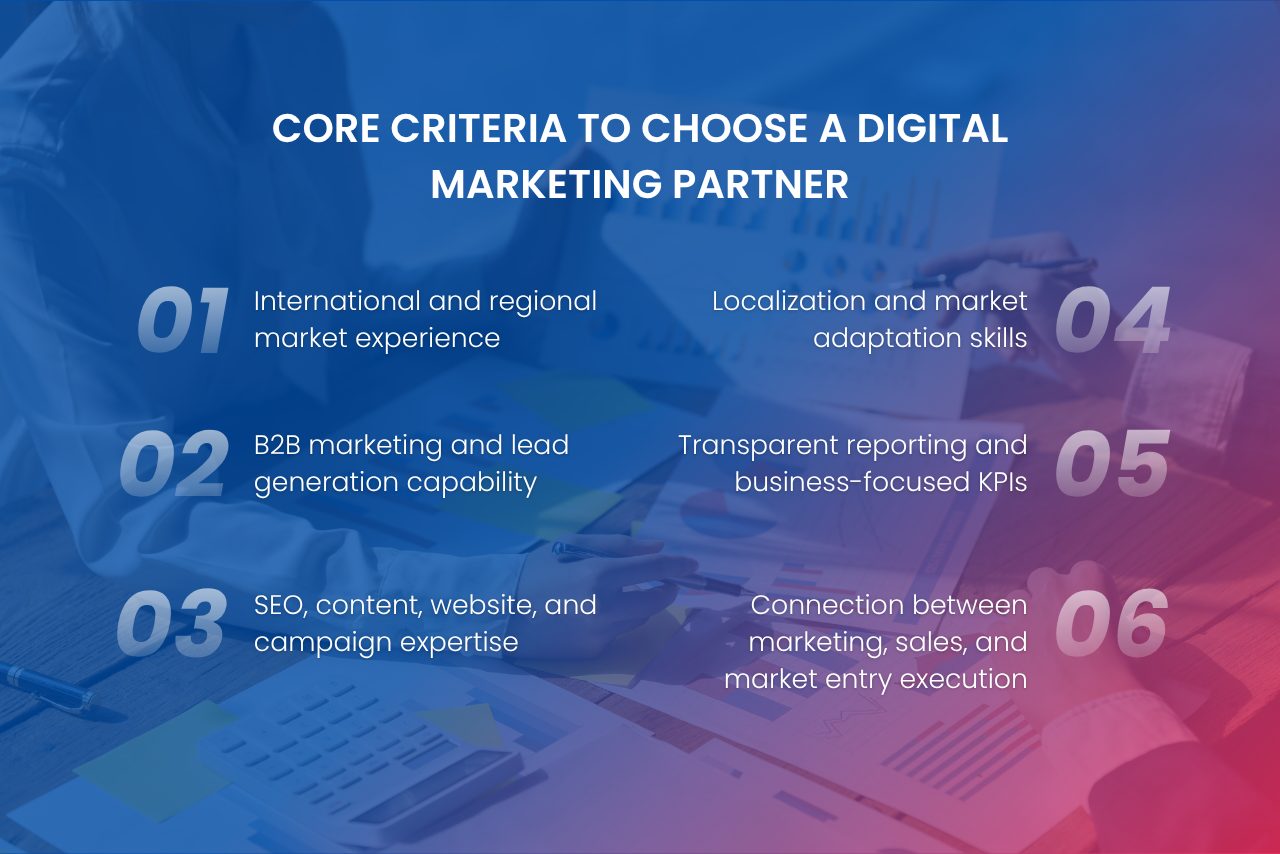
Choosing the right partner requires market knowledge, digital expertise, and measurable expansion support.
Conclusion
Digital marketing helps businesses approach international expansion with clearer market signals, stronger local visibility, and more structured lead generation. However, success depends on how well digital activities are connected to market entry objectives, customer expectations, and sales execution.
By combining market expansion experience with digital strategy and local execution, Source of Asia helps businesses turn online visibility into practical market entry actions across ASEAN.
- Brand strategy
- Content marketing & SEO
- Website development
- Social media development
Our approach helps companies build stronger market presence and connect digital activities with broader expansion objectives.
|
👉 Need execution support for your expansion strategy? Contact our team to build a stronger digital growth strategy for your target market! |
Frequently Asked Questions
Digital marketing helps foreign companies test target audiences and track behaviors. It allows faster and more evidence-based market entry decisions by showing signals to reduce uncertainty factors in new markets.
The most effective approach often combines international SEO, localized content, paid media testing, and CRM-based lead nurturing. However, actual effectiveness depends on market conditions, industry characteristics, and execution quality. This system helps attract relevant traffic, validate demand, and convert qualified leads across longer B2B decision cycles in new markets.
Engaging a digital strategy agency is typically relevant when entering unfamiliar markets, when internal capabilities are limited across channels, or when businesses need structured execution across SEO, content, paid media, and CRM aligned with expansion goals.