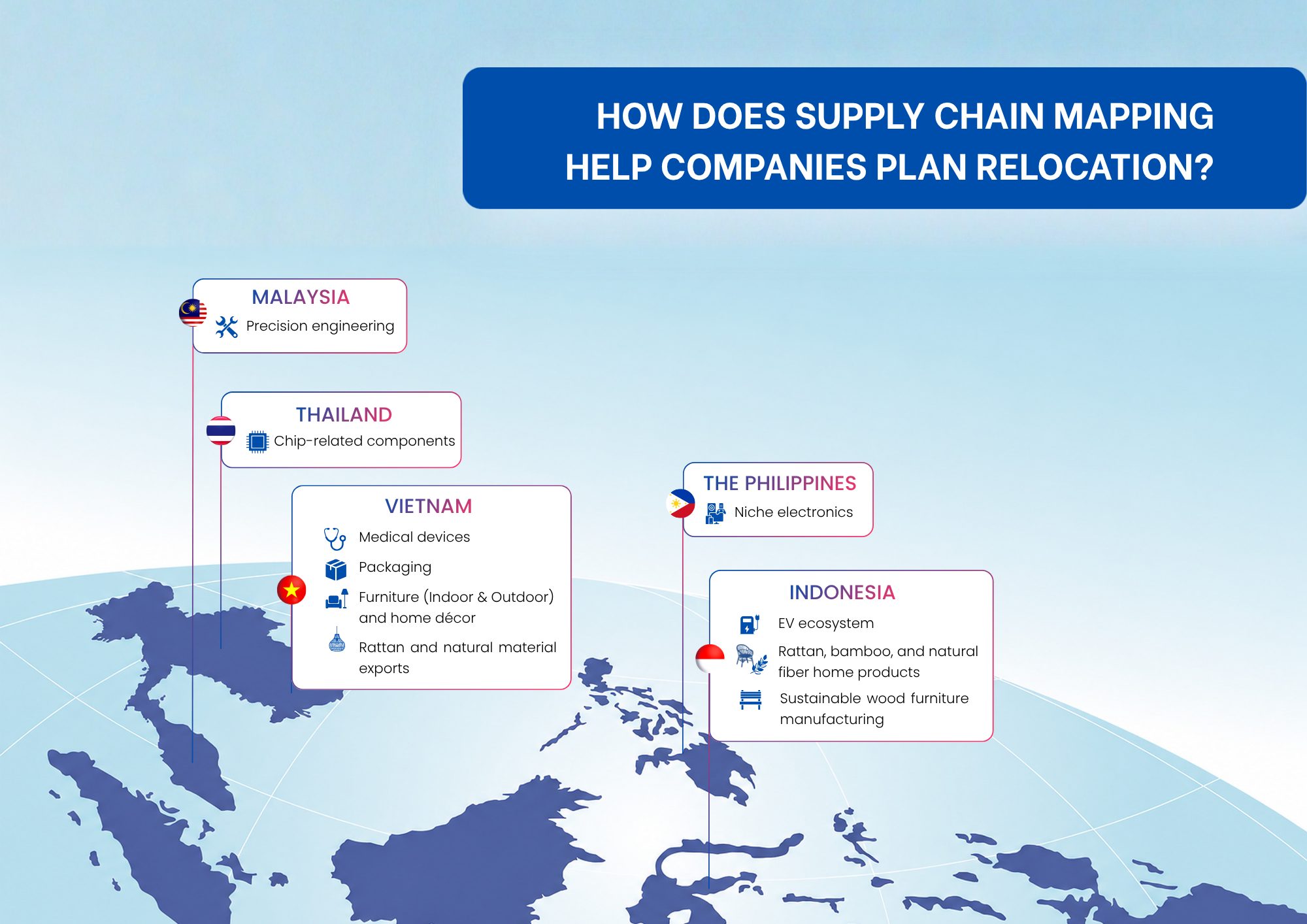
Before a company relocates production or redesigns its sourcing strategy, it needs a clear view of its existing supply chain. Without that visibility, relocation decisions can be based on incomplete cost assumptions, supplier promises, or market opportunities that may not be operationally realistic. This is where supply chain mapping becomes essential. It helps companies visualize suppliers, material flows, production stages, logistics routes, dependencies, risks, and decision points. More importantly, it helps leadership understand whether relocation, supplier diversification, or ASEAN sourcing is truly feasible.
In this article, Source of Asia explains how to create a supply chain map before relocation, which risks to assess, and how our Supply Chain Relocation Mapping publication can help you evaluate ASEAN opportunities with more confidence.
Key insights
- Supply chain mapping helps companies understand suppliers, material flows, production stages, logistics routes, and operational dependencies.
- A useful supply chain map should go beyond tier-1 suppliers and include multi-tier visibility where risk is high.
- Accurate mapping can reveal bottlenecks, supplier concentration, duplicated flows, compliance gaps, and hidden cost drivers.
- Companies should map their supply chain before making relocation, China+1, or ASEAN sourcing decisions.
- Source of Asia’s Supply Chain Relocation Mapping publication helps companies compare ASEAN-6 industrial clusters, compliance requirements, and relocation readiness.
Supply Chain Mapping Overview
Before companies decide where to relocate production, they need to understand how their current supply chain actually works. A supply chain map provides this visibility by showing the suppliers, production steps, logistics flows, and dependencies that shape relocation feasibility.
What is supply chain mapping?
Supply chain mapping is the process of documenting and visualizing the companies, locations, activities, and flows involved in producing and delivering a product.
A supply chain map may include direct suppliers, sub-suppliers, factories, warehouses, logistics providers, ports, distribution centers, and final markets. It can also show how materials, products, information, documents, and payments move across the network.
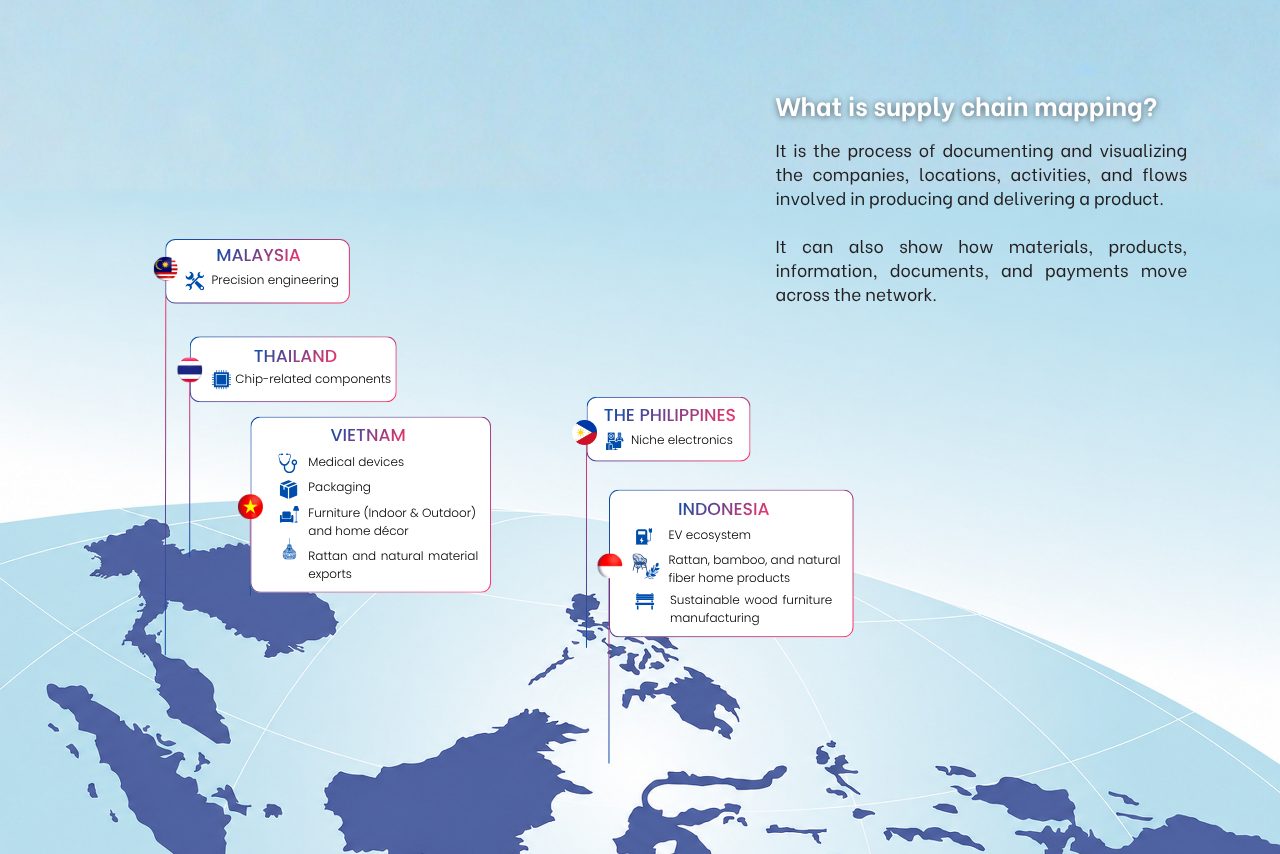
Supply chain mapping gives companies a clearer view of suppliers, production sites, materials, information flows, and logistics across their network.
A simple supplier list is not the same as a supply chain map. A supplier list tells you who you buy from. A supply chain map shows how the entire network works, where dependencies exist, and which parts of the chain could create operational, financial, compliance, or logistics risks.
For companies exploring relocation, this difference matters. You cannot evaluate a new production location properly if you do not understand the supply chain you are trying to move, rebuild, or diversify.
What a supply chain mapping example might include
A European furniture company exploring relocation from China to ASEAN may need to map several layers of its supply chain. The map could include wood or MDF sources, upholstery suppliers, hardware components, tier-1 furniture factories, finishing facilities, packaging providers, ports, shipping routes, and export markets. It may also include certification requirements such as FSC documentation, buyer audits, quality standards, and social compliance expectations.
With this map, the company can compare markets such as Vietnam, Malaysia, Indonesia, or Thailand based on supplier maturity, material availability, logistics, compliance readiness, and total cost. This makes relocation planning more realistic than relying only on country-level assumptions.
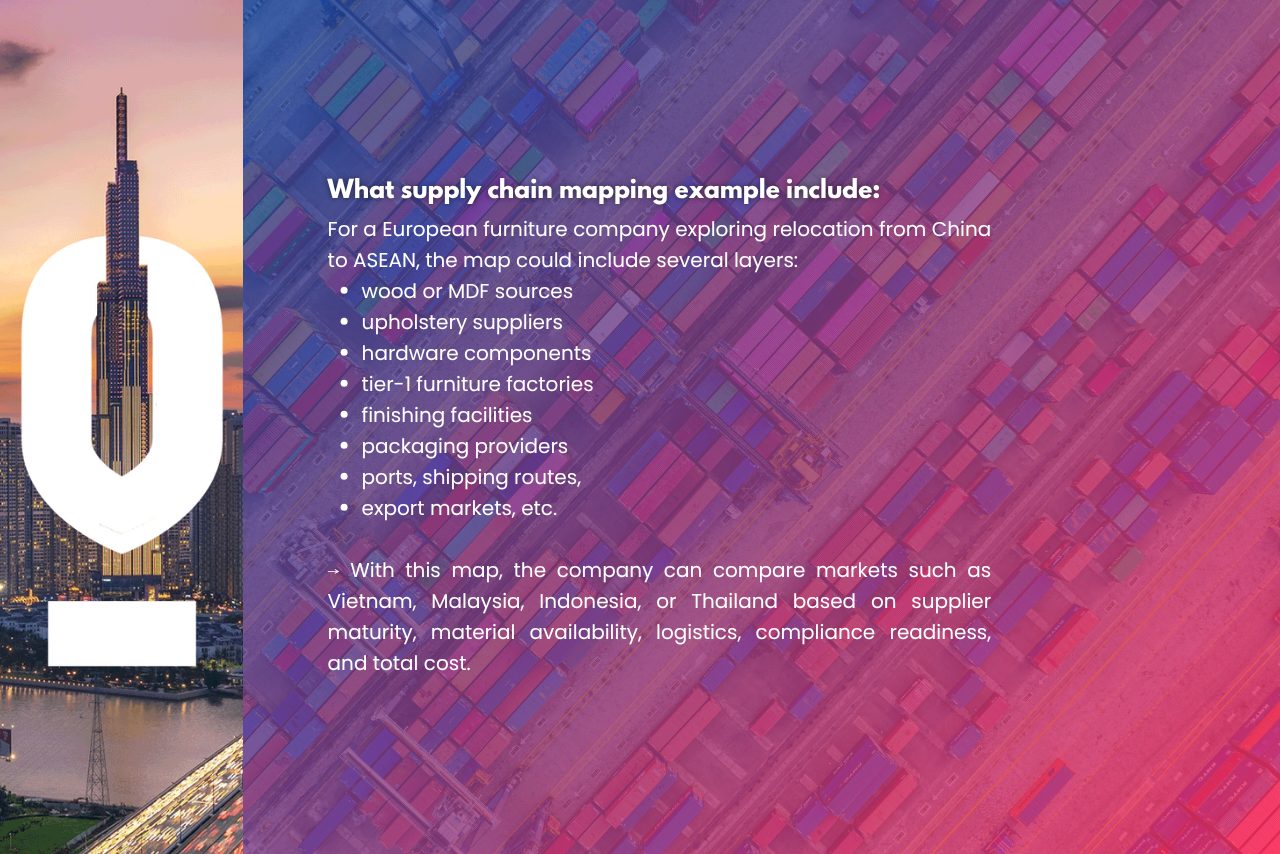
A practical supply chain mapping example can help companies compare ASEAN markets based on supplier maturity, material availability, logistics, compliance readiness, and total cost.
Why companies need a supply chain map before relocation
In terms of relocation, you should not ask the question, “Which country is cheaper?” Instead, you should begin with a more practical question: “What exactly needs to move, change, or remain connected?”
A supply chain map helps answer that question. It shows which suppliers are critical, which materials are difficult to replace, where lead time risks exist, and which logistics routes create dependency. It also helps companies understand whether specific certifications, raw materials, components, or supplier capabilities are available in the target relocation market.
This is especially important for ASEAN relocation. Vietnam, Thailand, Malaysia, Indonesia, the Philippines, and Singapore do not offer the same industrial strengths. Each market has different supplier ecosystems, labor conditions, infrastructure, regulatory requirements, and export advantages.
By mapping the supply chain first, companies can avoid treating relocation as a simple country selection exercise. Instead, you can evaluate whether a target market has the right supplier depth, production capability, compliance readiness, and logistics conditions for your specific product.
→ Supply chain mapping is only one part of relocation planning. Companies must also assess market entry models, legal setup, costs, local partners, and execution risks before moving into a new ASEAN market. Read our guide on how to relocate your business to Southeast Asia for a full overview of relocation planning.
How Accurate Mapping Improves Supply Chain Efficiency
Accurate mapping can improve supply chain efficiency because it makes hidden problems visible.
First, it helps companies identify supplier concentration. A business may believe it has several supplier options, only to discover that multiple-tier-1 suppliers depend on the same upstream material source, region, or logistics route.
Second, mapping reveals bottlenecks. These may include long transport routes, repeated handling points, slow documentation processes, limited port options, or production steps that depend on only one qualified facility.
Third, a supply chain map supports faster decision-making. Procurement, operations, logistics, quality, and finance teams often look at the same supply chain from different angles. A shared map gives these teams a common view of the network, which makes discussions more practical.
Finally, mapping improves risk and compliance readiness. Companies can better trace material origins, supplier certifications, ESG exposure, documentation gaps, and potential regulatory risks. This is increasingly important as buyers face stricter due diligence and sustainability requirements.
How to Create a Supply Chain Map in 9 Steps
Many companies start supply chain mapping with a spreadsheet. That is useful, but it is not enough. If the goal is relocation or supplier diversification, the process should also test feasibility, validate suppliers, and prepare for implementation.
Understanding that, Source of Asia’s relocation process follows three phases, including nine steps: evaluate & plan, test & validate, and implement & scale.
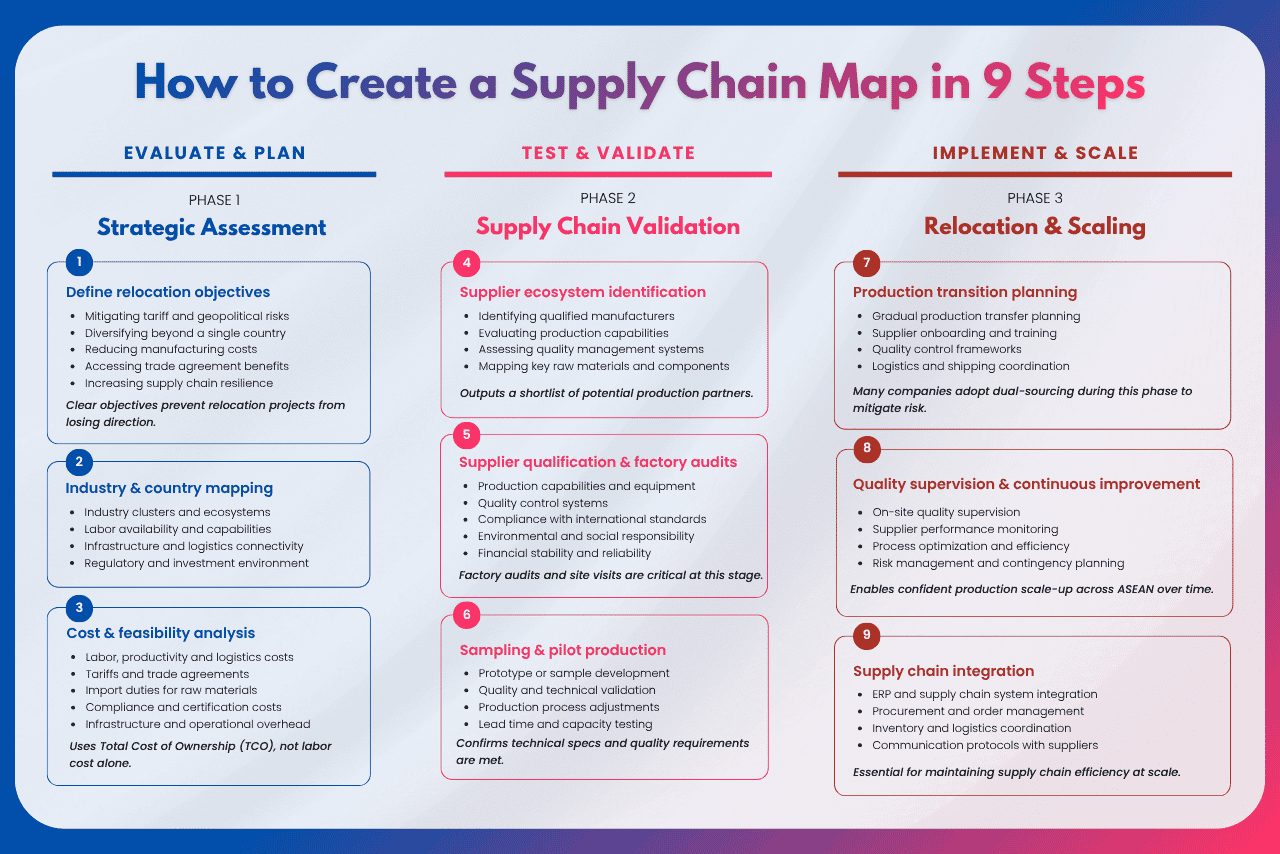
A 9-step supply chain mapping process helps companies assess relocation goals, validate suppliers, and scale production across ASEAN with greater visibility.
Step 1. Define relocation objectives
Start by clarifying why you want to map and potentially relocate your supply chain. Your objective may be to reduce tariff exposure, diversify beyond a single country, lower manufacturing costs, access trade agreement benefits, or increase resilience.
Clear objectives prevent the project from losing direction. They also help your team decide which suppliers, materials, countries, and product lines should be assessed first.
Step 2. Map industry and country fit
Next, compare your product category with the industrial strengths of each potential market. This includes industry clusters, supplier ecosystems, labor availability, infrastructure, logistics connectivity, regulatory conditions, and investment environment.
For example, a country may be attractive from a cost perspective but weak in supplier depth for your specific category. Another market may be more expensive but stronger in quality, compliance, or logistics.
Step 3. Conduct cost and feasibility analysis
A relocation decision should not rely on labor cost alone. Companies need to compare the total cost of ownership, including logistics costs, tariffs, import duties, compliance costs, certification requirements, raw material access, infrastructure, and operational overhead.
This step helps determine whether relocation is financially and operationally realistic before supplier discussions become too advanced.
Step 4. Identify the supplier ecosystem
Once you know which countries and categories are worth exploring, identify potential manufacturers and production partners. This includes checking production capabilities, quality management systems, key materials, components, and supplier availability.
The output of this step should be a shortlist of potential production partners, not a final supplier decision.
Step 5. Qualify suppliers and conduct factory audits
Supplier qualifications are where supply chain mapping becomes more concrete. Companies should assess production capabilities, equipment, quality control systems, compliance with international standards, environmental and social responsibility, financial stability, and reliability.
Factory audits and site visits are critical at this stage. They help confirm whether a supplier can meet technical, quality, compliance, and delivery expectations.
Step 6. Run sampling and pilot production
Before scaling, companies should test the supplier’s actual production capability. This may include prototype development, sample production, quality validation, technical checks, production process adjustments, lead time testing, and capacity testing.
Pilot production helps confirm whether technical specifications and quality requirements can be met before a larger production transition begins.
Step 7. Plan the production transition
Relocation does not always mean moving everything at once. Many companies use gradual production transfer or dual sourcing to reduce risk.
At this stage, the company should plan supplier onboarding, training, quality control frameworks, logistics coordination, and production transfer timelines. A phased approach helps protect business continuity while the new supply chain is being built.
Step 8. Supervise quality and improve continuously
Once production starts, companies need active quality supervision and supplier performance monitoring. This includes on-site quality checks, process optimization, efficiency reviews, risk management, and contingency planning.
This step is essential for maintaining consistency as production scales across ASEAN.
Step 9. Integrate the supply chain
The final step is supply chain integration. New suppliers, production sites, logistics partners, and procurement workflows must be connected to the company’s operating systems. This may involve ERP and supply chain system integration, procurement and order management, inventory coordination, logistics planning, and communication protocols with suppliers.
Without integration, relocation can create fragmented operations. With integration, the new supply chain becomes easier to manage on a larger scale.
When Supply Chain Mapping Shows You Are Not Ready to Relocate Yet
A supply chain map does not always show that relocation should happen immediately. In many cases, it shows that a company needs more preparation first.
Warning signs may include unclear relocation objectives, missing tier-2 supplier visibility, no total cost comparison, limited supplier alternatives, weak documentation, unresolved compliance questions, or lack of internal alignment.
This is useful information. It prevents companies from moving too quickly and helps them focus on the gaps that must be addressed before relocation becomes realistic. If your map shows too many unknowns, the next step should be deeper feasibility analysis, supplier validation, and relocation readiness assessment.
Download the Supply Chain Relocation Mapping Publication
The guide covers ASEAN-6 industrial clusters, sector relocation insights, ESG and compliance requirements, a 9-step relocation process, and a relocation readiness checklist.
It is designed for companies that need more than a general overview. It helps you understand where ASEAN may fit your supply chain strategy, which questions to ask before relocating, and how to prepare your next decision with greater clarity.
Download the free publication to map your supply chain, assess ASEAN fit, and plan your next relocation move with more confidence.
Conclusion
Supply chain mapping is not only a visibility exercise. It helps companies understand dependencies, efficiency gaps, supplier risks, compliance requirements, and relocation constraints before making major operational decisions. A strong map gives leadership a clearer basis for choosing what to validate, which ASEAN markets to explore, and which risks to address first.
Before you move production, make sure you understand the supply chain you are moving. Then, use SOA’s Supply Chain Relocation Mapping publication to evaluate your next step.
Frequently Asked Questions
Supply chain mapping is the process of visualizing the suppliers, production stages, logistics routes, locations, and flows involved in producing and delivering a product. It helps companies understand how their supply chain works and where risks or dependencies exist.
To create a supply chain map, define your objective, collect supplier and operational data, map direct and upstream suppliers, visualize product and information flows, identify risks, validate supplier inputs, and turn the findings into an improvement or relocation roadmap.
Supply chain mapping is important before relocation because it shows whether a company has enough visibility to move or diversify production. It helps identify supplier dependencies, cost drivers, compliance gaps, logistics constraints, and market-fit questions before decisions are made.