Introduction
If you’re planning to expand into South Korea, one of the first decisions is how to establish a local presence. You can register a company in South Korea as a local corporation, open a branch office, or set up a liaison office. Each option serves a different purpose, so choosing the right structure early can affect how you operate later.
Setting up a company in South Korea also involves more than incorporation. Foreign investors must manage separate steps for investment notification, capital remittance, incorporation, business registration, banking, and foreign-invested company registration. Missing a document or completing a step out of order can cause unnecessary delays.
In this guide, we – Source of Asia – break down the process step by step, including key requirements, costs, timelines, and practical considerations.
Quick Recap
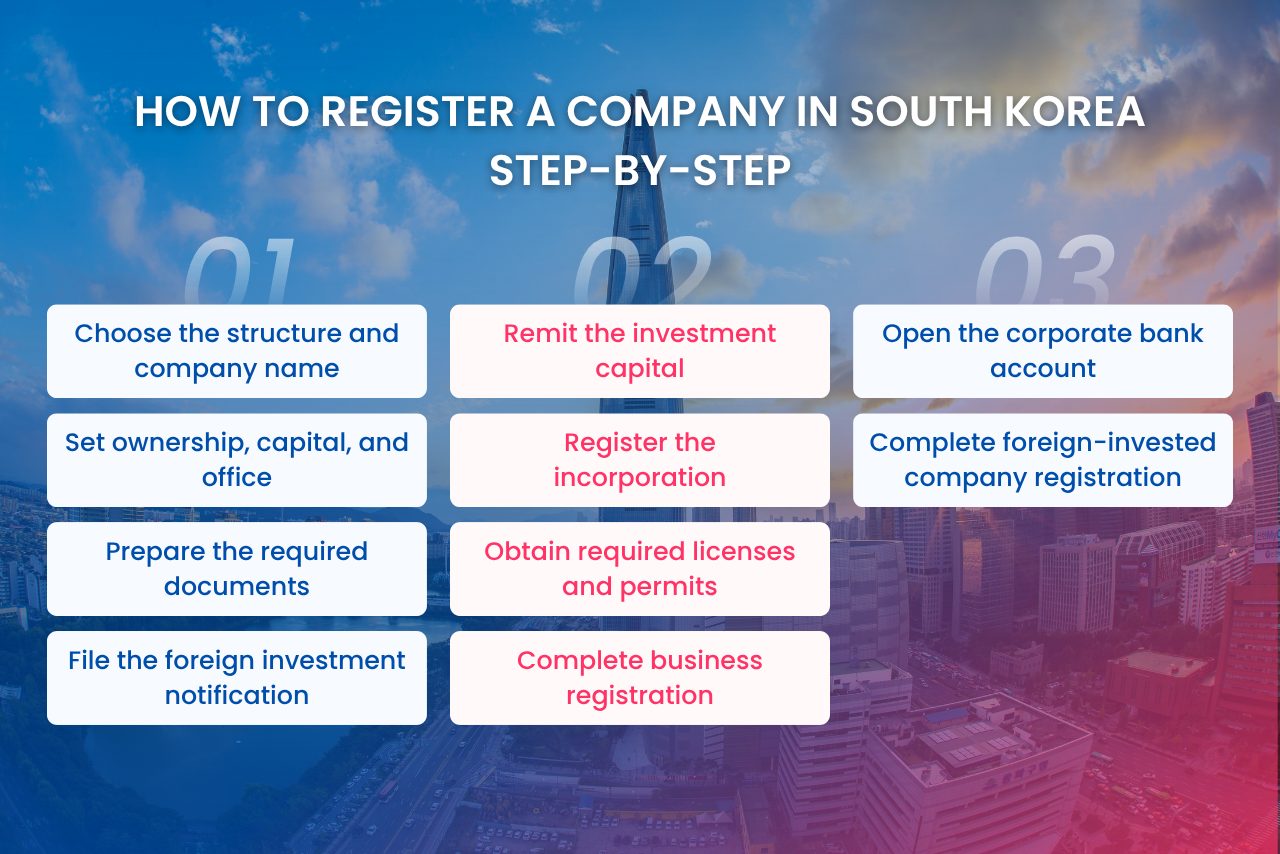
The process to register a company in South Korea consists of 10 key steps, from choosing the right structure to completing foreign-investment registration:
- Choose the structure and company name
- Set ownership, capital, and office
- Prepare the required documents
- File the foreign investment notification
- Remit the investment capital
- Register the incorporation
- Obtain required licenses and permits
- Complete business registration
- Open the corporate bank account
- Complete foreign-invested company registration
Following the right sequence can help foreign businesses avoid common delays and prepare for smoother market entry.
 Add Source of Asia as a preferred source on Google
👉 If you need a clearer overview first, explore our Pros and Cons of Doing Business in South Korea guide to understand the key advantages, common challenges, which companies may suit the market, and how to prepare for entry.
Compare Business Structures In South Korea At A Glance
The right business structure depends on the activities, ownership plans, and long-term goals of each company. Understanding the main options helps companies choose the right setup and avoid unnecessary costs or changes later.
| Criteria | Stock Company (Chusik Hoesa) | Limited Company (Yuhan Hoesa) | Branch Office (Jijeom) |
Liaison Office (Samuso) |
|---|---|---|---|---|
| Foreign Ownership | Generally 100% allowed
(Sector restrictions may apply) |
Generally 100% allowed
(Sector restrictions may apply) |
Part of the foreign parent company | Part of the foreign parent company |
| Local Management | At least 1 shareholder and 1–3 directors depending on capital | At least 1 member and 1 director | At least 1 branch representative | At least 1 representative |
| Capital Needed | No statutory minimum
(KRW 100M+ generally required for standard FDI recognition) |
No statutory minimum
(KRW 100M+ generally required for standard FDI recognition) |
No capital requirement | No capital requirement |
| Generate Revenue | Yes | Yes | Yes | No, non-commercial activities only |
| Separate Legal Entity | Yes | Yes | No, extension of the foreign parent | No, non-commercial office |
(The following 10 steps describe the standard process for setting up a foreign-invested local corporation. Branch and liaison offices may follow different requirements.)
10 key steps for foreign businesses to register a company in South Korea
Phase 1: Before Registering A Company In South Korea
Good preparation can make the registration process smoother. Before companies register a company in South Korea, define the business structure, ownership, capital, registered address, and required documents.
Step 1: Choose the structure and company name
Start with how the business will operate in Korea, then choose the structure that supports it. For example:
- Stock company: A common fit when the business expects multiple shareholders, external investment, or future expansion.
- Limited company: Often works well for SMEs and closely held subsidiaries with simpler ownership.
- Branch office: Lets a foreign company carry out commercial activities directly through its parent structure in Korea.
- Liaison office: Useful for market research, promotion, and local coordination when the company does not plan to generate revenue in Korea.
After choosing the structure, check the proposed name through Korea’s Supreme Court Internet Registry. A conflict can stop the filing, force changes to prepared documents, and affect the registration timeline, so resolve name issues before submitting the application.
Step 2: Set ownership, capital, and office
Define the shareholders, ownership structure, representatives, and investment amount early in the setup. Under Korea’s Foreign Investment Promotion Act (FIPA), standard FDI recognition generally requires at least KRW 100 million and 10% or more of voting shares, subject to applicable rules. An alternative may apply where the foreign investor appoints or dispatches an executive to the Korean company.
Next, plan the capital around the company’s expected startup, staffing, and operating needs. Companies should also secure a registered business address that matches the planned activities. Since proof of address may be required for later registration and banking procedures, securing the location early can help prevent delays and keep the setup on track.
Step 3: Prepare the required documents
Once the structure, ownership, and business address are set, start gathering the documents needed to register a company in South Korea. The core package typically includes:
- Investor documents: Passport or corporate registration documents
- Company documents: Articles of Incorporation and shareholder information
- Authorization: Power of Attorney, where applicable
- Address proof: Office lease or registered address documents
- Investment proof: Documents showing the investment and capital remittance
For documents issued outside Korea, notarization, apostille, or consular confirmation, and Korean translation may be required, depending on the document and filing. Check these requirements early, as missing certification or an incorrect format can lead to rework and delay the registration process.
Step 4: File the foreign investment notification
Before sending investment funds into Korea, file the Foreign Investment Notification with KOTRA or a designated foreign exchange bank. This step records the proposed investment and gives the relevant authority the key details needed to process it. The notification covers key details such as the investor, investment amount, ownership structure, and planned business activities.
At this stage, document requirements vary by investor type. Individual investors typically provide a passport, while corporate investors may need incorporation or equivalent company documents. If an agent files on the company’s behalf, a Power of Attorney is required. Keep the notification record, as it will be needed for later registration steps.
Phase 2: During the Company Registration Process
Once the initial setup is complete, companies move to the capital remittance and incorporation stages required to register a company in South Korea. Each step must follow the required sequence and use the correct supporting documents to keep the process moving.
Step 5: Remit the investment capital
After filing the FDI notification, remit the investment capital through the designated foreign exchange bank. Companies should follow the bank’s transfer instructions carefully and use the correct investment purpose and recipient details.
After the funds arrive, keep the foreign currency purchase or remittance certificate issued by the bank. This document serves as proof of the capital transfer and may be required for incorporation. Checking the transfer details in advance can help avoid additional bank verification or delays.
Step 6: Register the incorporation
When the investment capital has been transferred, move to the formal incorporation filing. Companies should prepare the documents carefully because errors at this stage can require corrections before the registration is accepted.
- Finalize the filing package: Prepare the incorporation documents, capital payment proof, corporate seal documents, and other required records.
- Submit the application: File with the relevant court registry office and pay the required registration tax and fees.
- Check the tax rate: The standard rate is 0.4% of paid-in capital. A 1.2% rate may apply in Seoul Metropolitan over-concentration areas, subject to exceptions.
- Track the registration: Allow around 2–3 days once the application is complete and no corrections are required.
- Budget the full cost: Include registration fees, local education tax, notarization, and company seal costs in the setup budget.
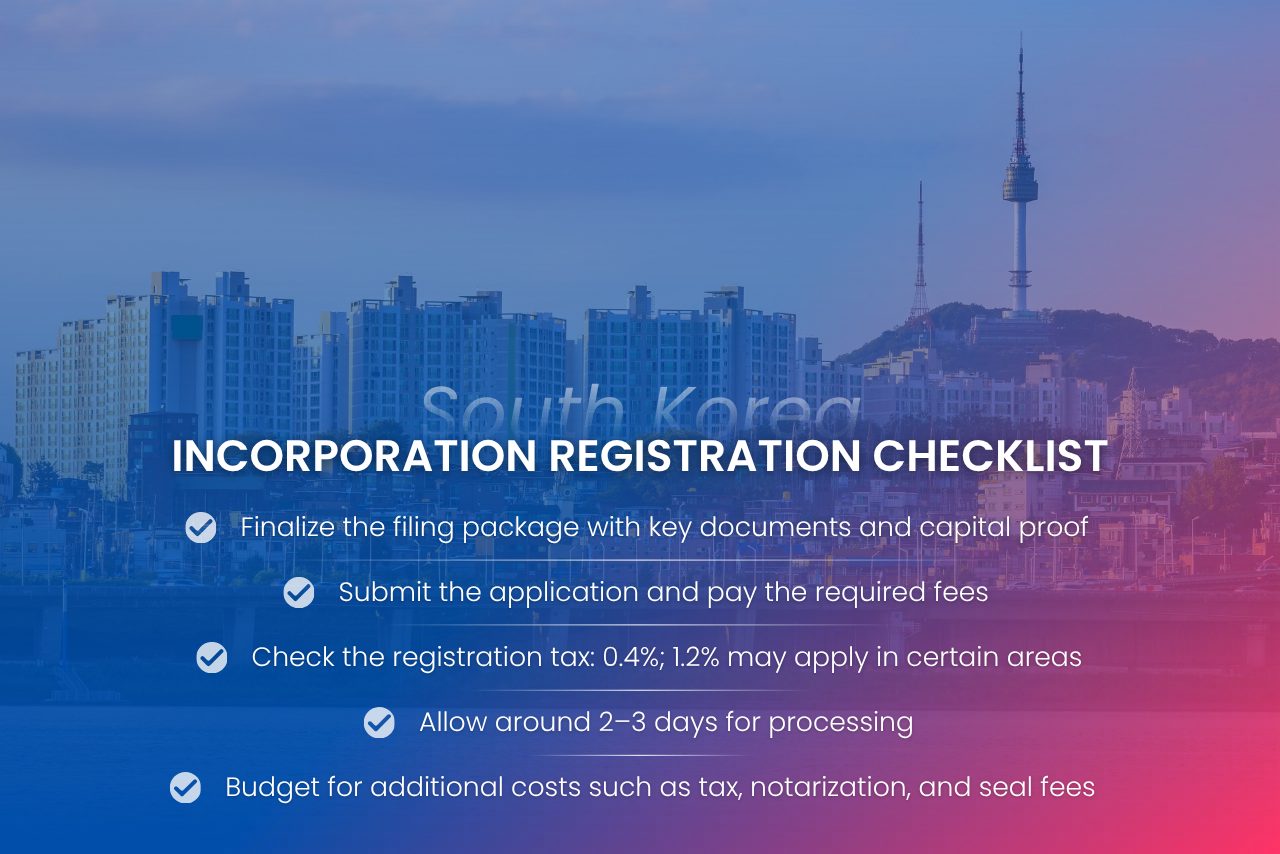
Incorporation registration checklist for foreign companies setting up in South Korea
Step 7: Obtain required licenses and permits
Some business activities in South Korea require sector-specific licenses, permits, or approvals before operations can begin. These requirements should be identified early when planning to register a company in South Korea.
For example, according to the Ministry of Food and Drug Safety, medical device businesses may need product notification, certification, or approval depending on the device class. Similarly, food businesses must meet specific safety and reporting requirements.
For this reason, companies should check these requirements during the setup stage and complete them in the required order. Licensing may take longer than incorporation, so early planning helps avoid launch delays.
Step 8: Complete business registration
After incorporation, register the company with the National Tax Service (NTS) and obtain the Business Registration Certificate. This registration supports tax administration and is commonly required for practical steps such as invoicing and opening the corporate bank account.
Companies generally need to complete business registration within 20 days of starting business activities. Processing usually takes around 3 days when the application and supporting documents are complete. Typical documents include:
- Business registration application
- Incorporation registration certificate
- Articles of Incorporation
- Lease contract and shareholder information
- Relevant licenses or permits, where applicable
Phase 3: After Opening A Company In South Korea
With the legal entity in place, companies still need to complete several post-registration steps before starting full operations. The focus now shifts to corporate banking and foreign-invested company registration.
Step 9: Open the corporate bank account
A corporate bank account is needed for payroll, supplier payments, tax, and other daily transactions. Companies can apply through a foreign exchange bank and should prepare the main corporate records, including:
- Incorporation registration certificate
- Business Registration Certificate
- Corporate seal documents
- Representative’s passport and shareholder information
Bank requirements can vary, so check the document list with the selected bank in advance. It is also worth choosing the bank carefully, as opening another corporate account with a different bank is generally restricted for 20 business days after the first account is opened.
Step 10: Complete foreign-invested company registration
At the final stage, register the company with KOTRA or the foreign exchange bank where the original FDI notification was filed. Under the Foreign Investment Promotion Act, this registration should generally be completed within 60 days after the investment capital has been paid.
Prepare the key documents, including:
- Incorporation registration certificate
- Foreign currency purchase certificate
- Shareholder list
- Business Registration Certificate
- Application form and Power of Attorney, where applicable
The registration certificate can support later foreign-exchange, investment, and other administrative procedures, making it an important final step in the FDI setup process.
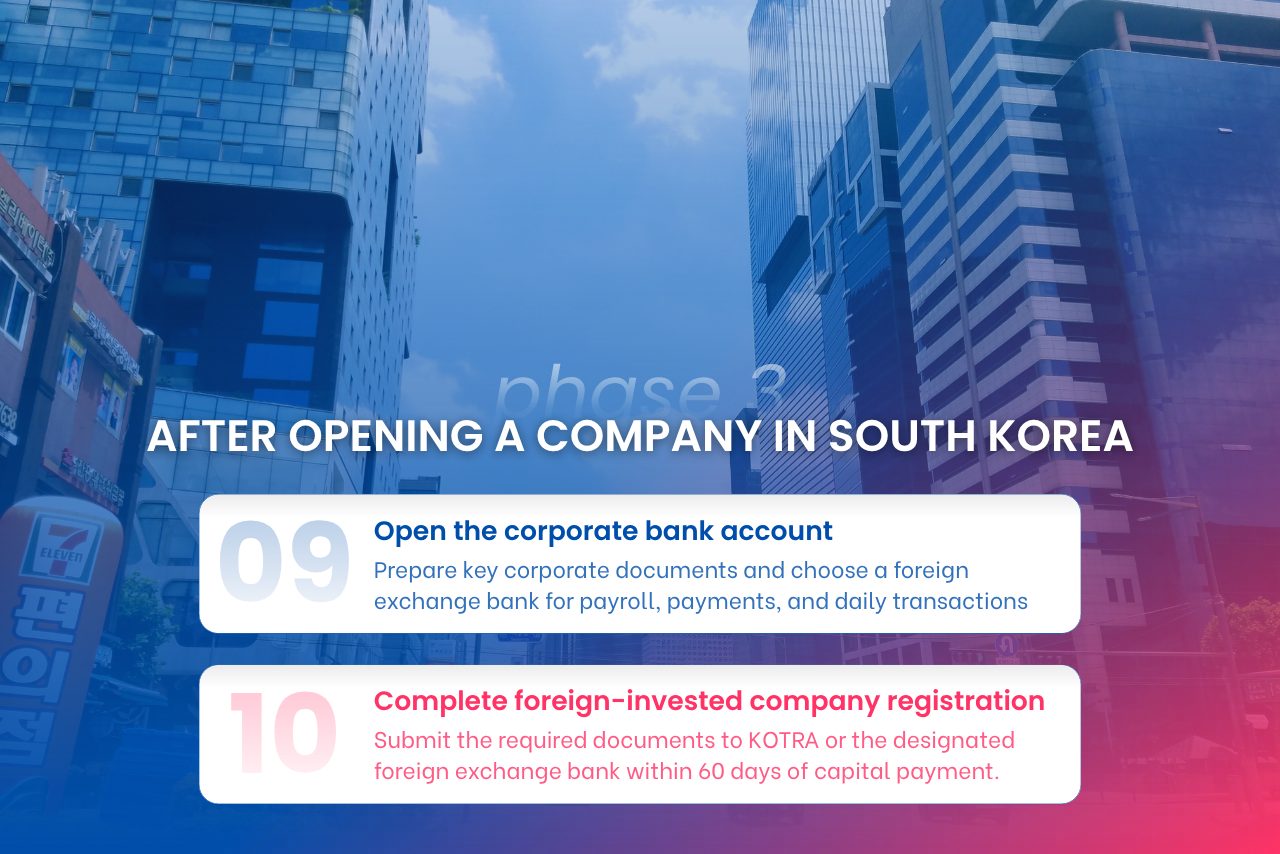
Post-registration steps for banking and foreign-invested company registration
How Source of Asia Can Support Your Company Setup in South Korea
Setting up a business in South Korea can involve more than legal procedures. Language barriers, cultural differences, local business practices, and administrative requirements can make it harder for foreign companies to handle each step efficiently without local knowledge.
This is where a local partner can add value by helping companies understand local requirements and coordinate the setup more effectively. Source of Asia supports companies beyond the paperwork, helping connect market entry planning with local setup and ongoing operations:
- Market entry planning: Support market diagnosis, partner identification, and market expansion strategy.
- Company setup and local establishment: Support company registration and licensing, corporate secretarial services, office setup, and related requirements.
- HR and payroll: Provide recruitment, payroll management, and EOR and HR solutions to help companies build and manage a local workforce.
- Local operational support: Assist with accounting, annual reports, process management, local invoicing, imports, customs, and other administrative needs.
- Support beyond setup: Continue supporting office needs, foreign employee relocation, HR, administration, and local operations as the business develops.
Final Considerations
To successfully register a company in South Korea, foreign businesses need to manage multiple connected steps, from choosing the right structure and filing the FDI notification to remitting capital, completing incorporation, business registration, and corporate banking. Each stage has its own requirements, so careful planning can help companies avoid delays and keep the setup on track.
Company registration is only the starting point for building a local operation. From there, companies may need to arrange an office, hire staff, manage payroll, and handle day-to-day administration. With our local presence in South Korea, Source of Asia can provide closer coordination, local market understanding, and ongoing support as businesses establish and develop their presence.
| 👉 Speak to our experts about registering a company in South Korea and planning your local market entry. |
Frequently Asked Questions
Yes. Foreign investors can establish a Korean corporation with 100% foreign ownership, or choose a branch or liaison office depending on planned activities. A local corporation generally requires at least KRW 100 million for FDI recognition under standard rules.
There is no fixed cost to open a company in South Korea. Total costs depend on the structure, paid-in capital, location, and setup requirements. Registration and license tax is generally 0.4% of paid-in capital, or 1.2% in certain over-concentration areas, plus other registration and professional costs.
Not fully. Some filings can be handled online, including business registration through Hometax, but foreign-invested company setup involves separate incorporation, banking, and investment procedures. Foreign documents may also require notarization, apostille, or other certification.
A straightforward setup takes around two weeks, although the actual timeline varies. Capital remittance and incorporation each typically take 2–3 days, while business registration takes around three days. Licensing and document issues can extend the process.