Introduction
Vietnam offers strong growth opportunities, but economic growth alone does not show whether a market is commercially viable for a specific company. Demand can vary across customer segments, while competition, pricing, distribution, regulation, and local business conditions can determine how attractive an opportunity is in practice. This is where market intelligence in Vietnam becomes essential. It helps companies move beyond broad market figures to understand where real opportunities exist, how the market operates, and which factors could affect commercial potential before committing resources.
In this article, Source of Asia examines the key drivers of Vietnam’s market growth, where the opportunities lie, and which local conditions can affect them. We then consider how market intelligence can help foreign companies turn these insights into better-informed decisions.
Quick Answer
What is market intelligence in Vietnam?
Market intelligence in Vietnam is the ongoing process of collecting and analyzing information about the local business environment to support better commercial decisions. It can cover:
- Customer demand and behavior
- Competitor activity and industry trends
- Pricing, distribution, and regulations
For foreign companies, these insights can help identify where demand exists, understand local market conditions, and assess opportunities and risks before entering or expanding in Vietnam.
If you need an overview first, read our Market Intelligence 101 Guide to understand the broader concept, key types of market intelligence, and how companies use it without over-investing.
 Add Source of Asia as a preferred source on Google
Vietnam’s Market Landscape and Growth Drivers
Before assessing opportunities, it helps to understand the size of Vietnam’s market, the sectors gaining momentum, and the forces shaping its growth.
Market size, economic growth, and consumer trends
Vietnam had an average population of 102.3 million in 2025, with 38.6% living in urban areas. According to Vietnam’s National Statistics Office (NSO), GDP grew by 8.02%, while GDP per capita reached about US$5,026. Total retail sales of goods and consumer services also increased by 9.2%. Together, these figures indicate a sizable domestic market, continued economic expansion, and growing commercial activity.
Still, national figures are only a starting point. Market potential varies by location and customer segment, as purchasing power and buying behavior differ across Vietnam. For example, premium products may see stronger demand in major cities than in smaller provinces. Companies should therefore assess market size alongside target customers, demand, and purchasing conditions.
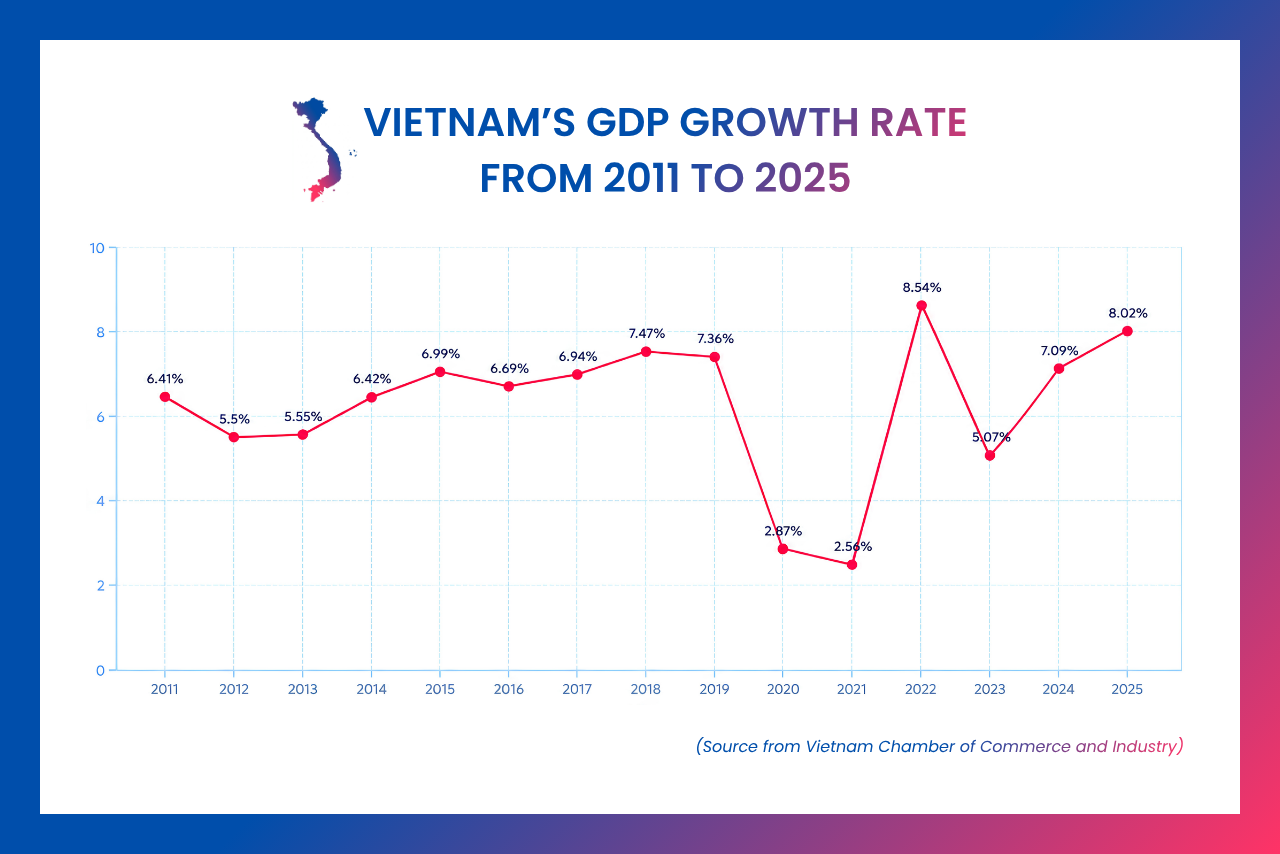
Vietnam’s annual GDP growth rate from 2011 to 2025.
Key industries and business sectors
Vietnam’s 2025 economic data highlights several sectors with strong relevance for foreign businesses. Each points to a different source of commercial potential:
- Manufacturing posted 9.97% growth, reinforcing Vietnam’s role as a production and export hub.
- Transport and storage expanded 10.99%, reflecting stronger trade flows and logistics demand.
- Accommodation and food services rose 10.02%, supported by tourism and consumer activity.
- Wholesale and retail trade increased 8.52%, showing continued momentum in domestic consumption and distribution.
Together, these sectors reveal where business activity is gaining momentum in Vietnam. For foreign companies, this can help narrow market intelligence efforts toward industries, customer groups, and opportunities with stronger potential.
Main factors driving market growth
Vietnam’s market growth is shaped by several connected forces. Domestic consumption and manufacturing continue to expand, while merchandise trade reached about US$930.05 billion in 2025. FDI also remains important, with registered foreign investment reaching about US$38.4 billion in 2025. Together, these figures reflect strong domestic demand and international business activity.
Meanwhile, digital adoption is creating new ways to reach customers. Vietnam’s online retail market was estimated at US$32 billion in 2025. As a result, opportunities are emerging across industrial supply chains, consumer markets, trade, and digital channels, giving Vietnam a more diverse and interconnected growth landscape.
What Market Opportunities Does Vietnam Offer?
Vietnam offers opportunities across industries and customer groups, but its commercial potential can vary. The following factors help companies assess where demand exists, how accessible customers are, and what may affect market entry.
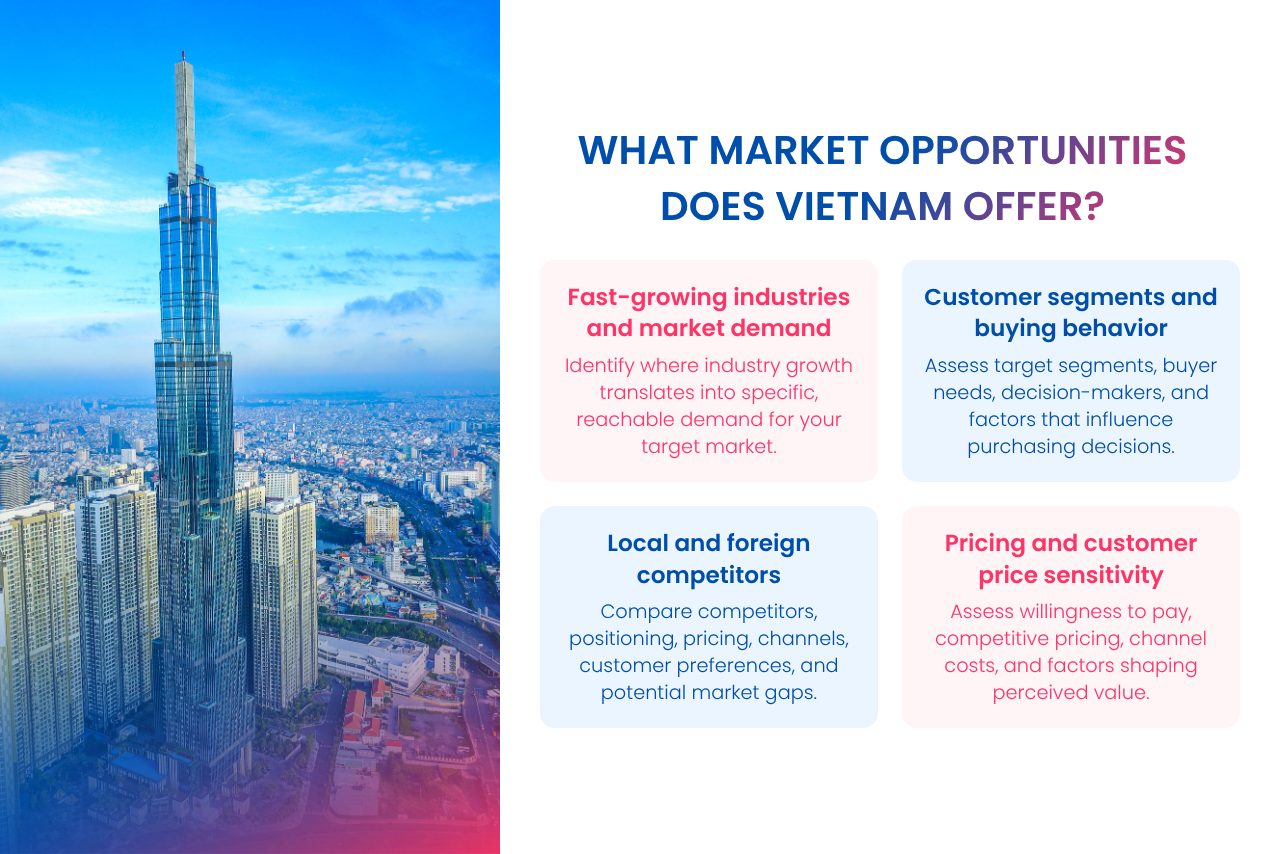
Key market opportunities in Vietnam across industry demand, customer segments, competition, and pricing.
Fast-growing industries and market demand
A fast-growing industry does not necessarily mean strong demand for every product or service. A growing industry does not necessarily mean strong demand for a specific product or easy access to customers.
Companies should assess:
- How many potential customers they can reach
- How strong and urgent their needs are
- Whether existing solutions leave clear gaps
- How intense competition is within the segment
For example, a growing manufacturing market may still offer limited potential in segments dominated by established suppliers. Vietnam market intelligence helps distinguish broad industry growth from opportunities a company can realistically capture.
Customer segments and buying behavior
In Vietnam, a market opportunity often sits within a specific customer segment, not the market as a whole. Companies need to compare segments by location, income, purchasing power, industry, company size, and use case. For example, a premium consumer product may target higher-income urban buyers, while an industrial solution may focus on manufacturers with a specific technical need.
Buying behavior helps determine whether that demand is accessible. Market intelligence in Vietnam can help companies understand who makes the decision, how buyers choose suppliers, and what factors may slow a purchase. This helps identify customer segments where demand is strong and customers are reachable.
Local and foreign competitors
Vietnam’s competitive landscape includes local companies, multinational corporations, distributors, agents, and newer entrants. Local players often hold advantages in pricing, customer relationships, distribution, and knowledge of local procurement practices, which can make differentiation harder for foreign companies. A useful competitive assessment should look beyond company names and focus on four areas:
- Market position and the customer segments each competitor serves.
- Product positioning, pricing, and channels used to reach customers.
- Customer preferences and the factors that influence supplier choice.
- Market gaps and entry barriers that may create or limit opportunities.
Pricing and customer price sensitivity
Price sensitivity can determine whether market demand is commercially viable. In Vietnam, acceptable pricing may vary by customer segment, industry, and location. Market intelligence helps companies identify what customers are willing to pay, what they compare, and which factors shape perceived value, rather than relying only on competitor prices.
The actual cost of reaching customers also matters. Logistics, distributor margins, localization, taxes, and after-sales support can all affect the final price and profit margin. By combining pricing data with customer feedback and channel research, market intelligence can show whether a proposed offer is competitive and commercially sustainable.
| 👉 Read our guide on Market Intelligence vs. Market Research to understand the difference and how each approach supports business decisions. |
What Local Market Realities Matter in Vietnam?
Beyond market size and growth, local conditions can shape market potential and accessibility. Companies should consider regional differences, business practices, distribution networks, and operating conditions.
Differences between Northern, Central, and Southern Vietnam
Vietnam is not a uniform market, and regional differences can affect market potential and accessibility. Key differences include:
- Northern Vietnam: Has strong concentrations of government institutions, manufacturing, and industrial activity, with Hanoi serving as a major administrative and business center.
- Central Vietnam: Has smaller business hubs, with conditions varying across tourism, logistics, manufacturing, and regional trade. Infrastructure and talent availability also differ between provinces.
- Southern Vietnam: Has strong private-sector activity, consumer markets, services, and foreign-invested businesses, with Ho Chi Minh City as a major commercial hub.
These differences mean market intelligence in Vietnam should assess customer demand, business networks, infrastructure, and talent by region, rather than rely on national-level data alone.
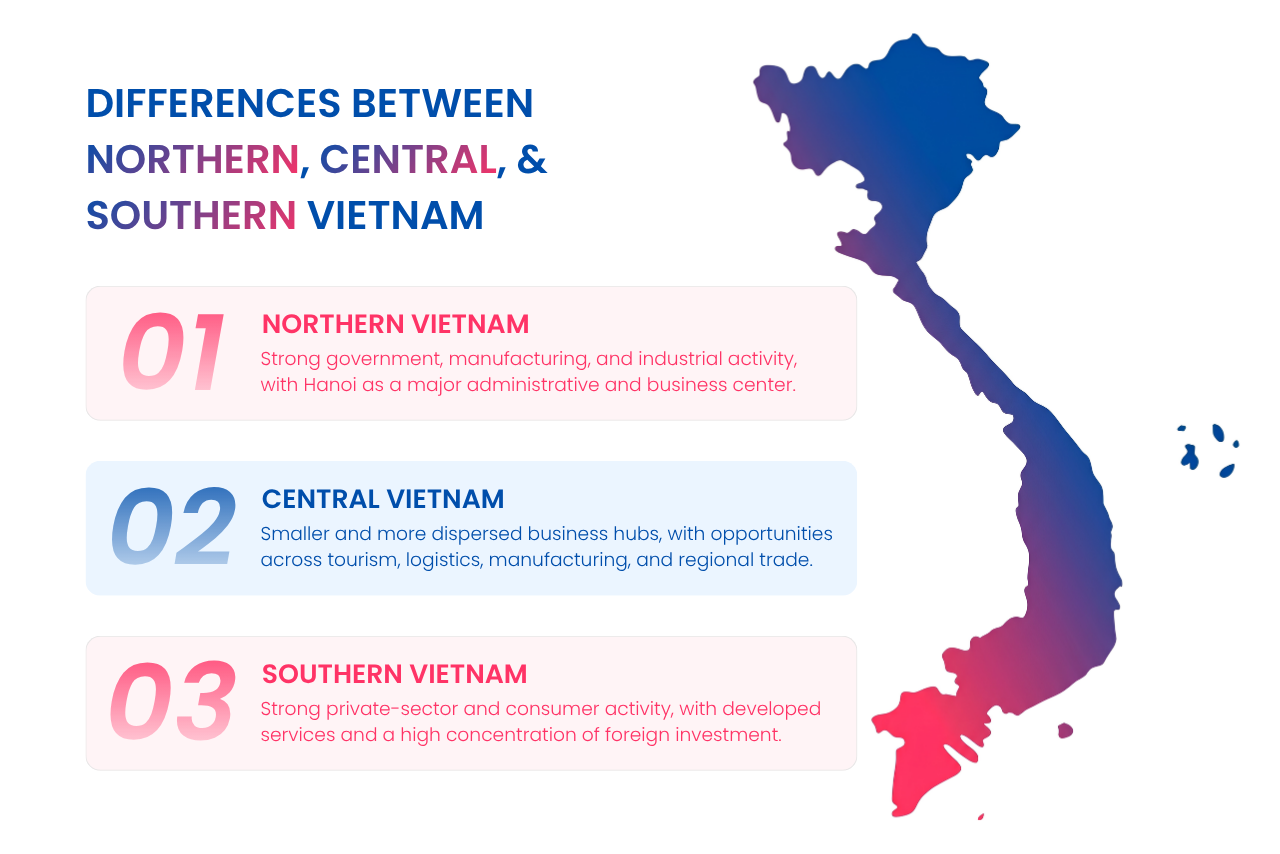
Regional differences in business activity, infrastructure, and industry concentration shape market opportunities across Vietnam.
Local business practices and B2B decision-making
Market data alone cannot show how B2B markets operate in Vietnam. Trust, established relationships, hierarchy, and stakeholder involvement can influence supplier decisions alongside price, quality, and technical capability. Decision-making may involve owners, purchasing teams, technical departments, or several stakeholders.
Therefore, market intelligence in Vietnam should examine how customers evaluate suppliers and make purchasing decisions. Local businesses may have simpler approval structures, while multinational companies often involve several departments. These differences can affect customer accessibility, decision complexity, and the potential of different B2B segments.
Distribution channels and partner ecosystems
Vietnam has a diverse distribution landscape, including traditional trade, modern retail, e-commerce, distributors, agents, and direct sales. These channels differ across industries and can affect customer reach, pricing, margins, and control over customer relationships. Understanding this structure helps companies assess how accessible their target market really is.
Partner networks also vary by sector and region. Market intelligence can reveal who has access to relevant customers, rather than relying on a partner’s market presence alone. Industry knowledge, customer relationships, geographic coverage, and capabilities can show how the local ecosystem may affect market accessibility.
Talent, supply chain, and regulatory conditions
Market attractiveness also depends on local operating conditions, not only customer demand. Talent availability varies by location, skill level, and industry, while competition for qualified workers can affect costs and access to key skills. Supply chains also differ across sectors, as supplier availability does not always mean suitable quality, capacity, certifications, or delivery capabilities.
Regulatory conditions add another layer of complexity. Sector-specific requirements can affect products, pricing, distribution, and operations, influencing both commercial potential and business risk. Market intelligence in Vietnam helps companies identify these local constraints and assess whether market conditions support their business objectives.
How Can Market Intelligence Affect Foreign Companies in Vietnam?
Market intelligence helps foreign companies turn market findings into clearer business decisions. In Vietnam, the findings can show whether an offer fits local demand, where opportunities may be strongest, and which assumptions still need local validation.
1. Product-market fit and commercial potential
Market intelligence helps companies assess whether a product or service fits Vietnamese demand before committing significant resources. Research can reveal differences in customer needs, pricing expectations, positioning, channel requirements, and technical or regulatory conditions. These insights help companies distinguish actual product-market fit from general market growth and determine whether their offer needs to be adapted.
2. Sectors, customers, and regions to prioritize
Vietnam is too broad to treat as one market. Research can help narrow the opportunity by comparing:
- Demand and purchasing power
- Competitive pressure and channel access
- Talent and supply-chain conditions
- Regional and regulatory differences
This gives management a clearer basis for deciding which sectors, customer groups, or regions to focus on first, rather than assuming the same opportunity exists across the country.
3. Risks and information gaps to validate
Public data can answer many early questions, but it rarely provides the full picture. Market intelligence in Vietnam can identify gaps that require local validation, such as customer demand, competitor pricing, purchasing behavior, distributor quality, and supplier capability. Companies can then use interviews, field research, supplier checks, and site visits to test these assumptions before making significant business commitments.
Top 5 Market Intelligence Companies in Vietnam
For companies without an in-house market intelligence team in Vietnam, external providers can help fill important information gaps. The following five companies offer different research capabilities in Vietnam, depending on the type of market information required.
Source of Asia
Source of Asia (SOA) is a business consulting and market expansion company established in 2007, with headquarters in Ho Chi Minh City, Vietnam. It supports foreign businesses across Vietnam, ASEAN, South Korea, and Asia.
- Core services: Market Expansion, Sourcing & Supply Chain, Corporate Services and HR Solutions, Marketing Services, Digital Solutions, and Trade Missions.
- Why they stand out: Combines 20+ years of local expertise and business networks with end-to-end market expansion support, from market intelligence and opportunity assessment to local partner development, on-the-ground support, and local establishment.
The verdict: A good fit for foreign companies seeking one partner to support their expansion from market assessment through ongoing local business development.
NielsenIQ
NielsenIQ (NIQ) is a consumer intelligence company founded in 1923 and headquartered in Chicago. It helps businesses understand consumer behavior, market performance, and demand.
- Core services: Market measurement, consumer insights, retail and omnichannel measurement, consumer panels, and analytics.
- Why they stand out: Combines large-scale consumer and retail data with analytics to track market trends, purchasing behavior, category performance, and competition.
The verdict: A suitable option for companies seeking data-driven consumer and retail intelligence to understand market demand and performance.
Milieu Insight
Milieu Insight is a Singapore-based market research and data analytics company established in 2016, with a presence across Southeast Asia, including Vietnam.
- Core services: Consumer research, surveys, audience profiling, data analytics, brand tracking, and custom research.
- Why they stand out: Combines a proprietary consumer panel with technology-driven research tools to deliver fast, data-driven consumer insights across Southeast Asia.
The verdict: A suitable option for companies looking for consumer insights, audience data, and quantitative research in Vietnam.
Cimigo
Cimigo is a market research company established in 2003, with operations in Vietnam and Indonesia and its Vietnam office in Ho Chi Minh City.
- Core services: Consumer research, market research, shopper insights, distribution research, segmentation, brand strategy, and data collection.
- Why they stand out: Strong focus on consumer and market research, supported by nationwide fieldwork capabilities and both quantitative and qualitative research methods.
The verdict: A suitable option for companies seeking detailed consumer, shopper, and route-to-market insights in Vietnam.
Decision Lab
Decision Lab is a Vietnam-based market research company established in 2016, headquartered in Ho Chi Minh City, and an exclusive YouGov partner in Vietnam.
- Core services: Custom research, consumer insights, audience profiling, brand tracking, and survey-based research.
- Why they stand out: Combines local market research expertise with YouGov data, technology, and consumer panels to support data-driven marketing decisions.
The verdict: A suitable option for companies focused on consumer behavior, audience understanding, and brand or marketing research in Vietnam.
Final Considerations
Market intelligence in Vietnam helps foreign companies understand what is shaping the market before deciding what to do next. From market size, customer demand, and competition to pricing, regional differences, distribution, local business practices, talent, supply chains, and regulations, these insights help companies assess where opportunities exist and what may affect their commercial potential.
At Source of Asia, we support foreign companies through Market Expansion Services, combining market intelligence with practical local support, including:
- Market diagnosis and opportunity assessment
- Competitor analysis and due diligence
- Identification and qualification of local business partners
- On-the-ground market validation and insights
Our approach helps businesses move from understanding Vietnam’s market to evaluating opportunities with greater clarity.
| 👉 Need reliable market intelligence before entering Vietnam? Contact us to assess Vietnam’s market potential and identify opportunities before entering. |
Frequently Asked Questions
There is no fixed cost. The cost depends on the research scope, methodology, target market, number of respondents, and level of analysis required. Custom studies generally cost more than focused research using existing data.
Northern Vietnam has strong government and industrial activity, Central Vietnam varies by sector and province, while Southern Vietnam has strong commercial, consumer, and private-sector activity. Market conditions should be assessed at the regional level.
A foreign company should consider a market intelligence provider when local data is limited, market conditions are unfamiliar, or decisions require deeper research into customers, competitors, pricing, channels, or regional differences.
Look for a provider with:
- Strong local market knowledge
- Relevant research experience
- Reliable data and sources
- Industry-specific expertise
- Practical, actionable insights
- Local research and validation capabilities
These factors help ensure the research reflects actual market conditions and supports sound business decisions.