Introduction
Foreign direct investment (FDI) continues to support Vietnam’s manufacturing growth, industrial development, and integration into global supply chains. However, foreign investment is not distributed equally across the country. Some provinces attract many projects, while others receive large investments from fewer companies.
Understanding Vietnam FDI by province helps foreign investors identify major investment locations, established industrial clusters, and emerging areas of interest. Yet a high FDI ranking does not automatically make a province suitable for every project. Companies comparing Vietnam with other regional destinations can also consult our Invest in ASEAN 2026 guide for a broader regional investment perspective.
In this guide, Source of Asia examines Vietnam’s provincial FDI rankings in 2026, the factors influencing investment locations, and the practical considerations businesses should assess before selecting where to invest.
Quick Answer
Which provinces are attracting the most FDI in Vietnam in 2026?
Ho Chi Minh City attracted the largest amount of registered FDI during the first nine months of 2026, reaching approximately US$18.23 billion. Thai Nguyen followed with nearly US$8 billion, while Bac Ninh, Hanoi, and Hai Phong completed the top five.
Several factors explain why these locations attract foreign investors:
- Established manufacturing clusters: Access to industrial customers and supporting suppliers.
- Industrial infrastructure: Availability of industrial parks and production facilities.
- Logistics connectivity: Connections to ports, airports, and major transport routes.
- Investment ecosystems: Existing foreign-invested businesses and local support services.
However, these rankings reflect registered capital rather than overall investment suitability. Companies should also assess industry fit, operating costs, infrastructure, and implementation requirements.
What Does Vietnam FDI by Province Show in 2026?
Vietnam’s foreign investment activity increased during the first nine months of 2026. However, national growth figures only provide part of the picture.
Provincial data reveals where investment is concentrated and how patterns differ across locations.
Vietnam’s Registered and Disbursed FDI in the First Nine Months of 2026
According to the National Statistics Office’s figures reported by the Government News, total registered foreign investment in Vietnam reached US$50.36 billion as of September 30, 2026, up 76.4% year on year.
The total included:
- US$29.24 billion in newly registered capital across 3,108 projects.
- US$14.15 billion in additional capital registered by existing projects.
- US$6.97 billion through capital contributions and share purchases.
Meanwhile, disbursed FDI reached approximately US$21.07 billion, an increase of 12.1% from the same period in 2025. Manufacturing and processing remained the largest recipient of newly registered investment, attracting US$13.38 billion, or 45.8% of newly registered capital. International trade relationships also shape Vietnam’s investment profile; our overview of US-Vietnam trade and strategic ties provides additional context on sectoral investment and supply-chain development.
These figures show continued investor interest and project activity. However, registered capital represents planned or approved investment commitments, while disbursed FDI reflects capital that has been put into use.
Therefore, both indicators are needed to understand Vietnam’s investment performance. For a broader overview of Vietnam’s economy, trade, foreign investment, and supply chains, see our Vietnam country profile.
Top 10 Provinces and Cities by Registered FDI in 2026
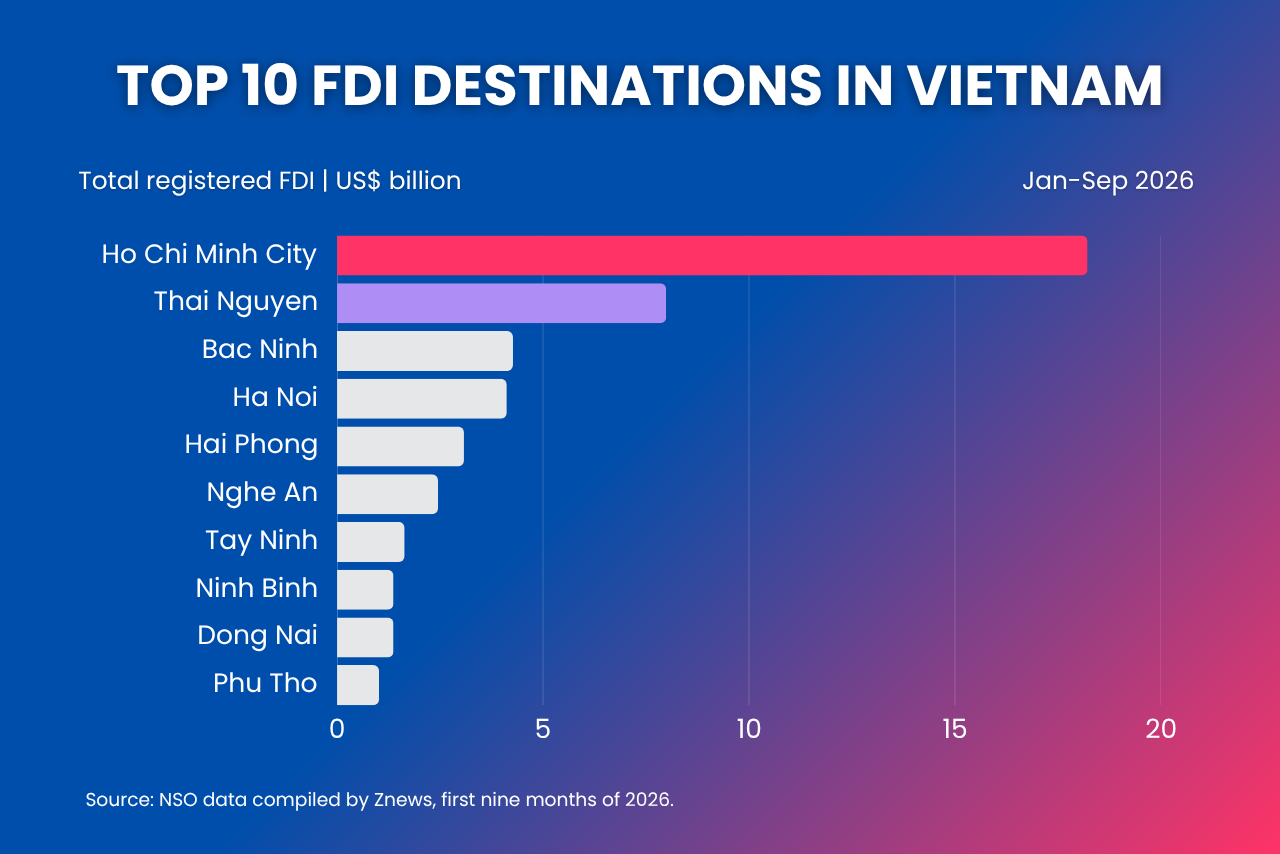
Vietnam FDI by province infographic ranking the top 10 investment destinations.
Ho Chi Minh City accounted for more than one-third of the country’s registered foreign investment during the period. It also recorded 1,593 newly licensed projects.
In contrast, Thai Nguyen attracted nearly US$8 billion despite recording far fewer projects. This reflects the influence that large investments can have on provincial rankings. Bac Ninh and Hai Phong also remained important investment destinations, supported by their established industrial bases.
Meanwhile, Nghe An entered the leading group with substantial newly registered capital. These differences show why investors should examine the type and scale of investment behind each ranking, rather than rely only on total capital. For a closer look at investment by source country, see our analysis of Singapore FDI in Vietnam in 2026.
Why Are These Provinces Attracting Foreign Investors?
The leading FDI destinations offer different advantages. Some benefit from large industrial networks, while others attract companies through logistics access, production capacity, or major investment projects.
Understanding these differences helps foreign investors compare locations based on business needs.
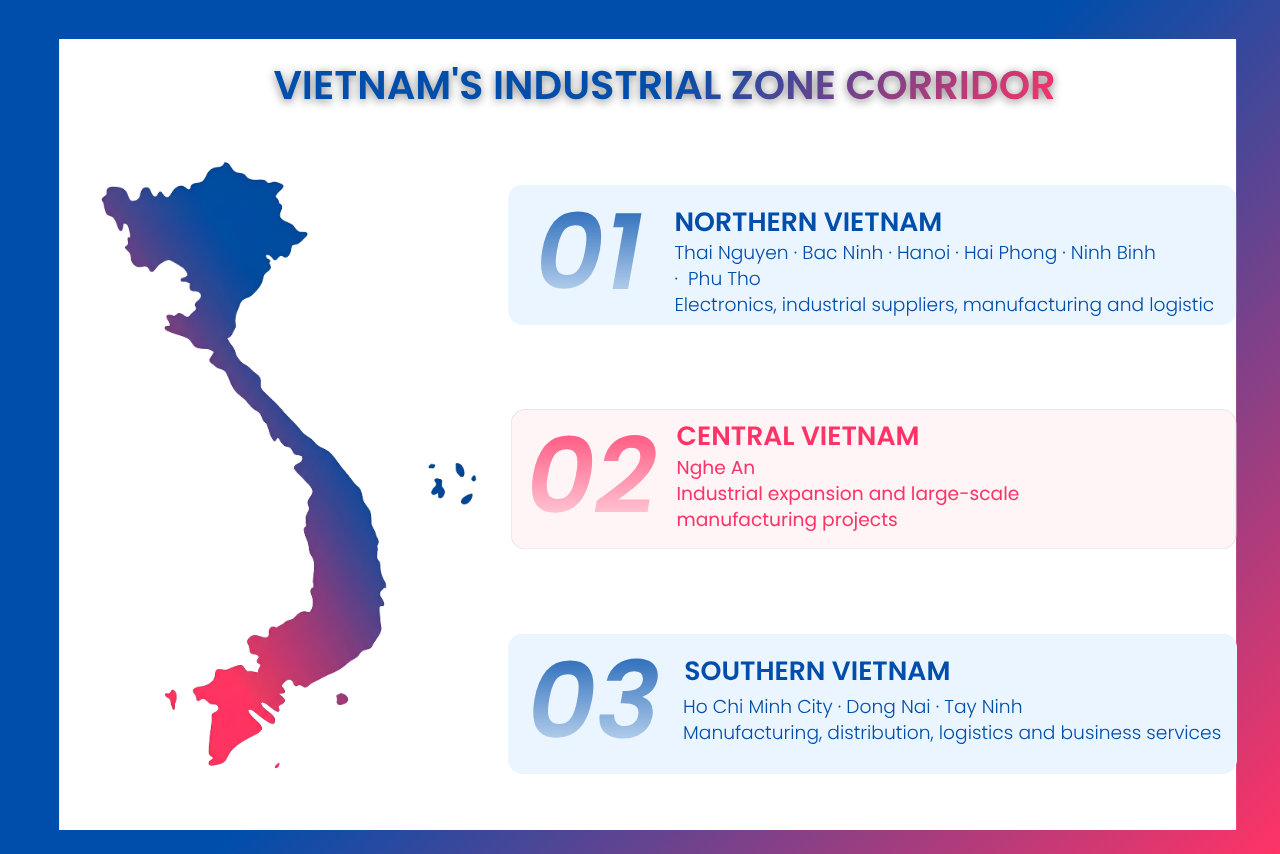
Vietnam investment clusters infographic showing Northern, Central, and Southern industrial hubs.
Ho Chi Minh City, Dong Nai, and Tay Ninh: Southern Industrial and Commercial Hubs
Southern Vietnam remains an important center for manufacturing, trade, logistics, and business services.
Ho Chi Minh City leads the 2026 ranking, supported by a large business ecosystem, skilled workforce, and access to industrial and commercial activities. Following the 2025 administrative reorganization, the city also includes the former Binh Duong and Ba Ria-Vung Tau provinces. This expanded territory brings together major manufacturing areas, established industrial parks, and port-related activities under one administrative unit. For foreign investors, the wider region offers access to industrial customers, suppliers, logistics providers, and business support services.
Dong Nai is another major manufacturing location, with industrial areas serving electronics, machinery, automotive components, and other sectors. Its connections to Southern transport networks make it relevant for companies requiring access to suppliers and export routes.
Meanwhile, Tay Ninh, which now includes the former Long An Province, offers industrial locations connected to the wider Ho Chi Minh City economic region.
However, conditions vary significantly between individual industrial parks. Therefore, investors should compare available facilities, logistics costs, workforce access, and utility capacity rather than treating Southern Vietnam as one uniform investment destination.
Thai Nguyen, Bac Ninh, Hanoi, and Hai Phong: Northern Manufacturing and Technology Clusters
Northern Vietnam remains an important destination for electronics, high-tech manufacturing, and supporting industries.
Thai Nguyen ranked second in registered FDI during the first nine months of 2026. Its investment activity is closely linked to large industrial projects and the electronics manufacturing ecosystem. However, high registered capital from a limited number of projects should not be interpreted as evidence of broad demand across every manufacturing segment.
Bac Ninh benefits from established electronics manufacturing networks, international investors, and supporting suppliers. Following the 2025 administrative changes, the province also includes the former Bac Giang area, expanding its industrial base.
Hanoi offers a different investment environment. As the national capital and a major business center, it provides access to corporate services, technical talent, administrative institutions, and the wider Northern market.
Meanwhile, Hai Phong combines manufacturing facilities with access to major seaports and logistics infrastructure.
This is particularly relevant for export-oriented manufacturers that need reliable transport connections.
Together, these locations provide several options for foreign investors. However, businesses should compare them based on the specific suppliers, customers, labor skills, and transport routes required by their operations.
Nghe An, Ninh Binh, and Phu Tho: Emerging and Expanding Investment Locations
Beyond Vietnam’s main commercial and industrial centers, several provinces are receiving growing attention from foreign investors.
Nghe An attracted approximately US$2.45 billion in registered FDI during the first nine months of 2026.
Its industrial parks, economic-zone infrastructure, and access to transport networks support manufacturing development. However, the availability of suitable sites and supporting services must be checked at the project level.
Ninh Binh also appeared among the top investment destinations. Following the 2025 mergers, the province includes the former Ha Nam and Nam Dinh provinces. Its expanded industrial base offers locations connected to Northern manufacturing and transport networks.
Similarly, Phu Tho, now incorporating the former Vinh Phuc and Hoa Binh provinces, includes established manufacturing areas and access to wider Northern supply chains.
For companies assessing these locations, the main question is whether their industrial ecosystems match the proposed project. Land availability, workforce skills, supplier access, and logistics may offer advantages for certain industries, but each factor requires direct verification.
What Factors Are Shaping Provincial FDI Trends in Vietnam?
Vietnam’s provincial investment patterns reflect more than investor preferences. Industrial specialization, infrastructure, and the size of individual projects all influence where capital is registered.
Manufacturing Specialization and Supplier Networks
Existing manufacturing clusters can make a location more attractive to new investors. For example, electronics manufacturers may prefer areas where component suppliers, engineering services, and experienced workers are already available.
These networks can reduce sourcing complexity and make it easier to build local operations. However, established clusters may also face competition for labor, industrial land, and utilities.
Therefore, investors should assess both the benefits and constraints of joining an existing manufacturing ecosystem.
Industrial Parks, Logistics, and Infrastructure
Industrial parks play an important role in Vietnam’s FDI landscape. They provide locations for factories and may offer shared infrastructure, utility connections, and services that support manufacturing activities.
However, industrial parks differ in land availability, power capacity, wastewater treatment, transport access, and expansion options. For example, a large manufacturer may need higher utility capacity and room for future production lines, while a smaller supplier may prioritize ready-built facilities and proximity to customers.
Vietnam’s list of industrial parks in 2026 provides an overview of established locations across the Northern, Central, and Southern regions.
Importantly, planned industrial park capacity should not be confused with land ready for immediate use.
Large Investment Projects and Changes in Provincial Rankings
Large investment projects can significantly affect provincial FDI rankings. Thai Nguyen provides a clear example. The province’s high position in 2026 reflects substantial registered capital concentrated in relatively few projects.
Meanwhile, other locations may attract a larger number of smaller investments without reaching the same capital value. As a result, a sharp increase in registered FDI does not necessarily indicate a similar increase in operating factories, employment, or immediate demand for local suppliers. Rankings may also change during the year as investors register new projects or increase capital commitments.
Therefore, foreign businesses should review multi-year investment trends and examine the projects behind the figures before making location decisions. For practical examples of foreign companies entering Vietnam and diversifying their supply chains, see our insights on Vietnam’s FDI and business landscape.
How Should Foreign Investors Interpret Vietnam’s Provincial FDI Rankings?
Provincial FDI rankings are useful for identifying investment activity. However, different indicators answer different questions, and changes in administrative boundaries can affect comparisons.
Registered Capital, Disbursed FDI, and Project Numbers
Foreign investors should distinguish between three measures.
| Indicator | What it shows | Main limitation |
| Registered capital | Value of investment commitments, including new and additional capital and relevant equity transactions | Does not show how much capital has been used |
| Disbursed FDI | Capital implemented during the reporting period | Does not directly measure future investment commitments |
| Number of new projects | Volume of newly licensed investment projects | Does not show their size or commercial performance |
For example, Thai Nguyen’s high registered capital reflects large investments. Meanwhile, Ho Chi Minh City’s substantial number of newly licensed projects points to a broader volume of investment activity.
However, these indicators should not be combined into a single measure of investment quality. A province’s position in the ranking provides a starting point for further research, not a final investment recommendation.
How the 2025 Provincial Mergers Affect FDI Comparisons

Registered capital, disbursed FDI, and project numbers measure different aspects of investment activity.
Vietnam reorganized its provincial administration in 2025, reducing the number of provinces and centrally governed cities from 63 to 34.
The new administrative units began operating on July 1, 2025. This change matters when comparing FDI data across years.
For example, Ho Chi Minh City’s 2026 statistics cover a larger area than the city’s figures before the merger with Binh Duong and Ba Ria-Vung Tau. Similarly, the present-day Bac Ninh, Dong Nai, Hai Phong, and several other provinces include areas previously reported separately.
Therefore, a rise in investment recorded under a province’s current name may partly reflect changes in geographic coverage. For accurate comparisons, businesses should use consistent boundaries and reporting periods rather than compare the new provinces directly with their former administrative areas.
How Can Foreign Companies Choose the Right Province for Investment in Vietnam?
The province attracting the most FDI is not necessarily the best choice for a particular investment. Foreign businesses should evaluate locations against their industry requirements, operating model, and long-term plans.
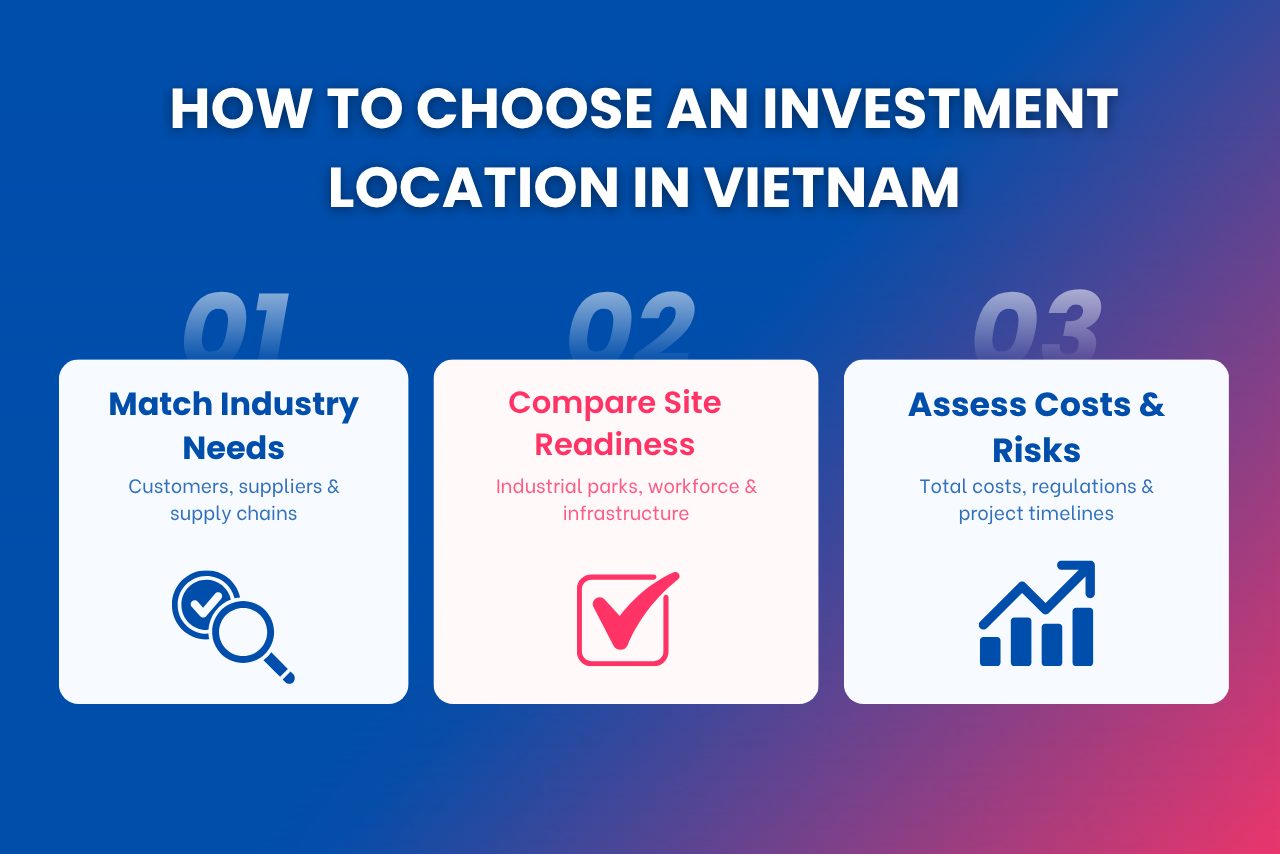
Three-step framework for choosing an investment location in Vietnam.
Step 1: Match the Location with Industry and Supply Chain Needs
Start by defining the main requirements of the proposed investment. These may include access to customers, suppliers, export routes, technical services, and suitable workers.
For example, an electronics supplier may benefit from proximity to established Northern manufacturing clusters. In contrast, a manufacturer importing bulky raw materials may place greater importance on port access and transport costs.
Next, identify provinces that meet these needs and compare the relevant industrial ecosystems. Companies should also consider whether they need to serve local customers, export finished products, or support existing multinational manufacturers.
SOA’s Vietnam market entry guide provides additional context on choosing a suitable commercial and operational model.
Expected outcome: A shortlist of provinces aligned with industry, customer, and supply-chain requirements.
Step 2: Compare Industrial Parks, Workforce, and Infrastructure
Once suitable provinces have been identified, the next step is to compare specific industrial locations.
Important factors include:
- Industrial land: Availability, lease conditions, and room for expansion.
- Utilities: Power, water, wastewater treatment, and connection capacity.
- Workforce: Access to workers with the required technical skills.
- Logistics: Transport costs, port access, and delivery reliability.
- Park management: Infrastructure maintenance, services, and operating support.
For example, two industrial parks within the same province may offer very different utility capacity and expansion options. Therefore, investors should request detailed site information and verify important conditions through visits and technical assessments.
SOA’s guide on how manufacturers choose industrial park locations in Vietnam explains how businesses can assess these factors before committing to a site.
Step 3: Assess Total Costs, Local Requirements, and Implementation Risks
After selecting potential sites, companies should evaluate the full cost of establishing and operating their business. This includes land or facility expenses, construction, equipment, utilities, staffing, logistics, and ongoing administration.
In addition, businesses should identify relevant investment registration, environmental, construction, fire safety, and other requirements based on their planned activities. For example, a site with an attractive lease price may become more expensive if major utility upgrades or longer transport routes are required.
Companies should also review implementation timelines and clarify responsibilities with industrial park developers, local partners, and professional advisers.
A detailed assessment helps reveal issues that may not appear in provincial investment rankings. For a broader framework covering market conditions, local operations, and expansion planning, see our practical guide to expanding a business in Vietnam.
Expected outcome: A practical investment location assessment covering total costs, key requirements, implementation timelines, and business risks.
How Source of Asia Supports Foreign Investors in Vietnam
Source of Asia supports international businesses seeking to assess market opportunities, identify suitable locations, and develop operations in Vietnam.
Our approach connects local market knowledge with practical business and operational support.
Market Intelligence, Provincial Assessment, and Investment Location Research
SOA helps foreign companies assess market conditions, industry clusters, customer and supplier networks, and potential investment locations.
This can include comparing provinces based on business needs, industrial ecosystems, and access to relevant partners.
For businesses considering several locations, a structured assessment helps narrow the options before significant resources are committed.
Our guide to market intelligence in Vietnam explains how local research supports better decisions about sectors, customers, locations, and operating conditions.
Industrial Site Selection, Supplier Development, and Local Operations
SOA also supports businesses through sourcing, supplier assessment, industrial site research, and selected local operational services.
Depending on project requirements, this may include identifying suitable industrial locations, assessing local suppliers, and coordinating practical market entry activities.
For investors developing technology-related facilities, infrastructure requirements may also influence location decisions.
SOA’s article on AI-ready data centers in Vietnam provides an example of how power, connectivity, and infrastructure capacity affect investment planning.
By combining market research with local execution support, SOA helps companies evaluate locations against their business goals.
Final Considerations
Vietnam’s provincial FDI rankings in 2026 show continued investment in major industrial and commercial centers, alongside substantial projects in other locations.
However, Vietnam FDI by province should be interpreted carefully. Registered capital, project numbers, and administrative boundaries can produce different views of investment activity.
For foreign companies, the right location depends on industry needs, supplier access, infrastructure, workforce availability, and total operating costs.
Source of Asia supports investors in evaluating these factors before making long-term commitments.
Considering an investment or manufacturing project in Vietnam? Contact our team to discuss provincial market assessment, industrial locations, and investment planning.
Frequently Asked Questions
Which Province Attracts the Most FDI in Vietnam in 2026?
Ho Chi Minh City ranked first in total registered FDI during the first nine months of 2026, attracting approximately US$18.23 billion. However, this reflects registered investment commitments, not the amount of capital already disbursed.
What Are the Top Provinces for FDI in Vietnam?
From January to September 2026, the leading destinations by registered FDI were Ho Chi Minh City, Thai Nguyen, Bac Ninh, Hanoi, and Hai Phong. Other provinces in the top ten included Nghe An, Tay Ninh, Ninh Binh, Dong Nai, and Phu Tho.
How Did Vietnam’s Provincial Mergers Affect FDI Rankings?
Vietnam reduced its provincial-level administrative units from 63 to 34 in 2025. As a result, several provinces and cities now report investment across larger geographic areas. Comparisons with earlier years should account for these boundary changes to avoid misleading conclusions.
What Should Foreign Investors Consider When Choosing a Province in Vietnam?
Investors should compare industry fit, customer and supplier access, industrial park facilities, workforce availability, logistics, total costs, and regulatory requirements. They should also verify site conditions and implementation timelines rather than choosing a location based only on its FDI ranking.