Introduction
Digital transformation in Vietnam is changing how businesses operate, serve customers, and compete. From artificial intelligence (AI) and cloud computing to smart manufacturing and digital payments, technology is becoming part of daily business activities across many industries.
For foreign companies, these changes create opportunities to provide technology solutions, form local partnerships, and support businesses seeking greater efficiency. However, market demand varies by sector, company size, and level of digital readiness.
In this guide, SOA examines Vietnam’s digital transformation landscape in 2026, the trends shaping business demand, and the opportunities international companies should assess before entering or expanding in the market.
Quick Answer
What are the key trends and business opportunities in Vietnam’s digital transformation?
Vietnam’s digital transformation is driven by growing technology adoption, government support, and demand for more efficient business operations.
Five trends are shaping the market:
- AI and automation: Helping companies reduce manual work and improve decision-making.
- Cloud computing and ERP: Connecting business data, teams, and daily operations.
- E-commerce and digital payments: Changing how businesses sell, receive payments, and engage with customers.
- Smart manufacturing: Using connected systems to improve production and supply chain visibility.
- Cybersecurity: Supporting secure systems and responsible data management.
For foreign companies, these trends create potential demand for software, IT services, industry-specific tools, and technology partnerships. However, the best opportunities depend on customer needs, available budgets, and the ability to deliver measurable business value.
What Does Vietnam’s Digital Transformation Landscape Look Like in 2026?
Vietnam has made progress in building its digital economy and improving access to technology. However, the level of digital adoption still differs across businesses and industries.
Understanding both economic growth and actual business adoption provides a clearer picture of the market.
Digital Economy Growth and Business Adoption
According to Vietnam’s National Statistics Office, the digital economy contributed an estimated 14.02% of GDP in 2025, equivalent to approximately US$72.1 billion. This share increased from 12.87% in 2021, reflecting the growing role of digital activities across the economy.
Yet digital economy growth does not mean that all companies have reached the same level of digital maturity.
Many businesses use basic digital tools for sales, accounting, and communication. Others are investing in connected systems, automation, and AI to improve how their teams work.
The UOB Business Outlook Study 2026 found that eight in ten Vietnamese businesses surveyed had started using AI, although only 25% had introduced advanced AI capabilities.
These findings suggest that interest in technology is growing, while many businesses still have work to do before they can use advanced solutions at scale.
For technology providers, this creates potential demand for both basic system improvements and more advanced digital solutions.
Government Strategy and Digital Infrastructure Development
Government policy is another factor shaping Vietnam’s digital transformation.
Resolution No. 57-NQ/TW, issued in December 2024, placed science, technology, innovation, and digital transformation among national development priorities.
In July 2026, the government also approved the National Digital Transformation Strategy for 2026–2030, with a longer-term direction toward 2045.
These policies support continued efforts in digital infrastructure, public services, data systems, and technology use across the economy.
At the same time, investments in connectivity, cloud services, and data centers are expanding the infrastructure available to businesses.
However, companies still need to assess infrastructure quality, system reliability, costs, and data requirements for their specific projects.
For a closer look at this area, read SOA’s article on AI-ready data centers in Vietnam.
What Are the Key Digital Transformation Trends in Vietnam?
Vietnam digital transformation is developing across several technology areas. Each trend addresses different business needs and creates opportunities for companies that can deliver practical solutions.
Artificial Intelligence (AI) and Business Process Automation
AI is becoming more relevant to Vietnamese businesses seeking to improve productivity, manage data, and reduce routine tasks.
Common applications include customer service chatbots, document processing, sales analysis, demand forecasting, and automated reporting.
For example, a distributor managing hundreds of customer orders may use automation to reduce manual data entry and track order status more accurately.
However, successful AI adoption depends on data quality, staff skills, and the ability to connect new tools with existing systems.
As a result, opportunities extend beyond AI software itself. Businesses may also need support with data preparation, system integration, staff training, and ongoing management.
Cloud Computing, ERP, and Integrated Business Systems
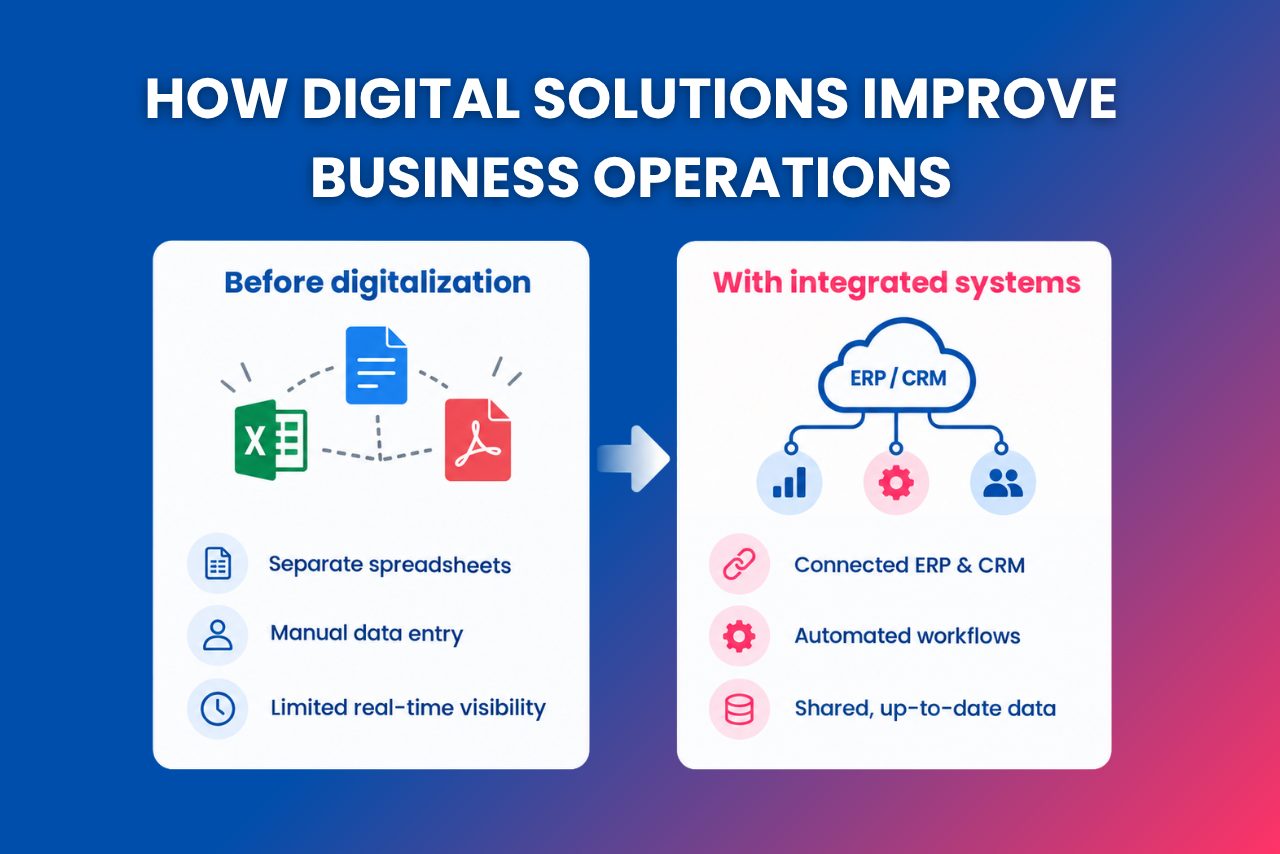
Digital transformation in Vietnam infographic comparing manual business processes with integrated ERP and CRM systems.
As companies grow, managing operations through separate spreadsheets and software tools becomes increasingly difficult.
Cloud services and enterprise resource planning (ERP) systems can help businesses connect data across finance, purchasing, inventory, and operations. Customer relationship management (CRM) systems can also improve sales tracking and customer service.
For example, a manufacturer using separate systems for purchasing and production may struggle to maintain accurate stock records. Connecting these functions can improve visibility and reduce manual work.
However, moving to integrated systems requires careful planning. Companies must consider existing software, data quality, employee training, and long-term costs.
This creates opportunities for ERP and CRM providers, cloud specialists, software developers, and system integration partners.
E-commerce, Digital Payments, and Customer Experience
Vietnam’s growing online commerce sector is changing how consumers discover products, compare prices, and make purchases.
Businesses now use marketplaces, social commerce, websites, and physical stores to reach customers. As these channels expand, companies need better ways to manage orders, payments, stock, and customer data.
Digital payment systems also support faster transactions and more connected buying experiences.
For retailers, the challenge is often bringing these channels together. For example, stock information should remain accurate whether a customer buys through a website, marketplace, or physical store.
As a result, businesses may need e-commerce platforms, payment tools, inventory systems, CRM solutions, and customer analytics.
Our guide to the e-commerce market in Southeast Asia provides further context on regional digital retail trends.
Smart Manufacturing and Industry 4.0
Manufacturing is another important area for digital transformation in Vietnam.
Smart manufacturing uses connected machines, sensors, software, and production data to improve factory operations.
Common applications include real-time production monitoring, predictive maintenance, quality control, and automated reporting.
For example, a factory may use sensor data to detect equipment issues before a breakdown causes major production delays.
However, not every manufacturer needs advanced robotics or a fully automated production line. Some may achieve greater value by first improving production visibility or connecting existing systems.
Technology suppliers should therefore identify specific operational problems before recommending costly solutions.
Read our article on smart manufacturing adoption in ASEAN to understand how manufacturers can assess practical use cases and implementation needs.
Cybersecurity and Data Protection
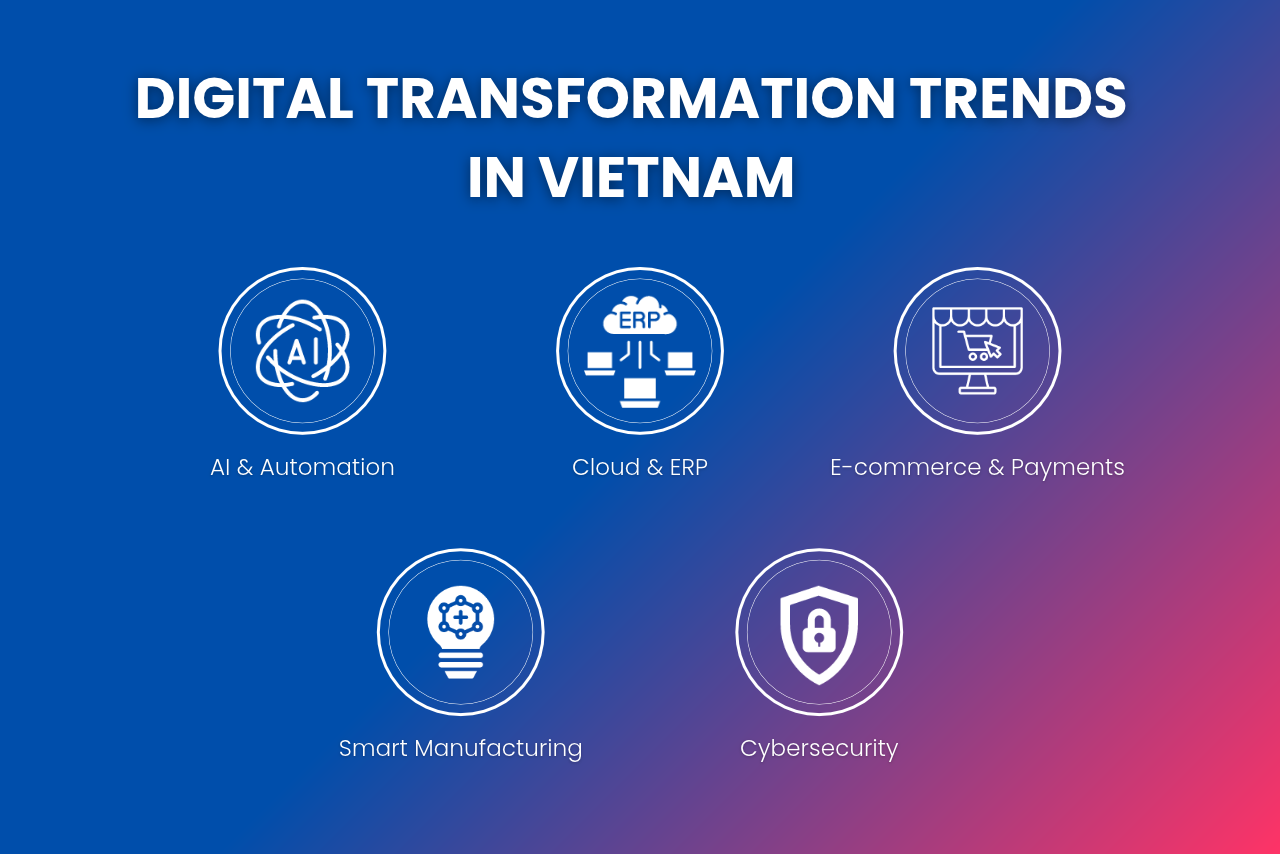
Five technology trends are shaping digital transformation in Vietnam, creating new needs for business software, automation, connected operations, and data security.
As businesses rely more on digital systems, they also need stronger protection against cyber threats, data loss, and unauthorized access. This is particularly relevant for companies managing customer information, financial records, production systems, or cross-border operations.
Common priorities include access controls, data backups, network security, employee awareness, and regular system reviews. Cloud services and connected business systems also raise questions about where data is stored and who can access it.
Therefore, companies should consider security from the start of a digital project rather than addressing it only after deployment. For foreign providers, cybersecurity services, risk assessments, secure cloud solutions, and ongoing IT support represent areas of potential demand. For companies scaling digital operations across multiple ASEAN markets, a structured cybersecurity readiness assessment can help identify governance, access-control, and incident-response gaps.
Where Are the Business Opportunities for Foreign Companies?
Vietnam’s digital transformation creates opportunities for international technology companies, but commercial potential depends on actual customer needs.
Foreign businesses should focus on where their products or services solve clear problems and where customers have the resources to adopt them.
Enterprise Digitalization and Technology Solutions
Many companies need to improve existing systems before investing in advanced technologies.
This can create opportunities for providers of:
- ERP, CRM, and business management software
- Workflow automation and data integration
- Cloud migration and managed IT services
- Cybersecurity and system monitoring
- Custom software and business applications
For example, a growing distribution company may need an integrated sales and inventory system before it can benefit from advanced demand forecasting.
Foreign providers that offer suitable pricing, clear training, and reliable after-sales support may be better placed to address these needs.
Industry-Specific Digital Solutions for Manufacturing, Logistics, Retail, and Services
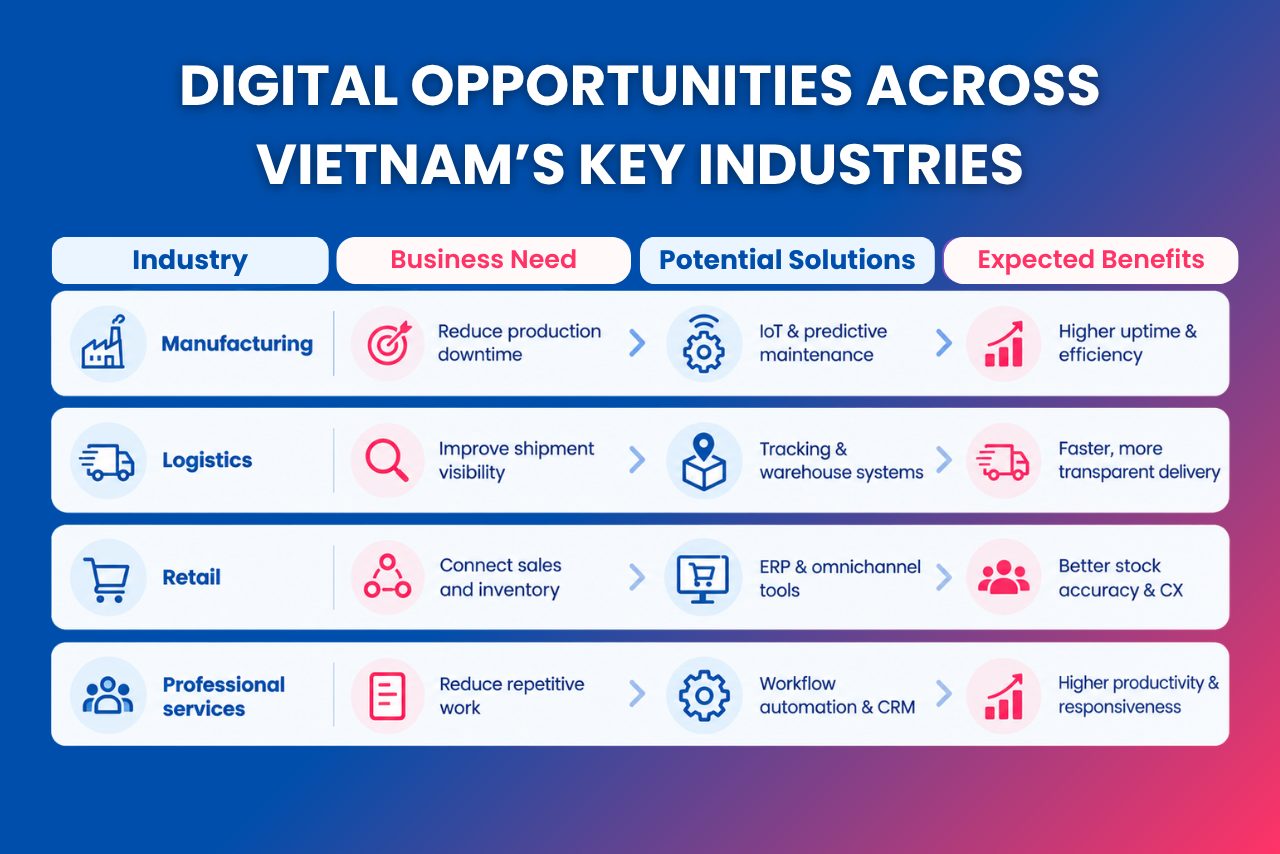
Digital transformation opportunities in Vietnam across manufacturing, logistics, retail, and professional services.
Digital needs also vary by industry. Therefore, sector knowledge can be as valuable as technical expertise.
| Industry | Potential digital needs |
| Manufacturing | Production monitoring, quality control, maintenance systems |
| Logistics | Shipment tracking, warehouse management, route planning |
| Retails | Inventory integration, e-commerce tools, customer analytics |
| Professional services | Document management, CRM, workflow automation |
For example, a logistics provider may prioritize shipment visibility, while a retailer may focus on connecting customer and inventory data across sales channels.
Foreign companies should assess these industry needs alongside budgets, local competition, and purchasing processes before choosing which solutions to offer.
Partnerships with Local Technology Providers and System Integrators
Local partnerships can help international companies understand customer needs and deliver services more effectively.
Vietnam has software developers, IT service providers, and system integrators that may support product localization, installation, training, and maintenance.
For example, an international ERP provider may work with a local implementation partner to support Vietnamese customers and provide ongoing technical assistance.
However, partner selection should go beyond technical skills. Companies should also review industry experience, delivery capacity, customer relationships, and service quality. For an example of a digital security provider establishing a local presence in Vietnam, see SOA’s TEK-ID digital security case study.
In addition, Vietnam can serve as a base for software development and outsourced IT services. Our Vietnam IT outsourcing guide explains common delivery models and the factors businesses should assess when choosing a provider.
What Challenges Could Affect Digital Transformation Projects in Vietnam?
Despite growing interest, companies may face several challenges when planning or delivering digital projects in Vietnam.
Common issues include:
- Different levels of digital readiness: Some businesses still depend on manual processes or older software.
- Budget constraints: Upfront costs and uncertain returns can slow investment decisions.
- Limited technical skills: Companies may need additional training or external support.
- System integration problems: New software may not connect easily with existing tools.
- Data security concerns: Businesses must assess relevant data protection, access, and security requirements.
- Resistance to change: Employees may need time and support to adopt new ways of working.
For example, installing an ERP system may bring limited value if staff continue using separate spreadsheets and do not follow the new process.
To reduce these risks, businesses should define clear goals, review existing systems, and test solutions before expanding them.
How Can Foreign Businesses Evaluate Digital Transformation Opportunities in Vietnam?
Foreign companies need to assess commercial demand before committing resources to the Vietnamese market. A practical approach involves identifying target industries, reviewing customer readiness, and choosing suitable delivery partners.
Identify Priority Industries and Business Needs
Start by selecting industries where the proposed solution addresses a clear business problem.
For example, an industrial software company may focus on manufacturers seeking better production tracking, while a cybersecurity provider may target companies managing sensitive data.
Next, identify relevant customer groups, their main challenges, and the results they expect from technology.
SOA’s guide to market intelligence in Vietnam provides a broader framework for assessing customer demand, competition, and market conditions.
Assess Digital Readiness and Validate Market Demand
Before presenting a solution, companies should understand the customer’s existing technology, internal skills, budget, and readiness to change. This can involve customer interviews, system reviews, and discussions with technical and business decision-makers.
For example, a company interested in AI forecasting may first need reliable inventory data and a connected management system. Foreign providers should also check whether customers have a clear purchasing need, available funding, and a suitable timeline.
As a result, they can separate general interest in technology from realistic sales opportunities. For further guidance, see SOA’s comparison of market intelligence vs market research.
Select Local Partners and Plan Implementation
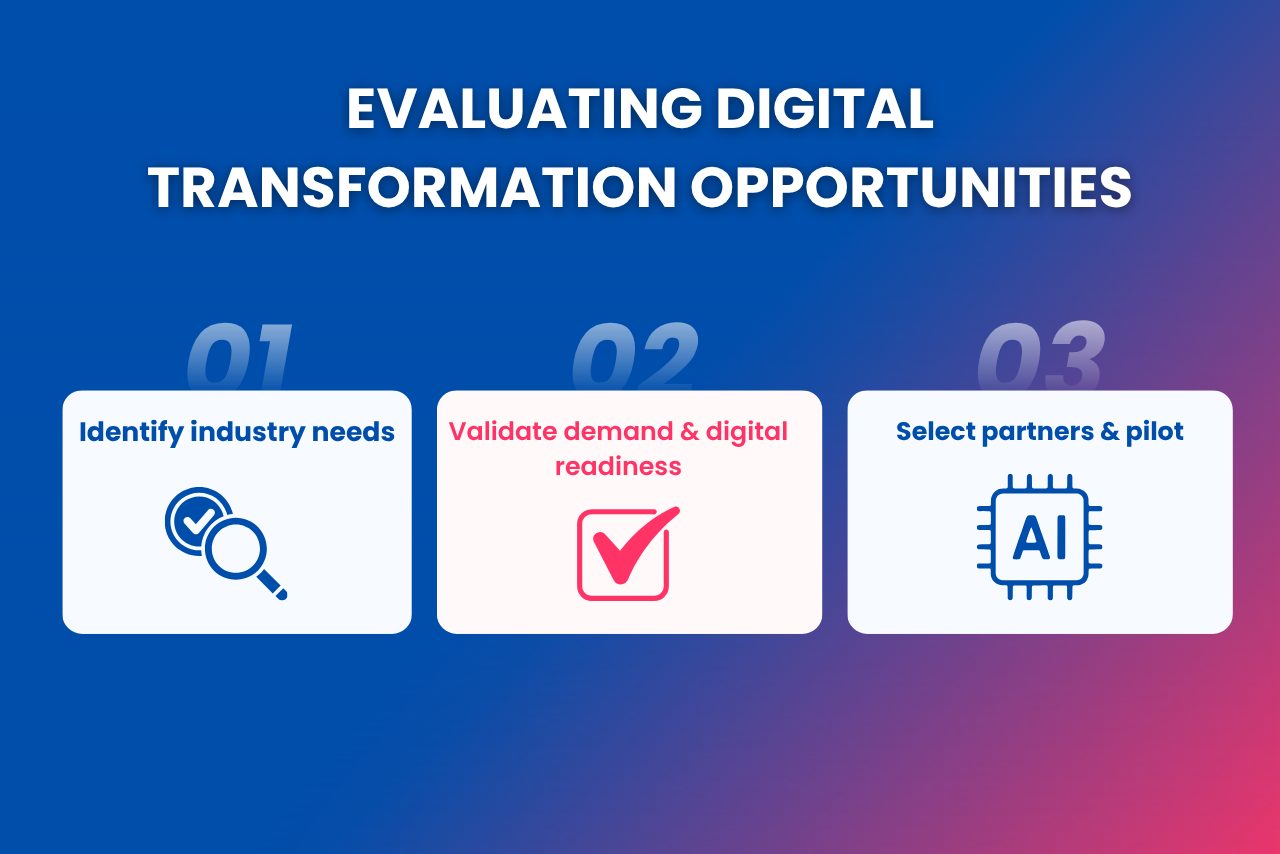
Three-step process for evaluating digital transformation opportunities in Vietnam, from industry needs to pilot projects.
Once demand is validated, companies should decide how to deliver their solution in Vietnam. This may involve direct sales, a local technology partner, or a system integrator.
Before starting, define project scope, responsibilities, timelines, support needs, and expected outcomes. A pilot project can help test whether the solution works in the customer’s actual business environment.
Useful performance indicators may include:
- Time saved through automation
- Lower operating costs
- Fewer manual errors
- Improved system reliability
- Faster order processing or reporting
If the pilot meets agreed goals, the company can then consider a broader rollout.
How Source of Asia Supports Digital Transformation in Vietnam
Source of Asia supports international companies seeking to assess technology opportunities, develop local partnerships, and improve business operations in Vietnam.
Our services connect commercial market knowledge with practical digital and operational support.
Market Assessment and Local Partner Development
SOA’s Market Expansion team supports companies through market research, competitor analysis, customer identification, and local partner development.
For technology providers, this can help identify target industries, qualify business opportunities, and connect with relevant customers or partners.
The goal is to give businesses a clearer basis for deciding where to focus their sales and market development efforts.
IT Solutions, Business Automation, and Operational Support
SOA also provides IT Services and Digital Solutions to help businesses improve systems and daily operations.
Depending on client needs, these services include:
- Digital audits and IT consulting
- ERP, CRM, and workflow automation
- Web, mobile, and custom software development
- IT helpdesk and managed services
- Cybersecurity and security operations support
- Cloud and DevOps services
By reviewing current systems, business needs, and technical risks, SOA can help companies define a practical improvement plan and the support needed to implement it. SOA’s approach to information security is also supported by its ISO 27001:2022 certification, reinforcing structured governance and security controls across its operations.
Final Considerations
Digital transformation in Vietnam is creating new opportunities across software, cloud services, AI, manufacturing, retail, and cybersecurity.
However, technology demand varies by industry and business readiness. Foreign companies should therefore assess specific customer needs, identify suitable partners, and confirm the value of their solutions before making major investments.
At Source of Asia, we help businesses understand the local market, develop partnerships, and improve digital operations.
Exploring digital transformation opportunities in Vietnam? Contact our team to discuss your market goals and technology needs.
Frequently Asked Questions
What Is Digital Transformation in Vietnam?
Digital transformation in Vietnam refers to the use of digital technologies to improve business operations, public services, and customer experiences. It includes tools such as cloud computing, AI, automation, and connected business systems.
Which Industries Are Leading Digital Transformation in Vietnam?
Banking, retail, technology, and manufacturing are among the sectors actively adopting digital solutions. Logistics and professional services are also using technology to improve workflows, tracking, and customer service. However, adoption levels differ across companies.
What Are the Main Challenges of Digital Transformation in Vietnam?
Common challenges include limited budgets, gaps in digital skills, older business systems, data security concerns, and difficulty managing change. Companies also need to ensure that technology investments address clear business needs.
What Opportunities Does Digital Transformation Create for Foreign Businesses?
Foreign companies may find opportunities in enterprise software, cloud services, cybersecurity, smart manufacturing, AI tools, and IT consulting. Local partnerships and industry-specific solutions can also support market development.
How Can Foreign Companies Start Digital Transformation Projects in Vietnam?
Foreign companies should first identify target customers and understand their technology needs. Next, they can assess digital readiness, validate demand, select suitable partners, and test solutions through pilot projects before expanding.