Introduction
In 2026, Vietnam IT outsourcing is reshaping how foreign companies build and scale engineering teams. Across the US, Europe, and the Asia-Pacific, many technology firms face the same pressures, such as rising hiring costs, limited developer supply, etc. As a result, Vietnam has become a practical way to expand capacity through IT services outsourcing while keeping development moving.
At the same time, outsourcing decisions now involve more than just costs. Companies now focus on dedicated teams and hybrid delivery models, while also managing risks such as IP protection, talent retention, and data compliance. These factors directly influence delivery stability and long-term operating costs.
In this guide, we – Source of Asia, explain how Vietnam IT outsourcing works in practice, why more companies are considering it in 2026, and what businesses should review before choosing a development partner in Vietnam.
Key Insights
- Companies choose Vietnam for IT outsourcing to control costs, access skilled engineers, and scale development teams more flexibly.
- Vietnam provides a large and growing pool of software engineers, supported by expanding STEM education and ICT training programs.
- Companies apply different outsourcing models, including project-based work, dedicated teams, and hybrid structures that combine internal and external development.
- Firms must build clear contracts and IP protection frameworks to manage legal risks and maintain stable outsourcing delivery.
- Vietnam outsourcing supports SMEs, SaaS companies, and tech startups that need flexible engineering capacity without building large internal teams.
IT Outsourcing 101 Overview
Before looking at where to outsource, it helps to understand what IT outsourcing means and how companies use it. The structure, delivery models, and responsibilities can vary depending on business needs and project scope.
What is IT outsourcing
IT outsourcing refers to the practice of working with an external provider to perform certain technology activities instead of handling them entirely with an internal team. Companies often consider this approach when internal resources are limited or when specific technical expertise is required.
In an outsourcing arrangement, the external provider is responsible for delivering a defined service or outcome. The scope of work, timelines, and expected results are usually agreed upon in advance. For this reason, IT outsourcing is not simply hiring extra labor. It is a way for companies to transfer responsibility for specific IT functions to a technology partner.
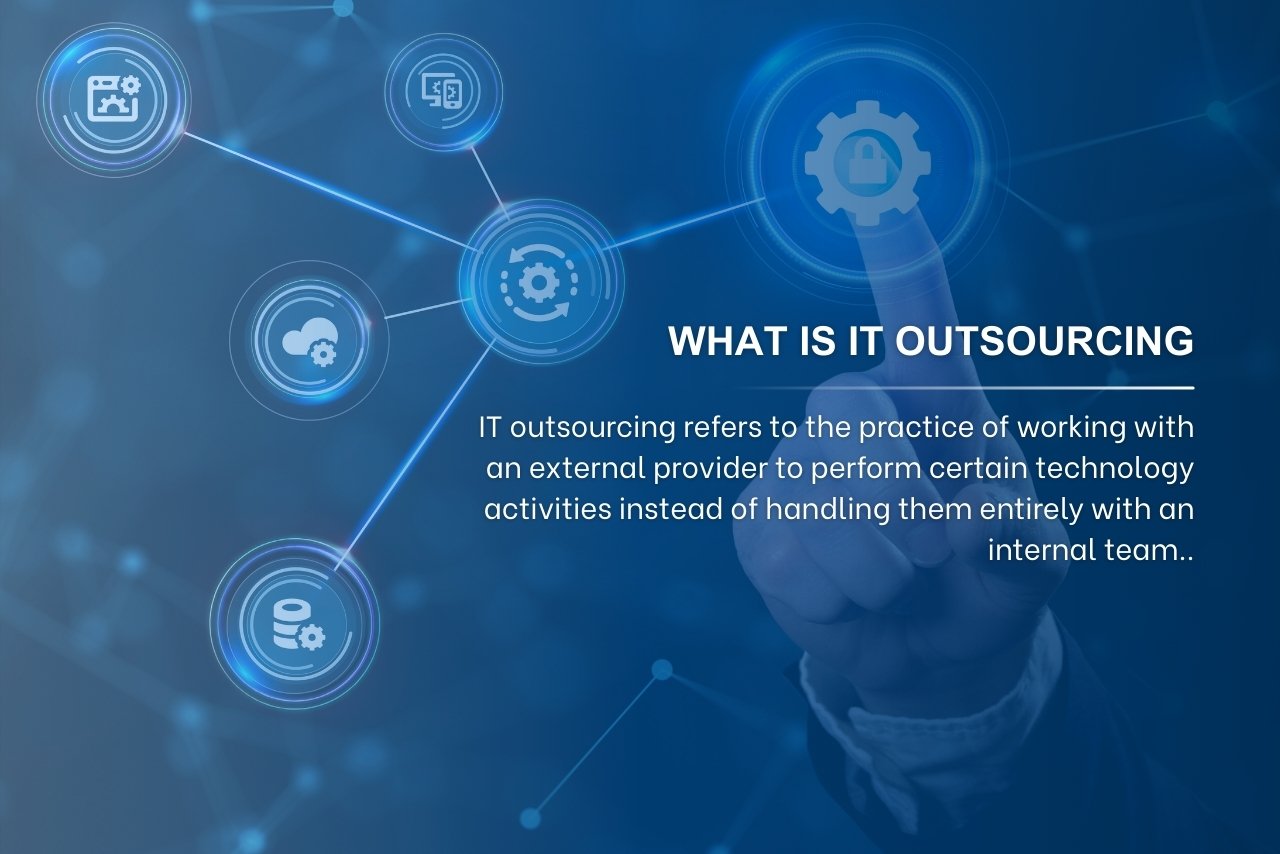
Definition of IT outsourcing showing the practice of delegating specific technology services to external providers.
How IT outsourcing differs from staff augmentation
Companies often compare IT outsourcing with staff augmentation, but the responsibility model is different. In outsourcing, the vendor manages a defined scope of work and is accountable for results. With staff augmentation, external engineers simply join the internal team and work under the client’s direct supervision.
Staff augmentation vs managed services
- Staff augmentation: external developers extend the internal team; the client manages tasks and delivery.
- Managed services: the provider operates and maintains a specific IT function based on agreed service levels.
Project-based outsourcing vs dedicated teams
- Project-based outsourcing: the vendor delivers a specific project with a defined timeline.
- Dedicated teams: developers work long-term and integrate closely with the client’s product team.
Types of IT outsourcing models
Companies use different IT outsourcing models depending on cost goals, team structure, and time-zone needs.
- Offshore outsourcing means working with providers in distant countries, often where labor costs are lower. For many US or European firms, Vietnam IT outsourcing fits this model. It provides access to a large engineering workforce, though teams must plan carefully for time-zone coordination.
- Nearshore outsourcing refers to providers located in nearby regions with closer time zones. For some Asia-Pacific companies, Vietnam can serve as a nearshore destination.
- Hybrid outsourcing models combine approaches. Many firms keep core development in-house while outsourcing specific functions or scaling capacity through offshore teams.
Commonly outsourced IT functions
Several technology activities are commonly handled through IT outsourcing because they can be delivered remotely without affecting core business operations.
- Infrastructure management: managing servers, cloud systems, networks, and overall system stability.
- Software development: building applications, platforms, mobile products, and running testing or quality assurance.
- IT help desk services: providing technical support and troubleshooting for employees or customers.
- IT BPO: handling technology-enabled back-office processes such as data processing or workflow support.
- Cybersecurity monitoring: operating security monitoring, threat detection, and vulnerability management systems.
These functions allow companies to expand technical capacity while keeping internal teams focused on core product development.
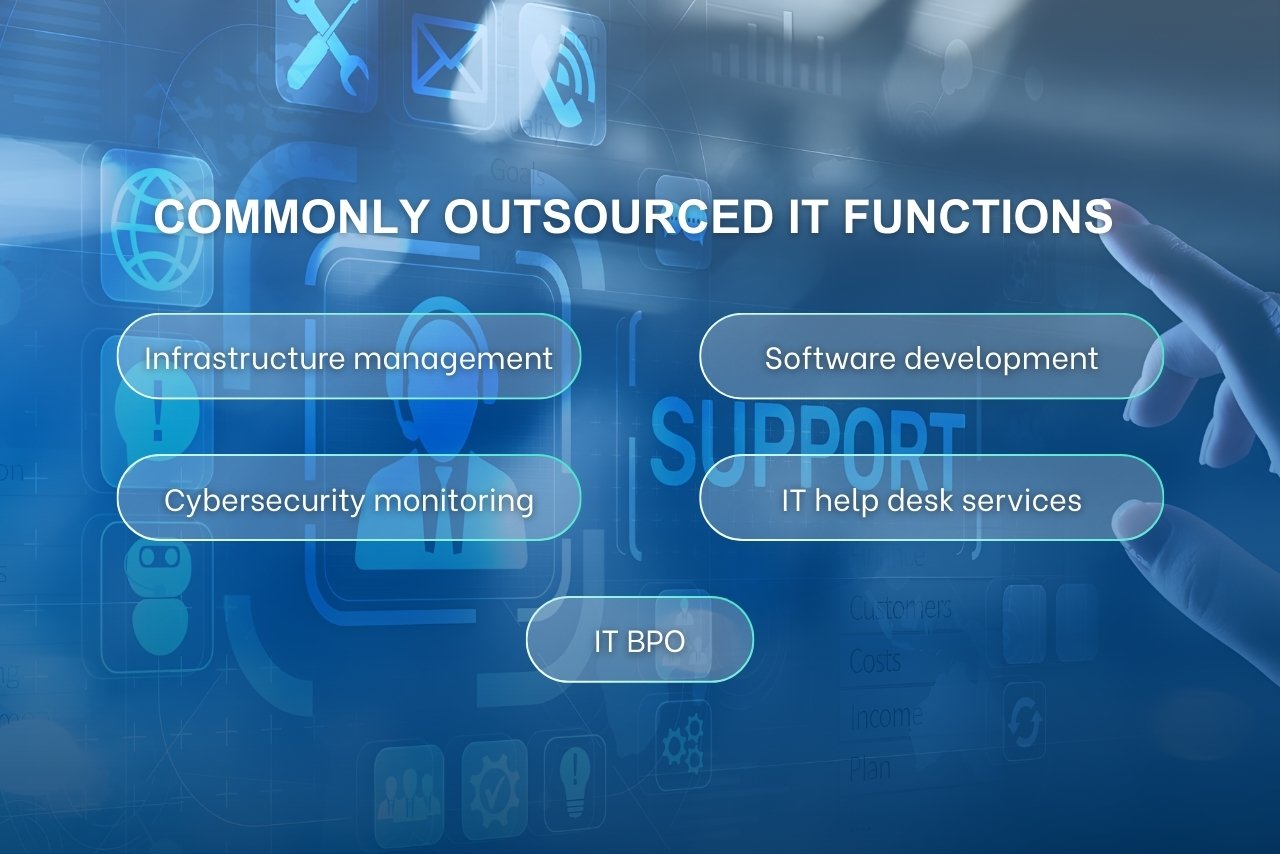
Common IT outsourcing services include software development, infrastructure management, cybersecurity monitoring, and help desk support.
Vietnam IT Outsourcing Industry Landscape
Companies exploring Vietnam IT outsourcing often first evaluate the strength of the local technology ecosystem, including digital growth, engineering talent, and the development of major tech hubs.
Growth Of Vietnam’s digital economy
Vietnam’s technology sector continues to expand, supported by exports, policy direction, and rising digital adoption. Software and IT services exports have grown rapidly, with Vietnam’s digital technology exports reaching about $172 billion in 2025, reflecting strong global demand for electronics, software, and IT services.
Moreover, according to Decision No. 749/QD-TTg 2020 national digital transformation program through 2025, with orientations toward 2030, Vietnam government promotes a digital transformation strategy, such as cloud infrastructure, digital public services, and platform-based businesses
As a result, in 2025, Vietnam’s digital economy contributed about 14.02% of national GDP, equivalent to roughly $72 billion, highlighting the sector’s expanding importance in the country’s development strategy.
Expansion of Vietnam’s technology workforce
Vietnam’s outsourcing growth depends on a steady supply of engineers. Vietnam has more than 1.2 million ICT workers and around 74,000 digital technology companies, forming a broad developer ecosystem that supports software and IT services.
At the same time, engineering talent supply continues to expand. Vietnam produces roughly 80,000 ICT graduates each year, with a national goal of 100,000 graduates annually in the coming years.
Meanwhile, ongoing STEM education expansion helps strengthen technical training in areas such as software engineering, AI, and data science, gradually improving the overall capability of the developer workforce.
Vietnam’s position in global outsourcing markets
Vietnam competes with several global outsourcing markets, each offering different strengths in cost, talent availability, and project scale.
- India: The largest global outsourcing hub with deep enterprise IT experience and massive engineering scale. However, rising labor costs and hiring competition push some firms to explore alternatives. When comparing Vietnam vs India outsourcing, Vietnam often offers lower development costs and smaller, focused teams.
- Eastern Europe: Countries such as Poland and Romania provide strong engineering talent and proximity to Western Europe, though costs are typically higher than in Vietnam.
- Philippines: Known for BPO and customer service outsourcing, while Vietnam shows stronger momentum in software development and product engineering.
Technology clusters supporting outsourcing
Vietnam’s IT outsourcing industry centers around three key technology hubs: Ho Chi Minh, Ha Noi, and Da Nang.
- Ho Chi Minh is the country’s largest tech hub. Many outsourcing firms, startups, and multinational R&D offices operate here, providing strong access to engineers and international business infrastructure.
- Hanoi combines a large university network with government technology initiatives. As a result, many local software firms and global development teams run engineering operations in the capital.
- Da Nang is an emerging tech hub. The city promotes software parks and digital infrastructure, attracting both startups and outsourcing providers.
Why Foreign Companies Choose IT Outsourcing In Vietnam
Many companies choose IT outsourcing in Vietnam to balance development costs, access skilled engineers, and maintain flexible operations while scaling technology teams for global projects.
Cost efficiency with flexible scaling
Vietnam IT outsourcing allows companies to reduce costs while keeping teams flexible as projects grow or change. In practice, three factors usually drive this advantage:
- Labor arbitrage: Engineering salaries remain significantly lower than in the U.S. or Western Europe, allowing companies to reduce development costs while maintaining solid technical quality.
- Ability to scale teams up or down: Outsourcing providers can expand or reduce engineering teams based on project demand, helping companies respond quickly to product changes or market growth.
- Reduced fixed operating costs: Businesses avoid long-term hiring commitments, office overhead, and HR management, making outsourcing a more flexible operating model.
Access to skilled engineers
Beyond cost advantages, many companies choose Vietnam for its growing pool of skilled software engineers supporting global development work.
- Technical depth: Vietnamese engineers commonly work in areas such as web platforms, mobile apps, cloud systems, backend, testing, DevOps, and system integration.
- Competitive productivity levels: Teams are often recognized for stable delivery, strong work discipline, and reliable project timelines.
- Experience with global tech stacks: Developers commonly used widely adopted technologies such as Java, .NET, Python, JavaScript, and modern cloud platforms, allowing smoother collaboration with international teams.
Communication and global work integration
Working with overseas teams requires clear communication and reliable coordination. Vietnam has improved in this area as the tech industry becomes more global.
- English proficiency: Many engineers use English daily when working with international clients, especially in software outsourcing projects.
- Time-zone coordination: Vietnam’s time zone allows practical overlap with Asia-Pacific markets and partial working overlap with Europe and the United States.
- Remote collaboration maturity: Development teams are familiar with global workflows using tools such as Git, Jira, and Slack, supporting distributed software development.
Strong technology ecosystem
Beyond talent and cost advantages, Vietnam’s broader technology environment also supports outsourcing operations.
- Presence of multinational investors: Global technology companies have established engineering centers and manufacturing operations in Vietnam, strengthening infrastructure and knowledge transfer.
- Private tech firms and startup growth: Local technology companies and startups continue to expand, creating a more dynamic development ecosystem.
- Expanding SaaS development scene: More Vietnamese teams now build cloud platforms, enterprise software, and SaaS products for international markets.
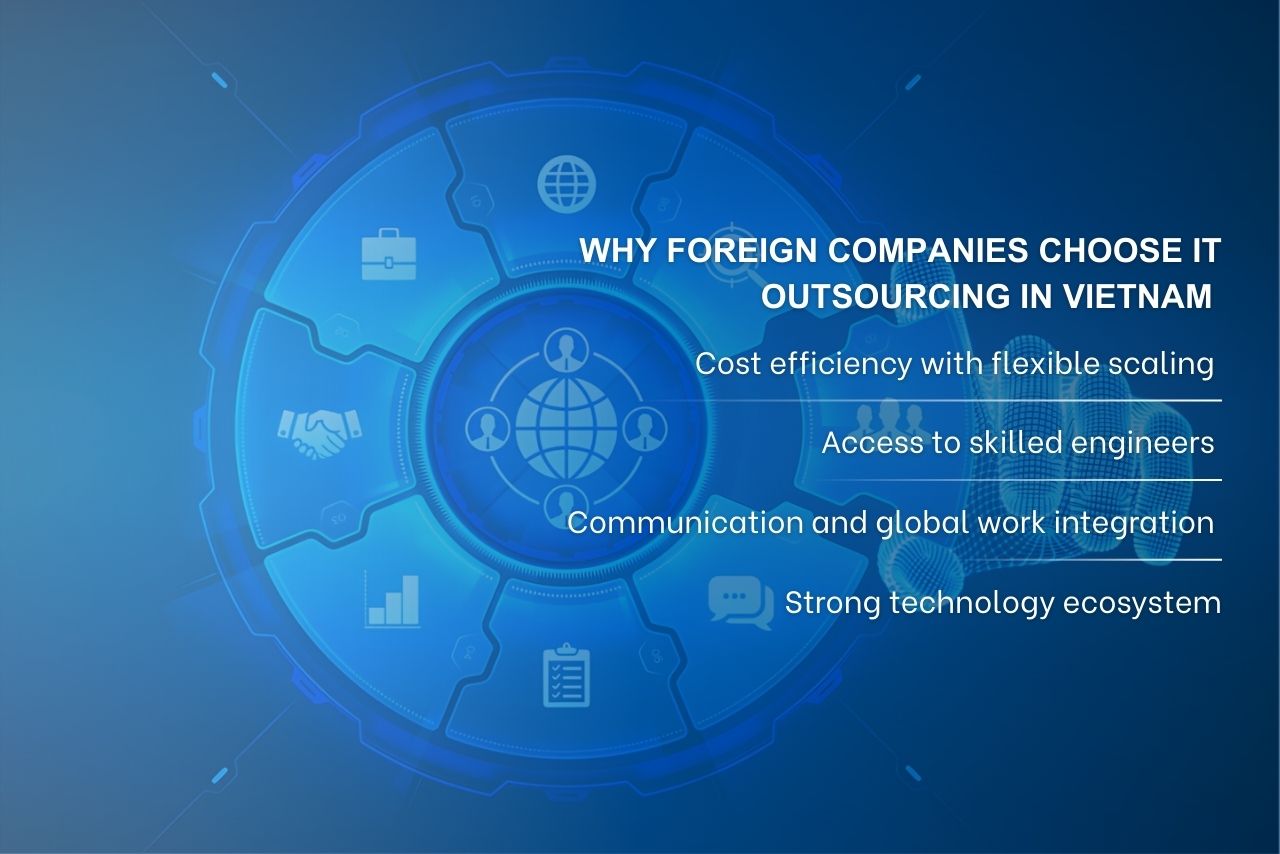
Foreign companies choose Vietnam IT outsourcing for cost efficiency, skilled engineers, and flexible development scaling.
Implementation And Execution Risks of IT Outsourcing In Vietnam
When outsourced IT in Vietnam, understanding the several operational risks early helps protect projects, maintain delivery stability, and avoid legal or contractual issues
Intellectual property and data security risks
Vietnam’s legal framework has improved, but companies still need careful governance when sharing source code, product designs, or customer data with outsourcing partners. Vietnam’s Law on Cybersecurity (2018) requires businesses to protect digital information and cooperate with authorities under certain conditions.
In addition, some digital services may face data localization requirements, meaning specific data categories must be stored or processed inside the country. As a result, firms usually review vendor security policies, infrastructure location, and access controls before starting development work.
Contract structure and SLA enforcement
Clear contracts are essential when development teams operate across borders. Most outsourcing agreements include Service Level Agreements (SLAs) that define measurable targets such as delivery milestones, response times, system uptime, and code quality standards. These metrics help both sides track performance and avoid misunderstandings during long projects.
In parallel, many international contracts also define dispute resolution mechanisms, often through arbitration in neutral jurisdictions such as Singapore, which provides a structured process if disagreements arise.
Talent retention and delivery continuity
Vietnam’s technology sector is expanding quickly, and demand for experienced engineers continues to rise. As a result, the labor market can be competitive, and developer turnover is a practical risk for long-term outsourcing projects. If a project depends on a small number of key engineers, unexpected departures may slow down delivery. To manage this, established outsourcing providers typically build team-based delivery models, maintain technical documentation, and apply structured knowledge transfer processes, so projects can continue smoothly even if staffing changes occur.
Implications For Foreign Companies Considering Vietnam
Companies considering Vietnam for IT outsourcing often need to decide when outsourcing fits best and when internal development is more appropriate. To clarify that decision, you should know:
- When Vietnam is the right outsourcing destination
Vietnam is often a strong fit when companies need cost-efficient engineering capacity and flexible scaling. This is especially relevant for small and mid-sized companies expanding their development capability without building a full in-house department.
- SMEs scaling development: Outsourcing allows smaller firms to add development capacity without committing to large permanent teams.
- SaaS companies: Many SaaS businesses rely on distributed engineering teams to accelerate feature releases and maintain platform updates.
- Fintech and AI startups: These sectors often need specialized developers but must manage burn rates carefully during early growth stages.
- When should companies build in-house teams instead
In some situations, keeping engineering fully internal may be more appropriate. This usually applies when technology ownership or research depth becomes a core competitive advantage.
- Core proprietary technology: If a product’s main value lies in unique algorithms or internal systems, companies often keep development inside the organization.
- Sensitive IP environments: Businesses managing financial systems, confidential data, or regulated technology often require tighter internal oversight.
- Long-term R&D centers: Firms running multi-year research programs typically benefit from stable internal engineering teams working closely with product leadership.
- Hybrid outsourcing models.
In practice, many companies combine both approaches to balance control and flexibility. Some firms maintain a small internal team while outsourcing supporting development work to external partners. Others establish dedicated offshore development centers in Vietnam, where engineering teams operate as a long-term extension of the company’s internal structure while still benefiting from local talent availability and cost efficiency.
Final Thoughts
Vietnam has become a practical IT outsourcing destination in 2026 as companies seek cost control, skilled engineers, and flexible scaling. Its growing developer workforce, improving technical training, and expanding technology ecosystem allow international firms to maintain stable product development while keeping operations adaptable.
At Source of Asia, we help companies access and manage IT talent in Vietnam. Our team supports the recruitment process, including candidate sourcing, background checks, payroll management, and HR advisory. Besides, we also provide IT outsourcing and digital development services. Our experts support companies in building applications and other digital solutions.
To deepen your preparation, you may find the following insights useful:
Frequently Asked Questions
Vietnam offers competitive costs, a growing pool of engineers, and strong software development capabilities. India remains larger, but Vietnam often provides smaller, focused teams and lower development costs.
It depends on business goals. Outsourcing works well for flexible scaling, while in-house teams are better when companies manage core technology or long-term R&D.
Yes. Many small and mid-sized companies use Vietnam outsourcing to access skilled developers, accelerate product development, and expand engineering capacity without building a large internal team.
Companies should review intellectual property protection, cybersecurity regulations, potential data localization requirements, contract structure, and dispute resolution mechanisms before entering outsourcing agreements.