The wine & spirits market in ASEAN is growing faster than almost any other region in the world. By 2034, the region’s total alcohol beverage market is projected to reach $19.05 billion USD, driven by a rising middle class, rapid urbanization, and a clear shift toward premium consumption. For brand owners and exporters, the commercial potential is increasingly difficult for international brands to ignore. However, choosing the wrong first market wastes time, budget, and distributor relationships that are hard to rebuild.
In this guide, we, at Source of Asia, compare Vietnam, Singapore, and Thailand, the three most commercially relevant entry points for wine & spirits in ASEAN today.
In short:
- Singapore offers the clearest compliance path.
- Vietnam delivers the highest growth ceiling, but only for brands that act before the 2027 tax inflection point.
- Thailand rewards brands that already have a regional distributor network.
Why Wine & Spirits Brands Are Targeting ASEAN Now
ASEAN’s wine & spirits sector is one of the most dynamic emerging markets in the world. While wine volumes in Asia-Pacific fell by 4% in 2024 (IWSR, 2025), India and Southeast Asia bucked the regional trend. Consumer interest in premium imported alcohol is rising, driven by a growing urban middle class and a clear shift away from domestic beer and low-tier spirits.
Meanwhile, traditional export markets in Europe and North America are either maturing or contracting. As a result, many global wine and spirits brands are actively shifting their expansion focus to Southeast Asia.
One major driver for this trend is premiumization. Consumers in Vietnam, Singapore, and Thailand increasingly shift from mass-market beer toward imported wine, premium spirits, and lifestyle-led consumption experiences. What’s else:
- A growing middle class. ASEAN’s middle-income population is expected to reach 400 million by 2030, according to the Asian Development Bank.
- A booming HoReCa sector. Hotels, restaurants, and bars are expanding rapidly in every major ASEAN city, from Ho Chi Minh City to Bangkok to Singapore’s CBD.
- Younger consumers. A large, digitally connected millennial and Gen Z population is actively discovering international wine and spirits through social media and dining experiences. (Statistic, 2025)
- FTA-driven market access. Vietnam has signed 16 FTAs. EU wine tariffs are scheduled for elimination by 2027 and Australian wine tariffs by 2028 under EVFTA and AAFTA, respectively.
Together, these factors make wine & spirits in ASEAN one of the most attractive B2B expansion opportunities in the Asia-Pacific region right now.
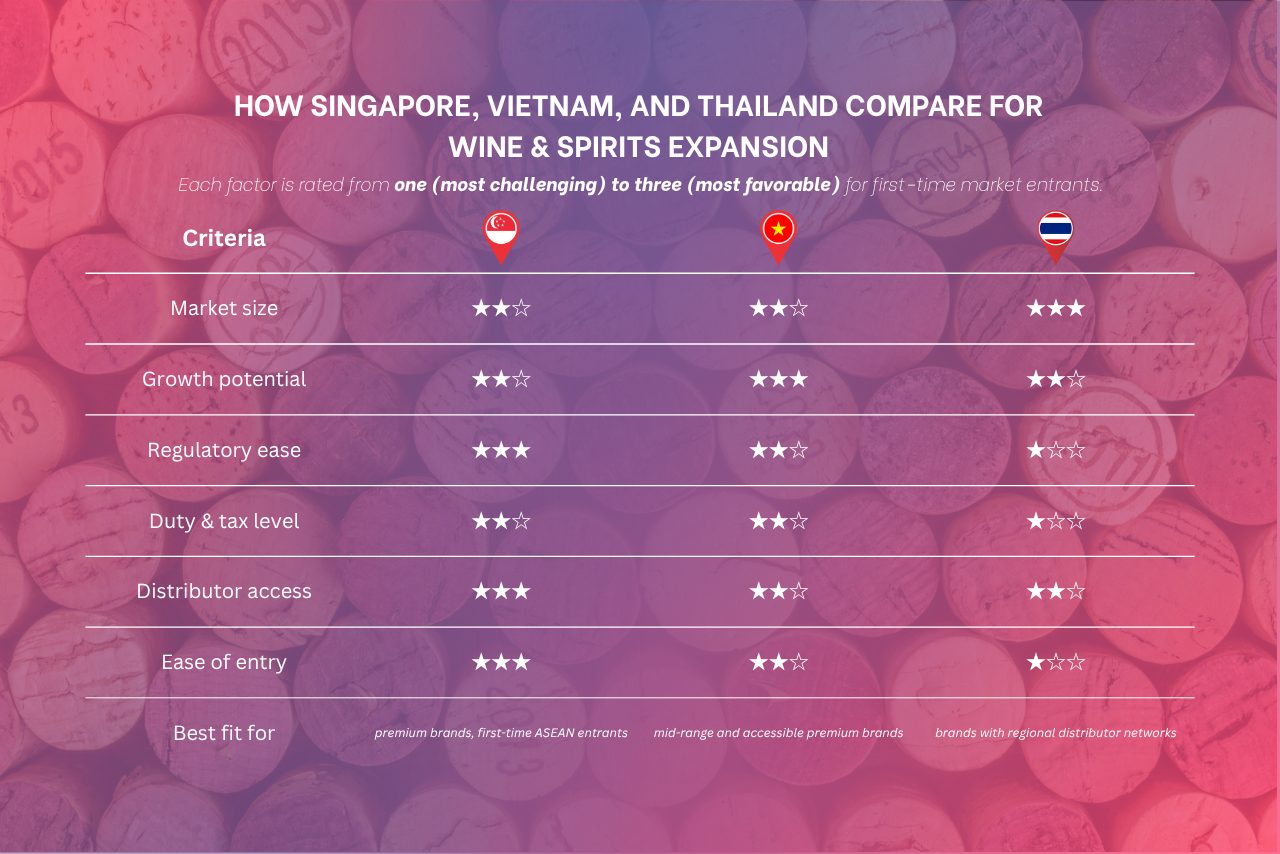
Strategic comparison of Singapore, Vietnam, and Thailand for wine & spirits market entry across growth potential, regulatory ease, distributor access, and expansion readiness.
How We Compare These Three Markets for Wine & Spirits in ASEAN
This comparison evaluates six criteria that matter most to B2B brand owners: market size, growth rate, import regulations, distributor landscape, consumer profile, and ease of entry. Each factor is rated from one (most challenging) to three (most favorable) for first-time market entrants.
| Criteria | Singapore | Vietnam | Thailand |
|
Market size |
★★☆ | ★★☆ | ★★★ |
|
Growth potential |
★★☆ | ★★★ | ★★☆ |
|
Regulatory ease |
★★★ | ★★☆ | ★☆☆ |
|
Duty & tax level |
★★☆ | ★★☆ | ★☆☆ |
|
Distributor access |
★★★ | ★★☆ | ★★☆ |
|
Ease of entry |
★★★ | ★★☆ | ★☆☆ |
The following sections will provide a detailed analysis of the potential, strengths, and limitations of these three countries. Let’s discover!
Singapore
Market profile: size, growth, key buyer segments
Singapore is a small but exceptionally developed market. The city-state imports virtually all of its wine and spirits. Total alcohol import value exceeds SGD 1 billion annually. In 2023, Singapore imported approximately USD 980M in wine and USD 2.11B in spirits.
Additionally, Singapore functions as a regional distribution and logistics hub, which means that winning here often opens doors across the wider ASEAN network. The on-trade sector is particularly strong, powered by a world-class hotel and MICE industry.
Import duties, GST, and licensing requirements
Wine enters Singapore with zero customs duty, which makes Singapore stand apart from every other ASEAN market. Wine imports in Singapore face significantly lighter licensing requirements compared to most ASEAN markets. Customs clearance is fully digitalized through the Singapore TradeNet portal. A 9% GST applies at the point of sale.
A separate excise of SGD 88 per litre of alcohol applies to spirits, not wine. Import licensing is minimal. The liquor license application via the GoBusiness portal takes approximately three weeks to process and is conducted entirely in English. As a result, total compliance cost and administrative burden for first-time entrants are significantly lower here than anywhere else in ASEAN.
Who buys: distributors, hotel chains, the MICE sector
Key B2B buyer segments include:
- Specialist wine and spirits importers and distributors
- Hotel and resort procurement teams (Singapore hosts major global hotel groups)
- MICE sector buyers serving conferences, incentive events, and corporate catering
- Modern retail chains such as Cold Storage and FairPrice Finest
- Independent wine merchants and fine dining establishments
Best fit for: premium brands, first-time ASEAN entrants
Singapore is best suited for premium and super-premium brands entering ASEAN for the first time. Its duty-free wine structure, regulatory transparency, and English-language licensing make it the most predictable and scalable launchpad in the region. For brands testing market reception before committing to a broader ASEAN rollout, Singapore is the logical first step.
Vietnam
Market profile: size, CAGR, urban consumer trends
Vietnam is among the fastest-growing wine markets in ASEAN. Wine consumption is forecast to grow by 3.2% per year in volume and 3.8% per year in value to 2028, according to industry data from IWSR. Ho Chi Minh City and Hanoi are driving most of this growth. Both cities have a young, aspirational urban consumer base that is actively exploring international wine and spirits.
Moreover, the number of international-style restaurants, wine bars, and hotel F&B outlets in these cities is growing rapidly year on year.
Import regulations, special consumption tax, and labelling
Vietnam applies a Special Consumption Tax (SCT) of 65% on wine, plus 8%-10% VAT and import duties. Brands from qualifying countries benefit from reduced tariffs under the ASEAN Free Trade Agreement (AFTA) and bilateral agreements such as the EU-Vietnam Free Trade Agreement (EVFTA). Indeed, import duty is 0% for wine from the EU, Australia, and New Zealand under existing FTA agreements, with EU tariffs scheduled for full elimination by 2027 and Australian tariffs by 2028. Moreover, product labels must comply with Vietnamese language requirements and be approved before commercial sale can begin.
However, Vietnam’s parliament has approved a phased SCT increase from 65% to 90% by 2031. Brands that build their pricing architecture and secure distributor agreements before 2027 will hold a structural cost advantage over later entrants. Brands that wait risk entering a market where margins have already been compressed by the new tax floor.
Importantly, selling through a locally licensed importer is mandatory. Therefore, distributor selection is one of the most consequential early decisions any brand makes when entering Vietnam.
Who buys: national distributors, modern trade, F&B chains
- National and regional distributors with a HoReCa focus
- Modern trade buyers at international supermarkets (AEON, Lotte Mart, Winmart+)
- Boutique wine shops and independent F&B operators in Ho Chi Minh City and Hanoi
- Hotel procurement teams at international and upscale domestic properties
Best fit for: mid-range and accessible premium brands
Vietnam is the right market for mid-range and accessible premium brands, typically retailing between $15 and $40 USD at the point of sale. It’s also the right market for FTA-origin wine brands (EU, Australian, New Zealand). Furthermore, it suits brands with a clear price-value narrative. A locally licensed importer is a legal requirement. Margins can be strong, but brands must invest in consumer education and distributor support to build volume over time.
Thailand
Market profile: size, tourism impact, premium segment
Thailand operates one of the region’s most established imported wine and spirits ecosystems, supported by strong tourism demand and a mature premium consumption segment. Indeed, tourism is a major demand driver – Bangkok, Phuket, and Koh Samui generate substantial on-trade volume year-round. Additionally, a well-developed upper-middle-class consumer segment supports premium wine consumption independently of tourist activity. Australia leads imported wine in Thailand with nearly 30% market share, which signals a sophisticated, origin-aware consumer base. Thus, the market is sophisticated and competitive, with a wide range of international brands already present.
Excise tax, import licenses, and advertising restrictions
Since March 2024, Thailand has implemented significant wine tax reforms. Import duties on wine, previously 54–60% depending on HS code classification, have been completely waived since February 2024. The USDA (Foreign Agricultural Service) excise tax on wine is now 5% of retail value, plus 1,000 THB per liter of alcohol (down from 1,500 THB previously). Standard VAT is 7%. Import licensing remains a mandatory requirement for importing wine into Thailand.
Regarding marketing, Thailand enforces strict alcohol advertising restrictions under the Alcoholic Beverage Control Act, making above-the-line (ABT) brand building nearly impossible. Brands wishing to establish a presence in this market must rely entirely on below-the-line (BTL), on-trade, and trade education. Competition from established international importers also presents a significant barrier.
Who buys: major importers, Bangkok on-trade, resort chains
- Large established importers with existing regional networks
- Hotel and resort chains in Bangkok and major tourist destinations
- Bangkok’s growing independent wine bar and fine dining scene
- Supermarket and hypermarket chains such as Tops and Central Food Hall
Best fit for: brands with regional distributor networks
Thailand is best suited for brands that already have an established APAC distributor relationship or a direct connection with a licensed Thai importer. It is a high-reward market for those who are prepared. However, the combination of high taxation, import licensing, and incumbent competition makes it challenging for brands entering ASEAN for the very first time.
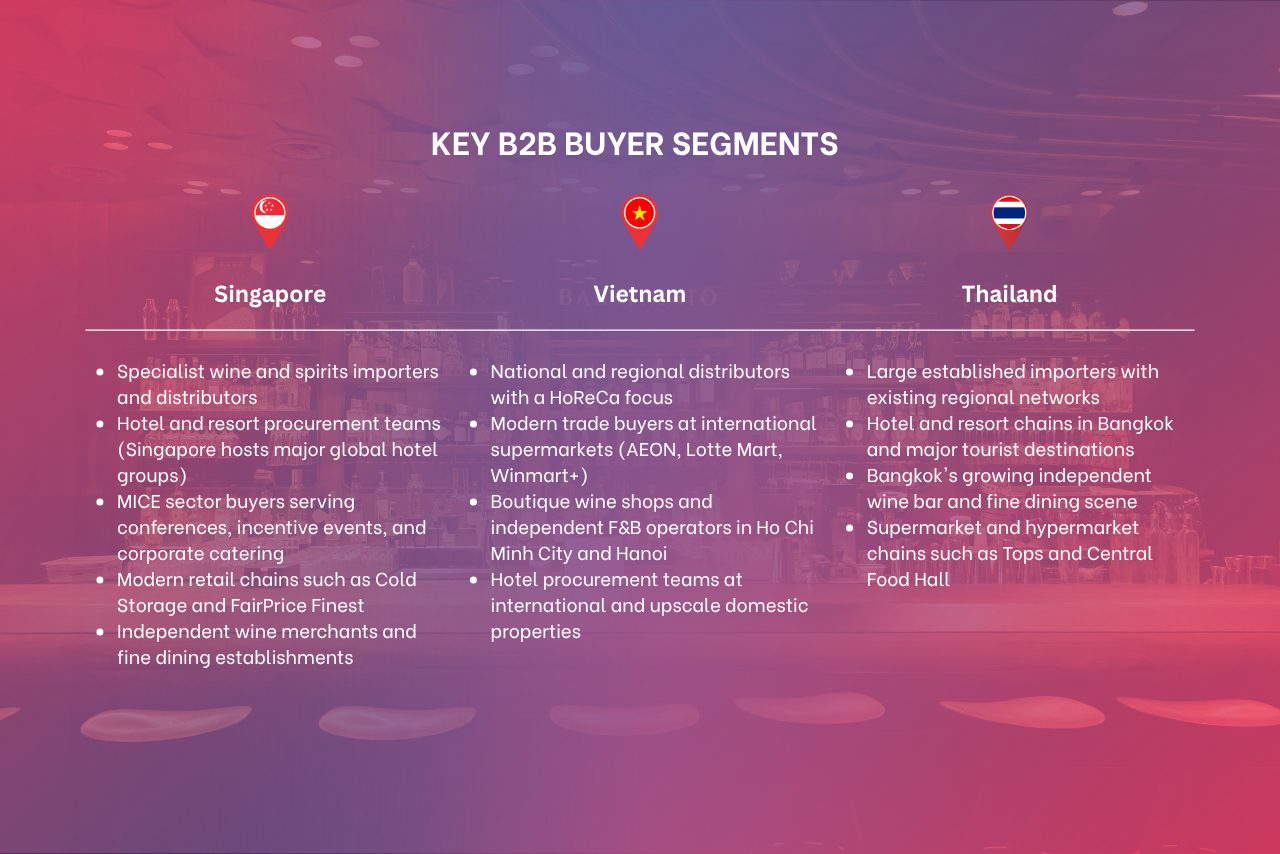
Overview of key B2B buyer segments and distribution channels for wine & spirits brands in Singapore, Vietnam, and Thailand.
Side-by-Side: Vietnam vs Singapore vs Thailand for Wine & Spirits in ASEAN
The right market depends on three factors: your price positioning, your existing distribution relationships, and your appetite for regulatory complexity.
You can use this framework to guide your decision:
- Choose Singapore if you are entering ASEAN for the first time and need a transparent, low-risk test market. Singapore’s buyer network, regulatory clarity, and logistics infrastructure make entry predictable and scalable.
- Choose Vietnam if you have a competitive price point in the $15–$40 retail range and want exposure to one of the region’s fastest-growing consumer markets. Be prepared to invest in distributor support and local market education.
- Choose Thailand if you already have a regional APAC distributor or an established relationship with a Thai importer. The market is large and sophisticated, but it is not the easiest place to start from zero.
Entry budget guide (from market research):
| Budget | Recommended market | Channel focus |
| Under USD 50,000 | HCMC only or Singapore | HoReCa only |
| From USD 50,000 to USD 200,000 | Vietnam (HCMC + Hanoi) + Thailand | HoReCa primary, selective off-trade |
|
Over USD 200,000 |
Vietnam + Singapore + Thailand core; Philippines secondary |
HoReCa flagship, off-trade in SG/VN/TH |
In all three cases, a reliable local distribution partner is non-negotiable. In practice, the biggest challenge is rarely product registration alone. Most international brands struggle with distributor prioritization, portfolio positioning, and maintaining commercial visibility after initial onboarding. In ASEAN, execution quality often determines whether a brand scales beyond its first distributor agreement.
Download our Southeast Asia Wine & Spirits Market guide to explore regional market dynamics, premium growth opportunities, distributor landscapes, and practical expansion insights across ASEAN.
Final Verdict
The wine & spirits opportunity in ASEAN is significant, but market selection determines whether your first-year builds momentum or burns budget. Singapore offers the clearest entry path and the strongest infrastructure for premium brands. Vietnam delivers the highest growth ceiling for mid-tier and accessible premium players. Thailand rewards those who already have a foothold in the region.
All three markets are viable. However, they demand different capabilities, timelines, and investment levels. The key is to match your brand’s positioning and resources to the right market from day one.
Ready to identify the right distribution partner for your wine or spirits brand in ASEAN? Contact us now, we’re here to support you there.