Introduction
Carbon reporting in ASEAN has moved from a sustainability initiative to a commercial requirement. In this region, buyers now request emissions data during supplier onboarding, while export markets require traceable disclosures. Scope 3 reporting and CBAM are extending these expectations across supply chains, making both a carbon footprint report and a carbon disclosure report necessary for cross-border operations.
As of mid-2026, many companies entering ASEAN are not prepared for this shift. Emissions data is fragmented across systems, supplier visibility is limited, and reporting standards differ by market. This leads to delays in supplier qualification, increased procurement scrutiny, and exposure to export compliance risks.
In this article, we – Source of Asia, outline how carbon reporting affects ASEAN expansion and how to build reporting readiness that supports market entry and ongoing operations.
Key Insights
- Carbon reporting is becoming a core requirement for supplier qualification and export market access.
- Buyers now require verifiable emissions data during onboarding, not only for ESG reporting.
- Scope 3 emissions drive most disclosure pressure across ASEAN supply chains and industries.
- Fragmented data systems and inconsistent supplier inputs limit credible carbon reporting.
- Lack of reporting readiness leads to delays, higher scrutiny, and lost sourcing opportunities.
Carbon Reporting 101
Before addressing compliance or buyer requirements, companies first need to understand how carbon reporting works, what data is involved, and which standards shape reporting expectations across global supply chains.
What is carbon reporting?
Carbon reporting is the process of measuring, tracking, and disclosing greenhouse gas emissions across your operations and supply chain. In simple terms, it shows how much carbon your business generates and how that data is shared with buyers, regulators, or investors.
This process includes:
- Measuring emissions from operations and supply chain activities
- Tracking energy use and overall carbon footprint report
- Preparing a carbon footprint report for external stakeholders
- Submitting structured carbon disclosure reports when required
More importantly, carbon reporting is not just about numbers. It requires consistent data, clear methodologies, and supporting documentation. As a result, it provides reliable emissions visibility through a carbon footprint report and a structured carbon disclosure report, supporting procurement decisions, compliance, and risk management.
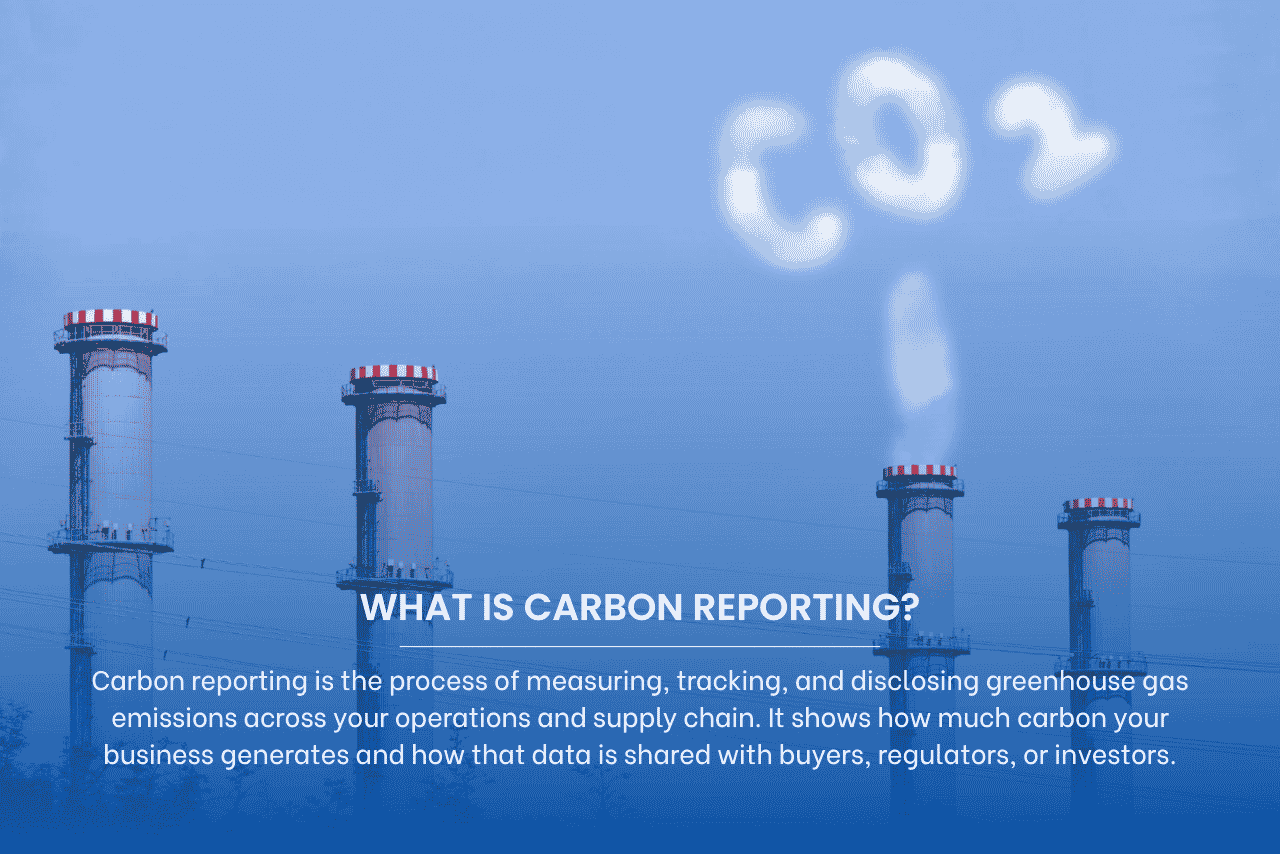
Carbon reporting measures, tracks, and discloses emissions across operations and supply chains to support transparency and compliance.
Key components of carbon reporting
A reliable carbon reporting system is built on a clear structure and consistent data. Each component plays a role in ensuring the report can support buyer requirements and regulatory checks. There are four key components a company needs to establish:
- Scope 1, 2, and 3 emissions: These define where emissions occur. Scope 1 covers direct operations, Scope 2 relates to purchased energy, and Scope 3 includes supply chain activities, which are often the most complex.
- Data collection and emissions calculation: Companies need to gather accurate activity data and convert it into emissions using standard factors.
- Reporting boundaries and verification: Clear scope and independent validation ensure your data is consistent and credible.
- Supporting documents and audit readiness: Strong documentation supports a verifiable carbon disclosure report, allowing you to prove and defend your data during audits or buyer reviews.
Common carbon reporting standards
Carbon reporting follows recognized frameworks that define how emissions data is measured and disclosed. Aligning with these standards ensures consistency and acceptance across markets. The following are key standards:
- GHG Protocol: The global foundation for emissions accounting. It provides the methodology for calculating Scope 1, 2, and 3 emissions and is widely used across industries.
- ISSB and TCFD: These frameworks guide climate-related financial disclosures, often required by investors and publicly listed companies.
- CBAM requirements: From 2026, EU regulations require verified emissions data for certain imports, making carbon reporting part of trade compliance.
- Buyer-specific reporting requirements: Multinational companies often request customized disclosures as part of supplier onboarding and evaluation.
Why Carbon Reporting Is Becoming A Commercial Requirement
Carbon reporting is no longer limited to ESG teams. In 2026, it affects supplier qualification, buyer expectations, and export access as emissions data becomes part of global procurement and compliance processes.
From voluntary ESG to business requirement
A few years ago, carbon reporting was primarily treated as a sustainability task. It was often handled by ESG teams and used for brand positioning. However, buyers now use emissions data to assess operational transparency and risk, especially when selecting and onboarding suppliers.
This shift is accelerating as global standards tighten. Frameworks such as ISSB and EU regulations increasingly treat emissions data as decision-making input. Thus, carbon reporting becomes part of supplier qualification, directly affecting contract access and long-term commercial viability.
How Scope 3 reshapes supplier expectations
Many companies used to focus only on emissions from their own operations. But today, most emissions come from the supply chain. In many manufacturing sectors, scope 3 emissions are often about 26 times higher than direct emissions and make up around 75% of total emissions. Hence, global buyers cannot meet their targets without supplier data.
Thus, expectations are changing across the supply chain. Suppliers are now asked to provide clear and verifiable emissions data, and in many cases, product-level information. Companies that can report accurately are easier to onboard and more likely to retain contracts, while others may face growing pressure or replacement.
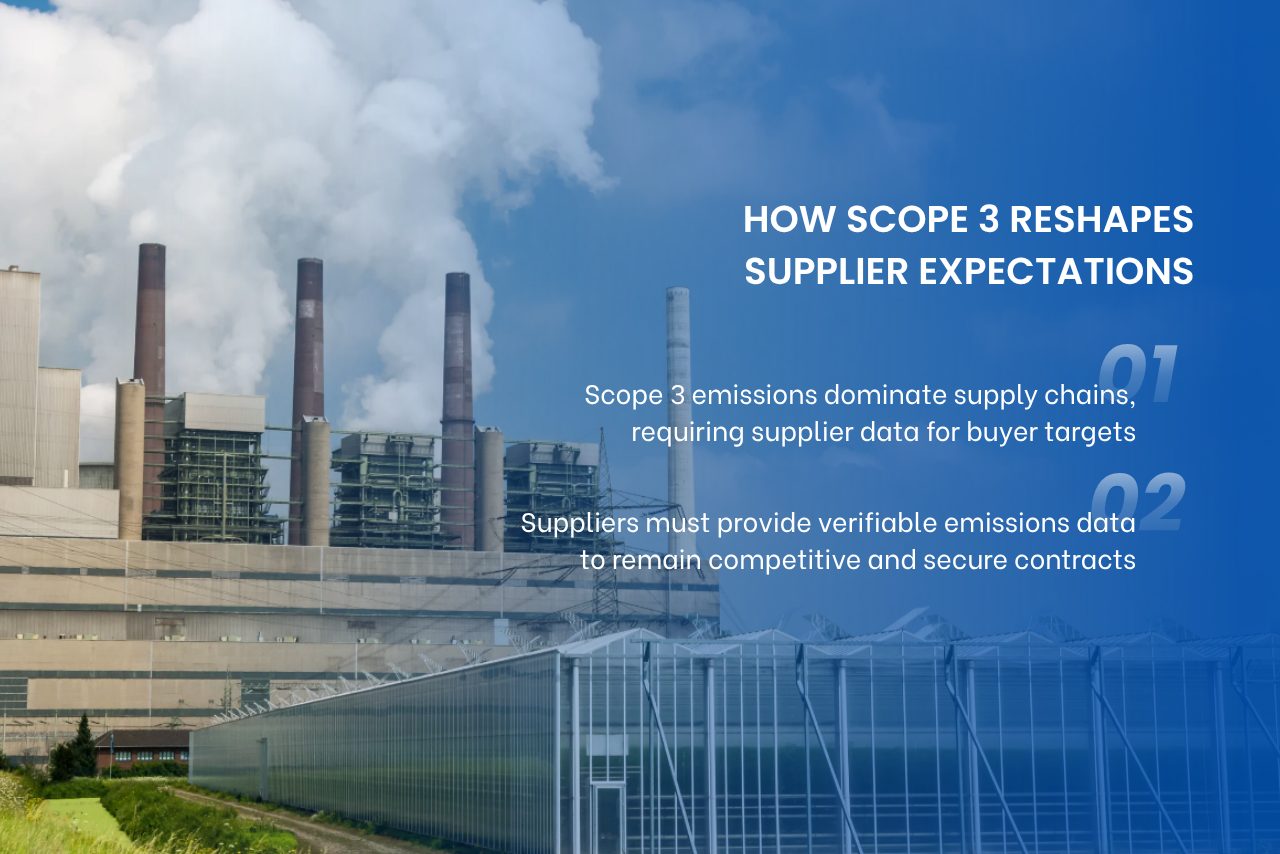
Scope 3 emissions extend reporting requirements across suppliers, making emissions data a core factor in procurement and supplier evaluation.
Carbon reporting in export market access
Pressure is no longer limited to buyer requirements, as export markets are now adding regulatory obligations. For example, in the EU, CBAM requires importers to declare the embedded carbon in products such as steel, cement, and aluminum. Consequently, exporters must prepare traceable emissions data as part of customs documentation, not just internal reporting.
This shift creates direct operational impact:
- Incomplete data can delay shipments or trigger customs review.
- Inaccurate reporting may increase compliance costs.
- Lack of transparency can limit market access.
Therefore, carbon reporting becomes a market entry requirement, not just a post-entry compliance task.
| Carbon reporting is now embedded in export commercial requirements and global sourcing structures. 👉 Understand how ASEAN is positioned within global supply chain rebalancing with us! |
How Carbon Reporting Reshapes Market Access In ASEAN
Market access in ASEAN is increasingly driven by data readiness, not only cost or production capability. Based on observed procurement behavior in manufacturing and export supply chains, carbon reporting is now part of supplier qualification, not just compliance.
1. Adding carbon reporting to supplier onboarding
Supplier onboarding has become more data-focused. Many procurement teams now request emissions disclosures alongside pricing and certifications. Common requirements include:
- Energy sources and consumption patterns
- Emissions measurement methods in use
- Availability of a carbon footprint report or equivalent dataset
In practice, buyers use this to assess operational transparency and control systems, not just emission levels. Missing data often leads to longer validation cycles before approval.
2. How global regulations raise reporting pressure
Reporting pressure is mainly driven by scope 3 obligations. CBAM, UK, EU, and US disclosure frameworks require companies to collect supply chain emissions data. As a result, buyers request emissions data from ASEAN suppliers earlier and in more structured formats, often before finalizing commercial terms, especially in export-driven sectors.
3. When emissions visibility affects market access
Carbon reporting now impacts contract continuity and renewal decisions. Buyers increasingly integrate emissions data into risk frameworks. Suppliers without verifiable data face more audits and slower approvals. In contrast, companies with consistent reporting systems tend to move faster through qualification and maintain stronger long-term buyer relationships.
Carbon Reporting Readiness Across ASEAN Markets
Carbon reporting across ASEAN is developing unevenly, with markets progressing from early policy design to mandatory disclosure systems. These differences reflect varying regulatory maturity, but all point toward stronger emissions transparency requirements for industries and supply chains.
Singapore as ASEAN’s reporting benchmark
Singapore is the most advanced carbon reporting market in ASEAN, combining carbon pricing with structured disclosure requirements that directly influence corporate behavior and regional expectations.
- Carbon pricing as a cost driver: Carbon tax rises from S$25/tonne (2024) to S$45/tonne (2026), with a projected S$50–S$80/tonne range by 2030. This shifts emissions into a measurable financial liability for industrial operators.
- Mandatory disclosure expansion: SGX requires Scope 1–2 reporting from 2025; selected large listed firms must include Scope 3 from 2026, with gradual inclusion of large non-listed entities.
- Standard alignment: Adoption of international reporting frameworks improves comparability for investors and cross-border supply chains.
These mechanisms establish Singapore as a benchmark shaping ASEAN procurement and compliance expectations.
Vietnam and Thailand accelerate industrial transition
Vietnam and Thailand are strengthening carbon governance, increasing reporting requirements across key industrial sectors and export supply chains.
- Vietnam ETS development: Vietnam is building an emissions trading scheme and carbon exchange. Mandatory MRV systems already include steel, cement, power, and chemical sectors, increasing structured emissions data requirements for manufacturers and exporters.
- Thailand climate framework: Thailand’s Climate Change Bill establishes the legal basis for a domestic carbon market and national registry. Industrial emitters face increasing reporting obligations aligned with emerging international standards.
- Supply chain pressure: Automotive, electronics, and export manufacturing sectors in both markets are experiencing faster adoption of emissions disclosure requirements driven by global buyers.
Indonesia and Malaysia expand sector-based reporting
Indonesia is formalizing its carbon governance under Presidential Regulation 110/2023, building a national MRV system and emissions trading scheme. Power and coal sectors are prioritized, with manufacturing and wider industrial segments expected to follow. This phased approach is establishing structured emissions accountability across one of ASEAN’s largest industrial bases, increasing compliance requirements for producers integrated into export supply chains.
Meanwhile, Malaysia is strengthening industrial carbon management through alignment with CBAM-related requirements and internal carbon pricing mechanisms. Export-oriented sectors such as electrical and electronics, palm oil, and rubber are facing rising disclosure expectations, driven by both regulatory convergence and international buyer requirements.
| Building a compliant ASEAN supply chain goes beyond emissions data. See how SOA helps buyers manage FSC-certified responsible furniture sourcing, from supplier qualification to production follow-up and documentation coordination. |
The Operational Challenge Behind Carbon Reporting
Operational constraints in data collection, verification, and cross-market coordination shape carbon reporting in ASEAN more than regulation alone, creating structural execution challenges for companies.
Managing emissions data across operations
Fragmented information systems often constrain how companies manage emissions data across ASEAN operations, rather than a lack of intent. In most cases, companies do not centralize emissions-related data, which creates gaps in reporting accuracy and consistency.
- Scattered data sources: Companies store utility bills, fuel usage, logistics records, and supplier invoices across different systems and formats.
- Incomplete supplier data: Many suppliers still provide non-standard or partial emissions information, making consolidation difficult.
- Regional reporting gaps: Different levels of data maturity across countries weaken overall reporting reliability.
Thus, companies struggle to build a consistent carbon footprint report and carbon disclosure report without first aligning data collection processes across operations.
Turning emissions data into credible reporting
Collecting emissions data is only the starting point; companies establish credibility by structuring and validating it properly. Without a clear methodology, even complete datasets can fail under buyer or audit review.
- Traceable methodologies are required: Companies must align reporting with recognized standards such as the GHG Protocol or ISO 14064, ensuring reviewers can assess, replicate, and verify calculations without ambiguity.
- Verification and audit readiness matter: Companies need supporting evidence and clear data lineage to demonstrate that emissions figures rely on verified data, not assumptions.
- Consistency across operations is critical: When methods differ across sites or suppliers, it directly weakens buyer confidence in reported emissions data.
This directly affects the reliability of any carbon footprint report used for external reporting.
Standardizing reporting across ASEAN markets
Standardizing emissions reporting in ASEAN is difficult because regulatory maturity differs across markets. For example, Singapore has structured disclosure rules, while Vietnam and Indonesia are still developing sector-based systems, and Malaysia is advancing export-linked requirements. This weakens consistency when preparing a regional carbon disclosure report.
Local suppliers follow different practices, with variations in data quality, formats, and measurement approaches across supply chains. As a result, standardization becomes difficult at scale, especially for companies operating across multiple jurisdictions. This requires structured coordination mechanisms to align reporting boundaries and ensure consistent, comparable emissions data across ASEAN operations.
| 👉 Carbon reporting complexity often requires regional coordination. Learn how ASEAN regional HQ strategies are evolving to manage cross-market operations. |
What Happens When Companies Are Not Carbon Reporting Ready
When buyers or regulators request emissions data and companies cannot provide it, the impact is typically immediate and affects day-to-day commercial operations rather than long-term planning.
- Supplier qualification delays
Procurement teams typically cannot pause sourcing cycles. When emissions data is missing, buyers often bypass companies in favor of suppliers with established reporting systems, slowing or blocking qualification.
- Increased procurement scrutiny
A failed emissions data request usually triggers higher-level review requirements, meaning future tenders and renewals demand more documentation and verification, not less.
- Export compliance and documentation risk
As regulations like CBAM expand emissions-linked trade requirements, companies without structured reporting face increasing exposure in export documentation and customs compliance processes.
- Reduced competitiveness in sourcing markets
Over time, buyers prioritize suppliers with reliable carbon data, making a lack of reporting capability a direct competitive disadvantage in global supply chains.
Lack of carbon reporting readiness leads to supplier delays, compliance risks, and reduced competitiveness in global sourcing and export markets.
Final Thoughts
Carbon reporting is shifting from ESG disclosure into a core transparency requirement across global supply chains, where emissions visibility now directly influences procurement decisions and export eligibility. As ASEAN markets integrate with international standards, regulatory divergence and Scope 3 expectations are increasing pressure on companies to maintain traceable, audit-ready emissions data across operations, supported by a consistent carbon footprint report.
In Southeast Asia, companies build readiness not only through reporting capability but also by aligning systems, suppliers, and processes across markets. Before scaling operations, companies need to assess whether their data infrastructure can support consistent emissions reporting under different regulatory environments. Understanding this, Source of Asia helps companies align carbon reporting systems with ASEAN expansion needs, ensuring operational consistency and compliance readiness across regional supply chains.
| 👉 Contact us to build structured carbon reporting readiness and support your long-term ASEAN expansion strategy. |
Frequently Asked Questions
Scope 3 carbon reporting covers indirect emissions across a company’s value chain, including suppliers, logistics, and product use. It is often the most complex category because it depends on external data outside direct operational control.
Energy-intensive and export-driven sectors face early pressure, including power generation, steel, cement, chemicals, automotive, and electronics. Higher emissions intensity and exposure to international supply chain requirements drive the prioritization of these industries.
Carbon reporting is gradually becoming mandatory in parts of ASEAN, starting with listed companies and high-emission sectors. Requirements vary by country, with Singapore leading structured disclosure and others phasing in sector-based obligations.
Buyers request emissions data to meet regulatory compliance, manage supply chain risks, and align with ESG commitments. It also helps assess supplier transparency and readiness for evolving carbon-related trade requirements.
Manufacturers collect emissions data through supplier questionnaires, utility and fuel records, and production inputs. Effective systems require standardized templates, verification processes, and coordination across multiple supplier tiers.