Introduction
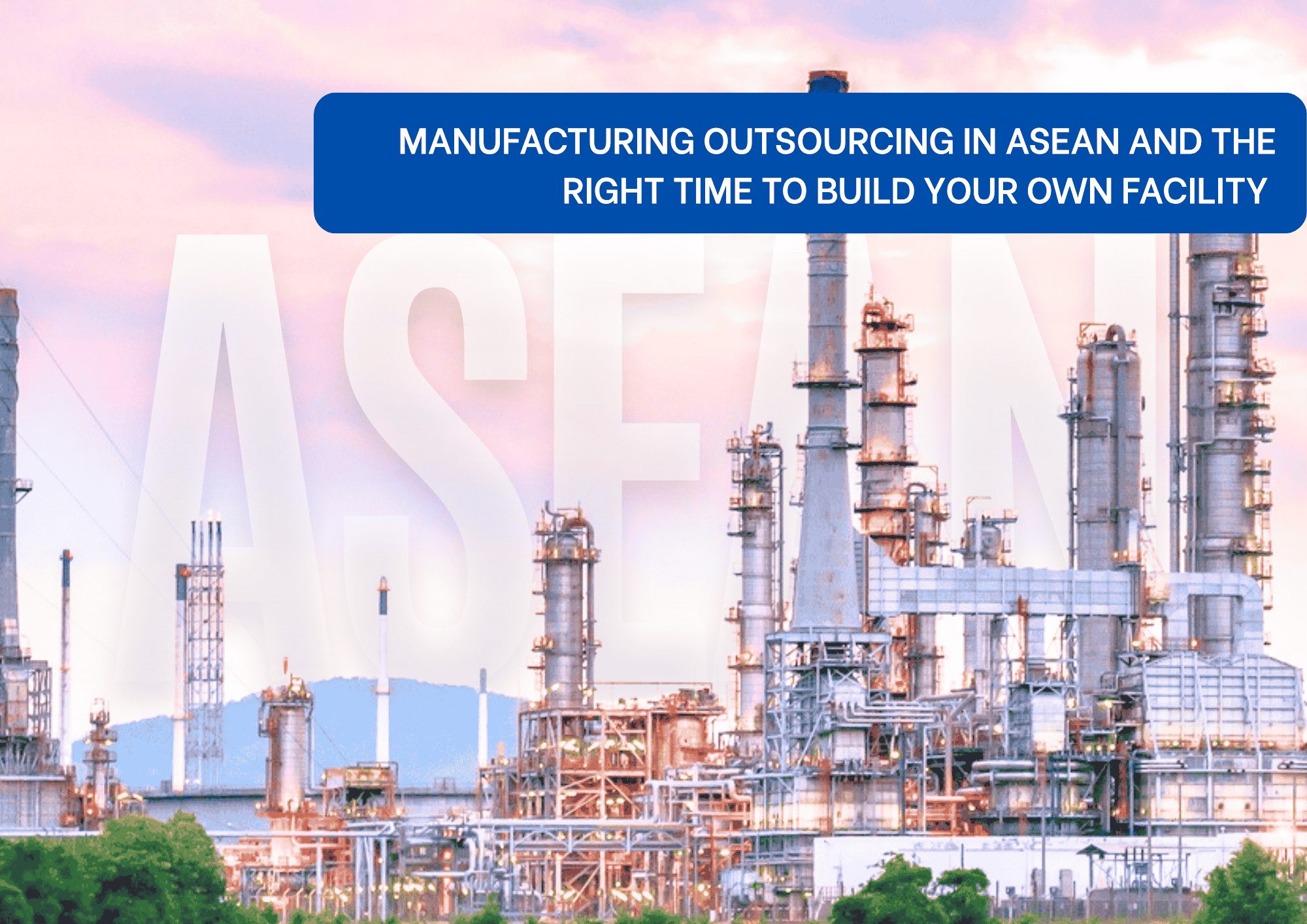
Starting production in an ASEAN country takes capital, time, and local knowledge that many companies do not have on day one. That is why most businesses entering Southeast Asia begin with manufacturing outsourcing. It removes the need to build facilities or hire large teams, connects you to established supplier networks and skilled labor, and gives you the flexibility to adjust production volumes.
As operations grow, the limits of this model become more visible. Higher volumes and more complex products can lead to quality issues, rising total costs, and heavier reliance on suppliers who may not scale or adapt as quickly as your business needs.
In this article, we, Source of Asia, explain how manufacturing outsourcing works in ASEAN, where its limitations typically emerge, and how to determine the right time to transition toward your own facility.
Key Insights
- Manufacturing outsourcing enables faster market entry with lower upfront investment but requires careful supplier management.
- ASEAN offers strong manufacturing advantages, but outcomes depend on operational complexity and execution quality.
- Outsourcing works well early but shows limits as scale, cost, and control requirements increase.
- Hybrid models help companies transition gradually while maintaining stability and operational flexibility.
- Moving in-house becomes relevant when volume stabilizes, costs rise, and manufacturing becomes strategic.
Manufacturing Outsourcing in ASEAN: 101 Overview
Many companies entering a new market begin with manufacturing outsourcing to move faster and avoid high upfront costs, but using it effectively depends on clearly understanding how it works and the options available.
What is manufacturing outsourcing?
Manufacturing outsourcing is when companies have external partners handle part or all of their production instead of running their own factory. The company still owns the product design and brand, while the supplier manages daily operations and output.
- Production is carried out by third-party manufacturers
- Can take place locally, nearshore, or offshore
- Shifts focus from owning assets to paying for production results
In practice, this approach allows companies to start production faster and use existing factory capacity in established markets. It is commonly used when internal resources are limited or when speed to market is a priority.
Common outsourcing models in manufacturing
After deciding to outsource, companies need to select the right operating model, as each option affects cost, control, and scalability. In practice, companies often start simple and adjust over time.
- Contract manufacturing (CMO): A partner produces goods based on the company’s designs and specifications. This is the most common starting point because it is fast to set up and requires minimal coordination. In this model, the brand owner often retains control over raw material procurement and supply chain oversight, ensuring higher material quality but requiring more internal management.
- Original Equipment Manufacturer/Original Design Manufacturer (OEM/ODM): OEM follows company designs, while ODM provides both design and production. This is widely used when companies need faster product development or lower design costs.
- Component outsourcing: Specific parts are outsourced while final assembly stays in-house, helping companies retain control over critical steps.
- Turnkey manufacturing: The partner takes full responsibility for the entire end-to-end process, from material sourcing to final logistics, offering the lowest operational burden for the company.
- Co-manufacturing: Production tasks are shared, allowing companies to balance control and efficiency.
In practice, companies often start with contract manufacturing or component outsourcing, then adjust the model as operations grow.
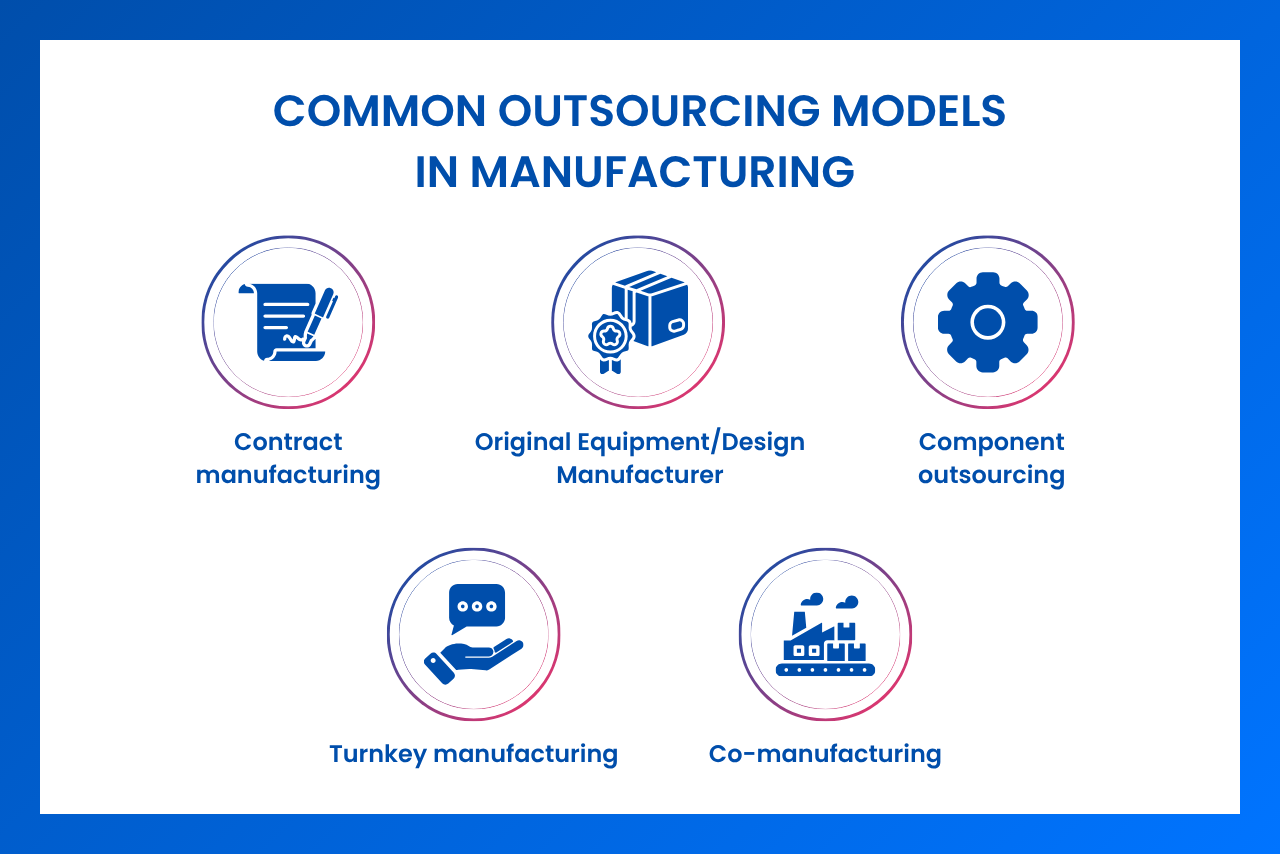
Common manufacturing outsourcing models include contract manufacturing, OEM, ODM, component outsourcing, and turnkey production.
Best ASEAN Countries for Manufacturing Outsourcing 2026
In 2026, ASEAN is not a single manufacturing market. Each country has different strengths in labor cost, skills, infrastructure, and sector specialization. To make this clearer, companies typically compare locations based on labor, infrastructure, and industry focus:
| Country | Typical strengths | Best for |
| Vietnam | Competitive labor cost, strong FDI, electronics & furniture hub | Electronics, furniture, industrial products |
| Thailand | Automotive cluster, mature suppliers, good infrastructure | Automotive, machinery, higher-spec assembly |
| Malaysia | Higher skill base, electronics, and medical devices | High-precision components, electronics |
| Indonesia | Large workforce, natural resources, growing industry | Labor-intensive and resource-based products |
| Philippines | Strong English, BPO, niche manufacturing | Niche assembly, support functions, packaging |
While Thailand leads in automation, Vietnam’s deepening industrial clusters provide the fastest “time-to-market” for consumer electronics and lifestyle products. Therefore, Vietnam could be the first choice for manufacturing outsourcing in ASEAN due to cost, cluster depth, and export readiness.
| Understanding country differences is only the first step; deeper sector insights help refine sourcing decisions further.
👉 Read our detailed Southeast Asia Sectorial Analysis for 2026! |
What Are the Pros and Cons of Manufacturing Outsourcing?
Manufacturing outsourcing helps companies move quickly without heavy investment. However, as operations grow, the trade-offs become more important. Understanding both sides early helps companies avoid costly adjustments later.
Advantages of manufacturing outsourcing
Manufacturing outsourcing allows companies to start production quickly with lower upfront investment. Instead of building their own facility, companies use existing supplier capacity, which reduces setup time and financial risk. It also provides access to established capabilities, including skilled labor and proven production systems.
As demand changes, companies can scale production more flexibly without fixed commitments. This setup helps shorten time to market and allows internal teams to focus on product, sales, and expansion rather than managing daily manufacturing operations.
Disadvantages and limitations
However operations grow, the limitations of manufacturing outsourcing become more visible. Companies often face reduced control over production, with limited visibility into daily processes. Quality consistency may vary across suppliers or batches, especially at higher volumes.
There is also increased exposure to intellectual property risks when sharing designs and processes. In addition, coordination becomes more complex due to time zones and communication gaps. Over time, hidden costs can erode margins, specifically unexpected import/export duties, expenses for quality rework due to insufficient oversight, and legal fees for protecting intellectual property across multiple ASEAN jurisdictions.
How To Evaluate If Manufacturing Outsourcing Still Makes Sense
Manufacturing outsourcing should be reviewed regularly to ensure it continues to support business objectives. What works well at the entry stage may not remain effective as production volume, operational complexity, and control requirements increase.
When outsourcing is working effectively
Manufacturing outsourcing continues to work well when core performance remains stable and predictable over time. At this stage, companies can operate with confidence and focus on growth rather than operational issues.
- Cost is predictable: Total production cost stays consistent, with no major fluctuations or unexpected increases
- Quality meets requirements: Output remains aligned with specifications across batches, with minimal variation
- Delivery is reliable: Suppliers meet agreed-upon timelines and support steady production without disruption
When these conditions are met, outsourcing remains a stable and efficient operating model, especially for companies focused on scaling without adding internal manufacturing complexity.
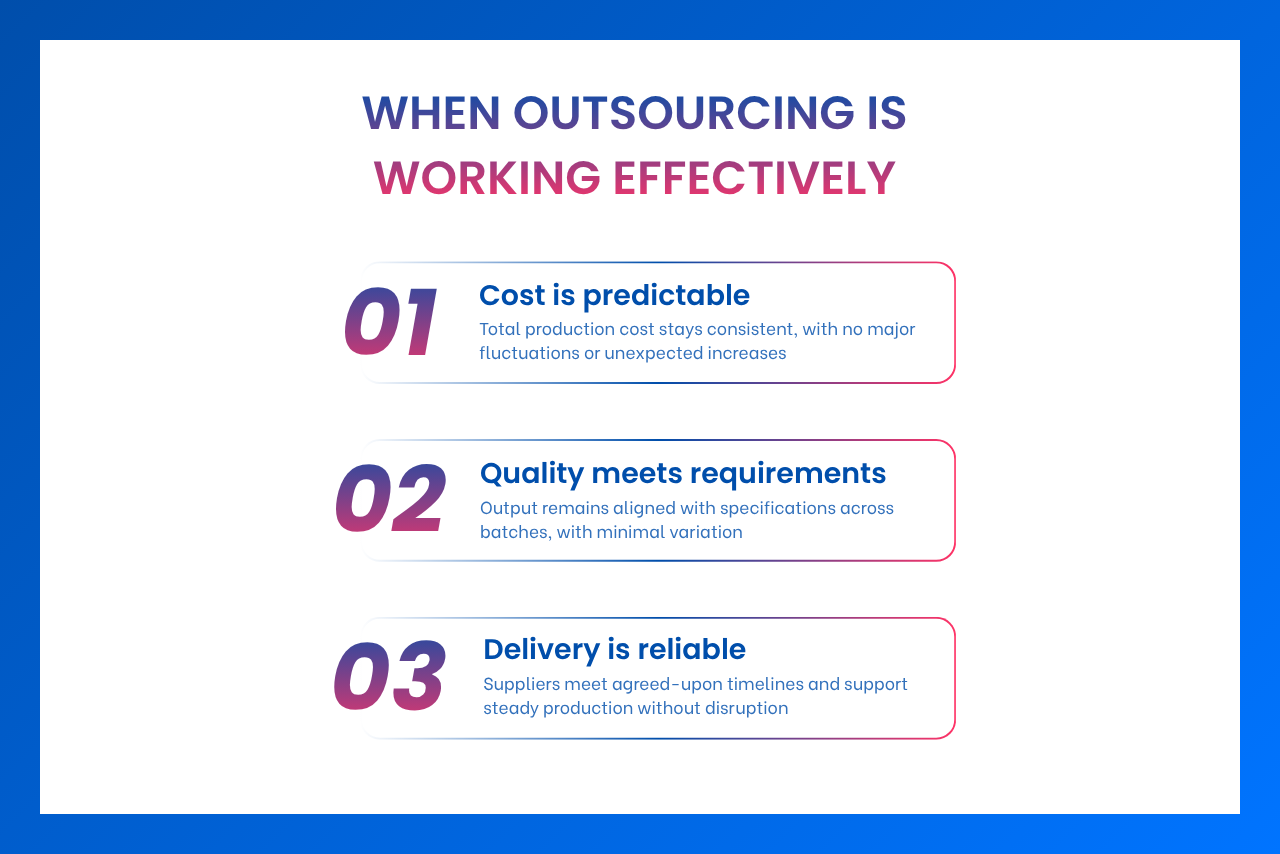
Outsourcing is working effectively with stable costs, quality, and delivery.
When outsourcing becomes a limitation
At the beginning, outsourcing is often used as a practical way to enter markets quickly and keep early-stage costs under control. It allows companies to avoid heavy internal investment while still starting operations with flexibility. In this phase, the model usually works well because it reduces pressure and supports faster execution.
However, as operations expand, clear limitations begin to surface. Over time, cost efficiency declines due to higher volumes or hidden inefficiencies, while control over quality and delivery timelines becomes less stable because of added external dependencies. In addition, suppliers may struggle to scale with more complex requirements, turning outsourcing from a support tool into a structural constraint.
Key questions to guide your decision
Before deciding to continue or adjust an outsourcing model, companies should evaluate a few key operational aspects that directly affect performance and long-term scalability.
- First, assess whether you have sufficient control over production quality, timelines, and consistency. Without this, operational risks tend to increase as complexity grows.
- Next, review if total costs remain competitive in the long term, including logistics, coordination effort, and hidden overheads.
- Finally, consider whether current suppliers can support future scale and more complex requirements as demand increases.
Together, these points help determine if outsourcing still fits your current growth stage and business direction.
When To Move from Manufacturing Outsourcing to Your Own Facility
Manufacturing outsourcing often supports early market entry by reducing upfront costs and speeding up setup. However, as operations scale, issues like delays, higher coordination effort, and limited control over production become more visible, leading companies to reassess long-term fit.
Key triggers for transitioning in-house
In most cases, the shift from outsourcing to in-house manufacturing does not happen suddenly. It becomes relevant when operational patterns change in a clear and sustained way.
- Production volume becomes stable and predictable: Demand is no longer experimental but supported by a steady customer base across key markets, making long-term internal planning more feasible.
- Control and quality become critical to the business: Requirements for traceability, compliance, and product consistency increase, especially when output directly impacts customer commitments and brand reliability.
- The total cost of outsourcing increases over time: When combined expenses such as logistics, coordination, rework, and supplier management continue to rise, internal production becomes more economically relevant.
- Manufacturing becomes a strategic capability: Production shifts from an execution function to a key driver of innovation, speed, and differentiation in the market.
| Once these triggers appear, the focus shifts to execution planning and location selection in Vietnam.
👉 See more on implementing factories in Vietnam’s industrial parks. |
Benefits of building your own facility capability
Moving production in-house is usually a response to the need for stronger control, better coordination, and long-term efficiency in operations. It changes both the cost structure and the way decisions are made across the value chain.
- Full operational visibility and control: You can define processes, systems, and KPIs directly, which allows real-time monitoring of the shop floor performance and faster response to issues.
- Improved cost efficiency at scale: When production volume is stable, internal manufacturing can reduce unit cost by removing external margins and optimizing fixed assets over time.
- Stronger protection of intellectual property: Designs, process knowledge, and continuous improvements remain fully within the organization, reducing exposure to external risks.
- Better integration with core functions: Manufacturing becomes closely aligned with R&D, supply chain, and commercial teams, helping reduce delays and improve overall execution speed.
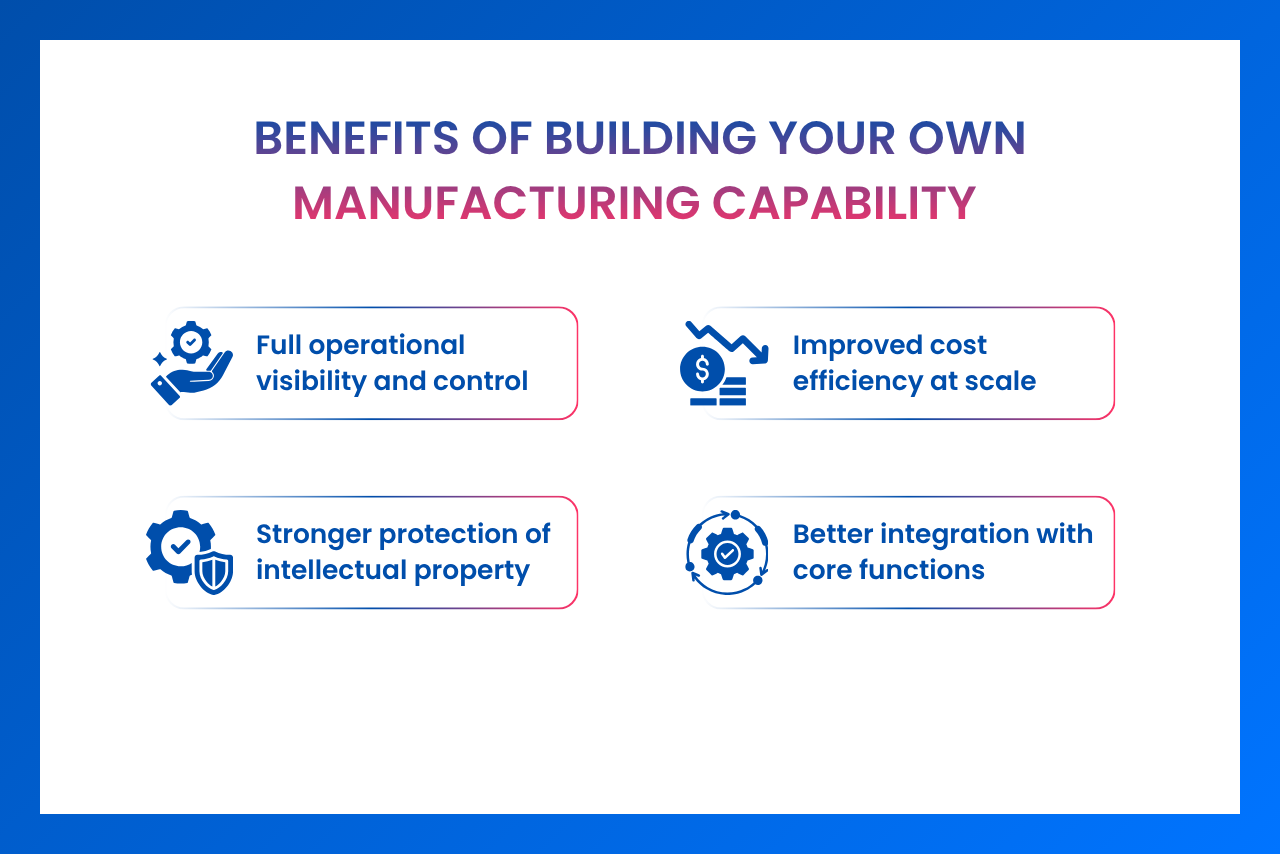
Benefits of building your own manufacturing capability for control and efficiency.
Hybrid models as a transition strategy
The shift from 100% manufacturing outsourcing to full in-house production is rarely immediate. Companies often use a hybrid model to manage risk and keep operations stable during transition. They begin by internalizing critical processes first, such as final assembly or core technologies, while still outsourcing non-core components. This ensures control over key activities without disrupting existing supply chains.
For example, an electronics firm might set up a small internal facility for final high-value assembly and proprietary firmware loading in Vietnam, while continuing to outsource bulk component machining to established local partners.
At the same time, they reduce supplier dependency gradually, maintaining selected contract manufacturers for certain products or regions while building internal capability. Meanwhile, companies maintain flexibility while scaling internal capacity, using outsourcing as a buffer during ramp-up and adjusting volumes as operations stabilize.
| 👉 If you are planning manufacturing outsourcing in ASEAN, contact us to discuss the right setup for your market entry strategy. |
Is ASEAN the Right Region for Manufacturing Outsourcing?
ASEAN continues to be a key region for manufacturing outsourcing in 2026, but it is not a one-size-fits-all solution. In practice, the value of the region depends on how well it matches a company’s product complexity, supply chain structure, and ability to manage operations across different markets.
- Balance cost advantages with operational complexity: While labor and production costs can be attractive, companies often face fragmented regulations, logistics constraints, and differences in local business practices that affect consistency.
- Ensure local oversight to maintain control: On-the-ground coordination is typically required to manage suppliers, monitor quality, and handle operational issues in real time.
- Align manufacturing decisions with long-term strategy: Location choices should reflect customer demand, product evolution, and planned investment direction, not only short-term cost optimization.
In many cases, ASEAN works well as an entry point for outsourcing and then evolves into a more strategic production base as regional operations mature.
| When ASEAN is suitable, the next step is execution planning through the right facility setup in Vietnam.
👉 Learn more about factory for rent options in Vietnam for manufacturers in 2026. |
Conclusion
Manufacturing outsourcing in ASEAN is often used in early stages because it helps companies enter faster, keep costs lower, and use existing supplier networks. As production grows, challenges appear in control, cost efficiency, and supplier capacity. A step-by-step transition, such as a hybrid approach or gradual in-house setup, helps keep operations stable while improving control and efficiency.
At Source of Asia, we support supplier identification and qualification, ASEAN country comparison, and end-to-end factory setup advisory from feasibility to execution. Our experts help companies align sourcing and manufacturing decisions with real market conditions and build operations that can scale effectively.
👉 Request an ASEAN manufacturing cost comparison for your product with our expert now!
Frequently Asked Questions
Key risks include quality variation, limited operational visibility, and IP exposure when sharing designs with external suppliers. Companies may also face hidden costs from logistics, audits, and longer lead times, which can reduce expected cost efficiency over time.
Companies outsource to lower upfront investment, enter markets faster, and access existing production capacity. It also allows them to test demand and refine products before committing capital to build their own facility.
Yes. ASEAN remains attractive due to cost competitiveness, growing infrastructure, and strong manufacturing clusters in countries like Vietnam, Thailand, and Malaysia. Success depends on supplier selection, governance, and a clear long-term operating plan.
Large-scale outsourcing expanded from the late 1970s, driven by globalization, trade liberalization, and cost advantages in Asia. Since then, global supply chains have become increasingly distributed across multiple regions.
No. Outsourcing refers to who produces the goods, while offshoring refers to where production takes place. Companies can outsource domestic or offshore production depending on their supply chain strategy.