Implementing a factory usually starts with a simple question: where should it be? Many companies first look at land prices or sizes. Soon after, they realize the real issue is whether the location can support daily work, future growth, and local rules at the same time. That is why industrial parks in Vietnam matter so much.
In 2026, Vietnam remains a practical manufacturing choice for foreign investors because these parks bring structure and clarity through pre-zoned land, standardized licensing, and coordinated local authority oversight. Still, not all parks work the same way, and early choices can shape costs and flexibility for years. In this guide, we – Source of Asia, will explain how industrial parks in Vietnam work, where they are located, and what to review before committing.
Key Insights
- Industrial parks are the primary entry model for foreign manufacturers setting up factories in Vietnam.
- Early industrial park selection has long-term effects on compliance, cost structure, scalability, and operational flexibility.
- Different types of industrial parks align with distinct business and market strategies.
- Regional choice across the North, Central, and South influences supplier access, labor conditions, operating costs, and growth potential.
- Infrastructure and utilities of readiness often have a greater impact on day-to-day operations than headline incentives.
Why Industrial Parks Matter In Vietnam’s Manufacturing Strategy
When companies consider manufacturing in Vietnam, a common concern is starting fast while maintaining control. Setting up a standalone factory often brings higher risk, especially in an unfamiliar regulatory and operating environment.
This is why industrial parks are the preferred entry model. Vietnam’s manufacturing growth is concentrated in planned zones rather than isolated sites, helping foreign companies operate with clearer structures and fewer uncertainties.
Industrial parks typically provide:
- Pre-approved land and zoning, reducing startup delays
- Shared infrastructure and utilities, lowering initial setup complexity
- Direct coordination with local authorities, simplifying compliance
This setup helps companies move faster while staying compliant, which is why many foreign manufacturers choose industrial parks to reduce early risk. Still, the park choice matters, since a poor location can limit expansion, supplier access, or future smart factory plans.
4 Types Of Industrial Parks In Vietnam
When companies plan manufacturing in Vietnam, they often assume all industrial parks work the same way. In reality, each type is designed for a different business path. Understanding these differences early matters because the wrong choice can quietly limit growth later.
Export processing zones
Export Processing Zones (EPZs) are built for companies that mainly serve overseas markets. They often look attractive at the start because they offer clear customs and tax advantages tied to export activity. For export-focused manufacturers with stable demand, EPZs can simplify early operations and reduce initial costs.
Over time, certain limitations become more visible:
- Domestic sales are restricted, or require extra approvals and procedures
- Local market access adds time and cost, reducing flexibility
- Operations become locked into an export-only model over time
- Changes in operating models within EPZs often require additional regulatory approvals, reducing agility over time.
As a result, EPZs can become limiting when companies want to sell locally, deepen local supply chains, or balance export and domestic demand.
Supporting industrial park
Supporting Industrial Parks are designed to serve supply chains. They are usually located near major manufacturers or logistics corridors and focus on component production and industrial services. For companies tied to specific buyers or suppliers, these parks can improve coordination and reduce logistics costs.
At the same time, this specialization brings limits. Operations often depend on a narrow set of industries or anchor clients, flexibility is lower when product lines or target markets change, and expansion into unrelated sectors becomes more difficult.
Because of this, supporting industrial parks works best for stable, supply-driven models. They can become restrictive when customer bases shift or when supply networks need to evolve.
Eco-industrial park
Eco-Industrial Parks focus on sustainability and shared resource use. They are designed to help companies meet rising environmental standards through coordinated systems and collective compliance. For firms with strong ESG goals, these parks support long-term alignment. While eco-industrial parks support compliance, they do not replace internal ESG governance or reporting responsibilities.
However, this model also brings trade-offs:
- Planning and reporting requirements are higher, especially for environmental metrics
- Operations depend on coordination with other tenants, not just internal teams
- Decision-making can be slower due to shared systems and approvals
Eco-industrial parks fit companies with mature sustainability strategies. They can create friction when speed, cost pressure, or internal readiness becomes the priority.
Industrial – urban – service zones
Industrial – Urban – Service Zones combine factories, housing, and daily services in one planned area. They are built to support long-term operations and help companies create a stable workforce over time. This model is common for large projects that expect steady growth.
The trade-offs become clear early. Land and service costs are higher than in standard industrial parks, governance is more complex because it involves multiple local authorities, and setup timelines are longer, requiring early planning and firm commitment.
As a result, these zones suit large, long-term investments. They are less practical when budgets are tight, timelines are short, or when flexibility matters more than integration.
Where Industrial Parks Are Located Across Vietnam
Industrial parks in Vietnam are spread across three main regions, each shaped by different cost levels, supply chains, and operating conditions. Understanding how the North, Central, and South differ helps companies narrow down locations that fit their production goals and long-term plans.
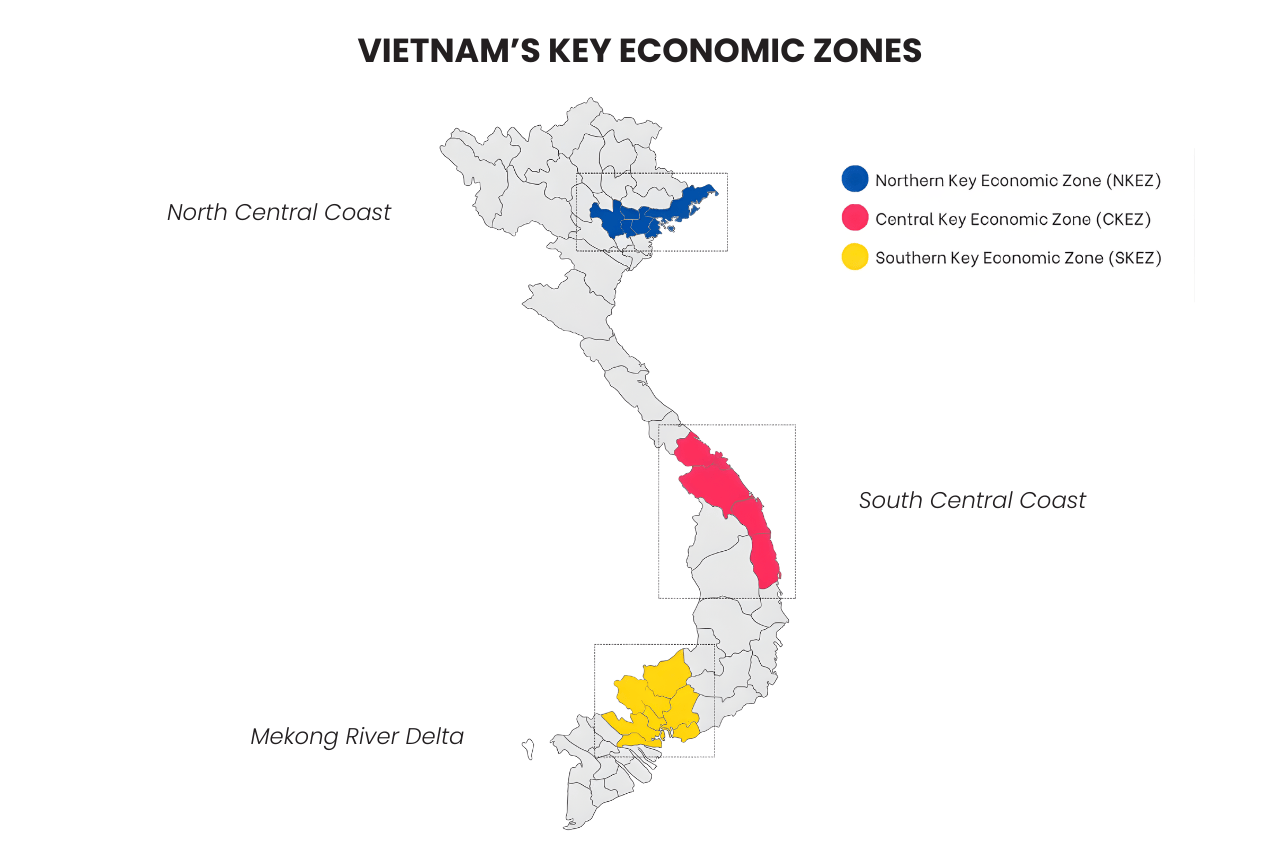
Industrial parks in Vietnam are organized across key economic zones in the North, Central, and South.
The North region
Northern Vietnam is one of the country’s most active manufacturing hubs, including Hanoi, Hai Phong, Bac Ninh, Vinh Phuc, Hai Duong, Hung Yen, and Quang Ninh. Data from the Foreign Investment Agency show that among the Top 10 cities and provinces attracting the most FDI are five in the country’s northern region. For many manufacturers, this is the first region they review.
The region attracts companies following a China+1 strategy because it sits close to China and key Northeast Asian routes. Over time, it has shifted from agriculture to industry, with strong growth in electronics, automotive, textiles, shipbuilding, and supporting industries.
Key characteristics of the North
- High supplier density, especially for electronics and components, but labor turnover is higher in mature parks
- Strong port access via Hai Phong, while industrial land is increasingly limited despite a relatively reliable power grid
- Fast approvals in established zones, yet less room to scale once parks reach capacity
Overall, the North suits companies that value supplier proximity and export speed and can manage tighter labor and land conditions as operations grow.
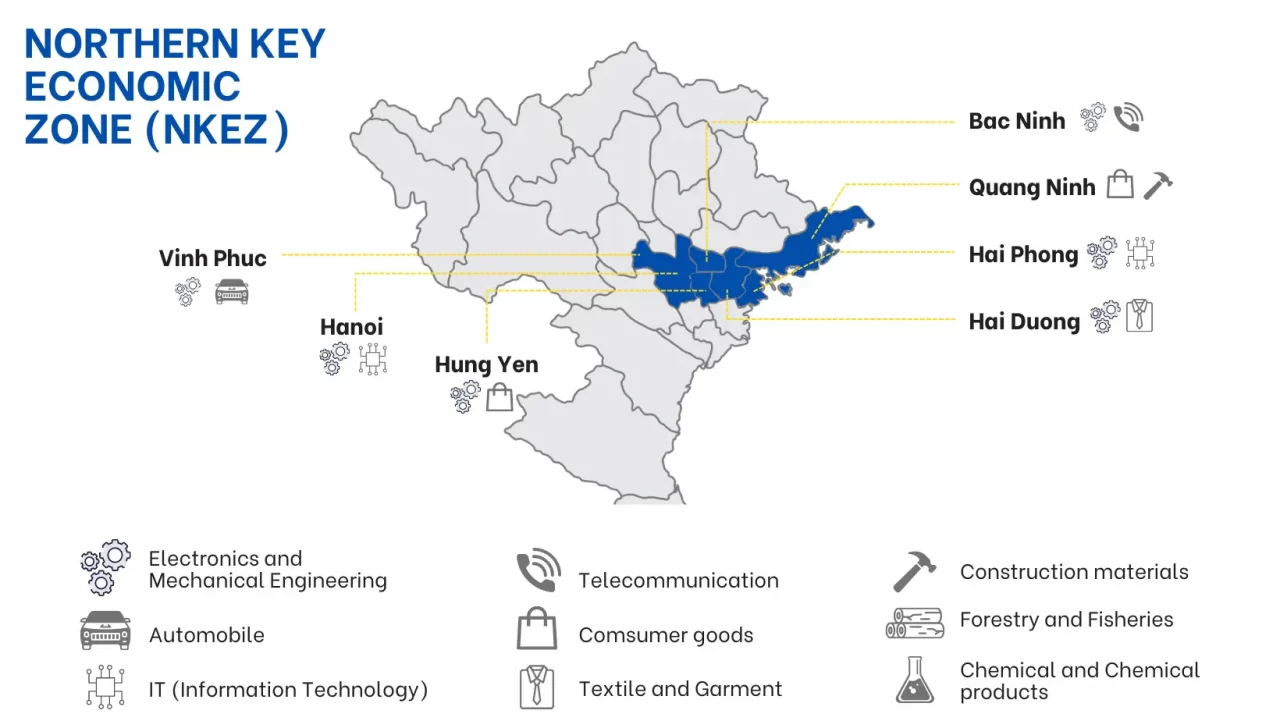
Northern Vietnam offers dense supplier networks and fast export access for manufacturers.
The Central region
The Central Region includes Da Nang, Quang Nam, Quang Ngai, Binh Dinh, and Thua Thien Hue. It is less developed than the North and South but offers a different kind of advantage for long-term planning.
Companies choose this region for lower costs, better land availability, and smoother local governance, especially in Da Nang. Wages are generally lower, and approvals are often efficient. This makes entry easier for projects that do not need immediate scale.
Supplier networks are thinner, and labor pools are smaller, as many workers prefer larger hubs. Infrastructure and power capacity are improving but still uneven compared to mature zones.
Key characteristics of the Central Region
- Supplier density is lower, but labor competition is also less intense
- Land availability is higher, while power and infrastructure capacity remain uneven
- Approvals are often efficient, but scale flexibility depends on long-term infrastructure rollout
The Central Region suits companies with simpler supply chains and longer timelines, rather than those needing rapid expansion.
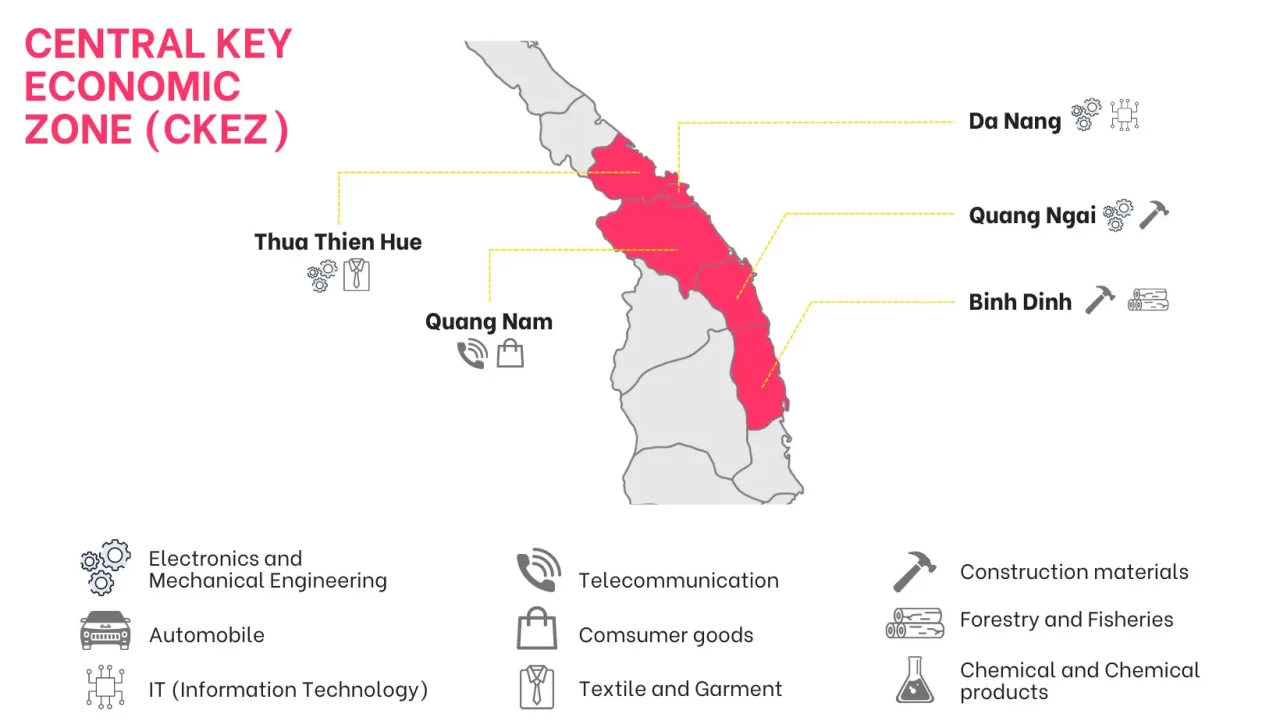
Central Vietnam provides lower costs and greater land availability for long-term factory planning.
The South region
The Southern Region includes Ho Chi Minh City, Binh Duong, Dong Nai, Long An, Ba Ria–Vung Tau, Tay Ninh, Tien Giang, and Binh Phuoc. According to Vietnam Financial Times, Ho Chi Minh City hits $8.37 billion in FDI, attracting 20,310 ventures with total registered capital nearly US$142 billion from 152 countries and territories.
This region attracts companies because of its deep supplier networks, strong service ecosystem, and experienced workforce. Manufacturing, electronics, IT, logistics, and high-tech industries are well established.
However, labor competition is intense, which drives wages and turnover. Land inside mature parks is limited, even though ports and power infrastructure are generally strong. Approvals often move quickly, but once a site is chosen, scaling later can be costly or constrained.
Key characteristics of the South
- Very high supplier density, paired with higher labor volatility
- Reliable infrastructure, but shrinking land availability in core zones
- Fast approvals, with reduced flexibility for large future expansion
The South fits companies that value speed, market access, and ecosystem depth, and are prepared to manage higher costs and competition.
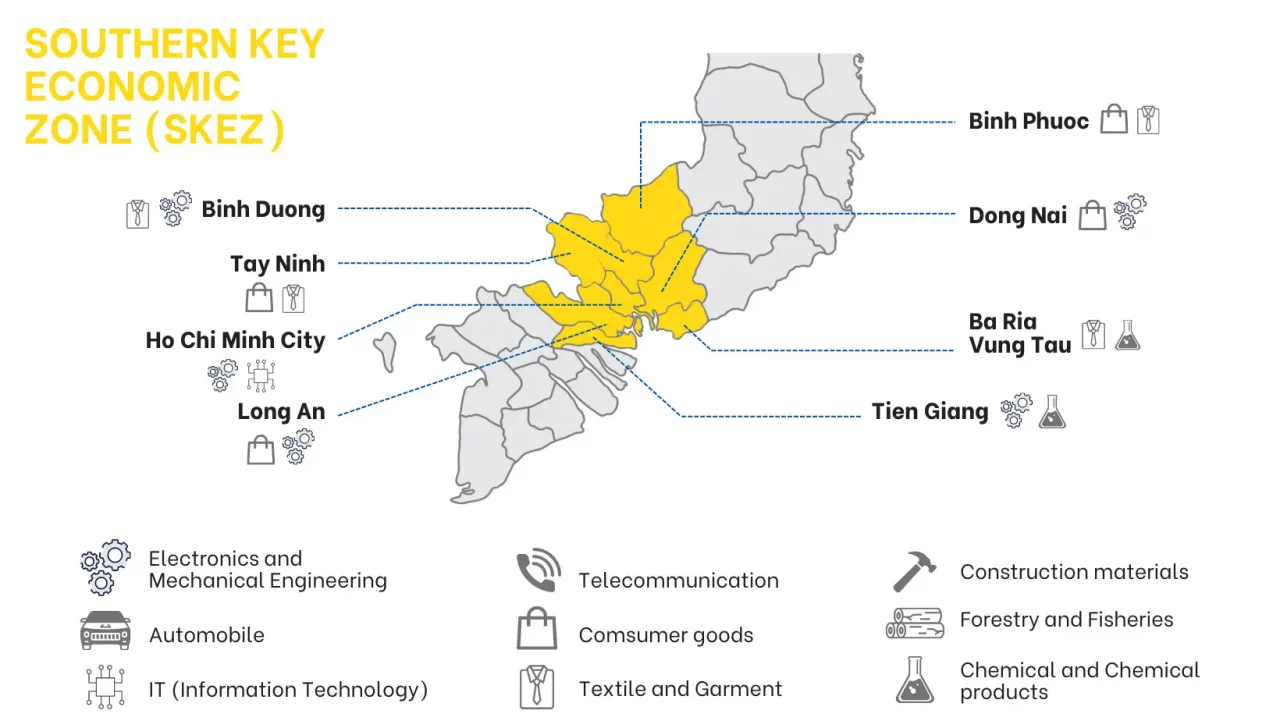
Southern Vietnam combines deep supplier ecosystems with strong logistics and services.
What To Evaluate Beyond Location When Selecting An Industrial Park
When companies choose an industrial park, the first thing they usually look at is the location. Over time, however, many discover that location alone does not determine whether operations run smoothly. What matters just as much is how prepared the park is for daily execution.
Infrastructure and utilities readiness
Infrastructure is often where differences show up first. Even parks in the same area can vary greatly in how dependable their utilities are, and those gaps usually appear only after operations begin.
A practical way to assess readiness is to look closely at:
- Power stability and whether backup systems are in place
- Water supply and wastewater treatment capacity
- Internal road conditions and real connections to ports and highways
- On-site readiness, rather than what is shown in brochures
When these basics are reliable, production stays on schedule and compliance risks are easier to manage. When they are not, management time is quickly pulled into operational firefighting.
Labor access and supporting industries
Once infrastructure is understood, attention naturally shifts to people and the surrounding ecosystem. Labor access has a direct impact on how fast a site can start up and how stable it remains over time.
This is best understood by examining:
- How close the park is to major labor pools
- Typical turnover levels in the local market
- The presence of nearby suppliers and service partners
Areas with strong supporting industries tend to lower coordination effort and reduce disruption as operations scale. This becomes especially valuable for factories that rely on consistent quality, process control, or gradual capacity expansion.
Final Thoughts
To sum up, choosing an industrial park in Vietnam is not just about finding available land. It is a long-term operational decision that affects cost control, compliance, labor stability, and future expansion. The right park aligns location, infrastructure, and ecosystem support with your production goals.
At Source of Asia, we support manufacturers from site screening to operational setup, helping align industrial park selection with long-term production and compliance realities. Moreover, we can assist you in setting up your business locally through a large range of services, from market diagnosis, targeting identification and qualification, and assistance with local stakeholders.
If you are planning to implement your future factory in Vietnam, you may find these insights from Source of Asia helpful:
Frequently Asked Questions
Yes. Vietnam permits 100% foreign-owned companies to establish and own factories within approved industrial parks through a locally registered entity. These parks simplify ownership by offering pre-zoned land, standardized licensing, and coordinated support from local authorities.
The choice depends on the target market and long-term flexibility. EPZs suit export-only models with customs and tax advantages but limit domestic sales, while non-EPZ parks allow both export and local sales, offering greater adaptability at the cost of standard tax procedures.
Industrial parks reduce entry risk by providing ready infrastructure, utilities, and regulatory coordination, enabling faster setup and smoother compliance. Standalone sites typically require separate approvals and infrastructure investment, increasing time, cost, and operational uncertainty.