Introduction
Expanding into Vietnam often starts with a practical operational question: where should your team work? Many companies initially consider traditional offices but quickly realize the real challenge is balancing setup speed, operational flexibility, lease commitment, and future scalability at the same time. This is one reason why demand for co-working space solutions in Vietnam continues increasing, particularly among foreign companies, sourcing teams, and regional business operations.
In 2026, flexible workspaces have become part of how businesses establish and coordinate operations in major hubs like Ho Chi Minh City and Hanoi. Compared with traditional leasing, co-working spaces help companies reduce upfront setup costs and support faster operational execution.
In this guide, we, Source of Asia, explain how co-working spaces work in Vietnam, how they compare with traditional offices, and what businesses should evaluate before using flexible workspaces as part of their Vietnam expansion strategy.
Key Insights
- Co-working spaces help companies enter and operate in Vietnam faster with lower setup complexity.
- Businesses choose flexible workspaces to reduce cost, increase agility, and avoid long-term office commitments.
- Vietnam’s co-working growth is driven by foreign investment, startups, and hybrid work transformation.
- Different workspace models exist, from hot desks to private offices, depending on operational needs.
- Co-working is especially effective for early-stage entry, sourcing activities, hybrid teams, and temporary operations
Co-Working Space 101
Before using a co-working space in Vietnam, businesses should understand how flexible workspaces operate, how they compare with traditional offices, and which workspace models best fit different operational and expansion needs.
What is a co-working space?
A co-working space is a flexible shared office model where multiple businesses, teams, or individuals operate within the same professional working environment. Instead of committing to a long-term office for rent, companies can access workspace through shorter and more adaptable lease arrangements based on operational requirements.
Most co-working spaces provide ready-to-use business infrastructure that allows companies to begin operations quickly, including:
- Workstations and internet connection
- Meeting rooms and reception support
- Printing facilities and pantry areas
- Utilities and daily facility maintenance
Some operators also provide private offices within shared facilities. This gives teams more privacy than open seating, while still keeping flexible lease terms and shared building services.
Although coworking is often associated with freelancers or startups, many international companies now use co-working spaces as a practical solution for market entry, supplier coordination, hybrid teams, and temporary operational setup in Vietnam.
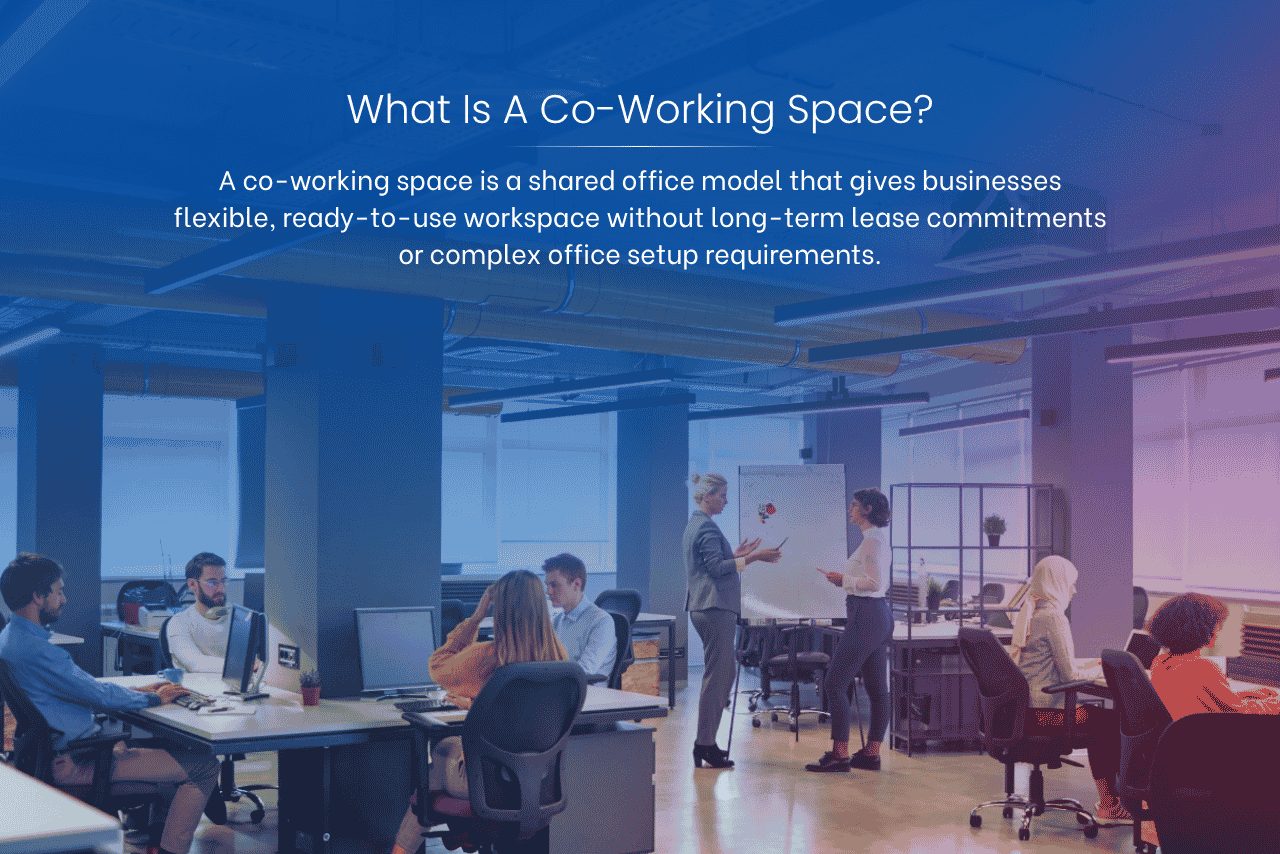
Co-working spaces provide shared professional environments with flexible infrastructure and shorter lease commitments.
How co-working spaces differ from traditional offices
The main difference between co-working spaces and traditional offices lies in flexibility, setup requirements, and operational management.
- Co-working spaces: Lower setup investment, flexible lease terms, ready-to-use infrastructure, faster operational setup, and easier scalability for changing team sizes.
- Traditional offices: Higher upfront costs, long-term lease commitments, self-managed office setup, longer preparation timelines, and greater administrative responsibility.
For businesses entering Vietnam, traditional office leasing can delay operations due to renovation work, utility registration, and facility setup. In comparison, co-working spaces help companies begin operations more quickly while reducing initial operational complexity and commitment.
Core types of flexible workspaces in Vietnam
Vietnam’s flexible office market offers several workspace formats designed for different operational needs, team structures, and budget levels.
- Dedicated desks
Dedicated desks provide a fixed workstation within a shared office environment. This option works well for businesses that require consistent workspace access while maintaining flexible lease arrangements. Common use cases include:
- Small operational teams
- Representative office activities
- Regular supplier or partner coordination
- Semi-permanent local setup in Vietnam
For example, sourcing teams that frequently travel between factories and client meetings often prefer dedicated desks because they can maintain a stable working setup without committing to a full office lease.
- Hot desks
Hot desks operate on a shared seating model where users choose available workstations when they arrive. This format is commonly used by business travelers, remote employees, and temporary project teams that only require workspace for short operational periods.
Many companies looking for a daily office space rental or needing to rent an office space for a day often use hot desk arrangements during supplier visits, market research trips, or short-term business meetings in Vietnam.
- Private offices
Private offices provide enclosed workspace within a larger coworking facility. Businesses commonly use this model for management teams, client-facing operations, and cross-border project coordination that require higher privacy levels while still benefiting from flexible office structures.
- Virtual office solutions
Virtual office services allow businesses to maintain a local business presence without renting permanent office space. These solutions often include business address registration, mail handling, and meeting room access, helping companies reduce fixed costs during early-stage market entry in Vietnam.
Vietnam’s Co-Working Market Landscape in 2026
Flexible workspace demand continues to grow across Vietnam as foreign investment, hybrid work adoption, and changing operational priorities reshape how businesses establish and manage office operations.
Growth of Vietnam’s co-working market
Vietnam’s co-working market continues to expand as businesses increasingly prioritize flexible operations, faster setup, and lower fixed costs. This growth is driven by startup expansion, rising foreign investment, and the wider adoption of hybrid work models across Southeast Asia. According to IMARC Group, Vietnam’s coworking market reached approximately USD 38.3 million in 2025 and is projected to continue growing strongly through 2034.
At the same time, hybrid work adoption continues reshaping office demand. Many businesses now prefer flexible workspace access, temporary collaboration areas, and shorter lease structures instead of maintaining large permanent offices. As operators improve meeting facilities, technology infrastructure, and support services, co-working spaces increasingly function as practical business infrastructure solutions rather than only temporary workspace options.
Where businesses use co-working spaces in Vietnam
Ho Chi Minh City remains the country’s largest coworking hub, particularly in central business districts where international companies, startups, and service providers are concentrated. Meanwhile, Hanoi continues attracting businesses that require proximity to government institutions and northern industrial networks.
Instead of broadly searching for a “shared workspace near me” or “co-working space near me,” many foreign companies usually prioritize established co-working hubs with stronger infrastructure, accessibility, and business support capabilities that can support a smoother operational setup in Vietnam.
Why Businesses Use Co-Working Spaces
Co-working spaces support businesses in Vietnam by addressing cost efficiency, faster setup, access to professional infrastructure, and flexible team coordination across different stages of market entry and operation.
Flexible and cost-efficient office operations
One of the main reasons businesses use co-working spaces is to maintain lower operational costs while keeping office usage flexible. Instead of investing heavily in office fit-out, utilities, and long-term leases, companies usually pay a predictable monthly fee with shared infrastructure already included. This helps businesses reduce:
- Upfront office setup costs
- Facility maintenance expenses
- Administrative coordination workload
- Unused office capacity during operational changes
Simultaneously, flexible lease structures allow companies to scale workspace usage more gradually as teams expand or projects change. This is particularly useful during early-stage market entry, where operational needs may still shift quickly.
Faster setup and operational readiness
Office setup in Vietnam often slows early execution because businesses must go through several steps before operations can begin, including renovation planning, utility installation, furniture sourcing, and internal coordination. These processes can extend timelines and affect early market entry plans.
Co-working spaces reduce this complexity by providing ready-to-use infrastructure that allows companies to start operations quickly with minimal preparation. Thus, teams can focus on execution rather than office setup. Most operators also support reception, meeting coordination, internet management, and basic administrative services that further reduce operational workload and improve day-to-day efficiency.
Access to professional infrastructure and business networks
Access to a professional working environment is important when businesses meet clients, suppliers, or local partners in Vietnam. Co-working spaces in major cities like Ho Chi Minh City and Hanoi provide business-ready infrastructure, including meeting rooms, stable internet, reception services, and shared lounges that support daily operations from day one.
In addition, some co-working providers may offer business address support, depending on the operator, location, and legal requirements. Companies should verify whether the address can be used for registration, correspondence, or only general business communication. Co-working spaces also support informal networking with startups, service providers, consultants, and international teams. Hence, businesses gain both operational support and early exposure to Vietnam’s business ecosystem within a single workspace.
Supporting hybrid and cross-border teams
In Vietnam, many companies operate with hybrid structures combining local staff, regional managers, and international teams. Co-working spaces support this model by providing a shared workspace where different roles can collaborate without fixed office constraints or complex setup processes. This is especially useful in early-stage expansion when team structures and workflows are still evolving.
For example, a regional manager visiting Ho Chi Minh City can work alongside local staff in the same facility, ensuring continuous coordination. Likewise, cross-border project teams can adjust workspace usage based on travel schedules and project phases. Thus, co-working spaces enable flexible coordination across time zones and reduce operational friction during regional execution.
| When operational pressure shifts to efficiency and structure, companies reassess internal workload allocation. 👉 Explore how Administrative Outsourcing Services help optimize operational efficiency in Vietnam. |
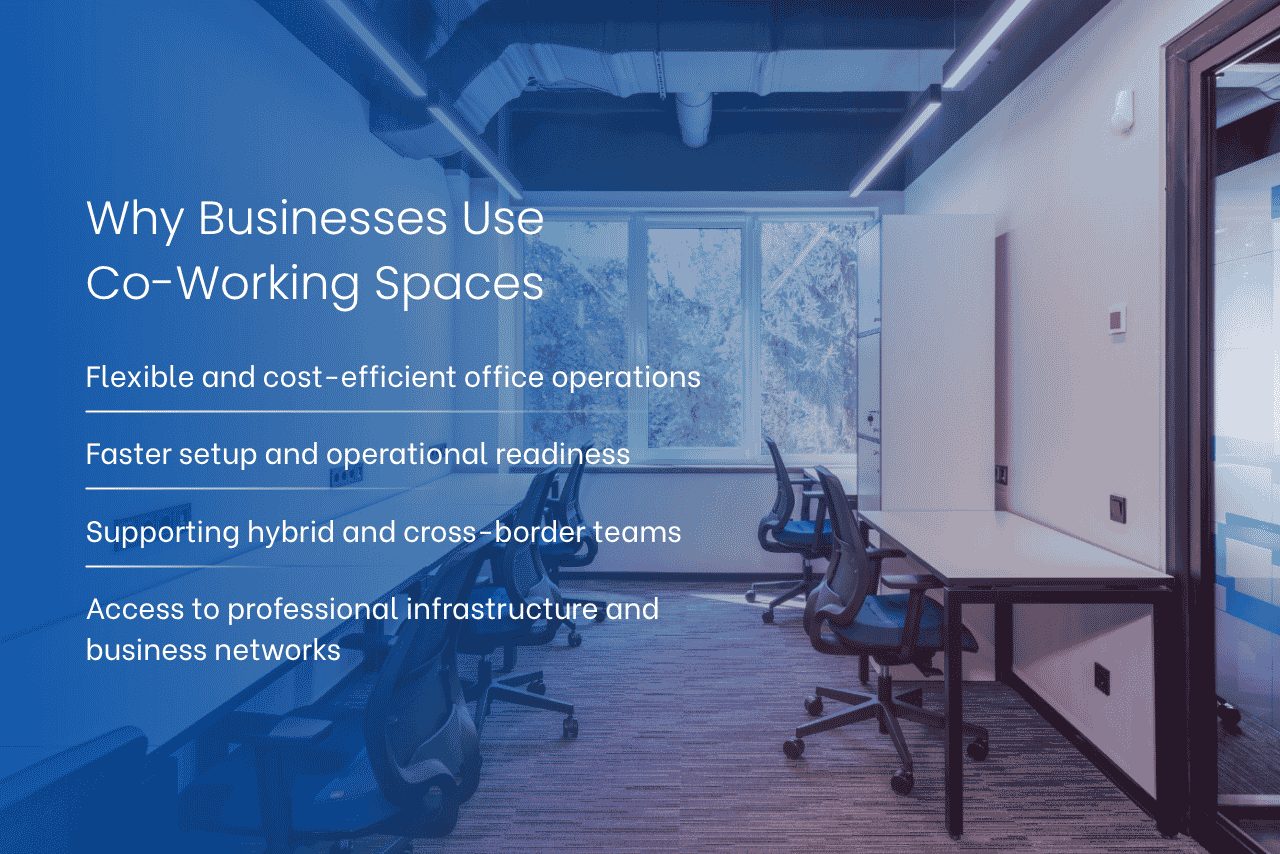
Businesses use co-working spaces to improve flexibility, reduce setup costs, and accelerate operational readiness.
Co-Working Space Vs Traditional Office: Which Fits Your Vietnam Strategy
The choice between co-working spaces and traditional offices depends on operational stage, team structure, and expansion strategy. In Vietnam, many businesses evaluate both options based on cost, flexibility, and speed of execution before committing to a long-term setup.
| Consideration | Co-Working Space | Traditional Office |
| Setup costs | Low | High |
| Lease flexibility | Month-to-month | 2 to 5 years |
| Operational scalability | Easy to adjust | Requires renegotiation |
| Infrastructure management | Handled by operator | Managed in-house |
| Privacy | Shared or limited | Full control |
| Team size suitability | 1 to 20 people typically | Better for larger teams |
| Administrative burden | Very low | Significant |
| Speed of setup | Days to weeks | Several months |
Therefore, co-working spaces often suit companies prioritizing speed, flexibility, and early-stage market entry, while traditional offices align better with long-term, stable operations requiring full control.
Navigating the Challenges of Shared Workspaces
Co-working spaces offer clear advantages in flexibility and speed, but they also introduce operational trade-offs that businesses should evaluate based on their stage of expansion in Vietnam.
- Privacy and confidentiality limitations: Shared layouts are not suitable for sensitive discussions, regulated data handling, or confidential client work. Even private offices within co-working buildings still operate in shared environments, which limits full control over access and security.
- Scalability and operational fit: Co-working works well for small to mid-sized teams, but as headcount grows, constraints appear in meeting capacity, coordination efficiency, and overall cost structure. At a certain scale, dedicated offices often provide better operational alignment.
- Branding and culture control are also limited: In shared spaces, companies have limited ability to fully express brand identity or build a customized internal culture compared to a standalone office setup.
These constraints do not reduce the value of co-working spaces; instead, they highlight the importance of matching the workspace model with the company’s operational stage.
Who Reaps The Most Benefits From Co-Working In Vietnam?
Not all business models benefit equally from co-working spaces. The value is most visible for companies that need flexibility, speed, and controlled operational risk during different stages of expansion in Vietnam.
- International companies and representative offices
Foreign companies entering Vietnam often use co-working spaces as an initial operational base while defining long-term market strategy. This approach helps them reduce setup risk, maintain a professional meeting environment, and coordinate suppliers or partners without committing to a long-term office lease. In many cases, it also supports early-stage market validation before scaling.
- SMEs, startups, and project-based teams
These organizations typically operate with changing headcount and limited upfront capital. Co-working spaces provide cost control, fast access to infrastructure, and flexible lease terms, allowing them to focus resources on execution rather than office setup. Project teams also benefit from avoiding long-term commitments.
- Remote and hybrid business operations
Companies with distributed teams increasingly rely on shared workspaces for on-demand collaboration, meeting coordination, and business travel support. Even with partial remote work models, access to a professional environment in Vietnam improves operational continuity and team coordination.
| For international companies at a more advanced stage of market entry, establishing presence through acquisition is another path worth evaluating. 👉 Explore Merger and Acquisition Services in ASEAN 2026 to understand how that route works in practice. |
Inside Source Of Asia’s Co-Working Space Experience
At Source of Asia, our co-working space in District 2, Ho Chi Minh City, is built for companies that need more than a desk. High-speed internet, fully equipped meeting rooms with AV support, and 24/7 secure access give your team a functional base from day one.
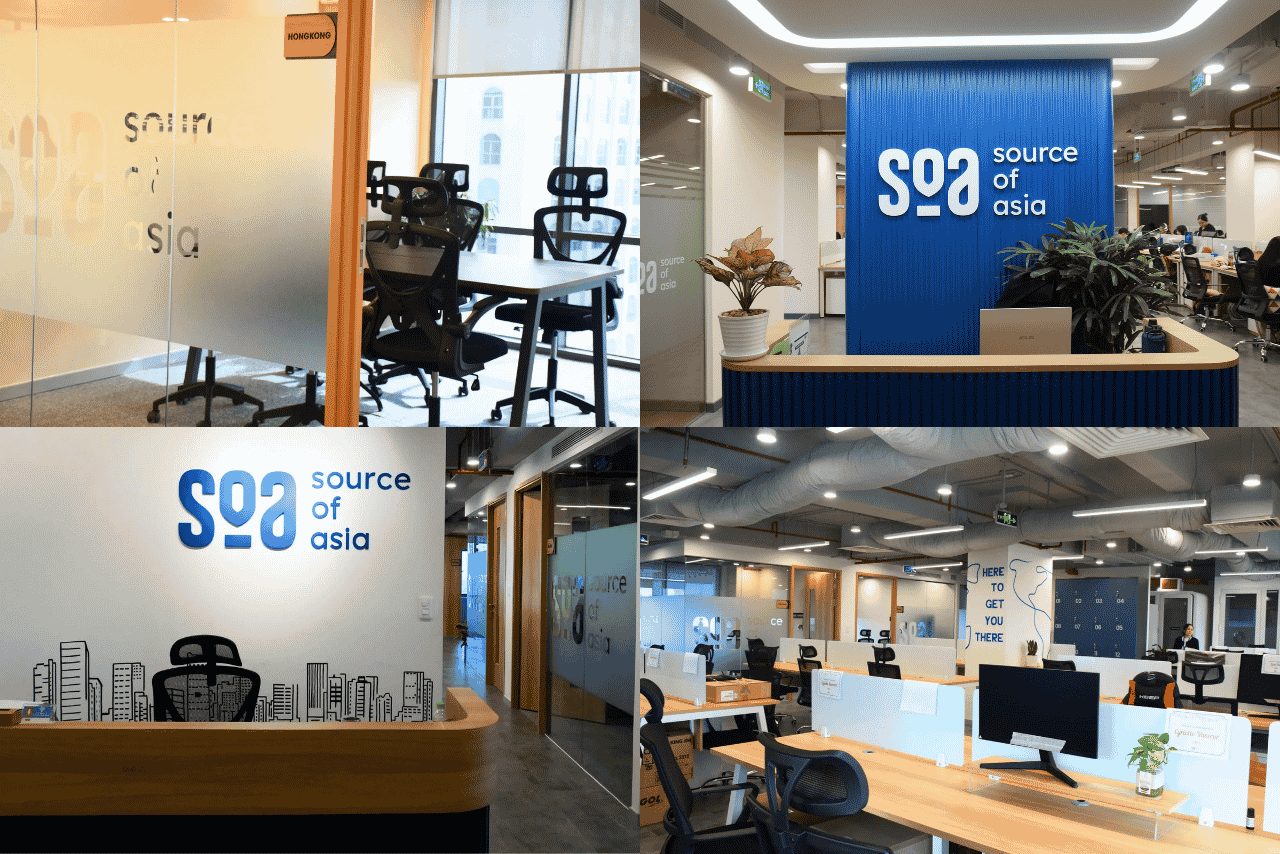
Source of Asia provides operational workspace support for international companies expanding into Vietnam.
International clients use the space during market exploration, sourcing coordination, and temporary operational setup. It simplifies meeting logistics, provides a credible local business address, and keeps visiting team members productive without any preparation.
Our team handles administrative tasks, local coordination, and document processing alongside you, so your staff focuses on the work that matters. For companies navigating a new market, that built-in support removes friction that would otherwise slow things down.
Beyond operations, the environment supports genuine relationship building. Members come from diverse industries and international backgrounds, and regular networking events create real business connections that remote setups rarely offer.
|
“It’s more than just a workspace — it’s a community.” |
| “The atmosphere here gives me the energy I need every day.” Mr.Charlie Smith, Global Sales Manager at Natural Fiber Welding |
Final Thoughts
Co-working spaces in Vietnam support faster market entry, lower fixed costs, and flexible operations for sourcing, hybrid teams, and short-term projects. They provide ready-to-use infrastructure that improves execution efficiency in early stages. However, businesses should still assess privacy, scalability, and long-term office strategy before choosing between flexible and traditional office models.
At Source of Asia, we provide co-working space solutions in District 2, Ho Chi Minh City, with 60+ desk spaces available through our Corporate Services. The space supports market entry, sourcing coordination, and temporary operations, enabling businesses to start quickly with ready infrastructure and administrative support.
| 👉 Interested in renting or visiting our co-working space? Reach out to us to schedule a visit and discuss the workspace setup that fits your operation. |
Frequently Asked Questions
Co-working spaces include workstations, high-speed internet, meeting rooms, reception support, printing facilities, utilities, and shared common areas. Many operators also provide administrative assistance, mail handling, and on-demand meeting room access, supporting daily business operations without setup requirements.
Yes. Many providers offer daily office space rental options, including private offices and meeting rooms. These are commonly used for regional meetings, supplier discussions, and short-term business trips requiring a professional setup without long-term commitment.
Beyond rent, businesses should consider deposits, fit-out costs, furniture, utilities setup, internet installation, maintenance fees, and facility management. These costs often make the initial setup significantly higher than expected.
They typically evaluate location, accessibility, infrastructure quality, meeting facilities, privacy options, lease flexibility, and available business support services. Proximity to clients, suppliers, and business districts is also a key selection factor.