Introduction
Administrative work often seems simple at first, but it can become a hidden burden as companies expand. When entering new markets, routine tasks such as payroll, HR documentation, and compliance start to multiply and spread across teams and systems. This leads to inefficiencies, execution delays, and a higher risk of errors. At this point, many companies start considering administration outsourcing services to bring structure and consistency to their back-office operations.
However, outsourcing is not a one-size-fits-all solution. The key decision is identifying which tasks can be outsourced and what should stay in-house to maintain control over critical functions.
In this article, we, Source of Asia, outline how to approach this balance and build an administrative model that supports efficient, scalable operations.
Key Insights
- Administration outsourcing helps companies reduce compliance errors and operational overload across ASEAN markets.
- Multi-country regulatory differences make in-house administration harder to scale and maintain consistently.
- Outsourcing improves payroll, HR, and reporting accuracy through standardized execution and local compliance expertise.
- Businesses keep strategic, financial, and governance decisions in-house while outsourcing execution tasks.
- The right model balances efficiency, control, and scalability for sustainable ASEAN expansion.
Administration Outsourcing Services Overview
Administrative outsourcing services vary in scope, structure, and execution models. Understanding what they include, how they differ, and how they are delivered helps companies design a scalable and controlled back-office operating model.
What is an administration outsourcing service?
Administration outsourcing services transfer non-core back-office tasks to external providers. These tasks are usually process-driven and repetitive. Instead of building internal capacity for routine execution, companies rely on specialized teams to handle tasks that require consistency and accuracy at scale.
These services typically cover:
- HR administration and employee records: Contract preparation, onboarding/offboarding documentation, and ongoing data maintenance
- Payroll processing and statutory compliance: Salary calculation, tax filings, and social contributions aligned with local regulations
- Documentation, reporting, and coordination: Internal reporting, document control, and communication with vendors, employees, and authorities
The objective is not cost reduction alone but to ensure these functions are executed reliably and consistently without increasing internal operational complexity as the business grows.
Administrative outsourcing transfers routine back-office processes to specialized external providers for consistent execution.
How it differs from other types of outsourcing
Administration outsourcing is often grouped with business process outsourcing (BPO) in general discussions, but the two are not the same thing.
- Business process outsourcing is broader. It can include customer service operations, IT infrastructure, finance transformation, and strategic shared services.
- Administration outsourcing is generally focused on recurring operational execution and process-driven tasks, supporting your business without requiring your team’s judgment.
It is also different from strategic outsourcing, which involves transferring decision-making or advisory functions to a third party. With administrative outsourcing, the third party executes. Your internal team decides.
Common administrative outsourcing models
The structure of administrative outsourcing depends on your operating scale, market footprint, and required level of local control. In practice, four models are commonly used across ASEAN.
- Fully outsourced back-office support
Companies outsource end-to-end administrative tasks, from payroll and HR administration to reporting and documentation. They often choose offshore models for cost-efficient, high-volume processing, or nearshore models for closer coordination, better communication, and faster response times.
- Shared services model
Administrative functions are centralized into a regional hub, supporting ASEAN coordination and multi-country operations. This structure improves consistency, reduces duplication, and enables standardized payroll, HR, and reporting across markets.
- Hybrid in-house and outsourced administration
Combines outsourced execution, offshore processing, and local compliance coordination. This model allows companies to scale efficiently while maintaining in-market control over regulatory requirements and operational oversight.
- Regional administrative support hubs
Companies establish hubs in Singapore, Malaysia, Vietnam, and Thailand to coordinate administrative functions, leveraging each location’s strengths in regulatory clarity, talent availability, and cost-efficient operations.
Why Companies Choose to Outsource Administrative Work
The benefits of administration outsourcing services are often evaluated through cost, but the real drivers are operational control, compliance, reliability, and scalability. As companies expand across ASEAN, administrative complexity increases faster than internal capacity.
The real cost of keeping admin in-house
At a small scale, administrative work may seem manageable. However, as operations expand, the cost of keeping admin in-house increases structurally, not just financially. Over time, these pressures become harder to control and directly affect execution.
- Fixed overhead grows with complexity: Each new hire or market adds costs in salaries, systems, and training, often without improving efficiency
- Fragmented processes reduce reliability: Different teams follow different workflows, leading to errors, delays, and repeated corrections
- System maintenance creates hidden workload: Payroll and HR platforms require continuous updates, integration, and internal coordination
Compliance exposure and error risk
Administrative work carries direct compliance exposure, especially when operations span multiple ASEAN markets. Even small payroll or filing errors can trigger penalties, audits, and reputational risk. This is where the advantages of administration outsourcing services become clear, as specialized providers reduce error rates through standardized processes and regulatory expertise.
Meanwhile, regulatory complexity increases across jurisdictions. Each country applies different labor laws, tax rules, and reporting timelines. As a result, maintaining accuracy requires constant updates and local knowledge. Without dedicated expertise, compliance processes become fragmented and operationally fragile, increasing the likelihood of repeated errors and delayed responses.
Growth bottlenecks hidden in routine admin
Routine administrative work often creates hidden bottlenecks in business execution, especially in growing organizations. These constraints are operational risks that directly affect scalability and decision speed.
- Hiring and onboarding are delayed when HR teams are tied up with manual processes
- Expansion speed is reduced due to administrative dependencies across markets
- Leadership attention is diverted from strategy to operational follow-ups
Outsourcing administrative work removes these constraints and delivers the benefits of administrative outsourcing services by enabling teams to focus on growth-critical functions instead of back-office execution.
| As administrative complexity increases with regional expansion, understanding how companies scale across ASEAN becomes critical. 👉 Explore how market expansion works in practice with us! |
What’s Included in Administration Outsourcing Services
The scope of outsourced administrative services varies by provider and contract, but the following key operational functions are the core of most administrative outsourcing arrangements.
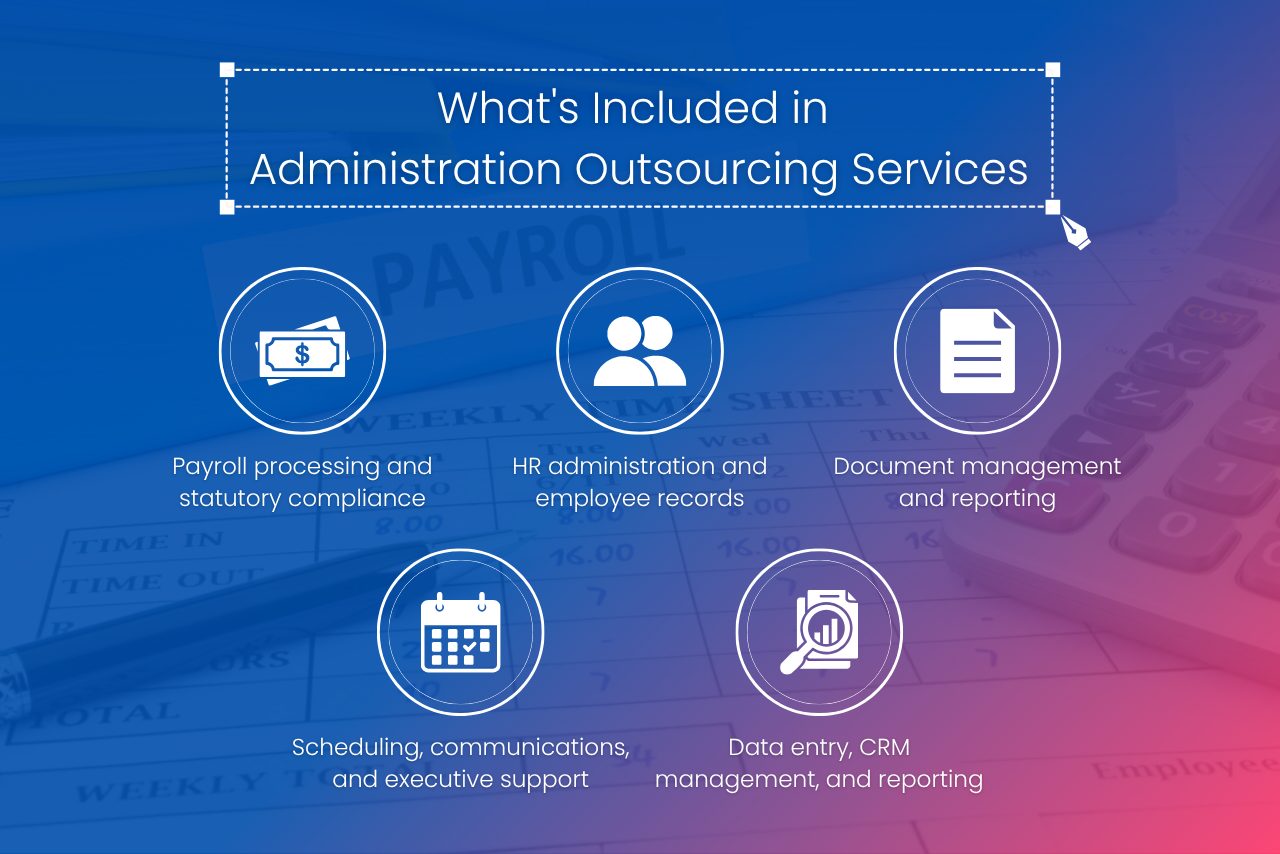
Core administrative outsourcing functions include payroll, HR documentation, reporting, and operational coordination.
Payroll processing and statutory compliance
Administration outsourcing services typically focus on the operational and compliance layer of HR and payroll management, ensuring accuracy and consistency across employee data and statutory obligations.
- Payroll and compliance processing: salary calculations, tax deductions, and social contribution filings
- Regulatory reporting: submission of required HR and payroll reports to local authorities
- HR documentation management: contracts, onboarding files, policy acknowledgments, and amendments
- Employee record handling: updates for leave, benefits, and offboarding processes
Consequently, organizations maintain compliant, structured HR records, while internal teams reduce manual workload and focus more on strategic workforce management.
HR administration and employee records
HR administration and employee records focus on the documentation and control layer of people operations, ensuring data accuracy, consistency, and compliance with local requirements rather than strategic HR activities.
It typically covers employment contracts and documentation, including offer letters, policy acknowledgments, and contract updates. In addition, onboarding and offboarding processes are managed systematically, from entry paperwork to resignation handling, final settlement, and record archiving. Thus, organizations maintain accurate employee records while reducing manual workload and enabling HR teams to focus on higher-value people-management activities.
Document management and reporting
Document management and reporting ensure that business information is accurately processed, structured, and maintained to support daily operations and compliance needs.
- Data entry and document processing: converting source files into organized digital records for consistent use
- Internal reporting and standardization: preparing operational reports, HR dashboards, and compliance summaries with unified formats across teams and markets
- Accuracy control across systems: applying checks to detect errors and ensure data consistency before reporting or audits
This helps organizations improve data reliability and operational transparency while reducing risks linked to inconsistent or incomplete documentation.
Scheduling, communications, and executive support
Scheduling, communications, and executive support ensure leadership operations remain structured and efficient, especially in multi-time-zone environments. It includes calendar and meeting coordination, aligning schedules across teams, and managing meeting logistics, as well as internal and external communication handling, such as drafting, routing, and following up on correspondence to maintain clear information flow.
In addition, it covers administrative support for leadership teams, including agenda preparation, meeting materials, and action item tracking. This helps reduce coordination delays and operational friction, enabling leadership teams to focus on decision-making and core business priorities.
Data entry, CRM management, and reporting
Data entry, CRM management, and reporting focus on keeping business data accurate, structured, and usable across daily operations and decision processes. This includes database maintenance and updates, where CRM records are continuously corrected and enriched with up-to-date contact, account, and activity information.
It also covers sales data entry and tracking, ensuring pipeline movements, deal stages, and forecast inputs are properly recorded. In parallel, expense reporting and dashboard creation support clear financial tracking and performance monitoring. Together, these functions strengthen data consistency and reporting reliability across the organization.
Which Administrative Tasks Should Stay In-house?
Administration outsourcing is most effective when operational execution is separated from functions that define financial authority, organizational direction, and internal accountability. These areas require direct leadership control due to their strategic and legal implications.
- Strategic and decision-making functions
These functions determine business direction, resource allocation, and growth priorities, so they must remain fully internal. They depend on contextual knowledge of the company’s market position and long-term objectives.
- Final financial approvals: budget approval, capital allocation, vendor payment authorization, and investment decisions
- Business planning and financial control: revenue forecasting, headcount planning, cost structure design, and market expansion strategy
- Strategic hiring decisions: defining critical roles, approving key hires, and aligning workforce structure with business priorities
- Investor reporting: communicating financial performance, risks, governance updates, and strategic direction to stakeholders
- Sensitive and high-risk operations
Certain processes carry regulatory, legal, or reputational consequences, requiring controlled internal governance and clear accountability structures.
- Legal risk decisions: contract interpretation, dispute handling, and regulatory response management
- Confidential data management: handling of M&A information, investor data, and non-public financial records
- Audit-related processes: coordination with internal and external auditors and regulatory inquiries
- Internal control systems: fraud prevention, approval hierarchies, and compliance monitoring
- Roles tied to culture and internal alignment
These areas shape organizational behavior, workforce standards, and employee experience, which directly influence long-term stability and performance.
- Compensation frameworks: salary bands, incentive structures, equity design, and benchmarking methodology
- Performance reviews: evaluation of individual and team contributions, requiring contextual leadership judgment
- HR strategy and employee engagement: workforce planning, cultural alignment, retention approach, and internal communication standards
Retaining these functions internally ensures that strategic control, legal responsibility, and organizational identity remain firmly within the company, while outsourcing remains focused on executional efficiency rather than decision ownership.
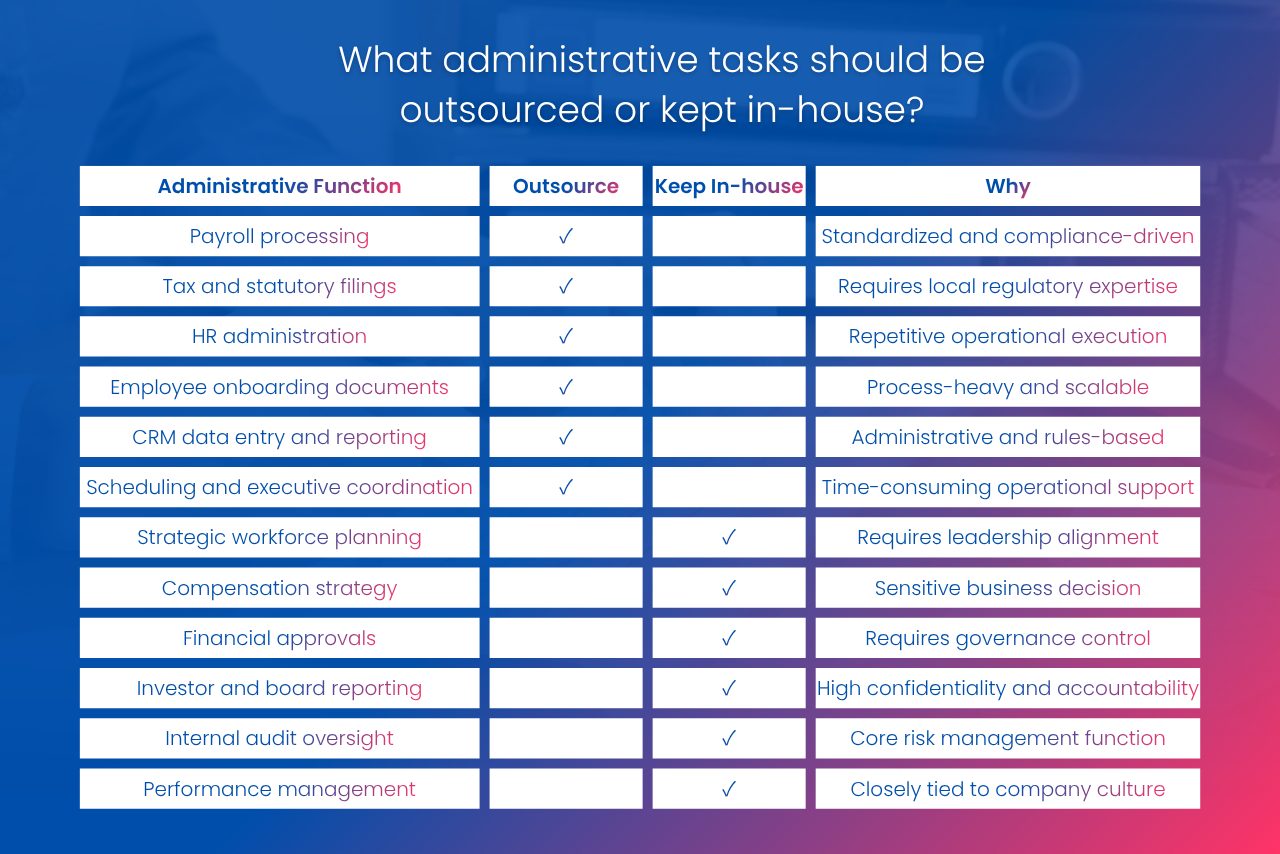
Outsourced tasks focus on execution efficiency, while strategic, high-risk, and decision-making functions remain under internal control.
In-House Vs. Outsourced Administration: Which Model Fits Your Business
The appropriate operating model depends on company scale, growth stage, geographic complexity, and internal capability, particularly when balancing cost, control, and scalability across markets. The table below outlines a practical comparison between in-house and outsourced administration.
| Criteria | In-house Administration | Outsourced Administration |
| Cost structure | Fixed costs, including salaries, systems, and overhead | Variable costs aligned with scope and usage |
| Control level | Direct and full operational oversight | Managed through SLAs, reporting, and governance mechanisms |
| Process type | Suitable for customized or non-standard workflows | Optimized for standardized and repeatable processes |
| Compliance handling | Relies on internal expertise and capacity | Supported by specialized compliance knowledge |
| Scalability | Constrained by hiring and internal resources | Scalable across functions and geographies |
| Best fit | Stable, centralized operations with strong internal systems | Growing or multi-market organizations with evolving needs |
When Administration Outsourcing Makes Sense in ASEAN
Administrative outsourcing becomes relevant when businesses face increasing complexity from multi-country operations, regulatory fragmentation, and the need for consistent compliance. It is especially important when internal capacity is limited, and processes must be standardized across ASEAN markets.
Why is admin complexity higher across ASEAN markets
Operating across ASEAN markets creates higher administrative complexity compared to single-market operations due to fragmented regulatory environments. Each country applies different labor laws, tax systems, and statutory obligations, which directly affect how HR, payroll, and compliance processes must be managed in practice.
Moreover, organizations must follow country-specific reporting requirements, including varied filing formats, submission timelines, and regulatory standards. Therefore, processes often become fragmented across jurisdictions, leading to duplicated work and higher coordination efforts. Ultimately, maintaining consistency requires continuous alignment across multiple legal and operational frameworks.
EOR and PEO models for companies without a local entity
For companies expanding into ASEAN without a local entity, there is often a delay between hiring plans and legal setup readiness, as entity incorporation requires time and regulatory approval. In this context, EOR and PEO models provide a structured way to bridge operational needs and compliance requirements.
- EOR (Employer of Record): Acts as the legal employer, managing contracts, payroll, tax, and statutory compliance, while the company directs daily work
- PEO (Professional Employer Organization): Operates under a co-employment structure, sharing HR and administrative responsibilities with the company
Consequently, both models combine HR outsourcing and administrative support, enabling faster market entry and reduced compliance exposure across ASEAN.
What to look for in ASEAN outsourcing partners
ASEAN outsourcing is not only about cost efficiency but also about handling regulatory differences across markets. Therefore, selecting the right partner requires focus on execution quality and compliance consistency.
- Strong local compliance expertise: In-country knowledge of employment law, tax obligations, and statutory filings is essential, with continuous updates to reflect regulatory changes.
- Multi-country operational capability: The provider must manage different regulatory systems in parallel while maintaining standardized reporting across ASEAN markets.
- Transparent processes and data control: Clear workflows, SLAs, and reporting are required to ensure visibility, traceability, and accountability.
| Choosing the right partner is closely linked to broader market entry decisions and partner evaluation. 👉 Learn how to evaluate the right local partner. |
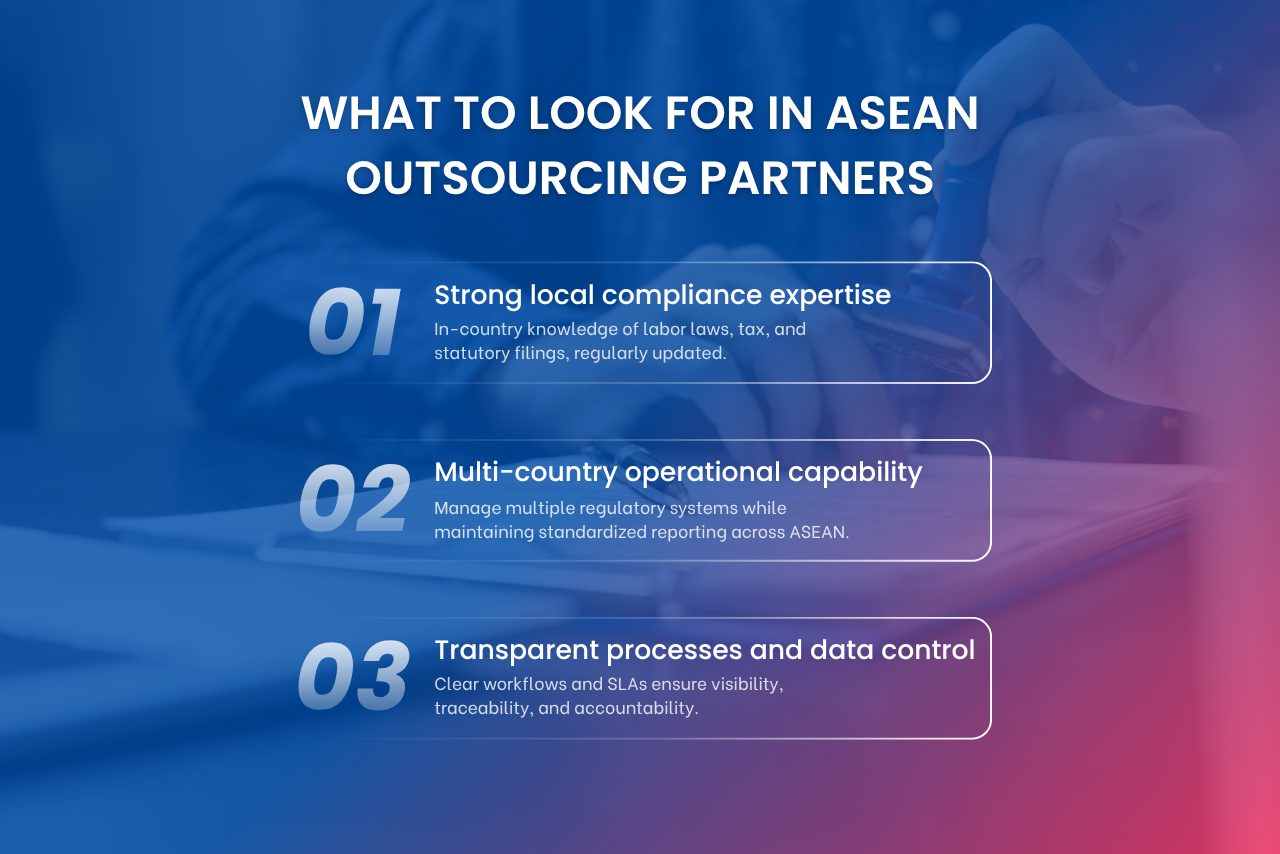
Selecting ASEAN outsourcing partners requires strong compliance expertise and multi-country operational capability.
Final Thoughts
Administration outsourcing in ASEAN is not about replacing internal teams but strengthening execution while maintaining control. As complexity increases across markets, outsourcing helps standardize HR, payroll, and compliance processes, reduce operational burden, and improve consistency. Core strategic and governance functions remain in-house, ensuring balanced, scalable, and compliant operations across the region.
At Source of Asia, we support companies through our Corporate Services and HR Solutions. Our expertise helps structure and manage administrative operations across ASEAN, ensuring compliant execution of HR, payroll, and statutory processes while maintaining consistency across multiple markets.
| 👉 Get in touch with us to explore how we can strengthen your ASEAN administrative operations and compliance setup. |
Frequently Asked Questions
Routine, repetitive tasks such as payroll processing, statutory filings, and document handling are often suitable for outsourcing. Core strategic functions involving decision-making, financial control, and sensitive business planning are typically kept in-house to maintain oversight and control.
Yes, when providers apply controlled access, secure systems, and role-based permissions. Safety also relies on clear governance, defined workflows, SLAs, and audit-ready reporting, ensuring accountability and traceability of all administrative processes.
Yes. SMEs benefit by reducing administrative workload and compliance pressure, allowing small teams to focus on core operations while maintaining structured, scalable, and cost-efficient execution support.
Yes. ASEAN countries have different regulations. A local-capable partner ensures jurisdiction-specific compliance, accurate filings, and coordinated cross-border administration, reducing operational and regulatory risk.