Introduction
Many manufacturers expand in ASEAN with a clear goal of starting sales quickly, but struggle to decide when to use market penetration vs. market development strategy. As a result, early plans often lack direction, and progress becomes slower than expected.
In 2026, many manufacturers miss their first-year ASEAN expansion targets and miss their first-year targets, not because the product is wrong but because the growth strategy is applied at the wrong stage. This is common in ASEAN, where each market moves at a different pace, yet companies still apply the same approach across countries.
In this article, we at Source of Asia clarify the difference between the two strategies, when each applies, and how to sequence them effectively to support more consistent first-year performance in ASEAN expansion.
Key Insights
- Market penetration focuses on growing share in existing markets, while market development expands into new ASEAN markets or segments.
- Successful ASEAN expansion often requires market development and market penetration to run simultaneously across different markets.
- First-year ASEAN expansion depends heavily on local channel activation, distributor quality, and execution consistency.
- ASEAN markets progress at different speeds, requiring companies to adjust investment and strategy market by market.
- Companies typically shift toward deeper penetration once sales stability, demand predictability, and distributor performance become measurable.
What Market Penetration Looks Like in ASEAN Expansion
Market penetration strategy becomes critical once companies have established initial market access and are scaling commercial performance across ASEAN markets.
What is market penetration
Market penetration is a growth strategy focused on increasing market share within a market where a company already operates. Rather than venturing into new territories, companies concentrate on maximizing the commercial potential of their current product portfolio within their existing footprint.
- Targeting: Current customers and established sales channels.
- Competition: Compete directly through aggressive pricing, heavy promotion, and wider distribution.
- Goal: To increase product usage frequency or capture market share from local or international competitors.
This approach is effective because existing customers are easier to convert and scale. Research from Bain & Company shows that improving customer retention by just 5% can increase profits by 25% to 95%, which highlights the value of focusing on current customers.

Market penetration focuses on increasing sales through stronger distribution, pricing, and commercial execution in existing ASEAN markets.
What market penetration looks like operationally
In ASEAN, market penetration strategy is execution-driven and depends on how well you activate local channels. Growth does not come from strategy alone. It comes from how consistently you perform in-market. This typically involves three areas:
- Sales and distribution depth: Products must move beyond a single importer and reach multiple channels and regions, including Tier 2 and Tier 3 cities, not only capital markets.
- Commercial and pricing alignment: Companies often adjust margins, offer volume incentives, or refine pricing to match local buying behavior and keep distributors active.
- Marketing and visibility: Strong penetration means your brand is consistently visible through trade activities, field support, and digital touchpoints, so buyers recognize you quickly.
What Market Development Means in ASEAN
Market development strategy follows a different growth logic from penetration. Understanding when and why companies pursue it is essential for structuring a realistic and well-sequenced ASEAN expansion plan.
What is market development
Market development is a growth strategy focused on entering new markets or customer segments using existing products. It applies when manufacturers have proven product-market fit but need to expand into new geographic or commercial environments.
In ASEAN, this approach is often the first step of expansion due to fragmented demand and differences in the following key operational directions:
- Geographic expansion into new ASEAN markets
- Segment diversification across industries or customer profiles
- Market validation and localization, including testing channels and adapting go-to-market execution
However, success depends mainly on local partner capabilities and distribution access rather than on changes to the product itself.

Market development helps companies enter new ASEAN markets using existing products and localized commercial strategies.
When market development becomes necessary
Market development strategy becomes necessary when domestic growth is no longer sufficient to support further expansion. In ASEAN, this shift is often structural rather than optional, as companies face clear limits in their home markets. Three primary factors typically drive this transition:
- Core market approaching saturation: Limited room for additional share in existing markets
- Need for geographic diversification: Expansion into ASEAN to unlock new demand
- Proven product-market fit but limited regional scale: Strong performance in one country but not yet replicated across the region
As a result, companies shift from optimizing existing performance to building structured access and scaling across multiple ASEAN markets.
| 👉 Explore how ASEAN market expansion works in practice and what companies should validate before entering new regional markets. |
Key Difference Between Market Penetration vs Market Development
Understanding the distinction between these two strategies is essential for structuring ASEAN expansion effectively. Each serves a different role depending on market maturity and operational readiness.
| Aspect | Market Penetration | Market Development |
| Market scope | Existing markets | New markets or segments |
| Growth objective | Increase market share | Expand market reach |
| Risk level | Lower – environment and demand are known | Higher-new variables require validation |
| Time to impact | Faster – channels and awareness already exist | Slower – setup, compliance, and ramp-up required |
| Investment focus | Commercial execution and optimization | Market entry, validation, and localization |
| Best for | Scaling markets with proven traction | Entering ASEAN markets for the first time |
Which Growth Model Fits ASEAN First-Year Expansion?
Choosing the right growth model depends less on strategy preference and more on where each market actually stands and how ready the company is to execute within it. Unlike single-market expansion models, ASEAN requires companies to manage multiple regulatory systems, fragmented distribution structures, and different buyer behaviors simultaneously. As a result, companies often apply market development and market penetration at different speeds across different markets, rather than following one fixed regional strategy.
Why the first year is not a single-strategy decision
In ASEAN expansion, companies enter markets while also working toward early revenue generation. As a result, the first year is not about choosing between strategies but about applying both market development and market penetration with different priorities.
Market development strategy supports initial entry, partner setup, and demand validation, while market penetration focuses on activating channels and driving early sales performance. Thus, companies do not separate these strategies by time but adjust their focus based on real market progress in each country.
How the sequence typically unfolds in the first year
In ASEAN expansion, the first year does not follow a strict step-by-step plan. Instead, activities progress based on how each market responds in real conditions.
- Early stage (months 1–4): Focus on market development, such as signing distributors, completing regulatory steps, and testing demand. In many cases, initial orders are small or delayed.
- Mid stage (months 4–8): Combine development with early market penetration, as seen when distributors in Vietnam or Thailand begin placing repeat orders after the first trade activation.
- Later stage (months 8–12): Shift toward selective scaling, where stronger markets like Vietnam expand faster, while others, such as Indonesia, remain in partner refinement.
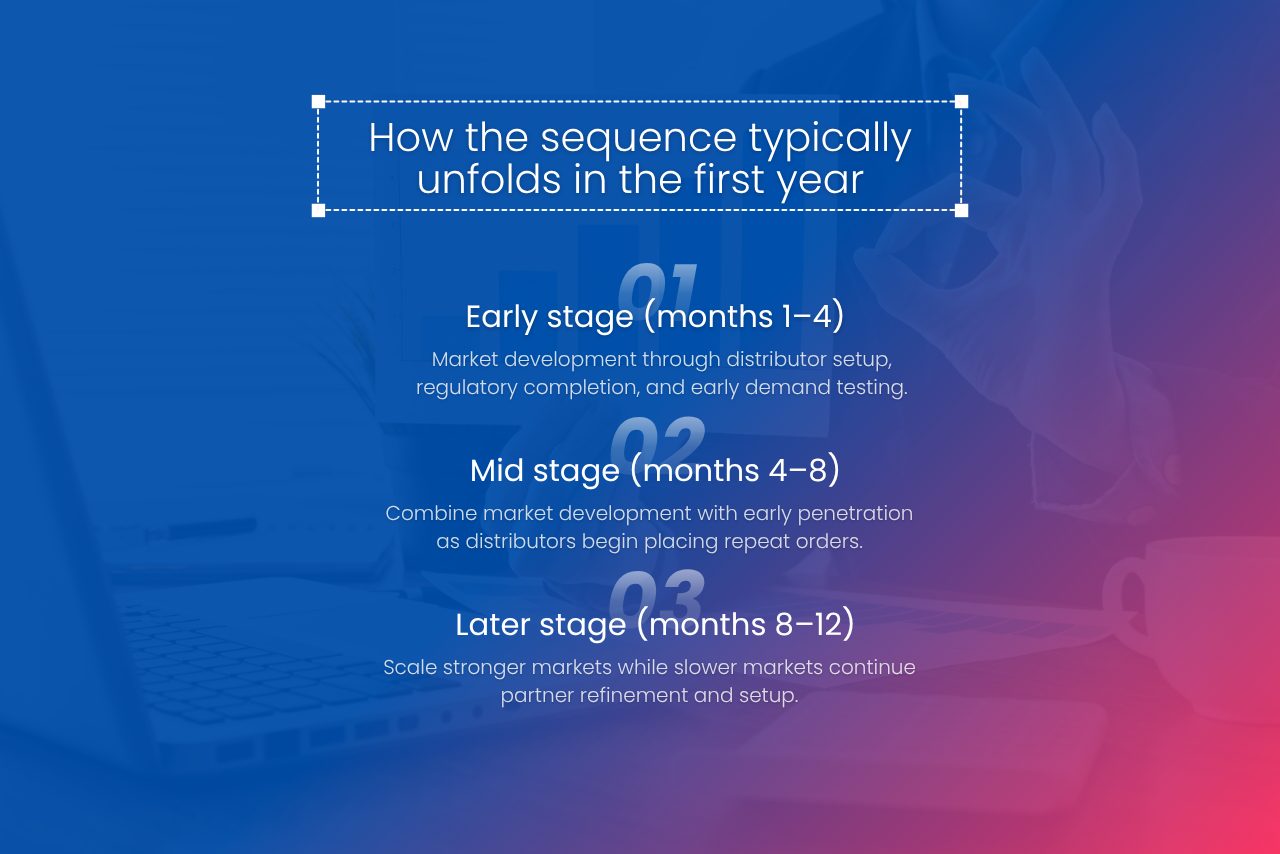
ASEAN expansion usually progresses from market validation to channel activation and selective scaling across different markets.
Why execution is different across ASEAN
ASEAN is not a single commercial environment. Each country operates with its own regulatory timelines, channel structures, and buyer behaviors. What activates sales in Vietnam does not automatically work in Indonesia, Thailand, or the Philippines. Key execution differences manufacturers typically encounter:
- Regulatory timelines: Some markets, like Indonesia and the Philippines, require significantly longer compliance periods before commercial launch is possible.
- Channel structures: Modern trade dominates in Thailand and Malaysia, while traditional trade remains strong in Vietnam and Indonesia, requiring different distribution approaches.
- Buyer readiness and partner quality: Traction speed varies by category and country, making first-year performance difficult to predict before actual market entry.
| 👉 Learn how B2B companies segment ASEAN markets more effectively instead of applying one commercial approach across the entire region. |
ASEAN expansion is rarely linear
In ASEAN expansion, markets do not move at the same speed. Each country develops differently due to regulatory processes, channel maturity, and partner readiness, which leads to uneven progress across the region. For example:
- Vietnam often shows early distributor traction and moves into market penetration faster.
- Thailand may still require regulatory completion and partner finalization before activation.
- Indonesia can remain in the validation stage, depending on the distributor and compliance setup.
Thus, companies manage multiple markets at different stages simultaneously. Therefore, resource allocation must be flexible, shifting investment toward markets with traction while maintaining development in slower ones.
How do local channels shape expansion speed?
Both market development and market penetration rely on execution quality, and in ASEAN, this execution is strongly shaped by local channel strength. For example, logistics costs in some ASEAN markets can reach 13%–17% of GDP, higher than the 8% to 9% typical in the US and EU, which reflects the operational complexity of moving products efficiently across fragmented ASEAN markets.
Expansion speed is driven by distributors, importers, local networks, and field teams, as they control product flow, buying behavior, and market visibility. Therefore, strong channels accelerate market traction, while weak ones slow performance, even when products and strategy are well prepared.
| 👉 Connect with our experts to evaluate your local channel strategy and discuss how to accelerate market traction across ASEAN. |
When to Shift from Market Development to Market Penetration
Market-based signals
The shift toward market penetration starts when market activity becomes stable and measurable, allowing companies to move from testing to scaling. At this point, decisions rely on consistent commercial patterns. Three key indicators show readiness for deeper penetration:
- Consistent sales over multiple periods: repeated performance across several cycles, confirming stable underlying demand
- Increasing predictability in demand: more reliable order cycles and improved distributor forecasting accuracy
- Strengthening distributor performance: partners actively sell and improve results instead of only holding stock
When these signals align, the market shows enough stability to scale penetration activities with improved efficiency and lower execution risk.
Execution readiness checkpoints
Before increasing investment in market penetration strategy, companies must first confirm that internal operations are ready to support scale. Without this foundation, stronger demand often creates execution gaps rather than growth. Key readiness factors include:
- Reliable logistics and fulfillment: ensuring consistent delivery when demand increases
- Clear pricing and positioning strategy: so distributors can sell with confidence and consistency
- Sufficient in-market execution capability: through a local team, agent, or committed distribution partner
If these elements are not in place, faster penetration efforts can lead to unmet demand, delivery delays, and strained channel relationships, reducing overall market performance instead of improving it.
How companies manage both strategies in practice
In reality, companies rarely follow a simple, step-by-step plan. Some markets move faster, while others take more time to set up, which creates uneven progress across the region. As a result, teams must balance building new market access with growing existing sales at the same time.
To manage this, companies continue market development in slower markets while focusing on market penetration in markets with stable demand. This balanced approach helps maintain growth across countries and reduces reliance on a single market. When done well, it leads to more stable and consistent regional performance over time.
Why do some companies maintain both strategies long-term?
Even after entering ASEAN, companies often continue using both market development and market penetration at the same time. This happens because the region does not move at one speed. Each country develops differently, and new opportunities keep appearing as markets evolve and competition shifts.
For example, a company may already be strong in Vietnam or Thailand, while still building basic market access in places like Cambodia or Myanmar. This creates a natural mix of mature and early-stage markets within the same portfolio. Consequently, companies that accept this structure tend to allocate resources more effectively and stay closer to actual market conditions.
Conclusion
To sum up, ASEAN expansion is not only about choosing market penetration vs market development. Companies often need both at the same time, adjusting priorities based on market maturity, channel readiness, and commercial traction in each country. Successful expansion depends on sequencing execution correctly across different ASEAN markets.
At Source of Asia, we help companies reduce first-year expansion friction through our market expansion services. Our experts support market validation, distributor identification, B2B meeting organization, and local channel development through on-the-ground commercial follow-up, helping companies strengthen both market development and market penetration across ASEAN markets.
| 👉 Contact us to discuss your ASEAN expansion challenges! |
Frequently Asked Questions
Market penetration focuses on increasing sales and market share in countries where a company already operates, usually through stronger distribution, pricing, or promotion. Market development focuses on entering new markets or customer segments using existing products to create new sources of demand.
Yes. During ASEAN expansion, companies often apply both strategies simultaneously because different markets progress at different speeds. One country may already generate repeat orders and require deeper penetration, while another still needs partner setup, regulatory alignment, or demand validation.
Market penetration generally carries lower commercial risk because the market, customers, and channels are already established. However, manufacturers entering ASEAN for the first time usually begin with market development, as initial market access and local demand still need to be validated.
Companies typically shift resources based on actual market performance rather than fixed timelines. Markets with stable sales and active distributors receive more penetration investment, while slower or newer markets continue development activities such as partner onboarding, regulatory setup, and channel validation.