
Introduction
ASEAN presents strong growth potential, but it is not a unified market. Each country differs in income levels, regulatory systems, and buyer behavior, making a B2B market segmentation strategy essential in this fragmented operating landscape for B2B companies.
Many companies struggle because they apply a one-size-fits-all approach, target the wrong customer segments, or misalign pricing and channels. Without a clear structure, resource allocation becomes inefficient, and market entry results remain inconsistent.
In this article, we – Source of Asia – explain how B2B market segmentation works as a practical decision-making tool, when to apply it, and how to execute it step by step to support a focused, scalable market-entry strategy in ASEAN.
Key Insights
- Effective B2B market segmentation helps companies focus on high-potential ASEAN markets and customer groups for better execution.
- Each ASEAN country differs in regulations, culture, and digital adoption, requiring tailored market strategies.
- Segmentation types include demographic, geographic, behavioral, psychological, and firmographic, which directly improve targeting and resource allocation.
- Validating segmentation with local insights reduces risk and ensures practical, actionable decisions.
- Common mistakes include treating ASEAN as one market, over-segmenting, and relying on incomplete data.
B2B Market Segmentation 101 Overview
Before applying B2B market segmentation in ASEAN, it is important to understand how it works, why it matters, and how it supports practical business decisions.
What is market segmentation
Most companies reach a point where broad targeting no longer works. Resources are limited, and different customer groups deliver different returns, so without a clear focus, efforts often become diluted, and results remain inconsistent.
According to Harvard Business Review, B2B market segmentation means dividing a broad market into smaller groups based on shared business characteristics such as needs, behavior, or company profile. This approach helps companies move from broad assumptions to clear, actionable decisions, including:
- Which markets to enter first
- Which customer segments to focus on
- Where to allocate resources effectively
When applied correctly, B2B market segmentation improves focus, execution, and long-term scalability.
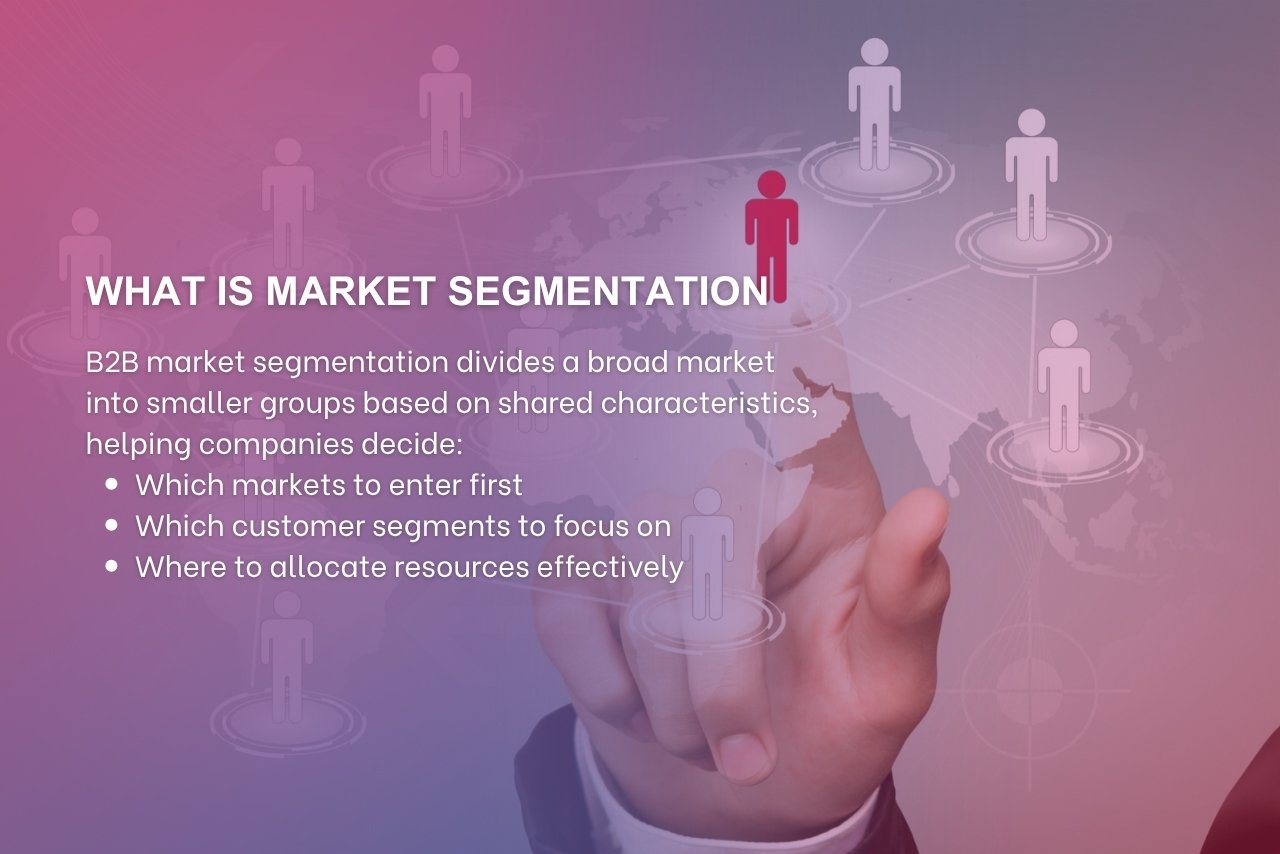
A broad market is divided into smaller segments to improve targeting, decision-making, and resource allocation.
Why B2B market segmentation strategies matter in ASEAN
At first, ASEAN may look like one large opportunity. However, once companies begin execution, the complexity becomes clear. The region includes 11 countries with very different economic levels, cultures, and business environments, which directly affects how customers buy and how markets respond.
Key differences you need to consider include:
- Income disparity, which impacts pricing and purchasing decisions (e.g., Singapore at $82k vs. Myanmar at $1k)
- Uneven digital adoption, shaping how customers research and buy
- Different regulatory systems, requiring country-specific compliance
Without a clear B2B market segmentation strategy, companies often face:
- Wrong targeting, where offerings do not match real demand
- Misaligned pricing, reducing competitiveness
- Inefficient resource allocation, lowering return on investment
In practice, segmentation helps you focus on high-potential markets and customer groups. For example, instead of targeting all SMEs, companies may focus only on export-oriented manufacturers in Tier 1 cities. As a result, you can improve conversion, avoid misalignment, prevent wasted investment, and build a more reliable growth path.
Core types of B2B market segmentation in ASEAN
To build an effective approach, you need to understand the main segmentation types in ASEAN, including demographic, geographic, behavioral, psychological, and firmographic factors.
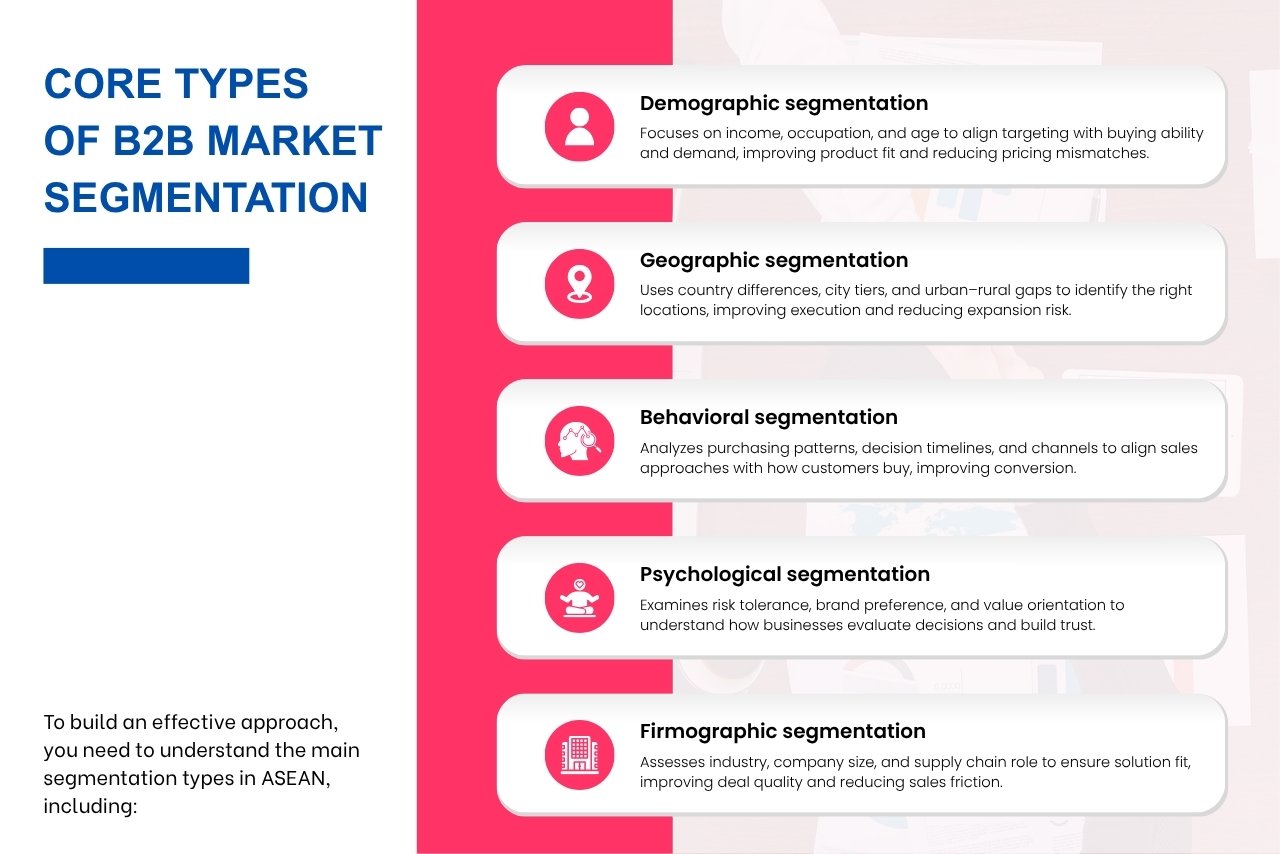
Key segmentation types help companies structure targeting and align strategies with diverse ASEAN market conditions.
Demographic segmentation
In many ASEAN markets, companies struggle not because demand is low, but because the target customer is too broadly defined, leading to weak conversion and pricing mismatches.
To address this, demographic segmentation focuses on a few core factors that directly affect buying ability and demand. These include income level, type of occupation, and in some cases, age group, depending on the product.
For example, the same offer may be considered affordable in one country but too expensive in another. By aligning your targeting early, you improve product fit and reduce execution risk.
Geographic segmentation
Companies often see mixed results across markets, even with the same product. In most cases, the issue is where the business is operating, not what it is offering. Location shapes how markets function. For example:
- Country differences affect regulations, demand, and competition
- City tiers influence customer concentration and spending power
- Urban and rural gaps impact infrastructure and distribution access
Research by the Asian Development Bank (2023) shows country differences affect regulations, demand, and competition, while city tiers influence customer concentration and spending power. Because of this, geographic segmentation is a key early step. It helps you focus on the right locations, improve execution, and reduce unnecessary expansion risk.
Behavioral segmentation
Even with a clear target customer, sales can still move slowly. This usually happens when the sales approach does not match how customers actually buy and make decisions.
Behavioral segmentation addresses this by focusing on key patterns such as purchasing frequency, decision timelines, and preferred sales channels. These factors directly influence how deals progress and where friction occurs. For example, some companies require multiple approval layers, while others allow faster, owner-driven decisions.
When your sales approach reflects real behavior, outcomes become more predictable. You improve conversion efficiency, shorten sales cycles, and create a more reliable go to market execution.
Psychological segmentation
Customers may still hesitate even when pricing and targeting appear aligned. In B2B contexts, this often reflects how companies perceive risk, trust, and long-term value rather than individual preferences.
Psychological segmentation focuses on how customers think and evaluate decisions. It helps clarify key factors such as:
- Risk tolerance: influences decision speed and caution
- Brand preference: includes trust in local or international providers
- Value orientation: focus on cost, quality, or long-term reliability
Firmographic segmentation
Choosing the right customer is not only about demand. It also depends on whether the solution fits how a business operates and makes decisions. Without this match, even strong leads may not be converted. Firmographic segmentation helps companies assess this fit by looking at core business characteristics:
- Industry indicates how the product will be used
- Company size reflects available budget and approval levels
- The role in the supply chain shows what the business needs to prioritize
These factors help companies improve deal quality, reduce friction in the sales process, and support more stable growth.
When Companies Should Use B2B Market Segmentation
In practice, companies frequently ask when to apply for B2B market segmentation. The most impactful use cases include the following:
- Expanding across multiple ASEAN markets
Entering multiple countries without segmentation creates confusion. Companies may invest heavily in low-return markets or miss early traction opportunities. By analyzing market potential and local conditions, companies can sequence entries, focus on high-value regions first, and plan budgets and teams strategically. This prevents wasted resources and sets a foundation for sustainable growth.
- Targeting diverse customer groups
ASEAN businesses range from SMEs to multinational subsidiaries, each with unique decision processes. Segmentation helps companies understand these differences and design approaches that align with customer needs.
For example, a simplified sales process may work for smaller firms, while enterprise clients require layered approvals. Matching approaches to actual behavior improves conversion and reduces friction.
- Managing complex offerings and investments
Companies offering multiple products, tiered pricing, or high upfront investments face the risk of misaligned offerings. Segmentation ensures:
- Product matches the right customer group
- Pricing reflects local purchasing power
- Channels suit customer accessibility and buying behavior
Applying B2B market segmentation allows companies to gain focus, improve execution, and establish a predictable growth path across ASEAN markets.
Segmentation becomes critical when expanding markets, targeting diverse customers, or managing complex offerings.
How To Do B2B Market Segmentation Step-By-Step in ASEAN
Effective B2B market segmentation in ASEAN turns strategy into action. Companies move from broad ideas to practical steps, focusing on markets, customers, and local insights for measurable results.
Step 1: Define objectives and success metrics
First, companies should decide whether the goal is a pilot or full-scale entry and set success metrics like revenue, market share, and adoption rates. Without this, segmentation can remain theoretical and misaligned.
- Entry goal: pilot or full-scale
- Success metrics: revenue, market share, adoption
- Align segmentation with business outcomes
This approach helps companies focus on resources, prioritize high-potential markets, and adjust strategies effectively, turning segmentation into a practical tool that drives predictable growth and measurable results.
Step 2: Identify and prioritize target markets
Second, companies need to shortlist countries for entry. Entering too many markets at once spreads resources thin, slows decision-making, and raises execution risks. Focus on a few priority markets using clear criteria:
- Market size: Prioritize regions with the highest demand potential
- Growth rate: Target markets showing steady or rapid expansion
- Competitive intensity: Avoid overly saturated markets
- Regulatory accessibility: Ensure feasible entry and compliance
Concentrating on a few high-potential markets first allows companies to allocate resources strategically, execute with confidence, and reduce operational risk. This approach lays the foundation for a structured, predictable, and scalable market entry.
Step 3: Develop actionable customer segments
Third, companies should group customers in a way that directly supports execution and decision-making, for example:
- Demographic: income, occupation, or age to align product fit and pricing
- Geographic: country, city tier, or urban-rural access to address market nuances
- Behavioral: buying patterns, decision timelines, and preferred channels for smoother sales
- Psychological: risk tolerance, brand preference, and value orientation to match messaging and approach
- Firmographic: industry, company size, and role in the supply chain to ensure solution fit
Segments need to be clear, measurable, and actionable. This allows companies to focus on resources effectively, improve conversion, and reduce execution risks while keeping the approach practical.
Step 4: Validate with local insights and data
Fourth, companies must validate their market choices with local insights and data. Relying on numbers alone can be misleading in ASEAN markets. To ensure decisions are practical and reliable, companies should:
- Gather on-the-ground validation from key locations
- Collect feedback from local partners to understand real conditions
- Incorporate industry-specific insights to align offerings with market realities
This step reduces execution risks, helps refine strategies, and ensures that market entry decisions are practical, informed, and aligned with real-world conditions.
Step 5: Activate across sales, marketing, and partners
Finally, companies turn segmentation insights into action across the organization. Maximum value is achieved only when sales, marketing, and partners are fully aligned.
- Sales teams focus on target accounts and outreach strategies.
- Marketing adapts messaging and channels to match each segment.
- Partners, including distributors and local alliances, follow consistent approaches.
With coordinated execution, companies scale efficiently, close execution gaps, and convert segmentation insights into measurable growth and stronger market impact.
| For a practical sales approach, see how B2B companies successfully sell across ASEAN markets in 2026. |
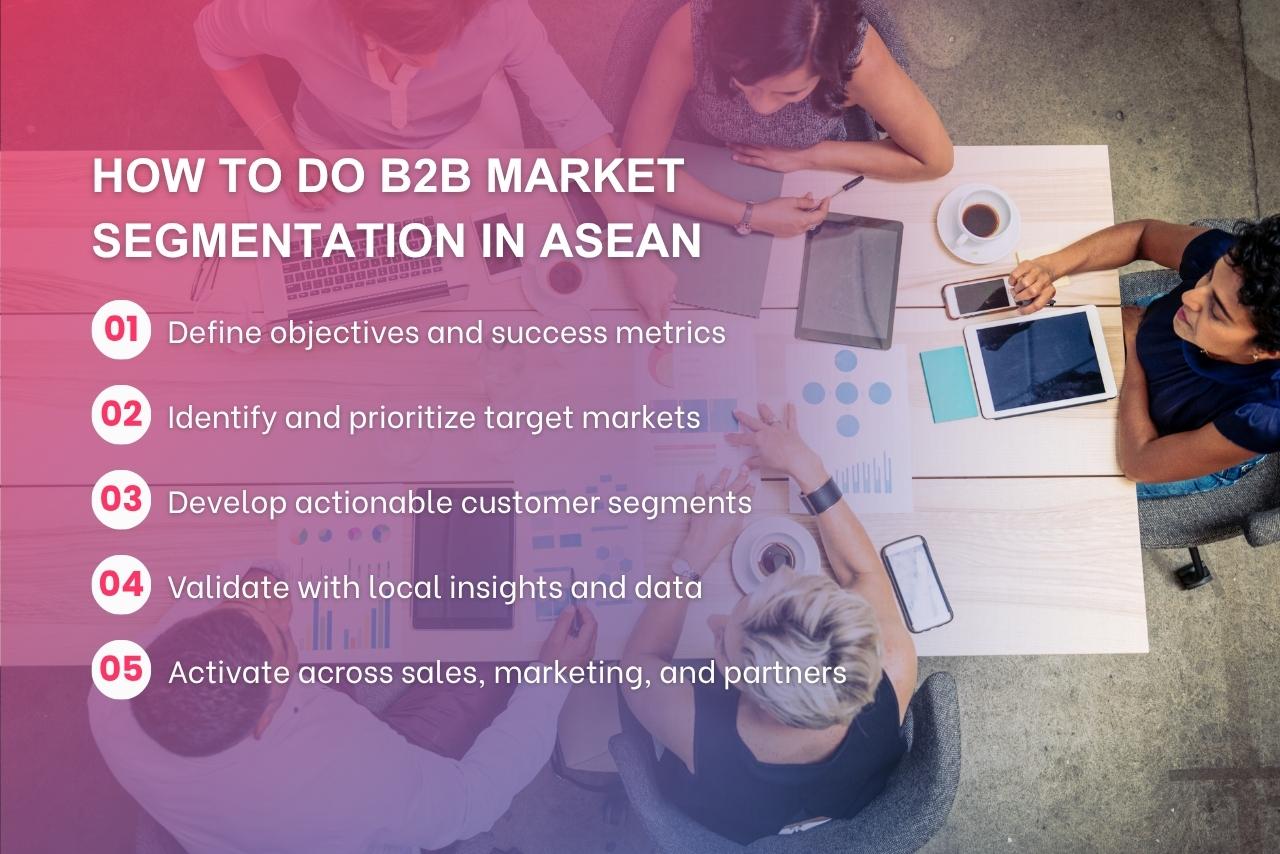
Step-by-step process diagram showing objectives, market selection, segmentation, validation, and execution stages.
How Market Segmentation Drives Market Entry Strategy
Expanding into ASEAN markets can stretch company resources and create higher execution risks. Without a clear plan, opportunities can be missed and efforts diluted. With a structured B2B market segmentation approach, companies can take targeted actions across three main areas:
- Prioritizing target markets: Companies identify high-potential countries by evaluating market size, growth trends, and competition. Within these countries, narrowing in on specific customer segments ensures efforts to deliver measurable results.
- Selecting entry model: The choice of entry method, whether direct presence, distributor, or joint venture, must match the accessibility and behavior of the target segments. Choosing the wrong approach can slow execution and limit market impact.
- Adjusting pricing and positioning: Pricing and positioning should reflect local purchasing power and segment preferences. Tailored messaging and clear value propositions strengthen adoption and improve market fit.
By following this framework, companies can prioritize opportunities, streamline execution, and establish a scalable and predictable market entry strategy across ASEAN.
Common Mistakes in Market Segmentation for ASEAN Entry
Expanding into ASEAN markets often seem simple, but many companies face early setbacks. Common mistakes include:
- Treating ASEAN as a single market: Each country has different regulations, consumer behaviors, and business norms. Applying one approach everywhere can slow growth and waste resources.
- Over-segmentation without operational readiness: Creating too many segments may seem thorough, but execution becomes difficult, and limited resources make it hard to serve all segments effectively.
- Relying on incomplete or unverified data: Global reports may provide broad trends, but without local validation, insights can be inaccurate, leading to poor decisions.
Thus, focusing on segments your business can realistically reach, grounded in validated local insights. This ensures strategies are actionable, reduces wasted effort, and accelerates market traction.
| Understanding ASEAN’s economic resilience can prevent costly missteps. Learn what US executives often misread and how to align strategy effectively. |
Conclusion
Effective B2B market segmentation in ASEAN helps companies prioritize markets, understand customer needs, and avoid common pitfalls. Grounded in local data and aligned across sales, marketing, and partners, it enables structured, predictable market entry that reduces risk and improves results.
At Source of Asia, we help companies expand in ASEAN through our Market Expansion Services. Our experts evaluate markets, identify and qualify local partners, organize B2B meetings, and provide on‑the‑ground support, ensuring strategies are actionable and growth is sustainable across the region.
| 👉If you are planning to enter ASEAN or explore new market opportunities, contact us to discuss your specific challenges. |
Frequently Asked Questions
Companies divide markets into clear customer groups based on demographics, behavior, firmographics, and local factors. Segmentation guides market prioritization, entry mode, pricing, and messaging, ensuring resources target high-potential opportunities and execution is efficient.
Yes. Each ASEAN country has unique regulations, customer behavior, and competitive dynamics. Segmentation helps companies adapt strategies to local realities, avoid wasted resources, and focus on markets and segments with the highest potential returns.
Local insights are critical. On-the-ground validation, partner feedback, and industry-specific data ensure segmentation is accurate, actionable, and aligned with real market conditions, reducing execution risks and improving decision-making.