If you are researching how to relocate your business to Southeast Asia, the first question is what you should relocate. Then consider why the move is needed and whether your company is ready to carry it out. For international companies, business relocation can mean moving production, diversifying suppliers, setting up a regional sourcing base, opening a support function, or redesigning part of the supply chain. Each option requires different decisions.
Southeast Asia offers strong opportunities, especially for companies reassessing cost, risk, supplier concentration, and market access. However, successful relocation depends on more than choosing a lower-cost country. It requires country mapping, supplier validation, compliance planning, and a clear execution roadmap.
This Source of Asia’s guide explains how to relocate your business to Southeast Asia through a structured 9-step process.
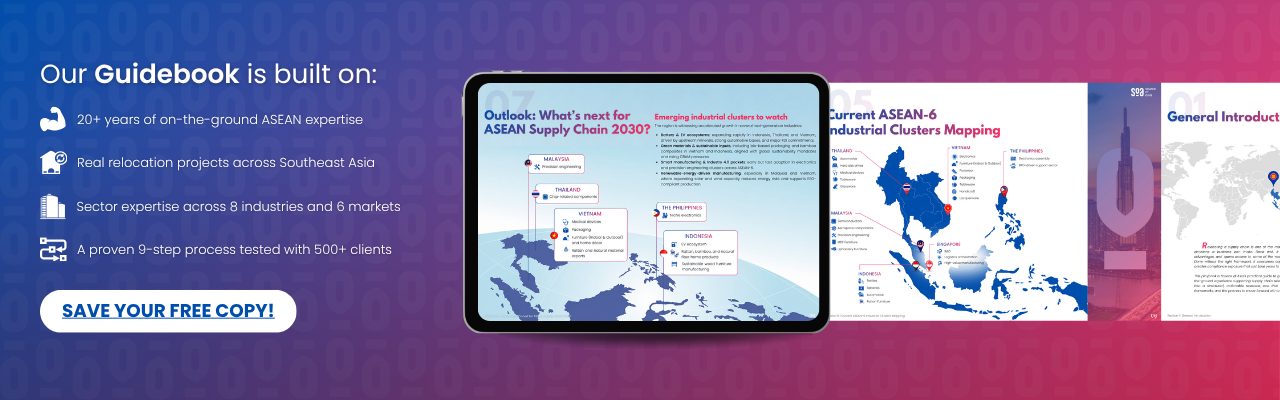
For a deeper framework, download SOA’s Supply Chain Relocation Mapping playbook.
Key Insights
- Relocating your business to Southeast Asia should start with clear objectives.
- ASEAN countries offer different strengths, so country fit depends on industry, supplier depth, workforce, logistics, and compliance.
- Companies should evaluate Total Cost of Ownership before moving operations or suppliers.
- Supplier qualifications, factory audits, and pilot production help reduce relocation risks.
- A readiness checklist can help companies decide whether to move forward or conduct deeper feasibility studies first.
 Add Source of Asia as a preferred source on Google
4 Reasons to Relocate Your Business to Southeast Asia
Companies relocate to Southeast Asia for different reasons. Some want to reduce supply chain risk. Others want better access to ASEAN markets, regional suppliers, or cost-efficient production. The strongest relocation strategies usually combine several objectives.
Reduce single-country dependency
Many companies are rethinking supply chains that depend too heavily on one country. Tariff exposure, geopolitical uncertainty, supply disruption, and compliance pressure can all affect production continuity.
Southeast Asia supports a more balanced footprint. For companies following a China+1 or multi-node Asia strategy, the region can absorb selected production lines, sourcing activities, or supplier tiers. This does not always mean replacing China. In many cases, it means building a more resilient regional structure.
Access ASEAN manufacturing and supplier ecosystems
Southeast Asia is not one single manufacturing base. Vietnam, Thailand, Malaysia, Indonesia, the Philippines, and Singapore each have different industrial strengths.
For example, Vietnam is often considered for electronics, furniture, footwear, and packaging. Thailand has strong automotive and medical device clusters. Malaysia is known for semiconductors and precision engineering. Indonesia is relevant for batteries, automotive, and textiles.
The right choice depends on product category, supplier ecosystem, technical capability, labor availability, and logistics.
Balance cost, risk, and market access
Relocation decisions should not be based on labor cost alone. Companies need to compare the full operating picture, including logistics, import duties, productivity, infrastructure, quality control, compliance, certification, and management costs.
A lower unit cost can become less attractive if supplier reliability is weak or transition risk is high. A stronger relocation plan uses Total Cost of Ownership to compare options more realistically.
Prepare for stricter compliance requirements
Global buyers are putting more pressure on supplier traceability, ESG documentation, and compliance readiness. For companies serving the EU or U.S. markets, relocation now includes questions around carbon reporting, forced labor due diligence, material traceability, certifications, and supplier documentation.
This changes the relocation question. Companies are not only asking where production is cheaper, but also asking where supply chains can be cost-competitive, auditable, and ready for long-term buyer requirements.
What to Clarify Before Relocating Your Business
Before entering the relocation process, you should define the scope of the move. This helps avoid unclear timelines, poor location choices, and underprepared execution.
- What exactly are you relocating?
Business relocation can take many forms. You may be relocating a production line, supplier base, sourcing team, regional office, distribution hub, or support function. Each model has different requirements. Moving a supplier network is not the same as setting up a factory. Opening a regional office is not the same as relocating manufacturing. The clearer the scope, the easier it becomes to assess countries, costs, risks, and partners.
- What objective should relocation support?
Companies should define the business reason behind the move. Common objectives include cost optimization, tariff mitigation, supplier diversification, customer proximity, compliance readiness, and regional growth. A clear objective prevents the relocation project from losing direction. It also helps leadership teams decide which trade-offs are acceptable.
- What operating model fits your strategy?
You may work with contract manufacturers, qualified suppliers, distributors, joint venture partners, or local entities. Some may eventually set up a factory owned by them. Others may build a sourcing office or start with supplier validation first. The best model depends on control needs, investment level, production complexity, market commitment, and internal capabilities.
9-Step Guide on How to Relocate Your Business to Southeast Asia
A business relocation project should move in phases. The process below follows a practical structure: evaluate and plan, test and validate, then implement and scale.
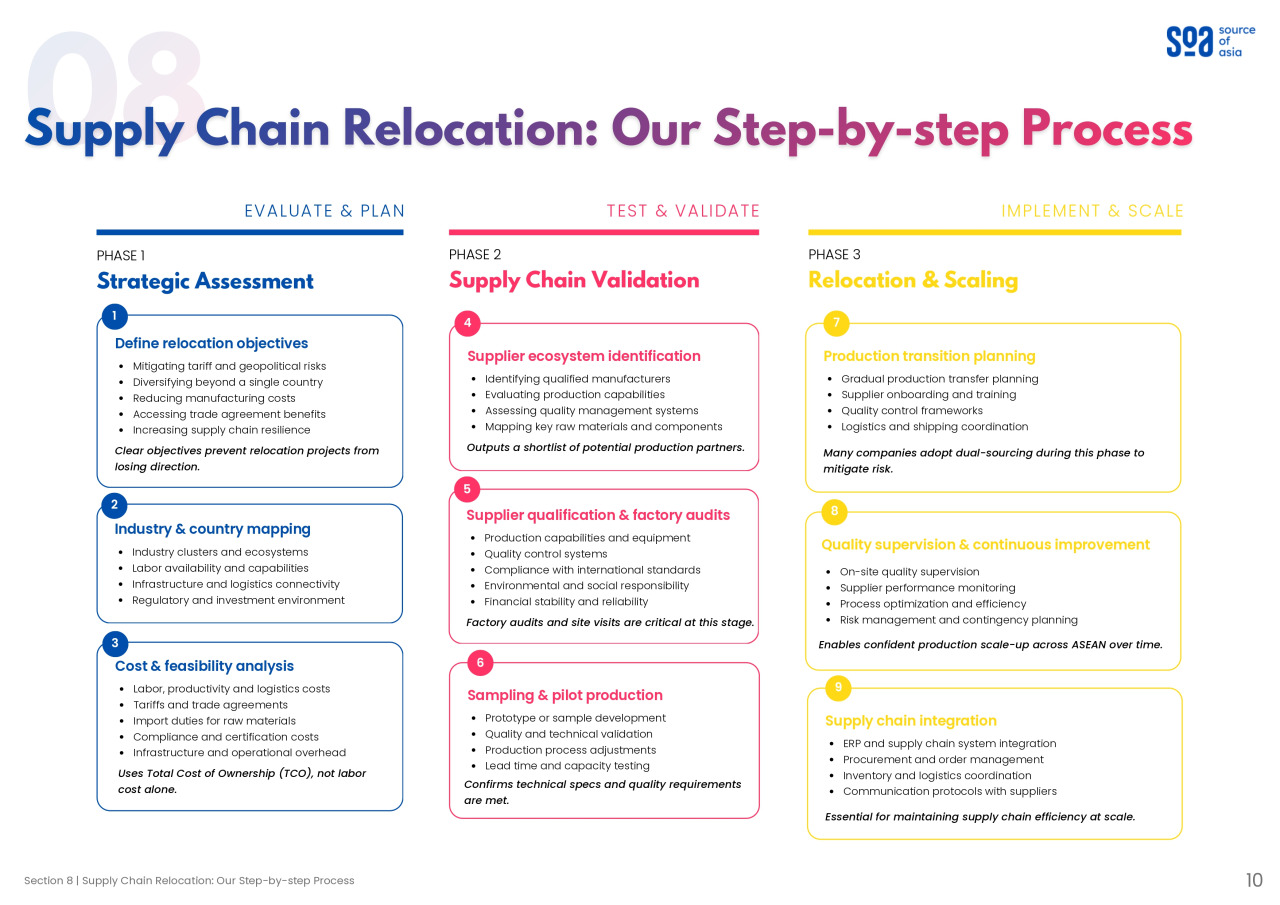
A structured 9-step process helps companies evaluate, validate, and scale business relocation or supply chain relocation projects across Southeast Asia.
Phase 1: Evaluate and Plan
The first phase helps companies understand whether relocation is strategically and operationally realistic.
Step 1: Define relocation objectives
Start by clarifying why the company wants to relocate. The reason may be tariff risk, supplier diversification, cost optimization, customer proximity, resilience, or access to trade agreement benefits. This step should involve leadership, supply chain, finance, operations, and compliance teams. Relocation affects the wider business, so internal alignment is essential.
Step 2: Map industries, countries, and clusters
Next, compare Southeast Asian countries based on industry fit. You should review supplier ecosystems, workforce availability, logistics, infrastructure, regulatory environment, and customer proximity. This is where ASEAN-6 industrial cluster mapping becomes useful. Different countries support different sectors, and the strongest option is often the one with the right ecosystem, not simply the lowest cost.
Step 3: Run cost and feasibility analysis
A proper feasibility study should compare Total Cost of Ownership. This includes labor, productivity, logistics, import duties, tariffs, infrastructure, compliance, certification, travel, supplier management, and transition costs. This analysis helps companies avoid decisions based on surface-level cost advantages.
Phase 2: Test and Validate
Once the strategy is clear, you need to validate whether the market can actually support the relocation.
Step 4: Identify the supplier ecosystem
Build a shortlist of potential manufacturers, suppliers, service providers, and local partners. The goal is not to collect as many names as possible. It is to identify qualified partners that match technical, operational, and compliance requirements.
Step 5: Qualify suppliers and audit factories
Supplier qualification should cover production capacity, equipment, quality systems, certifications, environmental and social responsibility, financial stability, and export experience. Factory audits and site visits are important at this stage. They help companies verify whether supplier claims match operational reality.
Step 6: Run sampling or pilot production
Before moving at scale, companies should test production through samples or pilot runs. This helps confirm technical specifications, quality standards, lead times, production process stability, and capacity. Pilot production also reveals issues that may not appear during desk research or supplier screening.
Phase 3: Implement and Scale
The final phase focuses on transition, quality control, and long-term integration.
Step 7: Plan the production transition
Relocation should not disrupt existing operations. Many companies use dual sourcing or phased production transfer to reduce risk. A transition plan should define timelines, supplier onboarding, logistics, quality control, inventory planning, and contingency actions.
Step 8: Supervise quality and continuous improvement
After production begins, companies need strong quality supervision. This includes supplier performance monitoring, on-site quality checks, process improvement, risk management, and corrective action planning. Continuous improvement helps stabilize operations and supports long-term supplier performance.
Step 9: Integrate the supply chain
The final step is integration. Companies should connect procurement, ERP, order management, inventory, logistics, supplier communication, and reporting systems. Without integration, relocation may create fragmented operations. With the right systems, companies can scale more confidently across Southeast Asia.
Which Southeast Asian Country Fits Your Business Relocation?
Country fit should be based on industry, product requirements, supplier depth, logistics, labor availability, compliance, and long-term business objectives.
The visual below summarizes key ASEAN-6 industrial strengths to help you compare relocation options across Vietnam, Thailand, Malaysia, Indonesia, the Philippines, and Singapore.
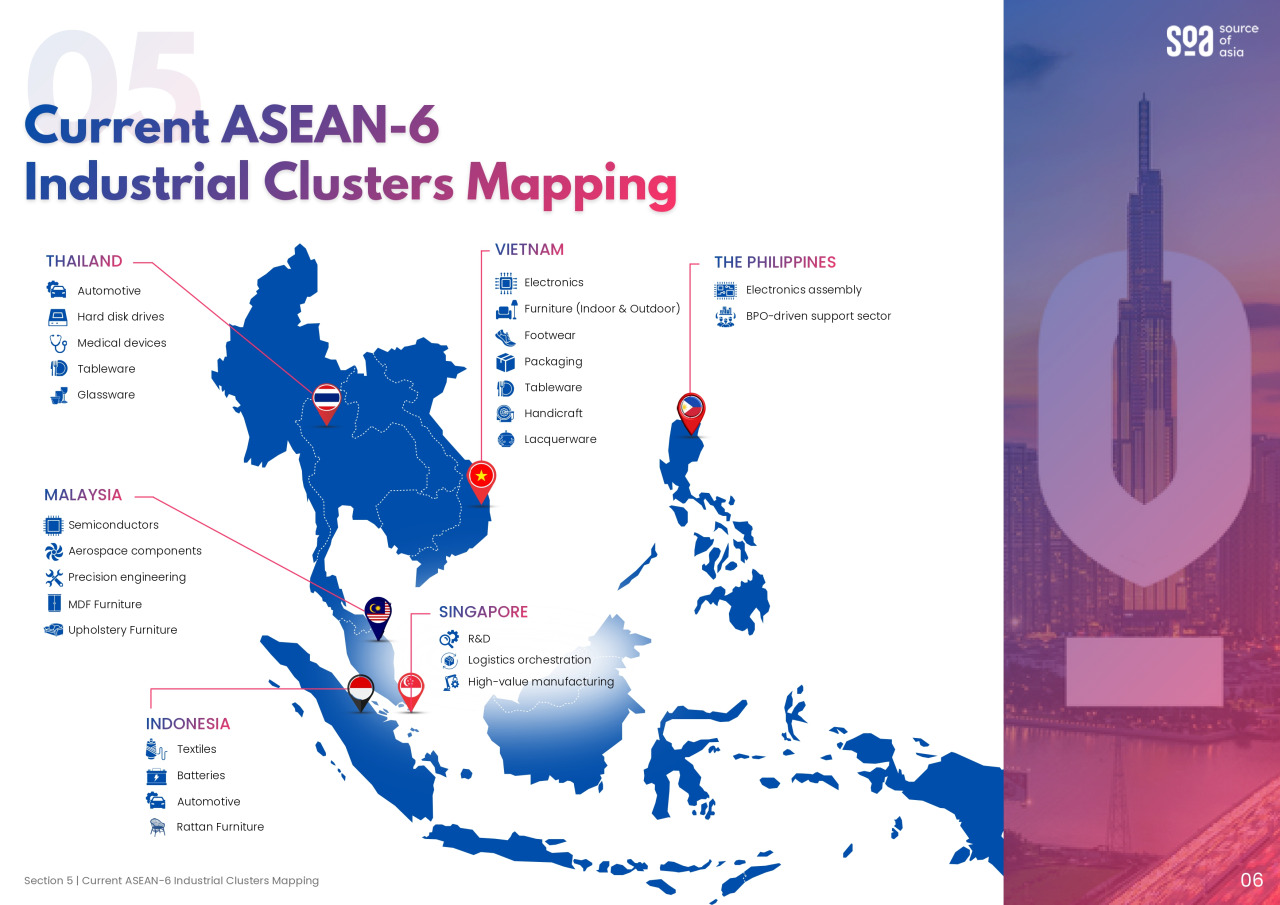
ASEAN-6 countries offer different industrial strengths, so business relocation decisions should be based on sector fit, supplier depth, and operational requirements.
The table below highlights key watchpoints for each ASEAN-6 market, which helps companies compare relocation risks beyond sector fit and identify which factors need deeper assessment before moving forward.
| Country | Watchpoints |
| Vietnam | Supplier depth, compliance, workforce planning |
| Thailand | Cost level, cluster-specific requirements |
| Malaysia | Talent availability, policy fit, location choice |
| Indonesia | Infrastructure, logistics, regulatory complexity |
| Philippines | Scale, supplier maturity, talent availability |
| Singapore | Higher operating costs |
Vietnam is often a common starting point for companies exploring business relocation to Southeast Asia. It has strong manufacturing relevance across electronics, furniture, footwear, packaging, and selected consumer goods sectors. However, Vietnam should still be evaluated against other ASEAN markets. The best country depends on the specific product, supplier ecosystem, input availability, export destination, and operational model.
If Vietnam is one of your shortlisted markets, you can explore our dedicated guide on how to relocate your business to Vietnam ↗.
And if Malaysia is also part of your relocation shortlist, explore our dedicated guide on how to relocate to Malaysia ↗ to understand company setup, location choices, costs, and operational requirements in more detail.
4 Key Risks to Assess Before Relocating Your Business
Relocation can create major advantages, but it can also create delays, hidden costs, and operational risk when planning is incomplete.
- Supplier ecosystems may not be ready for your product
ASEAN has strong industrial clusters, but not every product can be relocated easily. Some markets may lack upstream inputs, specialized components, technical skills, or qualified suppliers. Companies should assess supplier depth before committing to a location.
- Low cost does not always mean lower total cost
A lower production cost can be offset by logistics complexity, quality issues, rework, supplier management costs, customs delays, or compliance gaps. This is why Total Cost of Ownership matters. It gives a more accurate view of relocation feasibility.
- Compliance can affect supplier qualification
Regulatory and buyer requirements are becoming stricter. Depending on the sector, companies may need to review ESG readiness, traceability, carbon reporting, wood legality, restricted substances, packaging rules, labor standards, and certifications. A supplier that looks competitive on cost may not be suitable if it cannot meet buyer compliance expectations.
- Transition can disrupt production
Relocation is not a simple switch. If production transfer is rushed, companies may face quality problems, missed deadlines, inventory shortages, or customer disruption. Sampling, pilot production, dual sourcing, quality supervision, and contingency planning can reduce these risks.
How to Know If Your Company Is Ready to Relocate
Before relocating your business, leadership teams should assess whether they are ready to move from discussion to execution. Useful questions include:
- Have you clearly defined why you want to relocate?
- Have you assessed whether your products are suitable for Southeast Asian production?
- Have you compared Total Cost of Ownership across locations?
- Have you mapped suppliers, raw materials, and key inputs?
- Have you reviewed trade agreements, tariffs, and compliance requirements?
- Have you identified local partners or advisors?
- Have you prepared a preliminary relocation roadmap?
If many answers are still unclear, relocation may be premature. A structured feasibility study or supply chain mapping exercise should come first.
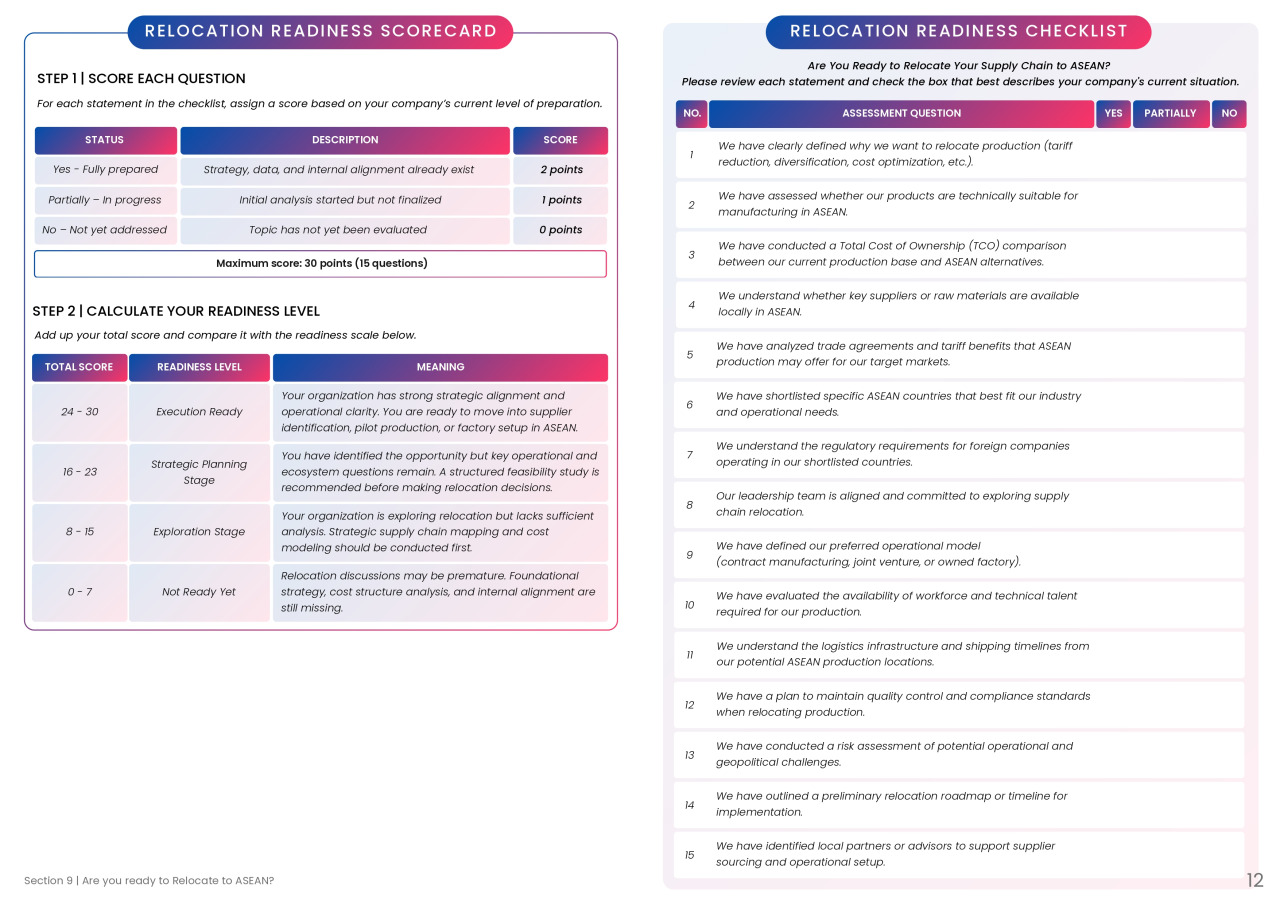
The relocation readiness checklist helps companies evaluate objectives, cost structure, supplier availability, compliance, risks, and operational preparation before moving forward.
Download the Supply Chain Relocation Mapping Playbook ↗
You can use the playbook to compare relocation options, identify gaps, and decide whether your company is ready to move from exploration to execution.
Conclusion
To sum up, relocating your business to Southeast Asia can support cost optimization, risk diversification, regional growth, and stronger supply chain resilience. Yet success depends on preparation. Companies should define relocation objectives, compare country fit, assess Total Cost of Ownership, validate suppliers, run pilot production, and prepare for compliance before scaling.
Southeast Asia offers strong opportunities, but each relocation decision should be based on industry fit, supplier readiness, operational feasibility, and long-term strategy.
To plan your next step with more clarity, download SOA’s Supply Chain Relocation Mapping 2026-2030 FREE playbook and start assessing where ASEAN fits in your business relocation strategy.