Introduction
Local sourcing across ASEAN has become more complex as companies face rising execution pressure and supply chain volatility. While many businesses focus on finding the “best” supplier, sourcing performance often depends on the strength of the local ecosystem surrounding that supplier. Infrastructure, logistics, workforce capability, and regulatory coordination all affect long-term execution stability.
In many ASEAN markets, even capable suppliers can struggle. Weak ecosystems lead to delays, quality inconsistencies, and scaling limitations. This is why sourcing decisions today increasingly depend on evaluating the broader operational environment, not supplier capability alone.
In this article, we – Source of Asia, explain how local sourcing ecosystems affect sourcing success and how businesses should assess ecosystem readiness before expanding sourcing operations in ASEAN.
Key Insights
- Local sourcing outcomes depend on ecosystem strength beyond supplier capability, shaping execution reliability across ASEAN markets.
- Logistics, supplier networks, and regulatory systems collectively determine sourcing stability and long-term operational performance.
- Weak ecosystems increase coordination friction, hidden costs, and operational risks despite strong individual supplier capability.
- Ecosystem maturity improves supply chain resilience through redundancy, infrastructure connectivity, and stronger operational support systems.
- Effective sourcing requires evaluating ecosystem readiness before selecting suppliers to ensure scalability and reliable execution.
What Is Local Sourcing and Why Does the Local Ecosystem Matter?
Local sourcing involves more than selecting nearby suppliers. Understanding what shapes sourcing stability, scalability, and execution reliability is important before evaluating sourcing performance across ASEAN markets.
What does locally sourced mean?
Local sourcing means purchasing products, components, materials, or services from suppliers located within the same country or regional operating market as the business. However, in modern supply chains, local sourcing involves more than buying from a nearby supplier. It also depends on whether the surrounding ecosystem can support stable and scalable operations.
A strong local sourcing ecosystem usually includes:
- Reliable supplier networks
- Transportation and logistics infrastructure
- Skilled workforce availability
- Warehousing and compliance support
Thus, sourcing performance is often shaped by how well these systems work together. This is especially important in ASEAN, where industrial maturity differs across markets. Two suppliers with similar production capability may still deliver very different operational outcomes depending on the surrounding ecosystem.
What makes up a local sourcing ecosystem
A local sourcing ecosystem is the operational structure that supports suppliers and manufacturing activities. Its strength directly affects sourcing stability, scalability, and execution efficiency. Some factors directly affect the effectiveness of sourcing:
- Supplier networks: Strong supplier depth improves sourcing flexibility, material access, and backup capacity during disruptions.
- Logistics and infrastructure: Ports, transportation systems, and warehousing capability affect lead times and delivery reliability.
- Workforce capability: Skilled labor supports production consistency and operational scalability.
- Supporting operational services: QA, testing, packaging, and compliance services help stabilize daily operations.
- Regulatory coordination: Customs, licensing, and certification processes influence execution speed and predictability.
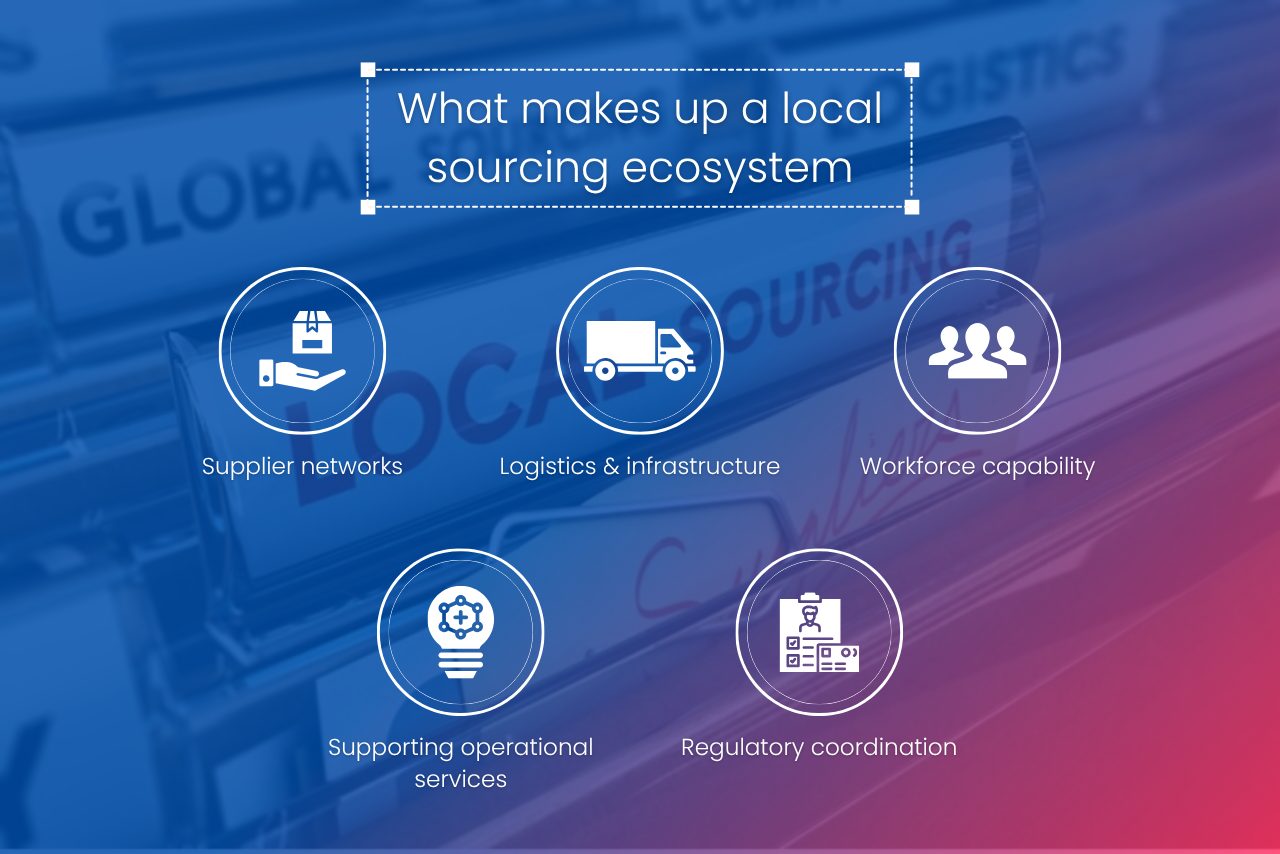
A local sourcing ecosystem integrates suppliers, infrastructure, labor, services, and regulatory systems into a single operational network.
Why supplier capability alone is not enough
Many companies entering ASEAN sourcing markets initially focus on supplier capability, assuming that strong production capacity automatically ensures stable execution. However, operational performance often depends on the broader ecosystem surrounding the supplier.
A factory may have modern equipment and experienced management, yet still face delays if logistics infrastructure is weak, supporting suppliers cannot scale quickly, or customs procedures remain inconsistent. For example, a supplier may produce well during sampling but fail to scale when packaging partners, customs clearance, or transport capacity cannot keep pace with larger orders.
As sourcing operations grow, these ecosystem gaps become more visible. Production continuity depends not only on the factory itself but also on transportation reliability, workforce stability, and local coordination efficiency. This is why businesses increasingly evaluate the overall execution environment rather than relying on supplier audits alone to maintain stable sourcing operations.
Why Ecosystem Readiness Matters in Local Sourcing
Local sourcing performance depends on more than supplier pricing alone. Ecosystem readiness directly affects sourcing efficiency, operational stability, and how well businesses can scale over time.
Moving beyond cost-driven sourcing decisions
For many years, companies selected sourcing locations mainly for their labor cost advantages. Lower wages were often viewed as the fastest way to reduce production expenses. However, as supply chains become more vulnerable to disruptions, cost alone is no longer enough to support stable sourcing operations.
Today, businesses are paying closer attention to execution capability alongside production cost. According to Ecommerce News Asia, many ASEAN companies are shifting supply chain priorities toward resilience, supplier visibility, and operational stability.
While lower labor costs can offer short-term savings, weak logistics, limited supplier networks, or inconsistent coordination often create hidden operational costs later. Hence, ecosystem maturity has become increasingly important for long-term sourcing reliability and scalability.
| To better evaluate sourcing feasibility, the next step is understanding how ASEAN has shifted beyond cost-based advantages. 👉 Explore why ASEAN is no longer a low-cost region and what that means for sourcing strategy. |
Cost advantages depend on ecosystem efficiency
Lower supplier pricing does not always mean lower total sourcing costs. In weak ecosystems, hidden issues such as logistics delays, quality inconsistency, and higher coordination effort can quickly offset initial savings. Therefore, strong sourcing ecosystems often deliver better operational efficiency and long-term cost stability.
| Cost Factor | Strong Local Ecosystem | Weak Local Ecosystem |
| Lead time | Lower | Higher |
| Inventory cost | Lower | Higher |
| Logistics risk | Lower | Higher |
| Supplier coordination cost | Lower | Higher |
| Production scalability | Higher | Lower |
Thus, many companies now evaluate total sourcing efficiency rather than comparing supplier pricing alone. In practice, ecosystem efficiency has become a direct cost factor in long-term sourcing decisions
Ecosystem capability and execution reliability
Mature local ecosystems help businesses maintain more predictable sourcing operations. When suppliers, logistics providers, and support services work efficiently together, companies often achieve faster coordination, more stable deliveries, and better operational visibility.
For example, manufacturers inside strong industrial clusters can recover from material shortages more quickly because backup suppliers and logistics options are readily available nearby. In weaker ecosystems, similar disruptions often lead to longer delays and higher operational costs.
As a result, ecosystem capability directly affects execution reliability, especially across ASEAN markets with varying levels of industrial maturity.
| 👉 See how ASEAN’s role in global supply chain rebalancing is reshaping sourcing networks. |
Why weak ecosystems limit sourcing performance
Weak sourcing ecosystems often create operational friction across multiple stages of the supply chain. In ASEAN markets, fragmented infrastructure or limited supplier depth can quickly reduce sourcing efficiency and operational stability over time.
Common challenges often include:
- Transportation and logistics delays
- Limited supplier backup options
- Poor inventory visibility
- Inconsistent quality control
- Administrative and coordination bottlenecks
These issues are often interconnected. For instance, logistics disruptions may affect production schedules, increase inventory pressure, and create higher coordination costs across suppliers. Consequently, weak ecosystems often reduce sourcing resilience, making operational recovery slower and more expensive during periods of disruption or rapid scaling.
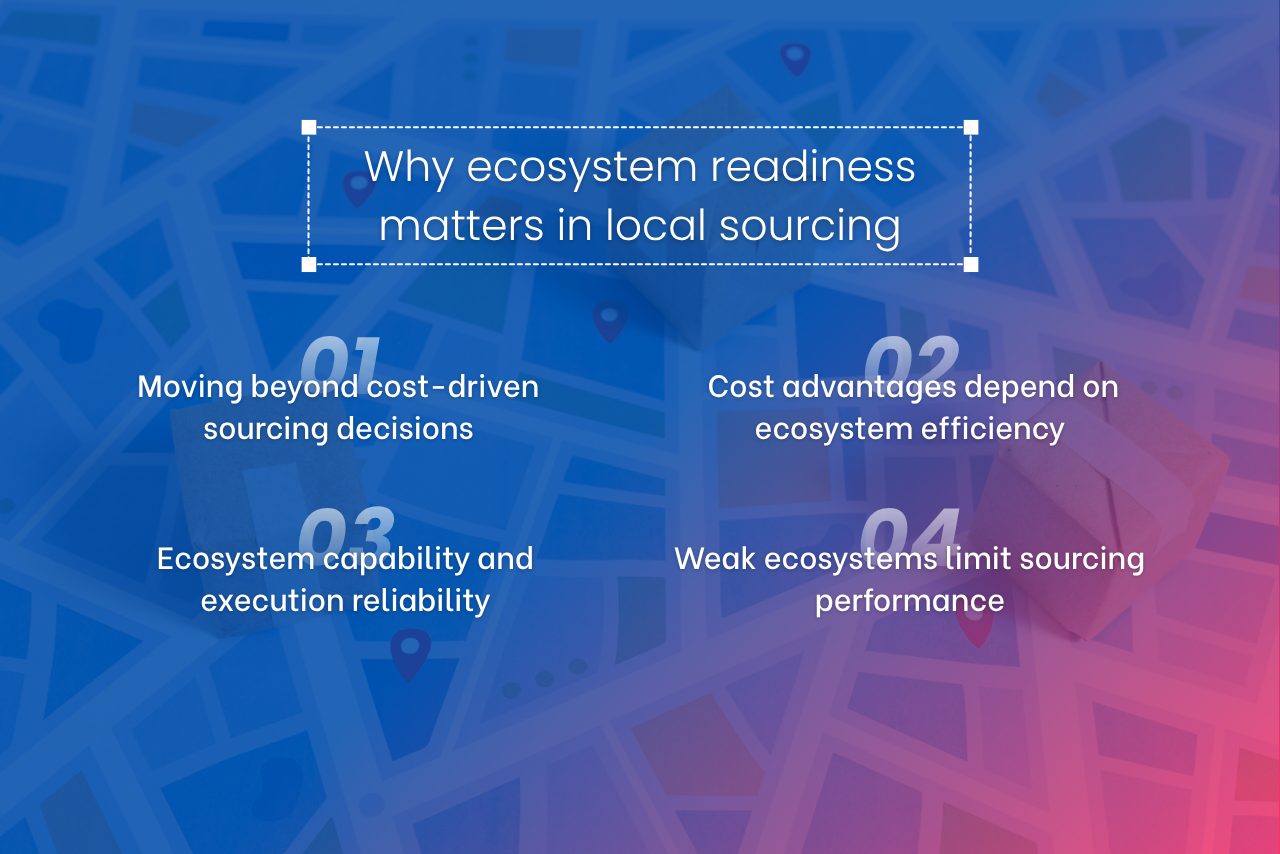
Ecosystem readiness helps businesses improve sourcing reliability, reduce disruption risks, and support long-term scalability.
How Weak Local Ecosystems Affect Sourcing Performance
Weak local ecosystems often create operational inefficiencies that extend beyond supplier capability alone. Fragmented coordination, infrastructure gaps, and inconsistent support systems can reduce sourcing stability, increase operational costs, and limit long-term scalability across ASEAN markets.
For electronics, sourcing success depends heavily on precision suppliers, testing capabilities, and component availability. For FMCG, logistics responsiveness, packaging, warehousing, and distribution coordination often matter just as much as supplier pricing.
Supplier fragmentation and scaling limitations
Fragmented supplier networks often reduce sourcing coordination efficiency across ASEAN markets. When suppliers operate independently without strong ecosystem integration, businesses may face:
- Communication gaps and inconsistent production standards
- Longer coordination cycles and weaker supply chain visibility
- Higher exposure to capacity shortages or supply disruptions
As production demand increases, these limitations often become more visible. Consequently, fragmented ecosystems can reduce scalability and long-term sourcing stability.
Logistics inefficiencies and lead time instability
Poor logistics systems can significantly affect delivery reliability and operational responsiveness. In some ASEAN markets, infrastructure gaps across transportation, warehousing, or port connectivity continue to create sourcing delays and scheduling uncertainty. Businesses may also face unstable delivery timelines, limited shipment visibility, and higher transportation costs.
Hence, weak logistics ecosystems often reduce sourcing predictability and operational flexibility. These limitations can make inventory planning, production scheduling, and supply chain coordination more difficult, especially during scaling periods or supply chain disruptions.
Quality inconsistency across supplier networks
Uneven supplier maturity often creates quality variation across sourcing operations. While some suppliers may maintain strong production standards, others may lack stable quality control systems, operational discipline, or compliance readiness. This often leads to:
- Inconsistent product quality
- Higher defect and rework rates
- Greater operational monitoring requirements
Without stronger ecosystem standardization, businesses may face higher operational risk and reduced sourcing consistency over time.
Regulatory coordination and operational complexity
Regulatory inconsistency can create delays and operational friction across sourcing activities. Across ASEAN markets, customs procedures, import licensing systems, and local compliance requirements often differ between countries.
For example, Indonesia’s local content requirement (TKDN) and import approval process can extend sourcing timelines for certain manufacturing sectors, while Vietnam and Thailand apply different product certification standards for imported goods.
These differences often increase administrative coordination efforts and create compliance uncertainty for businesses operating across multiple markets. As a result, companies may face slower customs clearance, inconsistent documentation requirements, and longer execution timelines, particularly when managing regional supply chains at scale.
What Defines A Mature Local Sourcing Ecosystem
Mature sourcing ecosystems improve sourcing stability, scalability, and execution consistency, especially as ASEAN supply chains face growing operational complexity and market volatility.
Supplier depth and sourcing redundancy
One of the clearest signs of a mature sourcing ecosystem is supplier depth across different production layers. Strong ecosystems provide wider supplier coverage, which improves sourcing flexibility and reduces dependency on individual vendors.
Supplier redundancy becomes particularly important during:
- Demand spikes
- Raw material shortages
- Production disruptions
- Supplier transitions
When backup suppliers are already available locally, businesses can maintain sourcing continuity more effectively and reduce operational disruption during unexpected events.
Infrastructure readiness and logistics connectivity
Infrastructure issues often become visible only after sourcing operations begin. A supplier may meet production targets, yet weak logistics networks can still create shipment delays, unstable lead times, and poor inventory visibility.
This remains a major difference across ASEAN markets. Vietnam and Thailand benefit from stronger industrial connectivity between ports, highways, and manufacturing zones, which supports more predictable sourcing execution. In contrast, some emerging markets still face infrastructure gaps that can slow transportation and reduce operational responsiveness as sourcing volumes scale.
Industrial clustering and manufacturing specialization
Industrial clusters are often strong indicators of ecosystem maturity. When suppliers, supporting industries, and operational services operate within connected manufacturing zones, sourcing coordination becomes faster, more responsive, and easier to scale operationally.
Specialized industrial ecosystems typically support:
- Faster supplier coordination
- Better workforce availability
- Lower operational friction
- More consistent production quality
This pattern is visible across several ASEAN sourcing hubs, including Vietnam’s electronics manufacturing zones, Thailand’s automotive production areas, and Indonesia’s expanding consumer goods manufacturing regions.
Workforce capability and production scalability
Workforce maturity directly influences production scalability and operational consistency. Regions with skilled labor availability, technical training systems, and experienced production workers are generally better equipped to support long-term sourcing growth.
Skilled labor often contributes to:
- Better production consistency
- Lower defect rates
- Faster onboarding processes
- More efficient operational scaling
In contrast, labor shortages and weak technical capability can limit sourcing expansion even when supplier demand remains strong.
Supporting services and operational coordination
Supporting services become increasingly important as sourcing operations scale beyond basic supplier management. In many ASEAN markets, execution problems often emerge during warehousing coordination, customs handling, packaging, or compliance processes rather than inside the factory itself.
Mature ecosystems usually provide stronger operational support networks around manufacturers, allowing businesses to reduce coordination friction, improve execution consistency, and maintain more predictable sourcing performance across larger supply chains.
| 👉 Understand global sourcing models and how companies structure multi-country supply chains. |
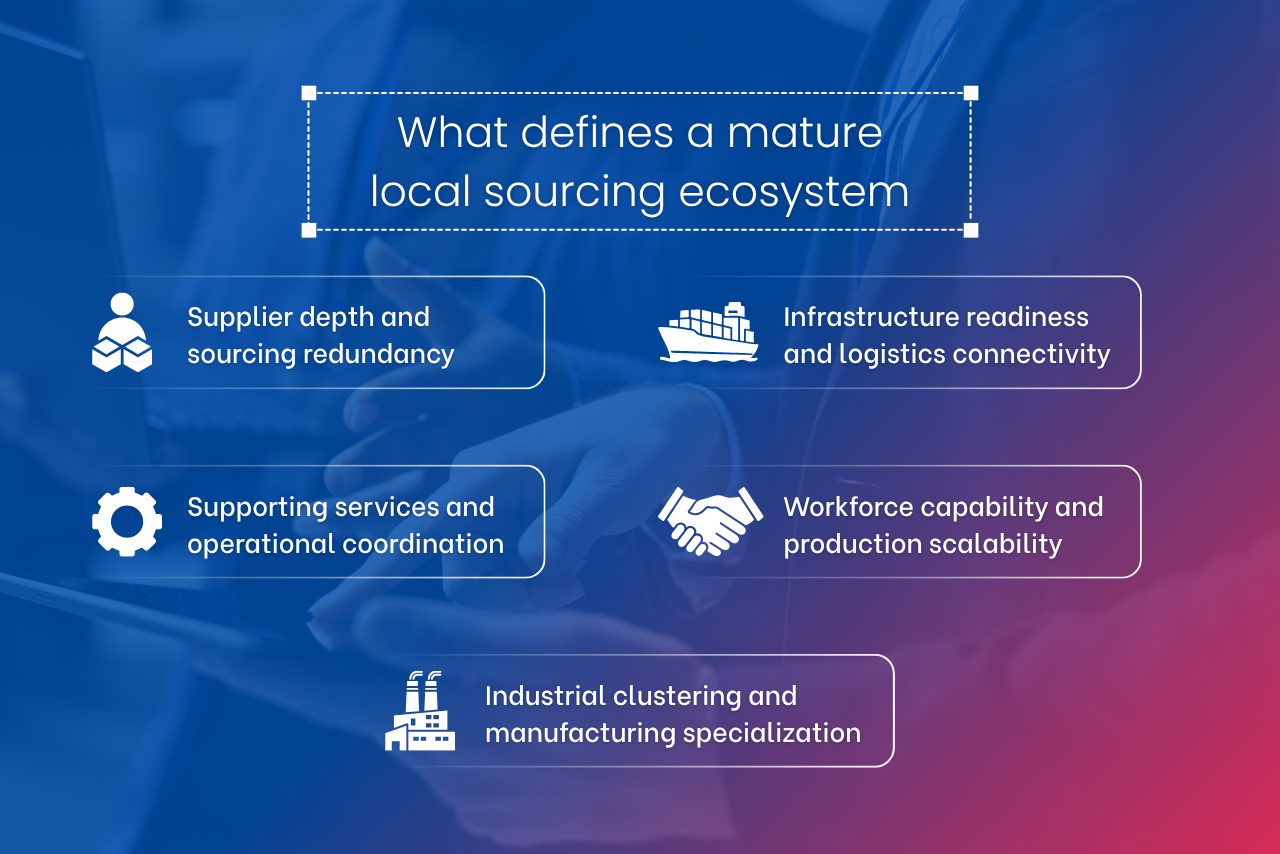
Mature sourcing ecosystems provide supplier depth, logistics connectivity, and operational resilience for sustained growth.
How to Evaluate a Local Sourcing Ecosystem Before Choosing Suppliers
A structured ecosystem evaluation should happen before supplier selection, not after it. These four areas often determine whether sourcing operations can remain stable, scalable, and operationally reliable over time.
- Supplier depth and backup options: Assess how many qualified suppliers operate within the same category, whether backup vendors are available locally, and how dependent operations may become on a small supplier base.
- Logistics reliability and lead-time control: Evaluate transportation infrastructure, port connectivity, warehousing capability, customs efficiency, and actual delivery conditions across the sourcing region.
- Quality, compliance, and audit readiness: Check whether the market has accessible QA providers, testing laboratories, certification bodies, and local compliance support to maintain stable operational governance.
- Scalability and local coordination capacity: Determine whether the ecosystem can realistically support future growth in labor availability, supplier coordination, logistics capacity, and operational responsiveness.
How SOA Supports Local Sourcing in ASEAN
At Source of Asia, we support businesses throughout the sourcing process across Southeast Asia, from supplier evaluation to operational execution. Our approach goes beyond supplier identification by assessing the broader sourcing ecosystem surrounding each market. This helps businesses better understand operational feasibility, execution risks, and long-term scalability before making sourcing commitments.
Our support includes:
- Supplier identification and qualification
- Local ecosystem assessment
- Factory visits and operational audits
- On-site validation across ASEAN sourcing markets
We also help businesses build sourcing roadmaps aligned with actual market conditions and operational requirements, covering supplier coordination, sourcing transition planning, local operational support, and execution monitoring throughout different sourcing stages. By combining local market knowledge with operational due diligence, we help companies improve sourcing visibility, reduce coordination gaps, and strengthen long-term supply chain resilience across the region.
| 👉 Discover our Sourcing Services to understand how we can support your end-to-end sourcing operations across Southeast Asia. |
Conclusion
Local sourcing success in ASEAN depends on ecosystem conditions beyond supplier capability, where logistics, supplier networks, supporting industries, and regulatory consistency shape execution outcomes. Thus, ecosystem assessment is essential for managing risk and ensuring stable, scalable sourcing strategies across markets.
At Source of Asia, our experts support businesses in evaluating sourcing ecosystems across Southeast Asia through supplier qualification, operational assessment, factory validation, and coordination support aligned with real-world execution requirements.
| 👉 If you are considering sourcing expansion or investment into ASEAN markets, contact us to discuss your strategy. |
Frequently Asked Questions
A local sourcing ecosystem refers to the full network supporting production and procurement in a market, including suppliers, logistics, supporting industries, labor, and regulatory systems that collectively determine sourcing feasibility and operational performance.
They directly impact stability by influencing lead times, supplier coordination, and risk exposure. Strong ecosystems improve flexibility and continuity, while weak ecosystems increase disruption risks and operational inefficiencies.
Local sourcing can reduce carbon emissions by shortening transportation distance and lowering logistics-related emissions. However, the actual impact depends on production efficiency, transport mode, energy source, and supplier operations.
Local sourcing focuses on regional suppliers with shorter supply chains, while global sourcing relies on cross-border networks. The key difference lies in cost structure, lead time, risk exposure, and operational complexity.
Companies should assess supplier capability together with logistics infrastructure, regulatory consistency, supporting industries, and execution reliability to determine real operational feasibility and long-term scalability in each market.