Introduction
For many years, the ASEAN region was widely seen as a low-cost manufacturing destination. Companies entered Southeast Asia mainly for cheaper labor, lower operating costs, and an alternative production base outside larger markets like China. That perception helped drive major investment into the region for decades.
However, by 2026, the situation is starting to change. Costs are rising across many ASEAN markets as industries become more developed and business environments continue to mature. For many businesses, this shift raises a new question: Does rising cost signal a growing challenge? Does it reflect a stronger, more sustainable operating environment in the long run?
Knowing that, in this article, we at Source of Asia explain why the ASEAN region is moving beyond low-cost competitiveness. What this shift means for businesses planning to enter markets and expand regionally in 2026.
Key Insights
- ASEAN is shifting from low-cost manufacturing toward capability-driven, value-based industrial competitiveness.
- Rising wages and industrial upgrading reflect structural economic maturity, not declining regional competitiveness.
- Foreign direct investment continues to increase, driven by supply chain diversification and long-term market access.
- Cost pressures in labor, logistics, land, and compliance are reshaping regional expansion strategies.
- ASEAN competitiveness now depends on workforce capability, regulatory maturity, and integrated supply chain ecosystems.
What Has Changed In The ASEAN Region Cost Narrative?
ASEAN’s cost narrative is changing as regional economies continue to develop and attract higher-value investment. At the same time, shifts in supply chains and industrial activity are changing how businesses evaluate cost, capability, and long-term growth across the region.
From low-cost hub to value-driven growth region
From 2026, the ASEAN region will no longer compete mainly on low labor costs. Instead, the region is becoming more attractive for its industrial capability, skilled workforce, and growing role in global supply chains. In HSBC Global Connections 2023, skilled workforce availability overtook competitive wages as ASEAN’s top investment attraction for the first time, showing a clear shift from cost-based to capability-based positioning.
This transition is also closely tied to industrial upgrading across the region. According to UNCTAD, total FDI into ASEAN reached around $226 billion in 2024 despite a decline in global FDI flows. At the same time, manufacturing FDI grew by roughly 150% to $44 billion, reflecting stronger investment into higher-value production and long-term industrial development across Southeast Asia.
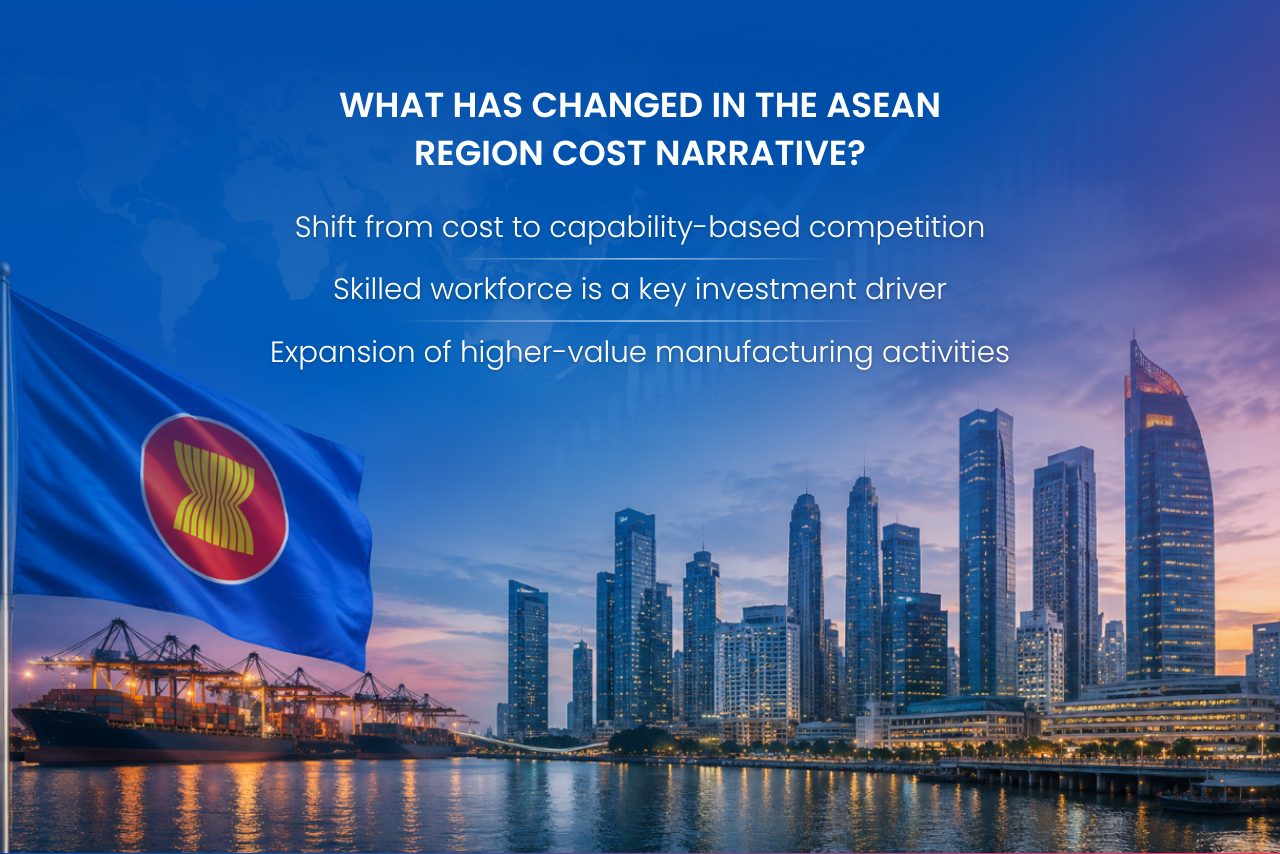
ASEAN is shifting from a low-cost manufacturing hub toward a value-driven growth region.
Why ASEAN is still associated with low-cost country sourcing
Many businesses still associate the ASEAN region with low-cost manufacturing, mainly because of earlier manufacturing waves in the 1990s and 2000s. During that period, countries such as Vietnam and Indonesia offered manufacturing wages below $150 per month, making Southeast Asia an attractive alternative to China for cost-driven production.
For many manufacturers, ASEAN was historically associated with low-cost country sourcing strategies, where businesses selected production markets mainly based on labor arbitrage and lower operating expenses. This approach shaped sourcing decisions across Southeast Asia for decades, especially during the early China+1 manufacturing shift.
However, the region has changed significantly since then. ASEAN now includes economies at very different stages of development. For example, Singapore has a GDP per capita above $80,000, while Cambodia remains below $2,000. As a result, many companies still mistake lower wages in CLMV markets for a region-wide cost advantage, even though each ASEAN country now plays a different role in the regional value chain.
What Do Rising Costs Look Like Across the ASEAN Region?
As ASEAN economies continue to develop, businesses are facing rising costs across labor, infrastructure, logistics, and compliance. These changes are reshaping how companies plan operations and expansion strategies across the region.
Wage growth across key economies
Labor costs are rising steadily across major ASEAN economies as industrial activity expands and labor markets become more competitive. Several markets are already seeing noticeable wage increases:
- Vietnam: Salary growth is forecast to rise by 6.7% in 2025, while the tech sector may reach up to 7.5%. Manufacturing wages now range from $290 to $350 per month.
- Indonesia: The government introduced a 6.3% minimum wage increase under President Prabowo in 2025.
- Thailand and Malaysia: Average manufacturing wages have reached around $431 and $797 per month, while skilled labor premiums continue rising faster than base wages.
| Beyond salaries, businesses also need to account for rising compliance, social insurance, and workforce management costs across ASEAN markets. 👉 Download the Vietnam Salary Guide 2026 by Source of Asia to know more! |
Land, logistics, and infrastructure cost pressures
Beyond labor, businesses across the ASEAN region are also facing rising land and logistics costs, especially in major industrial zones, such as Northern Vietnam, Greater Jakarta, and Thailand’s Eastern Economic Corridor. Several cost pressures are becoming more visible across the region:
- Industrial land prices in key Vietnamese provinces such as Binh Duong and Long An have risen around 15–20% since 2022.
- ASEAN logistics costs average around 13–14% of GDP, compared to roughly 8% in developed markets.
- Rapid urbanization across Indonesia, Vietnam, and Thailand is increasing costs related to warehousing, transportation, utilities, and industrial leasing in major cities and manufacturing hubs
Thus, businesses are facing higher infrastructure and distribution costs when scaling operations across the region.
| As industrial clustering becomes more important for cost efficiency and supplier access, factory location decisions are becoming more strategic than before. 👉 Explore which industrial parks in Vietnam are best suited for your future factory |
Compliance and regulatory cost expansion
As ASEAN markets continue to mature, regulatory requirements are also becoming more demanding for foreign businesses. Governments across Vietnam, Indonesia, and Thailand are tightening labor law enforcement, and penalties for non-compliance are becoming more severe.
At the same time, businesses operating across multiple ASEAN countries are dealing with growing administrative complexity, including:
- Payroll and tax reporting
- Work permit and entity management
- ESG and climate disclosure requirements
- Cross-border compliance coordination
For example, Singapore will require climate disclosures for listed companies from 2025, with other regional markets gradually moving in a similar direction. As a result, compliance is becoming a higher operational cost during regional expansion.
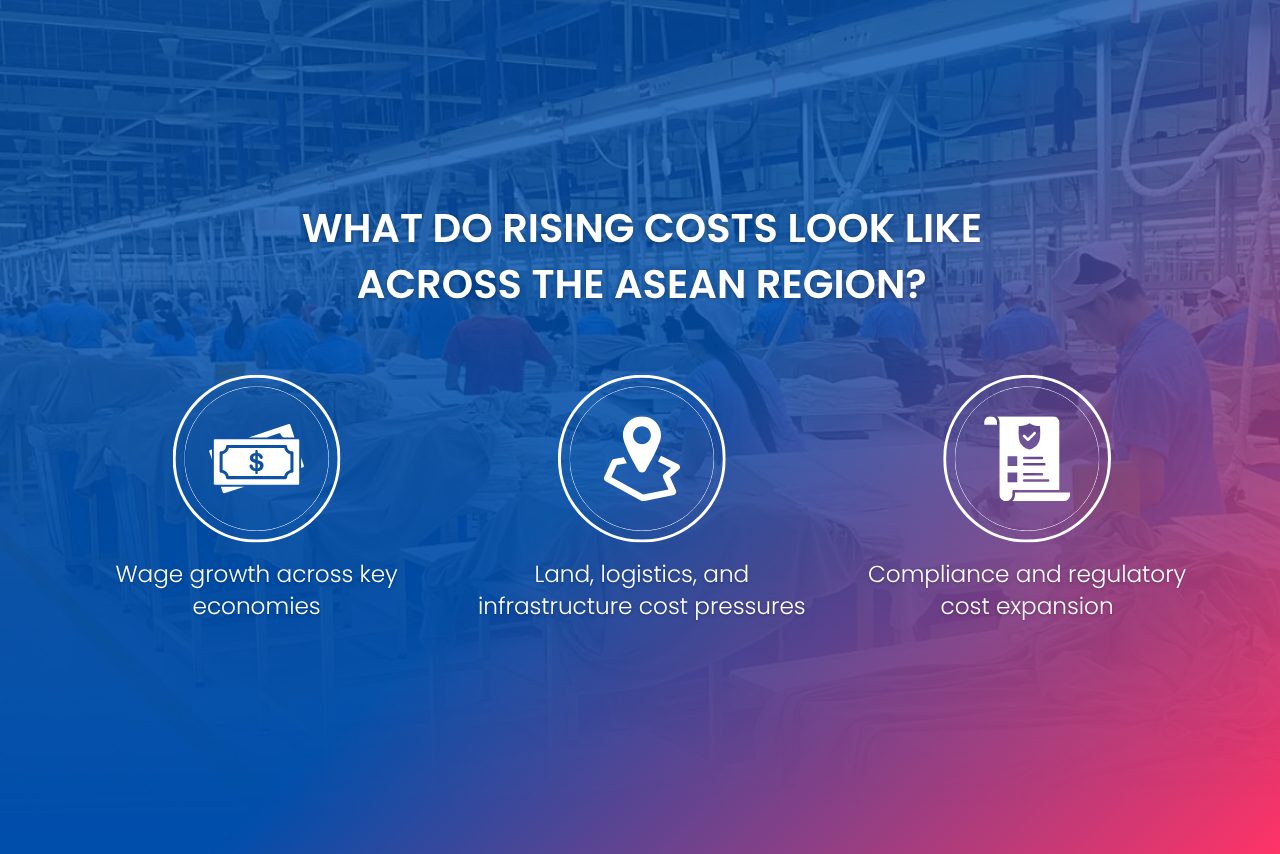
ASEAN is facing rising labor, logistics, and compliance costs as regional economies continue to mature.
Why The ASEAN Region Is Moving Beyond Cost Competitiveness
In 2026, ASEAN’s competitiveness is no longer defined solely by low cost but by structural shifts in labor, policy, and industrial strategy that are reshaping investment decisions across the region.
Demographic scale and workforce evolution
ASEAN offers a large and structurally important labor base, with a combined workforce of around 450 million people. In addition, more than 60% are aged 20–54, providing strong demographic support for industrial activity and long-term growth. At the same time, rising tertiary education enrollment in Vietnam, Indonesia, and the Philippines is improving technical and vocational capability across key markets.
Moreover, workforce evolution is becoming more visible. For example, Vietnam is increasingly linked to international R&D operations, while Indonesia leads the region’s digital economy expansion. As a result, ASEAN is shifting from a labor-cost advantage to a capability-driven workforce ecosystem supporting higher-value industries.
Strategic role in global supply chain diversification
When companies expand across Asia, they often face over-reliance on a single production base, which increases disruption risk. Therefore, many adopt China + 1 and broader geopolitical diversification strategies to more safely distribute operations. In this shift, ASEAN becomes important due to its proximity to China, established manufacturing base, and improving logistics networks, supporting both supply chain resilience and regional scale.
ASEAN is evolving into a connected regional production system, not separate markets. In addition, trade frameworks like RCEP help reduce cross-border friction and improve operational flow. As a result, companies can build regional manufacturing redundancy, allocate production more flexibly, and strengthen long-term supply chain resilience across multiple countries.
Policy-driven industrial upgrading
Policy-driven industrial upgrading across ASEAN is increasingly focused on higher-value manufacturing and technology-driven sectors, including electronics, EV supply chains, semiconductors, renewable energy, digital technology, and advanced manufacturing. This reflects a clear regional shift from labor-intensive production toward more complex industrial activities.
To support this transition, governments are deploying investment incentives, special economic zones (SEZs), industrial clusters, and manufacturing modernization policies. For example, Malaysia and Singapore are moving into semiconductor design and R&D, while Indonesia’s downstream strategy strengthens value-added mineral processing. Overall, these policies are reinforcing ASEAN’s role in advanced global supply chains.
Why Higher Costs In The ASEAN Region Can Be A Strategic Advantage
Higher costs in ASEAN are increasingly linked to structural upgrades in productivity, skills, and governance, which reshape how investors evaluate long-term market potential and operational stability.
Indicator of economic maturity and stability
Rising wages in ASEAN increasingly reflect productivity growth and industrial upgrading, rather than inflation alone. In many markets, wage growth of around 3–4% annually is linked to higher output and improving workforce capability, signaling structural economic development.
Meanwhile, regional cost gaps remain competitive but are gradually narrowing in a structured way. For example, Vietnam’s average hourly wage is still below USD 3, compared to China’s at USD 8.27, showing a continued cost advantage alongside skill progression. Additionally, improving regulatory environments across Vietnam, Indonesia, and Malaysia supports greater policy predictability and investment stability.
Improved workforce quality and operational capability
The ASEAN region is steadily improving workforce quality and operational capability across key industries, shifting the focus from cost efficiency to execution capacity. This shift occurs because manufacturers increasingly depend on operational precision, supplier coordination, and compliance execution rather than on labor costs alone. For example:
- Technical expertise is strengthening across manufacturing, engineering, and digital functions
- Middle management capability is improving, enabling better cross-border and multi-site coordination
- Manufacturing precision and process control are advancing, particularly in export-oriented industries
- Digital operations capability is expanding through the broader adoption of automation and data systems
Stronger compliance and governance frameworks
Across ASEAN, governments are strengthening compliance systems and governance frameworks to improve transparency and attract higher-quality foreign investment. This shift is increasingly shaping how investors assess regulatory risk across the region.
- High regulatory transparency: Singapore consistently ranks among the top 5 globally for ease of doing business and regulatory clarity, reflecting strong institutional stability.
- Stronger legal protection frameworks: Vietnam and Indonesia are reinforcing intellectual property protection and enforcement systems to support higher-value investment inflows.
- Improved ESG and governance standards: Rising ESG and compliance requirements are improving long-term risk management, regulatory predictability, and reputational safeguards for foreign investors.
| These evolving governance and ESG requirements are extending into carbon disclosure and reporting obligations across ASEAN markets. 👉 Understand why carbon reporting is becoming operational infrastructure for ASEAN expansion. |
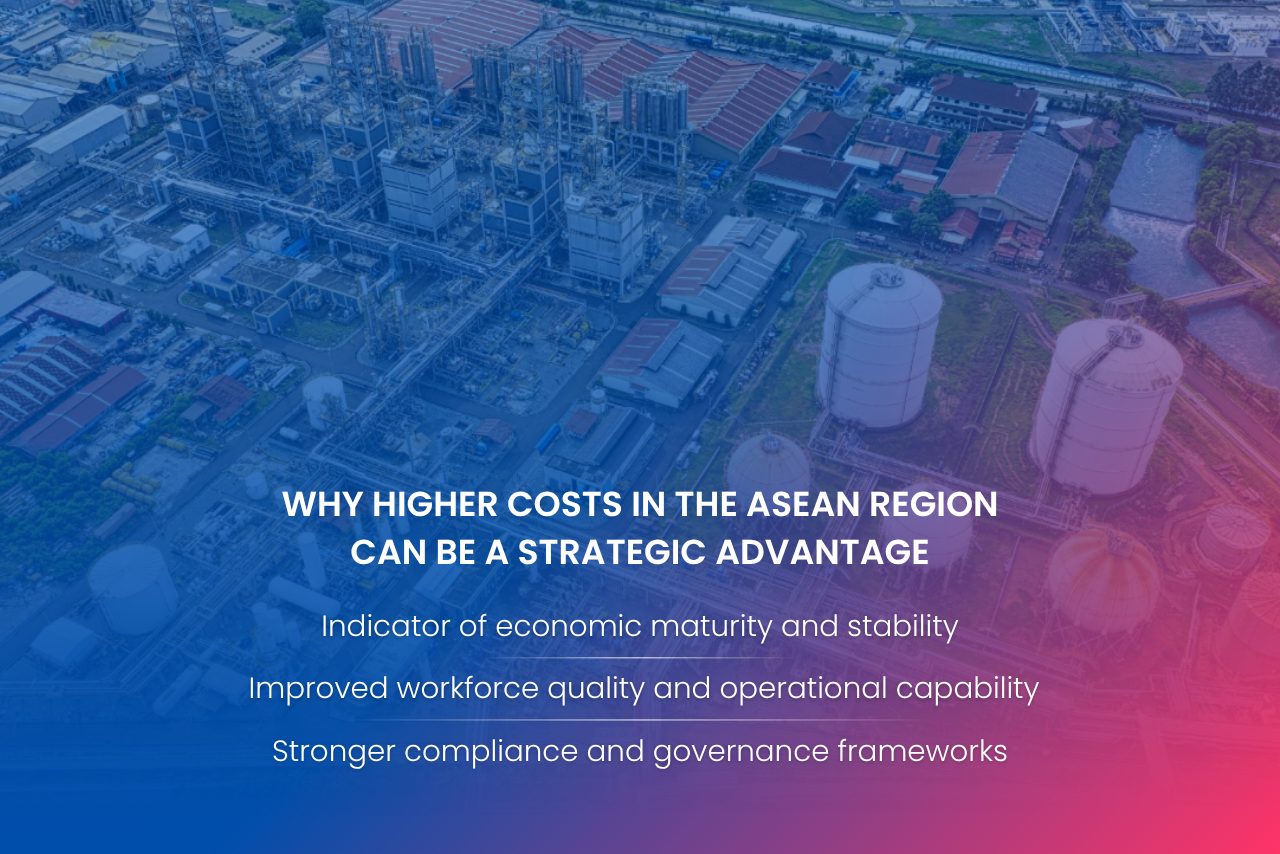
Higher costs increasingly reflect stronger capability, stability, and long-term business resilience.
How Businesses Should Re-evaluate ASEAN Expansion in 2026
ASEAN’s evolving structure means market entry decisions are no longer driven by cost alone but by access to consumers, talent ecosystems, and differentiated country capabilities across the region. As ASEAN markets continue evolving, many companies are reassessing their low-cost country sourcing services strategy. Instead of choosing suppliers based only on cost, they now look at long-term resilience, supplier reliability, and regional diversification.
- Rethinking market entry strategies
Businesses need to move from cost-driven expansion models to value-driven investment decisions. Market entry in ASEAN is no longer uniform, as each country offers different levels of capability, cost structure, and regulatory maturity. As a result, location-specific strategy design becomes critical to ensure alignment between business objectives and market conditions.
- Balancing cost, capability, and risk
Investment decisions now depend on total operational efficiency, not labor cost alone, combining capability, stability, and access considerations into a single framework.
Key evaluation factors include:
- Talent availability and workforce capability
- Regulatory stability and compliance environment
- Infrastructure quality and logistics readiness
- Supply chain integration and regional connectivity
In addition, ASEAN’s projected 415 million middle-income consumers by 2030 reinforces the importance of demand-side positioning, making cost-only strategies increasingly insufficient.
- Building long-term operational resilience
Sustainable operations in ASEAN depend on local partnerships and strong compliance infrastructure. Companies that invest in regulatory alignment, governance systems, and supplier integration are better positioned for scalability. Furthermore, leveraging regional economic integration enables firms to optimize cross-border operations and improve long-term resilience.
Conclusion
In 2026, ASEAN is no longer defined by a low-cost region alone. Rising wages, industrial upgrading, and stronger regulatory systems increasingly shape it. This reflects structural economic maturity rather than reduced competitiveness. Indeed, while low-cost country sourcing remains relevant in parts of ASEAN, businesses increasingly compete through operational capability, supplier reliability, and regional execution strength rather than labor cost alone. Companies that adapt can access diversified production networks, skilled labor pools, and growing demand across key Southeast Asian markets.
At Source of Asia, we support companies entering and scaling across ASEAN through market entry advisory, supplier sourcing and identification, compliance support, and operational setup. Our experts align strategy with on-the-ground conditions, including regulatory requirements, cost structure, and supply chain design across Southeast Asia.
| 👉 Contact us to define your market entry strategy, operational setup, and sourcing roadmap! |
Frequently Asked Questions
ASEAN is shifting away from being purely low-cost. Wage growth, regulatory strengthening, and industrial upgrading are reshaping competitiveness toward productivity, supply chain resilience, and skilled labor availability across different countries.
FDI continues to grow due to diversification strategies, China+1 supply chain shifts, and access to large, fast-growing consumer markets. Investors prioritize stability, scale, and regional integration over cost alone.
Vietnam remains strong in export-oriented manufacturing. Indonesia offers scale and domestic demand. Thailand provides established industrial infrastructure, while Malaysia specializes in advanced electronics and higher-value manufacturing ecosystems.
Yes, it is. ASEAN is driven by rising middle-class income, rapid urbanization, and demographic growth. Demand is expanding across FMCG, retail, and digital commerce but requires market-specific adaptation.