
Introduction
Entering a new market today requires companies to build a clear understanding of demand, competitors, regulations, customers, and local operating conditions before committing resources. In this context, making decisions based on assumptions rather than reliable market intelligence can lead to costly mistakes.
Many companies recognize the importance of market intelligence yet struggle to separate valuable insights from fragmented sources of information. Some invest heavily in reports that they rarely use, while others rely on outdated data or incomplete market knowledge, resulting in poor market selection, ineffective positioning, or unsuitable business partnerships.
In simple terms, market intelligence helps companies understand whether a market is worth entering, how competitive it is, what customers expect, and what risks should be assessed before investing.
To help businesses address these challenges, in this article, we at Source of Asia explain what market intelligence is, its key information sources, and how companies can apply it effectively without over-investing.
Key Insights
- Market intelligence transforms market information into actionable insights to evaluate opportunities, reduce risks, and support business decisions.
- The four main types of market intelligence help businesses understand markets, competitors, customers, and product readiness.
- Reliable market intelligence combines primary research, secondary research, internal business data, and external market expertise.
- Building effective market intelligence requires clear objectives, relevant information, and practical application rather than large research budgets.
- Market intelligence supports every stage of market entry, from market screening and feasibility assessment to partner selection and market launch.
 Add Source of Asia as a preferred source on Google
Market Intelligence 101
Market intelligence helps businesses understand markets, customers, competitors, and risks. It includes different types of intelligence, each supporting specific decisions throughout the business expansion process.
What is market intelligence?
Market intelligence is the process of collecting, analyzing, and applying market information to support business decisions. However, it is not simply about collecting large amounts of data. McKinsey research on the impact of data highlights that data creates business value only when companies turn it into useful insights and actions.
For example, market intelligence helps companies evaluate:
- Market opportunities and growth potential
- Customer needs and buying behavior
- Competitor strategies and positioning
- Potential risks before market entry
By combining information from different sources, businesses can turn fragmented data into practical insights. This allows companies, especially those expanding into new markets, to make more informed decisions and reduce uncertainty before investing resources.
Market intelligence vs. market research
Market intelligence and market research are closely related, but they do not serve the same purpose.
- Market research usually focuses on answering a specific question. For example, a company may conduct market research to understand customer demand, test product feedback, evaluate pricing expectations, or measure brand awareness in a target market.
- Market intelligence is broader. It combines market research with competitor analysis, customer insights, internal business data, regulatory information, and local market expertise. The goal is not only to collect information but also to support business decisions over time.
In short, market research can be one source of market intelligence. Market intelligence uses that research, together with other sources, to help companies decide where to enter, how to compete, and what risks to prepare for.
| 👉 To understand the difference in more detail, read our related guide on Market Intelligence vs. Market Research. |
4 main types of market intelligence
Different business decisions require different types of information. Therefore, understanding the main categories of market intelligence helps companies focus their research on the insights that matter most for their objectives.
- Market landscape intelligence
Market landscape intelligence provides an overview of market conditions and growth potential. It examines factors such as market size, industry trends, demand, economic conditions, and investment opportunities. This helps businesses evaluate market attractiveness and identify suitable markets before committing resources.
- Competitive intelligence
Competitive intelligence analyzes competitors’ activities, strategies, and market positions. It covers areas such as pricing, products, distribution channels, and competitive advantages. These insights help businesses identify market gaps, improve differentiation, and make better decisions when entering competitive environments.
- Customer intelligence
Customer intelligence focuses on understanding buyer needs, behaviors, and decision-making processes. It provides insights into customer expectations, purchasing criteria, pain points, and preferences. For B2B companies, this helps develop more relevant solutions and improve engagement with potential customers.
- Product readiness intelligence
Product readiness intelligence evaluates whether products can meet local market requirements. It considers industry standards, regulations, technology trends, supplier capabilities, and certifications. This helps businesses identify necessary adaptations and reduce risks before launching products in new markets.
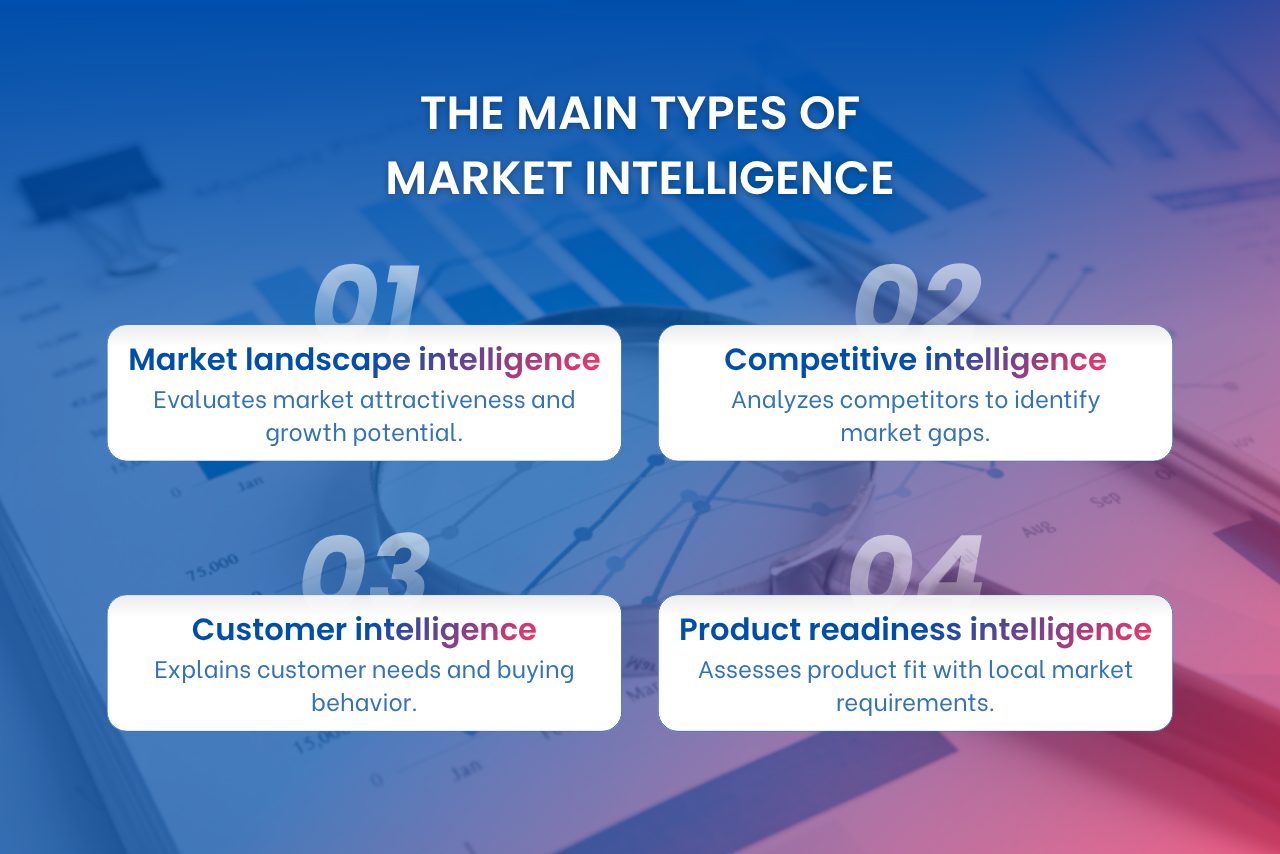
Different types of market intelligence provide insights into markets, competitors, customers, and product readiness.
What Are the Main Sources of Market Intelligence?
Reliable market intelligence rarely comes from a single source. Businesses often combine multiple information channels, including primary research, secondary data, internal records, and external expertise, to validate insights and support more accurate decisions.
Primary market research
Primary market research involves collecting first-hand information directly from customers, suppliers, distributors, and industry experts. It provides deeper insights into local market conditions that may not appear in existing reports or public data.
Common methods include:
- Customer interviews to understand needs and buying decisions
- Supplier discussions to evaluate capabilities and risks
- Surveys, focus groups, and market visits to validate assumptions
For example, customer interviews may reveal why buyers choose certain products, while supplier discussions can highlight operational challenges or partnership risks. Therefore, primary research is especially valuable when companies need specific insights before entering a new market.
Secondary market research
Secondary market research uses existing information from trusted sources, such as government agencies, industry associations, international organizations, and research providers. It helps businesses build an initial understanding of a market before investing in deeper research.
This approach provides insights into:
- Market size and industry trends
- Economic conditions and regulations
- Import and export activities
- Competitive landscape
Because secondary research is faster and more cost-effective, it is often used for market screening and opportunity evaluation. However, businesses should verify that the information is accurate, relevant, and up to date before making decisions.
Internal business data
Internal business data provides valuable market intelligence by using information a company already owns. Sales records, CRM data, customer feedback, website analytics, distributor performance, and previous expansion experience can reveal real business patterns before external research begins.
Companies can use internal data to identify:
- Customer inquiries from potential markets
- Sales trends and regional demand
- Product feedback and customer preferences
- Lessons from previous case studies
Because this information comes from real business activities, it is a cost-effective starting point. It helps companies make better decisions before investing in external research.
External market intelligence sources
Some business decisions require expertise beyond internal data or publicly available information. External market intelligence sources help companies validate assumptions, understand local market conditions, and access insights that are difficult to obtain independently.
Businesses often work with:
- Specialized market research firms
- Industry associations and business chambers
- Consulting companies and local market advisors
- Professional networks and industry experts
These sources are particularly valuable when evaluating suppliers, interpreting regulations, or validating market demand. However, businesses should choose external partners based on specific objectives, ensuring the insights directly support business decisions rather than simply adding more reports.
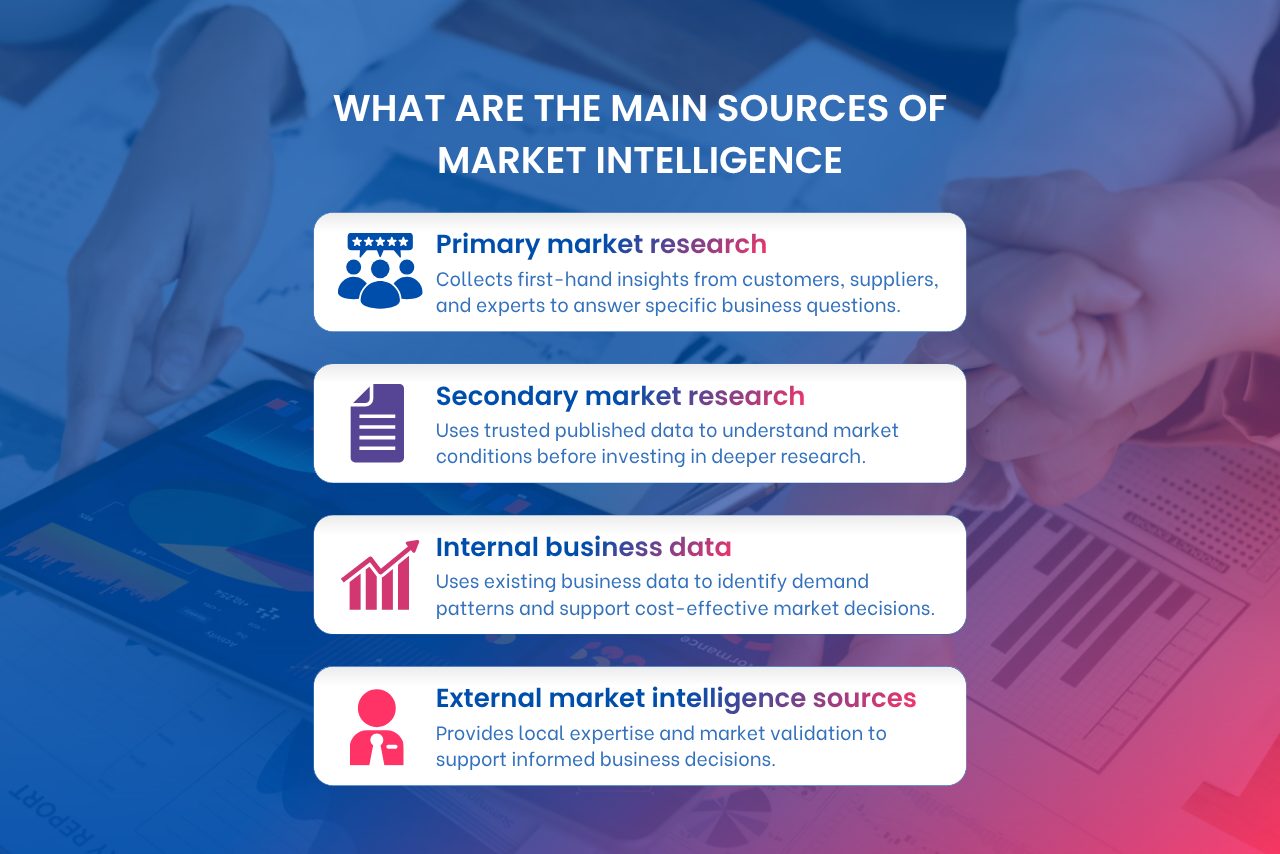
Reliable market intelligence combines multiple information sources to validate insights and reduce risks.
How Can Companies Build Market Intelligence Without Over-investing?
Effective market intelligence is not determined by research budgets but by a structured approach. Companies should define clear objectives, collect only relevant information, and convert insights into practical business decisions that support growth and market expansion.
In our experience, companies rarely lack information. The bigger challenge is knowing which information is useful enough to support a real market decision.
Define clear business objectives
Before collecting any market information, businesses should first define the decision they need market intelligence to support. A clear objective keeps research focused and prevents unnecessary spending on information that will not influence business outcomes.
For example, companies may need to answer questions such as:
- Which market offers the strongest growth potential?
- Is customer demand sufficient?
- Which suppliers meet business requirements?
- What regulatory barriers should be considered?
Once these objectives are defined, businesses can identify the most relevant data sources and research methods. As a result, they collect only the information needed to support confident, evidence-based decisions rather than broad, unfocused research.
Collect only relevant market intelligence
Many businesses try to understand every aspect of a market before making a decision. However, this often increases research costs without improving decision quality. A more effective approach is to focus only on the information that directly supports your business objective.
The table below shows the key intelligence areas companies typically evaluate during market assessment:
|
Intelligence Area |
Key Questions | Example Data |
|
Market potential |
Is demand sufficient? |
Market size, growth rate, consumption trends |
|
Competition |
Who are existing players? |
Competitor pricing, positioning, market share |
|
Customers |
Who buys and why? |
Buyer behavior, decision process |
|
Operations |
Can we operate effectively? |
Suppliers, workforce, logistics |
| Regulations | What barriers exist? |
Licensing, compliance requirements |
By prioritizing only relevant intelligence, businesses can identify knowledge gaps faster, allocate research resources more efficiently, and make better-informed decisions without unnecessary analysis.
Turn intelligence into business decisions
Market intelligence creates value only when it leads to business decisions. Collecting reports without applying the findings rarely improves business performance. Instead, companies should convert insights into actions that support expansion, investment, and daily operations. For example:
- Market analysis can help prioritize target markets
- Customer insights can guide product positioning
- Supplier intelligence supports partner selection
- Regulatory research helps businesses prepare for market entry requirements
Because market conditions continue to change, businesses should review and update their intelligence regularly. This helps them respond more quickly to new opportunities, changing customer needs, and competitive or regulatory developments before making major business decisions.

Effective market intelligence starts with clear objectives, relevant information, and practical insights.
How Does Market Intelligence Support a Market Entry Plan?
Market intelligence supports every stage of a market entry plan, from evaluating opportunities to executing local operations. As businesses move through the expansion process, the information they need also changes, helping reduce uncertainty and improve decision quality.
|
Market entry stage |
Intelligence needed |
Business decision |
|
Market screening |
Industry size, growth, competition |
Select priority markets |
|
Feasibility assessment |
Regulations, costs, ecosystem |
Evaluate expansion potential |
|
Partner selection |
Supplier/customer verification |
Choose reliable partners |
|
Market launch |
Customer feedback, performance data |
Adjust the strategy |
Successful market entry depends not only on identifying the right opportunity but also on validating whether the business can execute locally. Market intelligence helps companies assess commercial potential alongside practical factors such as compliance, partner capability, and operating conditions before committing significant resources.
| Once market potential is validated, the next step is identifying reliable local partners for successful execution. 👉 Learn more about finding the right business partner for Asia market entry. |
Final Thoughts
Market intelligence helps companies transform market information into practical insights for better strategic and operational decisions. However, effective market intelligence does not require unlimited research budgets. Instead, it depends on clear business objectives, relevant data sources, and the ability to turn insights into meaningful business actions.
At Source of Asia, we help businesses develop targeted market research, local validation, competitor analysis, and partner identification across Southeast Asia. By focusing on the information that directly supports business decisions, we help companies reduce research costs, validate opportunities, and enter new markets with greater confidence.
| 👉 Planning to assess a new market in Southeast Asia? Speak with Source of Asia to define the appropriate scope of market intelligence before investing in deeper research or local execution. |
Frequently Asked Questions
Market intelligence is the process of collecting, analyzing, and applying market information to support business decisions. It helps companies understand market opportunities, customer needs, competitors, and potential risks, allowing them to make more informed decisions before entering or expanding into new markets.
Market research usually answers a specific question, such as customer demand, pricing, or product feedback. Market intelligence is broader. It combines market research with competitor analysis, customer insights, internal data, regulatory information, and local expertise to support business decisions over time.
The main sources of market intelligence include primary market research, secondary market research, internal business data, and external intelligence providers. Combining these sources helps businesses validate insights, reduce information gaps, and build a more reliable understanding of target markets.
Yes. Small businesses can begin with internal business data, government statistics, industry reports, and targeted customer interviews. By focusing only on information that supports specific business decisions, they can build effective market intelligence without significant research costs.