
Introduction
When companies prepare to enter a new market, the first challenge is knowing which information to trust before making expensive entry decisions. At this stage, the comparison of market intelligence vs market research often comes up early, especially when businesses need both strategic clarity and practical next steps.
However, each supports a different stage of the market-entry decision, and misapplying them can lead to unvalidated investments, incorrect demand assumptions, or delayed responses to market changes. These gaps directly affect cost efficiency and execution outcomes.
In this guide, we – Source of Asia, clarify the difference between market intelligence and market research and outline how each should be applied at the right stage of market entry to support more structured and effective decisions.
Key Insights
- In simple terms, market research is structured and project-based, while market intelligence is continuous and focused on real-time market changes.
- Market research validates market entry decisions before investment by reducing uncertainty through structured, evidence-based analysis.
- Market intelligence enables continuous monitoring of competitors, customers, and regulations after entering a market.
- Combining research and intelligence improves decision accuracy across both pre-entry planning and post-entry execution.
- Many companies struggle due to disconnected data and a lack of trust in cross-team insights.
- Choosing the right approach depends on business stage, market complexity, and internal capability to manage information.
Why Businesses Struggle to Choose the Right Insight Approach
Many companies struggle with market intelligence vs market research, not because the tools are unclear, but because their data is not connected or trusted. According to HFS Research, around 75% of executives do not fully trust their data, which makes it harder to rely on any insight when making decisions.
For example, teams often work in silos. Marketing, sales, and strategy may each rely on different data sources, creating conflicting views of the same market. At the same time, companies collect large amounts of data but focus on surface metrics, without understanding what actually drives results.
Thus, decisions become inconsistent and slower. The issue is not which approach is better, but which one fits the right stage. Market research helps validate early decisions, while market intelligence helps companies adjust as the market changes.

Teams relying on disconnected data sources create inconsistent insights and slow decision-making.
What Market Research Actually Solves in Market Entry
Before diving into specific use cases, it is important to understand how market research directly reduces uncertainty in early market entry decisions and translates assumptions into validated, actionable insights.
What is market research?
Market research is a structured, project-based process used to gather and analyze information about customers, competitors, and market conditions. It is designed to answer clear business questions before making decisions, typically within a defined timeframe. In practice, it is used to validate assumptions before committing resources, especially in new market entry planning.
Therefore, it helps reduce early risks and avoid costly mistakes. In practice, market research for market entry is most commonly used before entering a new market, though it can also support post-entry decisions such as pricing, customer feedback, and positioning. From the very first step, companies should use this approach to understand demand, customer needs, and basic market feasibility in a clear, evidence-based way.
What problems does market research help you reduce
When companies first enter a market, they often have a lot of uncertainty about their core assumptions. Market research helps lower these risks by providing structured evidence. For example, businesses typically move from the following:
- Unclear customer demand, especially in new or unfamiliar markets, where buying behavior is not well understood
- Weak product–market fit validation, making it difficult to confirm whether the offering truly meets local needs
- Uncertainty in pricing or positioning, which can lead to misaligned market entry strategies and weak competitiveness
As a result, market research supports more reliable entry decisions by grounding strategy in validated data instead of assumptions.

Market research reduces uncertainty in demand, pricing, and product–market fit before entering a new market.
Where market research fits in strategies for market entry
In a market entry strategy, market research is typically applied at the early decision stage when companies assess whether entering a new market is realistic and commercially viable. At this stage, it helps validate market demand and feasibility while also improving understanding of customer segments and behavior to support clearer targeting and positioning.
It also plays a key role in reducing early-stage entry risks before capital and operational commitments are made. Thus, market research ensures early decisions are grounded in evidence rather than assumptions.
What Market Intelligence Adds Beyond Traditional Market Research
In contrast to traditional research, market intelligence is not just about understanding the market once but about staying aware of how it keeps changing. The following points explain how it adds real-time insight and supports faster, more adaptive decision-making.
What is market intelligence?
Market intelligence is the ongoing process of gathering and studying information about the market, such as what competitors are doing, how customers behave, and changes in the law. It focuses on changes that happen in real time that have a direct effect on business performance and decision-making, unlike static reports.
Common market intelligence examples include monitoring competitor pricing, tracking regulatory updates, identifying new market entrants, and observing changes in customer demand.
By focusing on live market signals, it helps businesses spot new trends early, react to what their competitors are doing, and change their plans based on what is happening now. This allows companies to make faster, evidence-based decisions. Then, they can make decisions more quickly and based on facts, and they can stay in line with changing market conditions. In fragmented markets like ASEAN, real-time market intelligence can be a major advantage.

Market intelligence tracks competitors, customer behavior, and regulatory changes in real time to support faster decisions.
What risks does market intelligence help you manage
When a business operates in a market, conditions can shift quickly and affect daily performance. For example, prices may change, new competitors can enter, and regulations can differ across countries. At the same time, supply chains and partner networks are not always stable, which creates ongoing operational uncertainty.
Thus, market intelligence helps companies stay informed and respond early by tracking key risks, including:
- Fast competitor actions or new entrants, which can impact pricing and positioning
- Regulatory and policy changes, especially across diverse ASEAN markets
- Supply chain and partner disruptions, which may affect delivery and continuity
In practice, this gives businesses earlier visibility into what is changing and more time to adjust before small issues become bigger problems.
Where market intelligence supports market entry execution
Conditions can change quickly after entering a new market, which can make it harder to carry out plans. Market intelligence helps businesses stay in line with how the market really works, which keeps decisions practical and timely.
- Tracking competitors and market dynamics: Competitors may change pricing, offers, or positioning soon after entry. Monitoring these shifts helps identify pressure early and respond before performance is affected.
- Navigating regulatory and local market changes: Rules and local practices can change across regions. Staying informed helps reduce compliance risks and avoid operational delays.
- Adjusting strategy after entering the market: Actual results often differ from plans. Market insights help refine strategy step by step based on what works.
| 👉 Explore our insight on market expansion in ASEAN to better understand how research and intelligence together support real market entry decisions. |
Key Differences Between Market Intelligence and Market Research
In practice, both approaches support different stages of decision-making. The main difference lies in how they are used before and after market entry, as well as how insights are generated and applied.
For many companies, the comparison of competitive intelligence vs market research highlights the difference between tracking competitor moves and validating broader market demand.
Here are the key differences between market intelligence and market research that impact business decisions:
| Aspect | Market Research | Market Intelligence |
| Scope and objective | Focuses on specific questions with a defined scope | Covers broad monitoring of the market environment |
| Time horizon | Conducted once or periodically | Continuous and ongoing |
| Data type | Deep, structured, often primary data | Mixed sources with real-time signals |
| Business application | Supports pre-entry validation | Supports post-entry strategy adjustment |
| Outcome | Provides insights for initial decisions | Enables ongoing optimization of performance |
Market Intelligence vs Market Research: How to Choose the Right Approach
In reality, the choice between market intelligence and market research depends on your stage of expansion, the complexity of the market, and your internal capability to manage information over time.
- Based on business objective
When a company is still evaluating a new market, market research is the right starting point because it helps validate demand, customers, and feasibility. Once the company is operating, market intelligence becomes more relevant as it supports ongoing adjustments and operational decisions.
- Based on market complexity
In stable and predictable markets, periodic research may be enough to guide decisions. However, in fast-changing and fragmented environments such as ASEAN, continuous intelligence is needed to track shifts in competition, regulation, and customer behavior.
- Based on internal capability
If internal resources are limited, companies often rely on external research projects for entry decisions. For long-term market presence, a hybrid or internal intelligence system is more effective to ensure continuous visibility and faster response.
Do Businesses Need Both for Effective Market Entry
In practice, market entry decisions are rarely effective when based on a single type of insight. Companies need both structured validation and ongoing visibility to manage different stages of expansion and reduce decision gaps.
- Complementary roles, not substitutes: Market research provides structured depth and validation before entering a market, while market intelligence ensures continuity by tracking real-time changes once the business is operating.
- Integrated approach to reduce risk: When combined, both approaches improve decision accuracy across the full entry cycle, helping reduce blind spots and ensuring strategies remain aligned with actual market conditions.
- Building a scalable market entry framework: Beyond initial entry decisions, integrating both approaches helps align insights across strategy, sales, and operations, ensuring consistent execution and supporting long-term expansion in multiple markets.
| 👉 To go further into practical market entry planning, you can explore the full guide Set Up Your Business in ASEAN for structured steps and execution support when entering new markets. |
Common Mistakes in Applying Market Intelligence and Market Research
Many issues do not come from a lack of data but from how insights are used. When companies misunderstand the role of each approach, it often leads to weak execution and avoidable risks.
- Treating them as interchangeable tools: Market intelligence and market research serve different stages of decision-making. Confusing them often results in incomplete insights and creates gaps between planning and real execution.
- Relying on static insights in dynamic markets: Market conditions change faster than traditional reports can capture. As a result, outdated information can lead to delayed responses, missed opportunities, and higher risk exposure.
- Ignoring local execution realities: This is especially critical in Southeast Asia, where regulatory differences, partner ecosystems, and cultural factors can significantly impact how strategies perform on the ground.
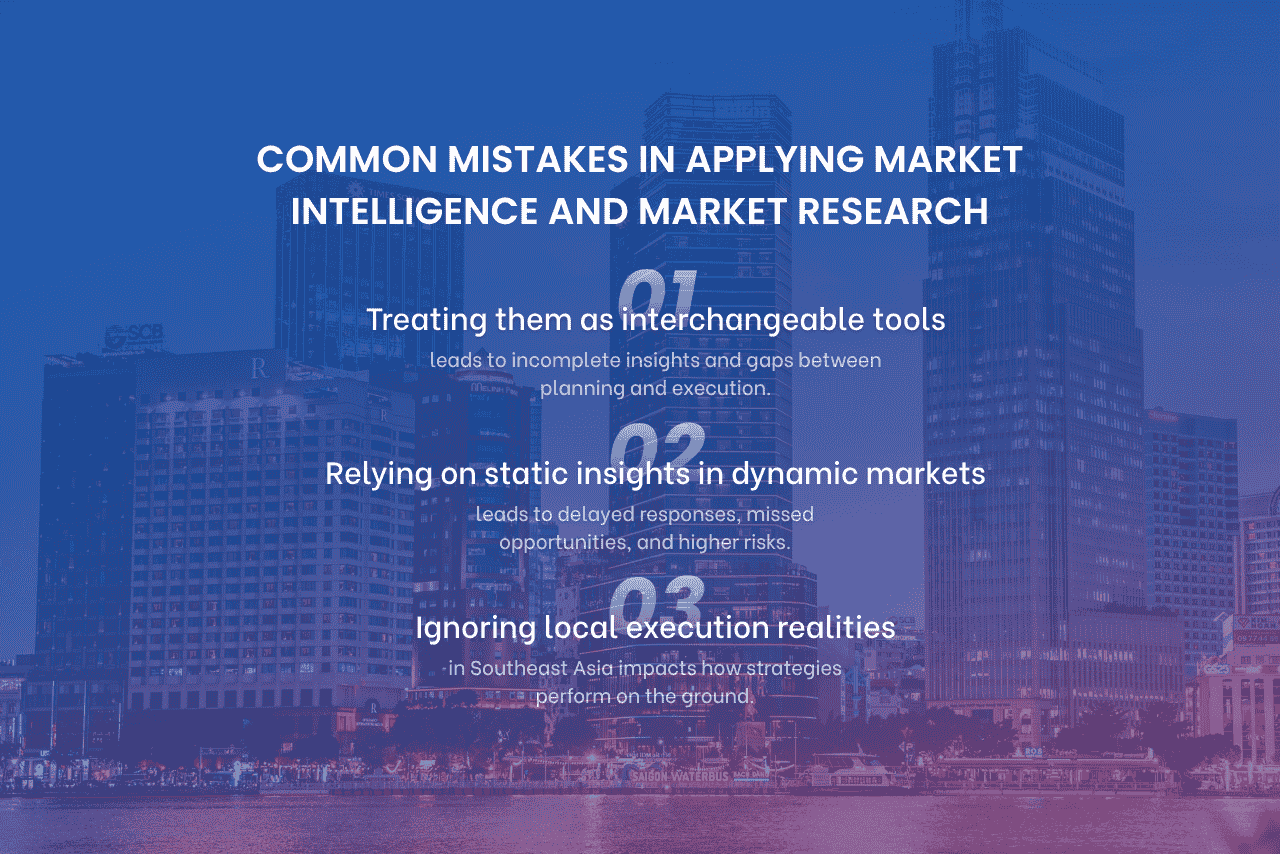
Common mistakes in using market intelligence and market research, leading to weak execution and risk.
Conclusion
To sum up, market intelligence vs market research should not be viewed as competing approaches. They play different but connected roles in market entry decisions. Market research validates demand and feasibility before entry, while market intelligence tracks competitors, regulations, and market changes after entry. Together, they reduce uncertainty and improve decision-making across the full expansion journey.
At Source of Asia, we support companies entering and operating in ASEAN through structured market research, competitor analysis, and on-the-ground market insights. Our experts help businesses turn fragmented information into clear, actionable direction for entry and growth decisions.
| 👉 Planning expansion in ASEAN? We help turn fragmented market information into clear entry decisions, local execution plans, and measurable traction. Set a free call with our expert now! |
Frequently Asked Questions
In some cases, market research is primarily conducted before entering new markets, but it also aids post-entry decisions such as pricing and customer feedback. Market intelligence is particularly useful after market entry while also offering support for pre-entry analysis of competitors, regulations, and market signals.
Their importance depends on the business stage. Research is critical before investment decisions, while intelligence becomes essential during execution and scaling. These approaches can help businesses reduce risk and improve decision quality.
Companies use market research to validate the initial entry plan, then apply market intelligence to monitor the market, track competitors, and adjust strategies for ongoing performance and growth.
Market intelligence is valuable for SMEs as well, not only large corporations. In fact, smaller businesses often benefit even more because they need to allocate limited resources carefully and respond quickly to market changes. By tracking competitors, customer behavior, pricing shifts, and regulatory updates, SMEs can make faster decisions, reduce risk, and identify growth opportunities without relying on large internal teams or expensive expansion mistakes.