Introduction
Global sourcing has shifted from a cost-cutting option to a core supply chain decision for many US companies. Tariff changes, supplier concentration risk, and post-pandemic disruptions have pushed procurement leaders to rethink where and how they source.
ASEAN has become one of the most active destinations in this shift, with Vietnam, Thailand, Indonesia, and Cambodia offering strong manufacturing capacity across multiple industries.
However, global sourcing in ASEAN is not simply about finding cheaper suppliers. It also requires a clear operating model, compliance management, and on-the-ground alignment. In this guide, we – Source of Asia, explain what global sourcing means in practice and what US companies need to consider before committing.
Key Insights
- Global sourcing is a supply chain strategy built on geographic diversification, not just cost reduction
- Strategic sourcing provides the methodology that makes global sourcing more structured and repeatable
- ASEAN offers a practical sourcing base for US companies, with each market serving different industries and production needs
- Execution requires compliance planning, supplier governance, and on-the-ground alignment
- Sourcing and market entry often work best in parallel, with sourcing serving as the first operational step into ASEAN
What Is Global Sourcing?
Global sourcing is a term many companies use, but few define clearly. What it means, how it differs from strategic sourcing, and why US companies rely on it are worth covering before moving into how it works.
Global sourcing definition
Global sourcing means purchasing goods, materials, or services from suppliers outside your home country. Unlike simple international purchasing, global sourcing is typically structured across multiple countries to balance cost, capability, and risk. Therefore, companies use it to access better prices, broader capabilities, or production capacity unavailable locally.
The core difference from domestic sourcing comes down to geography and complexity:
- Domestic sourcing is faster to manage, but limits supplier options and cost structure
- Global sourcing expands both, but adds logistics, compliance, and coordination that require deliberate planning
For US companies, global sourcing often serves as the first operational step into a new region, allowing them to test markets and build supplier relationships before committing a larger investment.
Global Sourcing Definition: What It Means for US Companies
Global sourcing vs strategic sourcing
Strategic sourcing and Global sourcing are two terms that often appear together, but they describe different things.
Strategic sourcing is a methodology focused on how a company evaluates, selects, and manages suppliers. The goals are to reduce total cost, improve quality, and lower supply chain risk.
Global sourcing describes where a company sources. It is the geographic expansion of your supply base beyond domestic borders.
In practice, the strongest sourcing programs treat global sourcing as the scope and strategic sourcing as the method.
Why US companies use global sourcing
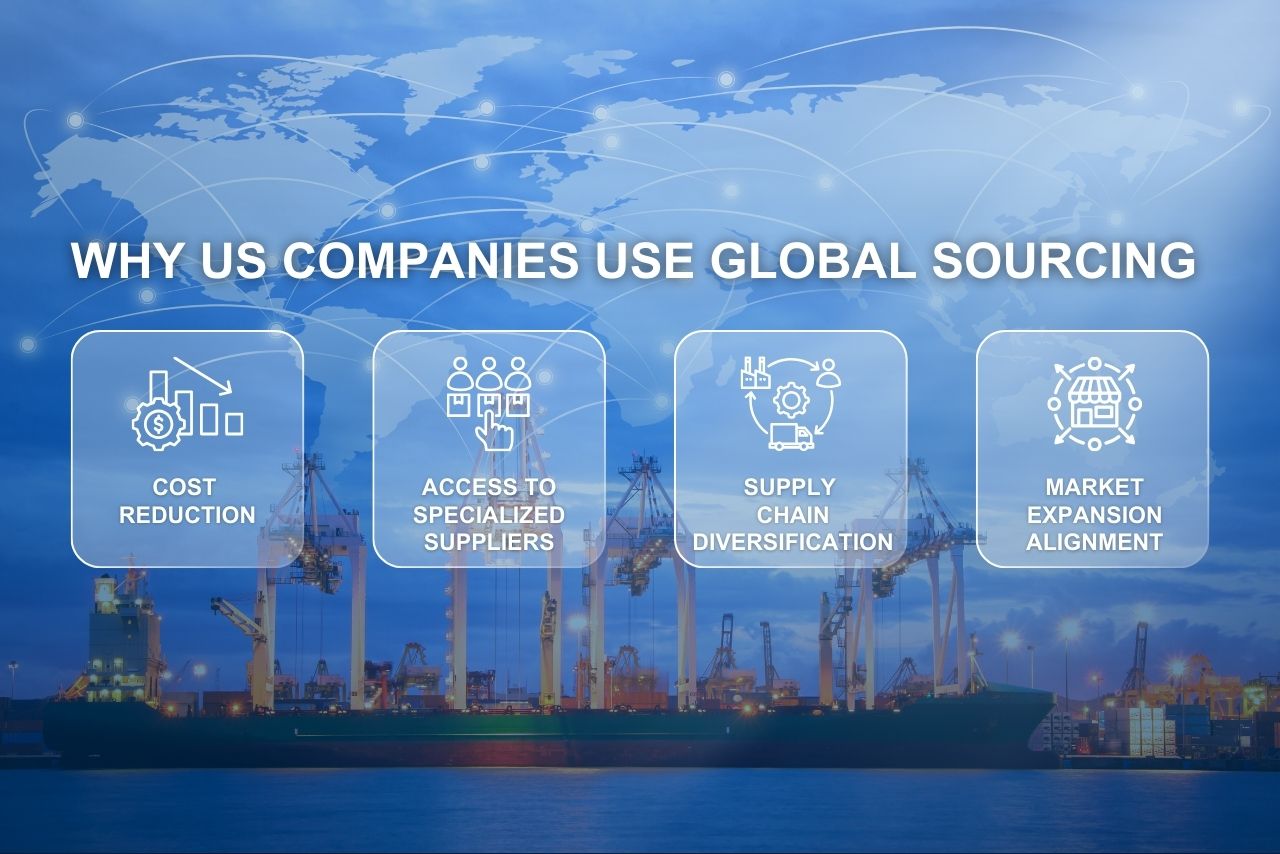
US companies pursue global sourcing for several reasons. Cost is the most visible driver, but rarely the only one.
- Cost reduction remains the primary entry point, as labor costs in ASEAN are significantly lower than in the US.
- Access to specialized suppliers is the second driver. For example, Vietnam leads in electronics assembly and textiles, while Thailand dominates automotive components.
- Supply chain diversification has grown in priority since 2020, as over-reliance on single markets proved risky during trade tensions and pandemic disruptions.
- Market expansion alignment is the fourth reason. Sourcing activity in a new region builds local knowledge and operational credibility that supports broader market entry later.
Why US Companies Use Global Sourcing
How The Global Sourcing Operating Model Works
Global sourcing is not a one-time procurement decision. It follows a structured operating model that covers supplier identification, contract management, and ongoing governance. Each stage carries distinct risks and requires deliberate execution.
Supplier identification and evaluation
Finding the right supplier starts with mapping, not browsing. Companies first build a picture of available suppliers across target countries, then apply structured evaluation before committing.
Supplier mapping identifies vendors by country, capability, and capacity, often revealing differences in quality standards, minimum order volumes, and production flexibility.
Due diligence typically covers:
- Financial stability and production capacity
- Quality certifications and compliance history
- Factory audits, either remote or on-site
Sourcing agents reduce early evaluation risk through local networks and market knowledge. However, agent selection requires the same diligence as supplier selection, since misaligned incentives can introduce risk rather than reduce it.
Contracting and compliance management
Once suppliers are selected, the focus shifts to structuring agreements and managing regulatory requirements. This stage is where many companies underestimate complexity.
Negotiation framework should cover more than price. Key terms include payment conditions, lead times, IP protection, and dispute resolution.
Regulatory and customs considerations vary by country and product. Tariff classifications and rules of origin under agreements like CPTPP directly affect landed costs. Companies that overlook these early often face unexpected cost increases after contracts are signed.
ESG checks are increasingly required by US buyers and regulators, covering labor practices, environmental compliance, and supply chain transparency.
Ongoing supplier governance
Signing a contract does not end the sourcing process. Consistent governance is what separates stable supply chains from fragile ones. Key considerations include:
- Quality control should be built into operations through pre-shipment inspections, in-line production checks, and clear defect standards agreed before orders begin.
- Performance monitoring tracks reliability using metrics such as on-time delivery rate, defect rates, and cost stability across order cycles.
- Risk management involves identifying single points of failure and building contingency plans before disruptions occur.
- Dual sourcing addresses concentration risk by qualifying two suppliers for the same product, improving resilience while maintaining negotiating leverage over time.
Global Sourcing Vs China+1 Strategy
China+1 was the turning point that made global sourcing a strategic priority. The shift did not happen by choice alone — structural pressures made it necessary, and ASEAN emerged as the most practical response.
Why China+1 triggered global sourcing
China+1 was not a sudden decision. It was a gradual shift in how US companies think about risk. Over time, rising labor costs reduced China’s cost advantage, while trade tensions made tariffs unpredictable. Then the pandemic exposed how fragile single-country sourcing could be.
But the cost and tariffs were only part of the story. Investors, boards, and compliance teams began asking tougher questions about supply chain concentration and resilience. China+1 became less about leaving China and more about avoiding overdependence. For many US companies, ASEAN emerged as the most practical way to build that balance.
ASEAN as a global sourcing destination
ASEAN has grown into one of the most active global sourcing destinations in recent years. Each market offers a different profile, so the right fit depends on product type and supply chain structure.
According to Vietnam Briefing, manufacturing value added in Vietnam grew 9.97% in 2025, the highest rate recorded in the 2019–2025 period, confirming Vietnam is one of the first choices for many US companies with the following reasons:
- Strong capacity in electronics, textiles, and furniture
- Competitive labor costs with improving technical skills
- Solid trade access through CPTPP and other agreements
Thailand and Indonesia suit more complex production needs:
- Thailand leads in automotive parts and industrial machinery
- Indonesia offers scale in consumer goods and industrial products
Cambodia competes primarily on cost:
- Wages among the lowest in ASEAN
- Viable for garments, footwear, and simple assembly
- Supplier depth and infrastructure are still developing
Pros And Cons Of Global Sourcing For US Companies
Global sourcing creates real opportunities but also introduces risks that are easy to underestimate. Understanding both sides helps US companies plan with more accuracy and fewer surprises.
Benefits of global sourcing
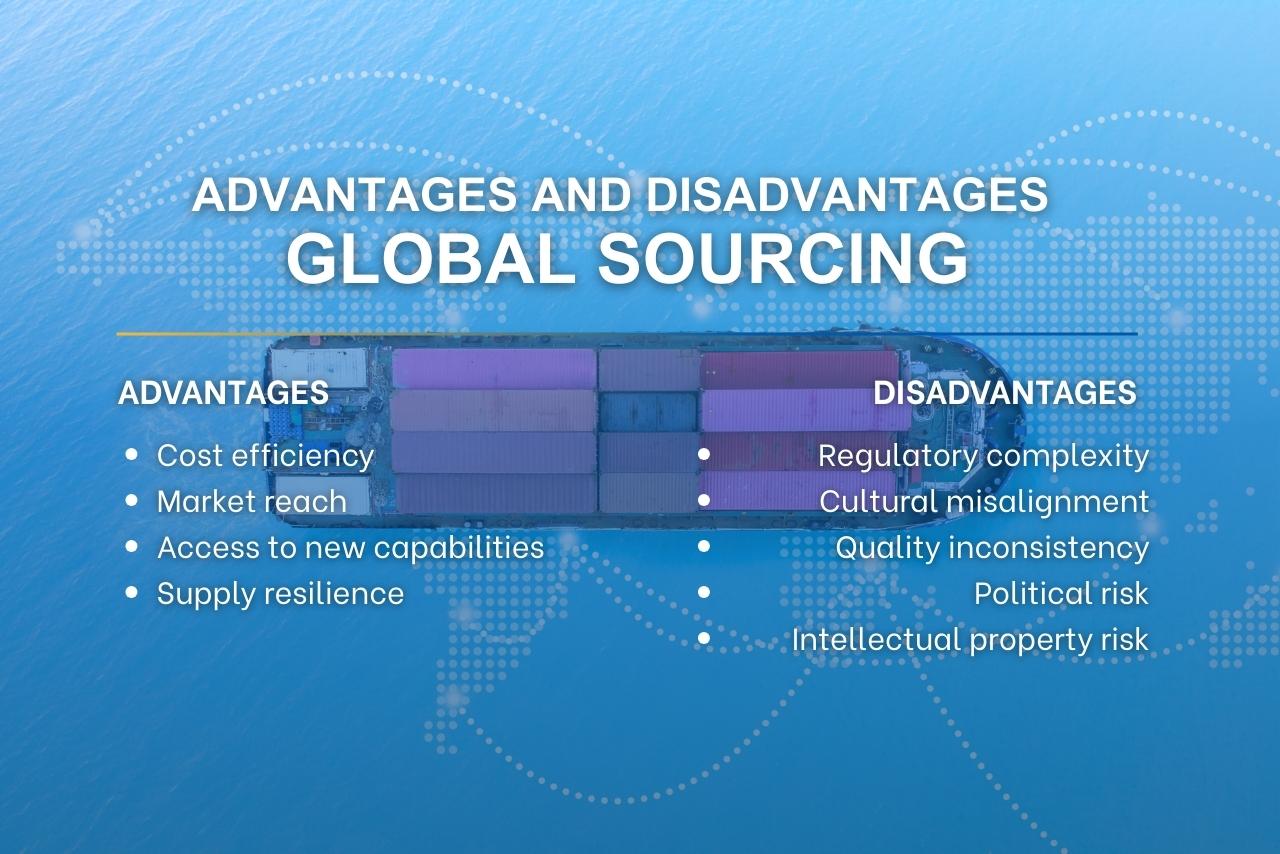
When executed with a clear model, global sourcing delivers four core advantages for US companies:
- Cost efficiency: Labor and production costs in ASEAN are significantly lower than in the US, directly improving margins for labor-intensive production
- Market reach: Sourcing activity in Vietnam, Thailand, or Indonesia builds regional presence that supports future market entry
- Access to new capabilities: Certain manufacturing skills are more developed in ASEAN, giving companies access to expertise that would be costly to build at home
- Supply resilience: A diversified supplier base reduces the impact of disruptions in any single market
Risks and limitations
Global sourcing adds complexity that domestic procurement does not have. These risks are manageable, but they require early attention:
- Regulatory complexity: Import rules and licensing requirements differ by country. Overlooking these early often leads to delays and unexpected costs
- Cultural misalignment: Different expectations around timelines and quality feedback can create friction that slows progress and damages supplier relationships
- Quality inconsistency: Without regular audits and clear standards, quality levels can vary between orders and become hard to manage remotely
- Political risk: Trade policy shifts or regulatory changes can affect supply chains quickly, and companies without contingency plans are most exposed
- Intellectual property risk: Operating across borders increases the risk of IP leakage, and weak protection may result in the loss of proprietary assets.
Hidden costs in global sourcing
Many companies underestimate total sourcing costs because early projections focus on unit prices alone. Several additional costs accumulate over time:
- Logistics volatility: Freight rates and shipping conditions change frequently, making cost projections harder to maintain
- Tariff fluctuations: Trade policy changes can alter landed cost with little warning, requiring regular tariff reviews
- Coordination overhead: Managing suppliers across multiple countries requires dedicated resources for time zones, language gaps, and quality checks
- Compliance expenses: Factory audits, ESG reporting, and customs documentation all add cost as programs scale
Advantages And Disadvantages Of Global Sourcing Us
When Global Sourcing Works In ASEAN
Global sourcing in ASEAN does not fit every company equally. Industry type, company profile, and internal readiness all shape whether a sourcing program succeeds or stalls early.
Industry fit
ASEAN has built strong manufacturing capacity across several industries, but depth and quality vary by market and product type.
| Industry | Key Markets | Strengths |
| Manufacturing | Thailand, Indonesia | Consumer goods, industrial equipment |
| Electronics | Vietnam | Assembly, PCB, components |
| Textiles | Vietnam, Cambodia, Indonesia | Garments, apparel, fabrics |
| Industrial components | Thailand | Precision parts, automotive, machinery |
The right market depends on what you produce. Vietnam suits high-volume assembly and textiles, Thailand fits more technical production needs, and Indonesia offers scale across general manufacturing.
Company profile fit
Three types of companies tend to get the most value from global sourcing in ASEAN.
Mid-size exporters benefit most directly. Cost reduction improves their competitiveness, and their order volumes are large enough to attract reliable suppliers while remaining flexible enough to test and adjust.
Industrial manufacturers use ASEAN to diversify away from China, particularly for components and materials where single-country dependence has become a risk.
Companies scaling into Asia often treat sourcing as the first operational step into the region. Supplier relationships built early create local knowledge and contacts that support broader market entry later.
Preconditions for success
Global sourcing in ASEAN works best when certain conditions are in place before the first order is placed:
- Clear sourcing strategy: Define what you need, at what volume, quality standard, and price point. Without this, supplier selection becomes inconsistent
- On-the-ground validation: Factory visits and in-person meetings reveal information that remote research cannot replace
- Strong local partner or sourcing agent: Reduces supplier risk, speeds up evaluation, and helps navigate regulatory and cultural differences
- Structured entry plan: A clear timeline and governance model keeps decisions focused and prevents costly corrections later
Global sourcing & direct market entry: How the two relate
Many US companies start with sourcing and expanding from there. Understanding how the two related helps clarify which path fits your current stage and long-term goals.
Sourcing without entity setup
Many US companies begin sourcing from ASEAN without setting up a legal entity. This approach keeps early risk low and allows market testing before a larger commitment.
Two models are common at this stage:
- Import/export model: Products are sourced directly from ASEAN suppliers and imported into the US. No local presence is required, and the company operates entirely through contracts and logistics partners
- Distributor partnerships: A local distributor handles purchasing, compliance, and delivery on your behalf. This reduces coordination effort but limits visibility into supplier quality and pricing
When sourcing evolves into market expansion
As sourcing programs grow, some companies find it practical to deepen their local presence. This transition usually happens in stages.
- Local warehouse: The first step for many companies. A warehouse reduces lead times, improves stock availability, and signals a longer-term commitment to local partners
- Subsidiary formation: A fully owned legal entity allows direct hiring, local contracts, and greater operational control. It suits companies with stable, growing activity that justifies the added structure
- Joint venture: Some companies partner with a local firm to share market knowledge, regulatory access, and operational risk. This works well in markets where local relationships and licenses matter significantly
Why US companies often combine both
In practice, many US companies run sourcing and market entry in parallel rather than treating them as separate decisions.
Starting with sourcing allows companies to build early market knowledge before committing to a full local presence. Each phase builds the previous one, which is the core logic behind a phased ASEAN entry approach.
Running both in parallel also improves risk mitigation. Sourcing generates revenue and market insight while market entry builds local structure, reducing dependence on a single strategy.
Over time, this combination leads to stronger long-term positioning, deeper supplier relationships, and a more stable regional foundation.
Final Thoughts
Global sourcing is a supply chain decision that shapes supplier relationships, compliance, and long-term positioning in ASEAN. Success comes down to preparation, local knowledge, and execution discipline.
At Source of Asia, we support companies across the full sourcing cycle, from supplier identification and qualification to compliance management and ongoing governance. Our experts work on the ground across Southeast Asia and South Korea, helping companies build sourcing programs that are structured and built for long-term reliability.
To deepen your preparation, you may also find these insights useful:
- Explore more of ours sourcing services in ASEAN.
- Or contact us to discuss your specific market challenges.
Frequently Asked Questions
Global sourcing refers to selecting and purchasing from suppliers located in different countries. The company retains control over product design, specifications, and supplier management, even if production happens abroad.
Outsourcing, by contrast, means transferring a specific business function or production of responsibility to an external party. In outsourcing, the external partner may take operational control over certain processes, not just supplying goods.
No. Cost is often the starting point, but companies also use it to access specialized suppliers, diversify supply chain risk, and build regional presence in markets like ASEAN.
Not always, but agents add real value for first-time entrants. They bring local supplier networks and market knowledge that reduce early risk. Selecting agents carefully is essential, as misaligned incentives can create problems rather than solve them.
Sourcing builds local knowledge and supplier relationships before a company commits full market entry. For many US companies, it serves as the first operational step into ASEAN and creates a foundation for broader expansion later.