Introduction
Selling in ASEAN looks like a strong opportunity on paper. But in reality, many companies struggle to turn that potential into actual sales. A common mistake is treating ASEAN as one single market, applying the same approach everywhere, or entering without a clear market entry strategy. As a result, they struggle with slow traction, weak pipelines, and limited scalability.
Accessing decision-makers is also complex. In most ASEAN markets, business is relationship-driven, requiring local partners, networks, and adapted positioning. Without this, outreach efforts rarely convert.
In this guide, we share a practical framework to sell in ASEAN, focusing on market selection, entry models, and early demand validation.
Key Insights
- ASEAN is not a single market; success requires country-specific strategies and localized execution.
- Market selection, entry model, and business development alignment determine long-term scalability.
- Local partners and networks accelerate access to decision-makers and improve conversion rates.
- Early validation of demand, such as pilot meetings, small-scale partnerships, or initial proof-of-concept projects, reduces risk and informs market entry decisions.
- Tailored messaging aligned with operational realities, budget, and decision-making structures strengthen credibility and buyer trust.
Why ASEAN Is a Strategic Market for B2B Expansion
ASEAN offers growing B2B opportunities driven by supply chain diversification, uneven market maturity, and the need for localized positioning, requiring tailored entry strategies for each country to sell in ASEAN effectively.
Supply chain shifts driving ASEAN growth
Supply chain shifts strengthen ASEAN’s role as a production base and create sustained B2B demand. As companies diversify production across multiple countries rather than relying on a single location, ASEAN is chosen for its cost structure, trade access, and regional connectivity. According to OEC, ASEAN exports reached $2.03 trillion in 2024, accounting for 8.88% of global exports, with 6.97% year-on-year growth and a 5-year CAGR of 6.2%, reflecting steady manufacturing expansion.
This diversification creates ongoing production, sourcing, and logistics needs rather than one-time shifts. As a result, supplier ecosystems expand, and procurement demand becomes more consistent, providing a more reliable base for a long-term go-to-market strategy.
| Explore how ASEAN is reshaping global supply chains in our detailed analysis. |
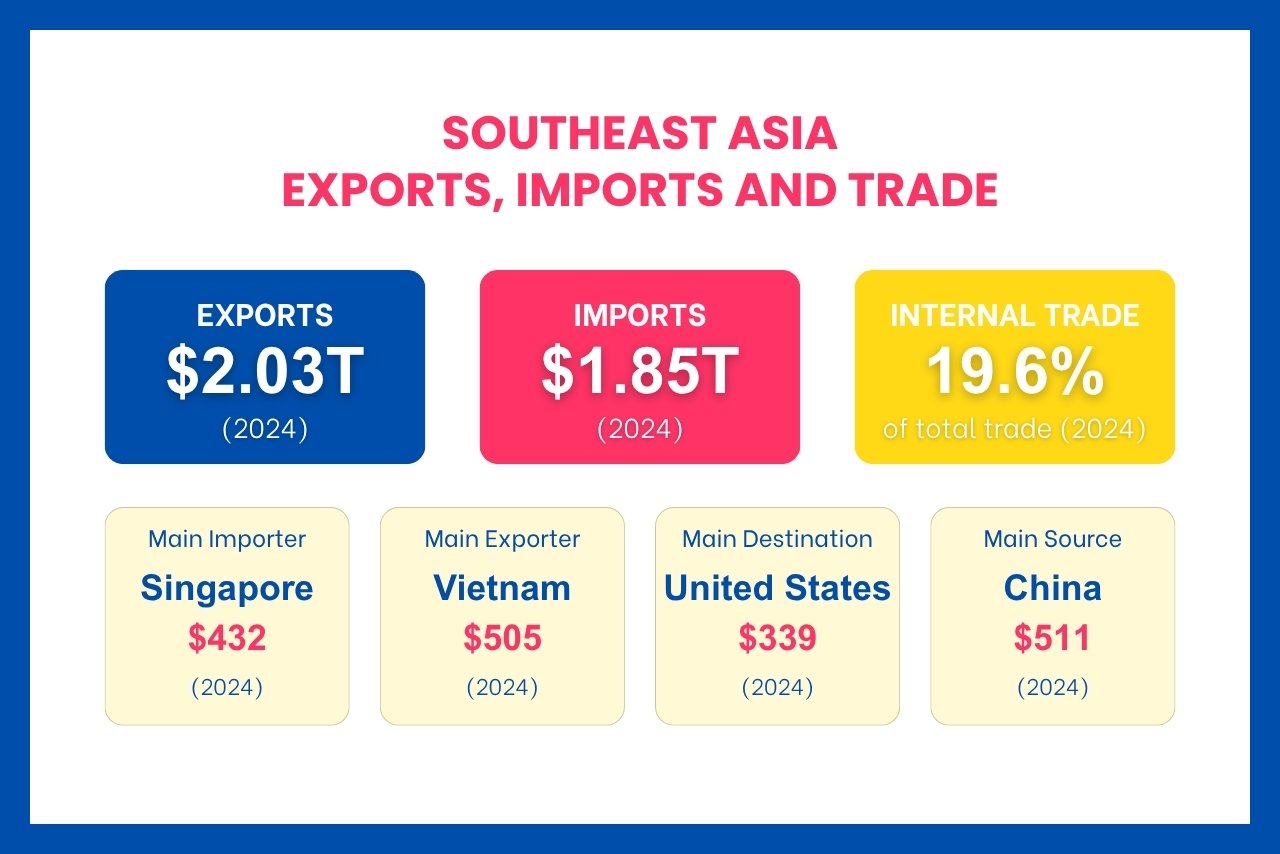
The import and export situation and top trading partners of Southeast Asia in 2024.
Uneven market maturity across ASEAN
Southeast Asia is not a single market, and each country presents unique conditions that directly shape how you enter and sell in ASEAN. Differences in market size, infrastructure, and access to decision-makers mean a one-size-fits-all approach rarely works. For example:
- Singapore offers transparency and straightforward processes, but has a smaller market scale.
- Vietnam and Indonesia provide large markets, yet require deeper local networks and longer sales cycles.
- Thailand and Malaysia fall in between, with sector-specific opportunities and moderate accessibility
To succeed, companies must adapt their expansion plans to each country’s realities rather than apply a uniform approach.
Market-specific positioning determines success
In ASEAN, success depends on how well your offering fits each market. For example, a cloud-based procurement platform performs well in Singapore, where companies are digitally mature, and decision-making is centralized. In contrast, in Indonesia, the same solution requires local support, integration with existing systems, and longer engagement with multiple stakeholders.
To succeed, companies must:
- Understand the industry landscape to target sectors with actual demand
- Adapt to market maturity and operational readiness
- Align with local buyer processes, including procurement cycles and decision-making norms
An effective market entry strategy requires customizing your approach to each country’s conditions rather than applying a standard model. This includes adapting pricing models, implementation support, and communication style to local expectations. Without this level of alignment, companies may enter the market but struggle to sell in ASEAN at scale.
| Choosing between EOR and Legal Entity is a critical part of your market entry strategy. Discover it now! |
How To Select and Enter the Right ASEAN Market
To enter and sell in ASEAN effectively, you need a structured approach that links demand, feasibility, entry model, and expansion sequence, ensuring your market entry approach is both practical and scalable.
Define your commercial use case in ASEAN
To sell in ASEAN, you must clarify the problem your solution addresses and ensure it aligns with real demand in each market. This requires:
- Identifying industries with active demand where your offering can deliver a measurable impact
- Mapping your solution to specific use cases to ensure practical relevance
- Avoiding broad targeting that spreads resources too thin
Thus, defining a clear commercial use case provides direction for your market entry strategy, improves early engagement, and lays the foundation for sustainable B2B growth across diverse ASEAN markets.
Assess market attractiveness and entry feasibility
Entering ASEAN requires careful evaluation of each market to focus on realistic opportunities rather than just size. Consider market size, competition, entry barriers, and access to decision-makers to design a feasible and efficient strategy.
- Demand size: Is there a measurable, ongoing demand for your product or service?
- Competition: Which local or global players are already active, and how strong is their presence?
- Entry barriers: Licensing, regulatory compliance, local incorporation, or infrastructure limitations
- Access: Can you engage the right stakeholders through local networks, partners, or channels?
Choosing markets with clear demand and accessible entry conditions ensure faster traction and reduces execution risk, forming a reliable foundation for a long-term B2B expansion strategy. This assessment is typically conducted through market research, competitor benchmarking, and initial stakeholder interviews.
Choose the appropriate entry model
Selecting the right entry model is a critical step in building an effective go-to-market approach in ASEAN, as it directly impacts speed, cost, and control. In practice, companies typically choose between:
- Direct entry – full control over operations and branding, but requires higher investment and longer setup time
- Partner-led entry – faster market access through local partners, though with reduced control
- Hybrid model – combines direct presence with local partnerships to balance access and oversight
The decision should align with internal resources, risk tolerance, and required level of local access, ensuring execution is both practical and scalable.
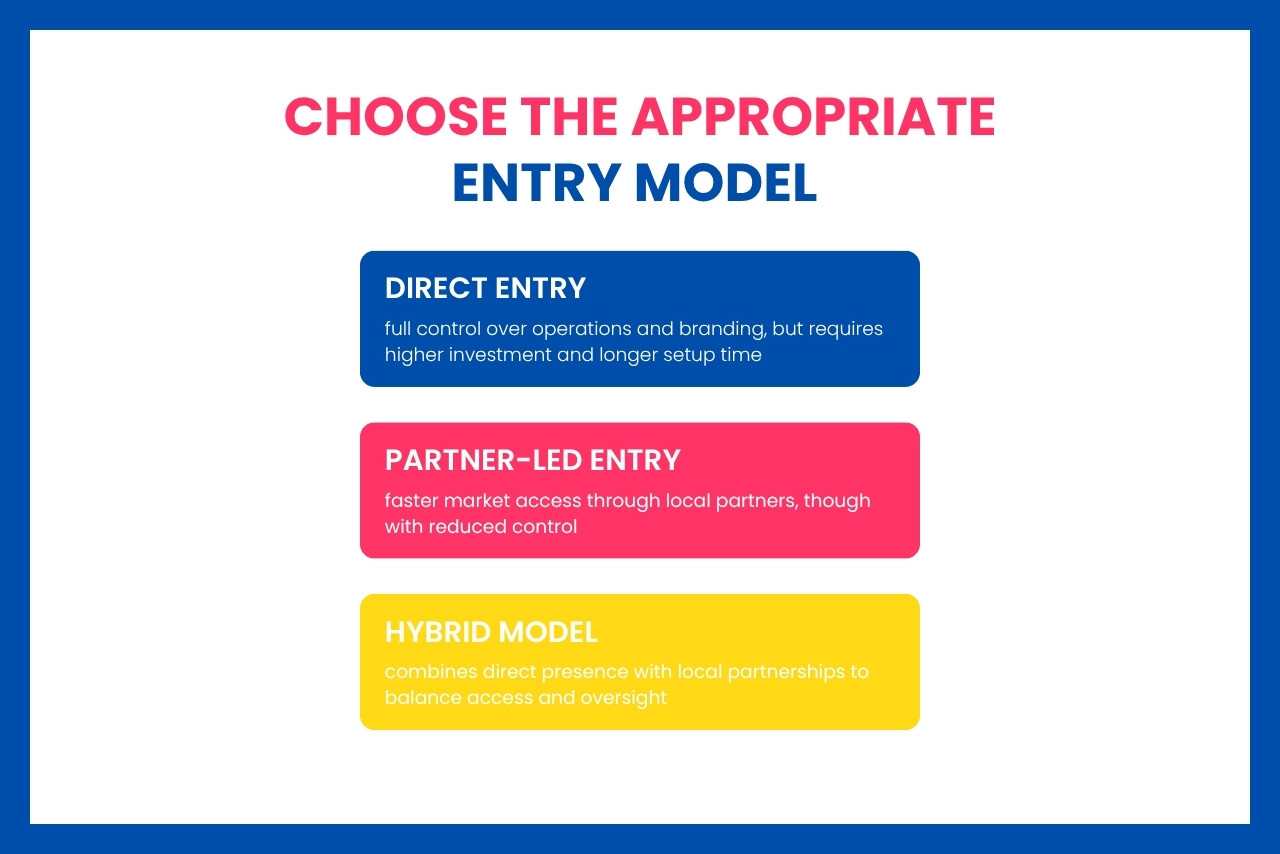
Three common market entry models help businesses optimize resources when entering the ASEAN region.
Sequence market entry based on expansion priorities
A structured expansion path helps reduce risk and improve execution in ASEAN. Instead of entering multiple markets at once, companies often begin with an entry hub, such as Singapore, which offers ease of setup, strong connectivity, and a transparent business environment. This allows you to validate your approach, coordinate regional activities, and build an initial presence.
From there, you can expand into scaling markets like Vietnam or Indonesia, where demand is greater, but execution is more complex. This phased approach supports better learning, controlled investment, and more effective market entry strategy execution.
| To turn our market entry insights into actionable investment strategies, explore how we guide foreign investors to succeed across ASEAN: Invest in ASEAN 2026: What Foreign Investors Should Know to Succeed |
Structuring A Business Development Approach In ASEAN
To build a strong pipeline in ASEAN, companies need a focused approach that aligns target segments, market access, and localized messaging with how buyers operate and make decisions.
Define priority segments and target accounts
Effective B2B selling in ASEAN requires clear focus on the right segments and accounts rather than broad outreach. Given differences across markets, companies should concentrate on industries where demand is already visible and accessible. In practice, this involves:
- Identifying high-potential industries aligned with your solution
- Building a shortlist of target companies with relevant needs
- Prioritizing based on accessibility and fit, not just size
By narrowing your focus, you create a more realistic and actionable pipeline, improve engagement quality, and increase the likelihood of converting early opportunities.
Build access through local channels and networks
In ASEAN, partners, intermediaries, and ecosystem connections play a key role in reaching decision-makers faster. Direct outreach alone often leads to low response rates, as access is largely relationship driven. As a result, companies need to work through established local channels to improve engagement.
This includes collaborating with local partners or advisors, leveraging industry networks, and using existing business ecosystems to gain credibility and introductions. These approaches help shorten the sales cycle and improve conversion, where strong local access often determines whether initial interest turns into real opportunities.
Adapt value proposition to local buying context
To improve engagement in ASEAN, your messaging must reflect local operational realities rather than rely on global positioning. Buyers evaluate solutions based on how well they fit their day-to-day operations, not just on general value claims. This means your approach should align with:
- Local operational challenges that affect how solutions are used
- Budget expectations and price sensitivity in each market
- Decision-making structures, which may involve multiple stakeholders
When messaging is aligned with these factors, it becomes more relevant and credible. Consequently, localization improves both conversion rates and trust, making your market entry strategy more effective.
Validating The Market and Building Initial Traction
Successful ASEAN market entry depends on testing assumptions, building credibility, and creating an initial pipeline before scaling. Companies should take a structured approach to ensure early efforts are both practical and measurable.
1. Test demand through targeted market engagement
Before committing significant resources, engage in a small set of high-potential target accounts to validate actual interest. Run structured outreach campaigns, including direct meetings, emails, or workshops, and carefully measure responses. This helps identify whether your solution addresses real market needs and confirms that your market entry approach is viable. Early testing reduces wasted effort and informs subsequent targeting and messaging.
2. Establish credibility with relevant proof points
In emerging markets, credibility is critical for early-stage conversations. To build this, demonstrate understanding of local context, highlight relevant case studies, and clearly articulate the value your solution brings. Providing evidence reduces perceived risk and positions your company as a trusted partner capable of navigating local complexities.
3. Build a controlled initial pipeline
At the same time, focus on a limited number of opportunities to maintain manageable execution and gather actionable insights. Track conversion rates and refine your approach based on feedback. This iterative process creates a repeatable foundation for scaling, supported by validated demand and proven credibility.
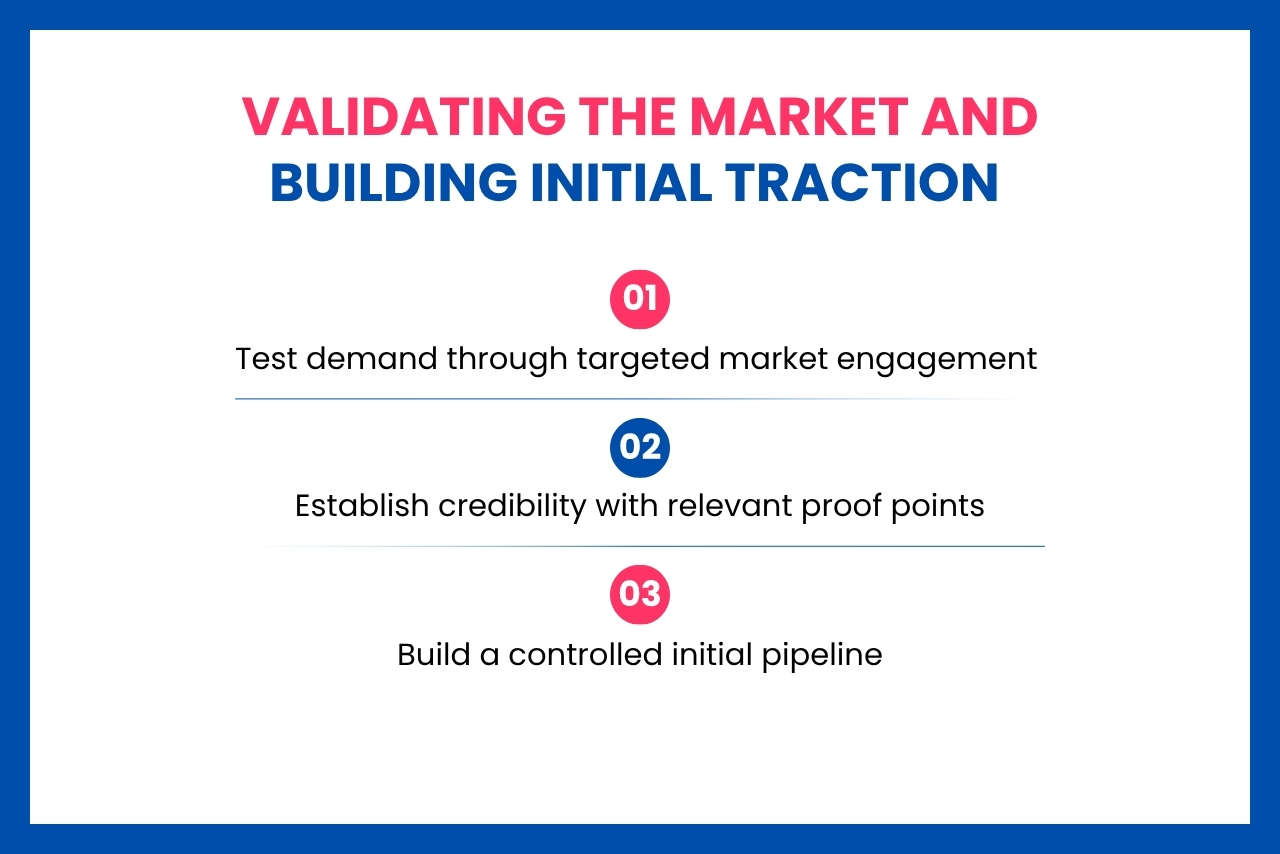
Key steps to market validation and building sustainable growth momentum for a new business.
Common Market Entry Strategy Mistakes In ASEAN
Expanding into ASEAN requires deep local understanding and a structured approach. Companies often underestimate market diversity, resulting in costly delays, wasted resources, and missed opportunities. Drawing on regional experience, these common mistakes are crucial to recognize:
- Treating ASEAN as a single market: Each country has unique regulations, compliance requirements, and operational realities. Ignoring these differences can slow entry and increase costs. A uniform strategy often fails to gain traction, particularly in larger, more complex markets like Indonesia or Vietnam.
- Entering without a clear entry model: Without a defined approach—whether direct, partner-led, or hybrid—companies struggle to identify priority segments and access decision-makers. This lack of structure reduces efficiency and makes early business development unpredictable.
- Over-reliance on outbound outreach without local support: Direct engagement alone rarely works. Local partners and intermediaries are essential for credibility and introductions, especially in markets where relationships dictate access to key stakeholders.
- Scaling before validating demand: Expanding too quickly without confirming product–market fit leads to misallocated resources and slower adoption. In practice, regional experience shows that phased entry with tested demand ensures measurable traction and sustainable growth.
Therefore, avoiding these mistakes requires practical market insight, local networks, and phased execution, enabling companies to enter ASEAN with confidence, reduce risk, and achieve meaningful, long-term results.
| To avoid common entry mistakes by applying a structured approach, you can discover practical insights and use cases in our guide: Market Expansion in ASEAN: Definition, Examples, and Use Cases |
Conclusion
To sum up, success in ASEAN depends on careful market selection, choosing the right entry model, and aligning business development—sales cannot be treated in isolation. Thus, each market requires a structured, localized approach, where early decisions directly influence long-term scalability.
At Source of Asia, we support companies entering and expanding across ASEAN through market assessment, entry strategy, and business development execution. Our team ensures each step is practical, data-driven, and tailored to local market realities, helping you build a scalable and sustainable presence.
| Contact our team to start your market entry strategy in ASEAN with insights, local credibility, and disciplined execution, to enter each market efficiently and confidently. |
Frequently Asked Questions
Start with markets offering clear demand, easier regulatory access, and manageable operational complexity. Prioritize countries where early success is feasible, allowing you to test your strategy, build credibility, and gather insights for scaling across ASEAN efficiently.
Yes. Local partners or intermediaries provide credibility, introductions to decision-makers, and guidance on market norms. They accelerate engagement, reduce risks, and help navigate regulatory, cultural, and operational challenges, which are essential for building a sustainable B2B presence.
Validate demand through targeted outreach to selected accounts, pilot campaigns, and market testing. Monitor engagement, interest, and feedback to confirm market fit, ensuring your investment is guided by practical insights rather than assumptions.