Introduction
Registering a company in Vietnam is only the first step toward operating legally. Once established, businesses must manage tax reporting, accounting records, employment obligations, licenses, and other ongoing requirements.
For foreign investors, these responsibilities can be especially challenging. These obligations should be assessed as part of a broader Vietnam market entry strategy, alongside the company’s business model and local operating requirements. Local regulations may differ from those in the company’s home country, while reporting requirements depend on business activities, investment structure, and workforce size.
A well-organized business compliance checklist helps new companies identify their obligations, assign responsibilities, and avoid missing important procedures. Business support providers such as Source of Asia (SOA) can also assist with incorporation, accounting, payroll, and local administration.
This guide outlines the key compliance areas that businesses should review when establishing and operating a company in Vietnam.
Quick Answer:
What Compliance Requirements Apply to New Companies in Vietnam?
A business compliance checklist for new companies in Vietnam should cover seven essential areas:
- Company registration and licensing: Confirm enterprise information, investment requirements, and any sector-specific permits.
- Tax registration and reporting: Establish the appropriate tax filing procedures and payment processes.
- Accounting and financial records: Maintain accurate transactions, supporting documents, and financial statements.
- Employment and payroll: Prepare employment contracts, manage payroll, and meet applicable insurance obligations.
- Corporate governance: Maintain company records, ownership information, and required approvals.
- Data protection: Review the handling of employee, customer, and other personal data.
- Ongoing compliance monitoring: Track reporting obligations, changes in regulations, and internal compliance responsibilities.
However, not every requirement applies to every company. The precise obligations depend on the legal structure, industry, workforce, and whether the business has foreign investment.
Why Business Compliance Matters for New Companies in Vietnam
Business compliance refers to meeting the legal, tax, financial, and administrative requirements that apply to an organization.
In Vietnam, these responsibilities extend beyond obtaining an Enterprise Registration Certificate (ERC). For example, companies may need additional licenses, tax reporting systems, employment procedures, and internal recordkeeping before or during operations.
Failing to manage these requirements can create several risks, including administrative penalties, delayed business activities, incorrect tax filings, and difficulties during regulatory inspections.
Moreover, compliance problems may affect daily operations. Inaccurate corporate information can complicate banking arrangements, while incomplete payroll records may create issues during employee or insurance reviews.
Therefore, companies should treat compliance as an ongoing management responsibility rather than a one-time registration task.
A structured business compliance checklist provides a practical starting point for assigning tasks and monitoring progress.
Business Compliance Checklist: What New Companies Must Review in Vietnam
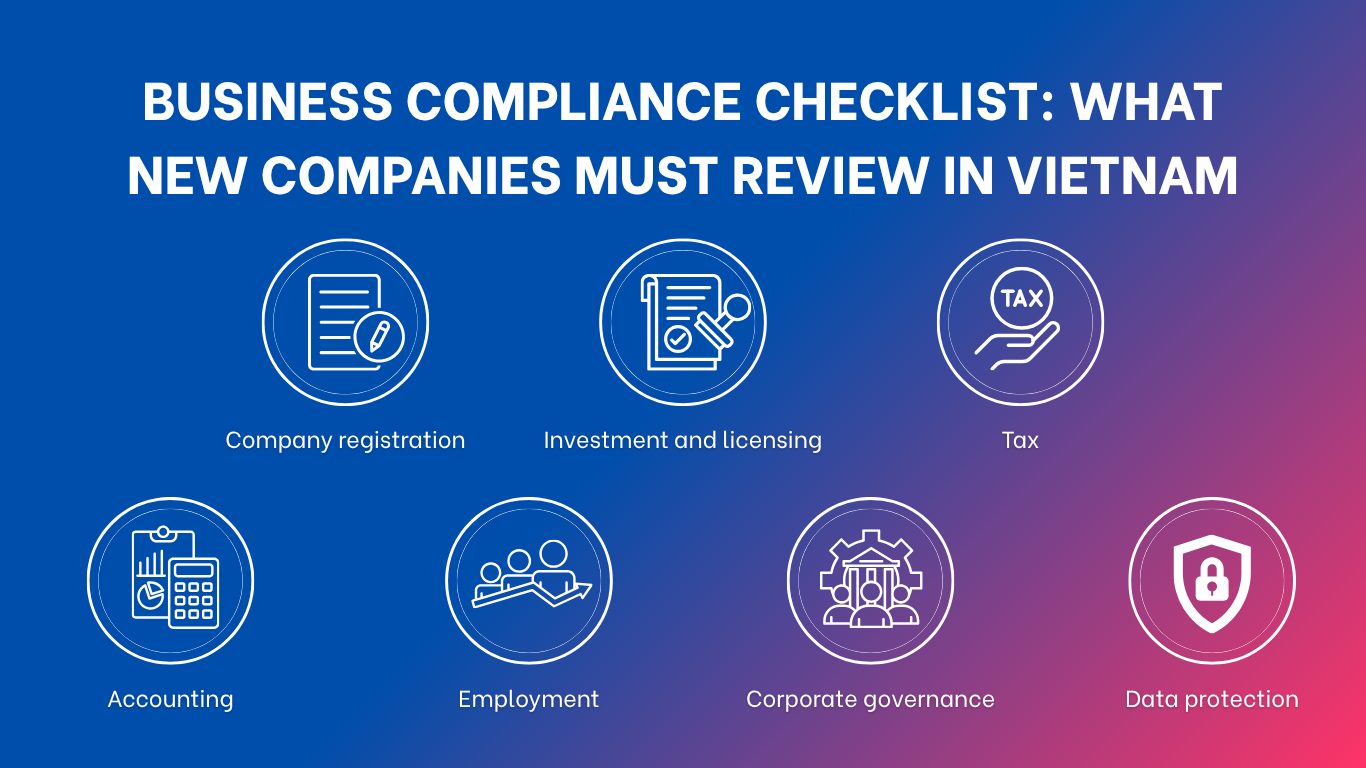
Seven essential compliance areas new companies should review when establishing and operating a business in Vietnam.
The following checklist covers the main areas that new companies should assess.
| Compliance area | Key actions | When to review |
| Company registration | Verify registered information and ownership records | At incorporation and after changes |
| Investment and licensing | Check applicable investment and operating conditions | Before starting regulated activities |
| Tax | Establish tax reporting and payment procedures | At setup and throughout operations |
| Accounting | Maintain records and prepare financial reports | Ongoing and at reporting periods |
| Employment | Prepare contracts, payroll, and insurance arrangements | Before and during employment |
| Corporate governance | Update internal registers and company documents | Ongoing and when changes occur |
| Data protection | Review personal data handling and required safeguards | Before and during relevant processing |
This table is a general compliance framework. Companies should adapt it to the obligations that apply to their specific activities.
Company Registration and Corporate Information
The first step in a business compliance checklist is verifying the company’s registered information.
New businesses should confirm that their company name, registered address, legal representative, business activities, and ownership structure match their official records. In addition, companies should maintain the corporate documents needed to support their operations and future changes. Vietnam’s Law No. 76/2025/QH15, effective July 1, 2025, amended several provisions of the Enterprise Law. Meanwhile, Decree No. 168/2025/ND-CP sets out enterprise registration procedures and requirements relating to beneficial ownership information.
For example, the decree includes criteria for identifying individuals who directly or indirectly own at least 25% of charter capital or voting shares, as well as certain individuals who exercise control over key corporate decisions.
Companies should review which beneficial ownership disclosure and recordkeeping obligations apply to their structure.
Checklist:
- Verify the Enterprise Registration Certificate and company information.
- Review shareholder, member, and beneficial ownership records.
- Maintain the company charter and relevant corporate decisions.
- Confirm legal representative information and authorized signatories.
- Review changes that may require registration or notification.
Importantly, companies should assess relevant changes before implementing them, rather than waiting until the next annual compliance review.
Investment Registration and Business Licensing
Foreign-invested companies may have additional compliance obligations arising from their investment structure and activities. Vietnam’s Law on Investment No. 143/2025/QH15 took effect on March 1, 2026, with certain provisions on conditional business activities taking effect on July 1, 2026. The law allows foreign investors to establish an economic organization before completing certain investment registration procedures, provided applicable market-access conditions are met.
However, companies must still determine which investment procedures and approvals apply to their specific projects. Some sectors also have operating conditions beyond general enterprise registration. For example, certain activities in healthcare, education, food production, retail, and logistics may require additional permits or technical standards. As a result, businesses should not assume that obtaining an ERC alone authorizes every proposed activity.
Checklist:
- Confirm whether investment registration procedures apply.
- Review foreign investor market-access conditions.
- Check sector-specific business licenses and permits.
- Monitor license validity and renewal requirements.
- Review any operating conditions tied to a particular activity.
- Assess whether changes to a project require updated approvals.
For foreign businesses, this part of a legal compliance checklist in Vietnam is particularly important before committing to premises, equipment, or commercial contracts. For a broader overview of entry structures, licensing, and operational risks, see our practical guide to expanding a business in Vietnam.
Tax Registration, Filing, and Electronic Invoices
Tax compliance is one of the most important ongoing responsibilities for newly established companies.
Vietnam’s Law on Tax Administration No. 108/2025/QH15 took effect on July 1, 2026. Its implementing framework includes Decree No. 252/2026/ND-CP, which provides rules for tax administration. Companies should determine their applicable tax obligations, filing periods, payment procedures, and required supporting records. Depending on their activities, relevant taxes may include corporate income tax (CIT), value-added tax (VAT), personal income tax (PIT), and other sector- or transaction-specific taxes. Companies assessing their overall tax exposure should also review Vietnam’s tax incentives and eligibility conditions.
In addition, electronic invoices require attention. Decree No. 254/2026/ND-CP, effective July 1, 2026, provides rules on electronic invoices and electronic documents under the current Tax Administration Law. Therefore, companies should confirm their electronic invoicing requirements and ensure that their accounting and invoicing systems support the applicable procedures.
Checklist:
- Confirm the company’s tax identification information.
- Identify relevant taxes and filing obligations.
- Determine applicable declaration and payment schedules.
- Establish electronic invoicing arrangements where required.
- Retain invoices and supporting transaction records.
- Assign responsibility for reviewing and submitting tax filings.
A useful business compliance checklist should also identify who prepares, reviews, approves, and submits tax information.
This reduces the risk of missed filings or inconsistent reporting between the finance team and external service providers.
Accounting Records and Financial Reporting
Accurate accounting records support both compliance and business decision-making. New companies must establish suitable processes for recording income, expenses, assets, liabilities, and other financial transactions. These records should follow the accounting framework applicable to the business. Moreover, the company must retain supporting documents and prepare financial reports as required. Foreign-owned businesses may also need to align local reporting with the financial processes of their headquarters.
However, management reporting and statutory accounting serve different purposes. A report prepared for the parent company does not automatically replace the records required under Vietnamese rules.
Checklist:
- Establish an appropriate accounting system.
- Identify the applicable accounting and reporting framework.
- Maintain invoices, contracts, and supporting documents.
- Reconcile bank accounts and accounting records.
- Prepare statutory financial statements and tax-related reports.
- Confirm whether an independent audit is required.
Companies should also check whether their ownership structure or investment status triggers specific audit or reporting requirements. For example, foreign-invested enterprises may be subject to statutory financial statement audit requirements under applicable rules. As a result, audit planning should begin before the financial year closes, rather than after reporting deadlines approach.
Employment Contracts, Payroll, and Social Insurance
Hiring employees creates additional responsibilities for companies operating in Vietnam. Employers should establish clear employment procedures covering contracts, working hours, salaries, leave, payroll, and mandatory insurance. The employment framework is governed by Vietnam’s Labor Code and related implementing regulations. The consolidated Labor Code published in 2026 provides an official reference for reviewing relevant employment provisions.
Meanwhile, Law on Social Insurance No. 41/2024/QH15, effective July 1, 2025, governs compulsory social insurance and other relevant matters within its scope. Companies must determine which employees fall within applicable insurance schemes, the correct contribution bases, and the related reporting procedures.
Checklist:
- Prepare employment contracts that meet applicable requirements.
- Establish payroll calculation and payment procedures.
- Review working hours, overtime, holidays, and leave policies.
- Register eligible employees for required insurance schemes.
- Manage personal income tax withholding and reporting.
- Maintain employee records and required internal policies.
- Check work permits and immigration requirements for foreign employees.
In addition, businesses employing foreign workers should review whether work permits, exemptions, visas, or residence documents are necessary. Companies planning to hire before establishing their own local entity should also understand how Employer of Record services work in Vietnam.
For companies hiring their first local team, a small business compliance checklist can help ensure that employment administration is in place before payroll begins. For practical guidance on recruitment, employment models, and local HR requirements, see our guide to building a local team in Vietnam.
Corporate Governance and Internal Recordkeeping
Corporate governance is another key part of a business compliance checklist, particularly for companies with several shareholders or overseas parent entities. Businesses should maintain records of ownership, management appointments, corporate decisions, and authorized representatives.
Furthermore, major changes to the company’s structure or registered information may trigger filing or notification requirements. Examples include changes to the legal representative, company address, charter capital, or registered business activities.
The required procedures depend on the nature of the change and the applicable enterprise and investment rules.
Checklist:
- Maintain up-to-date company registers and corporate documents.
- Record relevant shareholder or member decisions.
- Review the powers of legal representatives and authorized signatories.
- Track changes to registered company information.
- Maintain records of major corporate approvals.
- Check whether specific changes require authority filings.
For international businesses, it is also useful to define responsibilities between headquarters and the Vietnamese entity.
This helps ensure that corporate decisions are documented locally when required.
Personal Data Protection and Information Management
Data protection should not be overlooked during company setup. Even small businesses may process personal information relating to employees, clients, suppliers, or job applicants. Vietnam’s Law on Personal Data Protection No. 91/2025/QH15 took effect on January 1, 2026.
In addition, Decree No. 356/2025/ND-CP provides implementing rules under the law. As a result, companies should review how they collect, use, store, share, and protect personal data.
The exact obligations depend on the company’s processing activities, data categories, and applicable requirements. Businesses should also assess any special rules concerning cross-border data transfers.
Checklist:
- Identify the personal data the company processes.
- Define relevant data processing purposes and responsibilities.
- Review privacy notices and other applicable legal requirements.
- Implement appropriate access and security controls.
- Check data retention and deletion procedures.
- Assess obligations relating to cross-border data transfers and relevant filings.
For foreign businesses using group-wide HR, CRM, or cloud systems, data protection should be reviewed before local personal information is transferred or shared.
How to Conduct a Legal Compliance Audit for a New Company in Vietnam
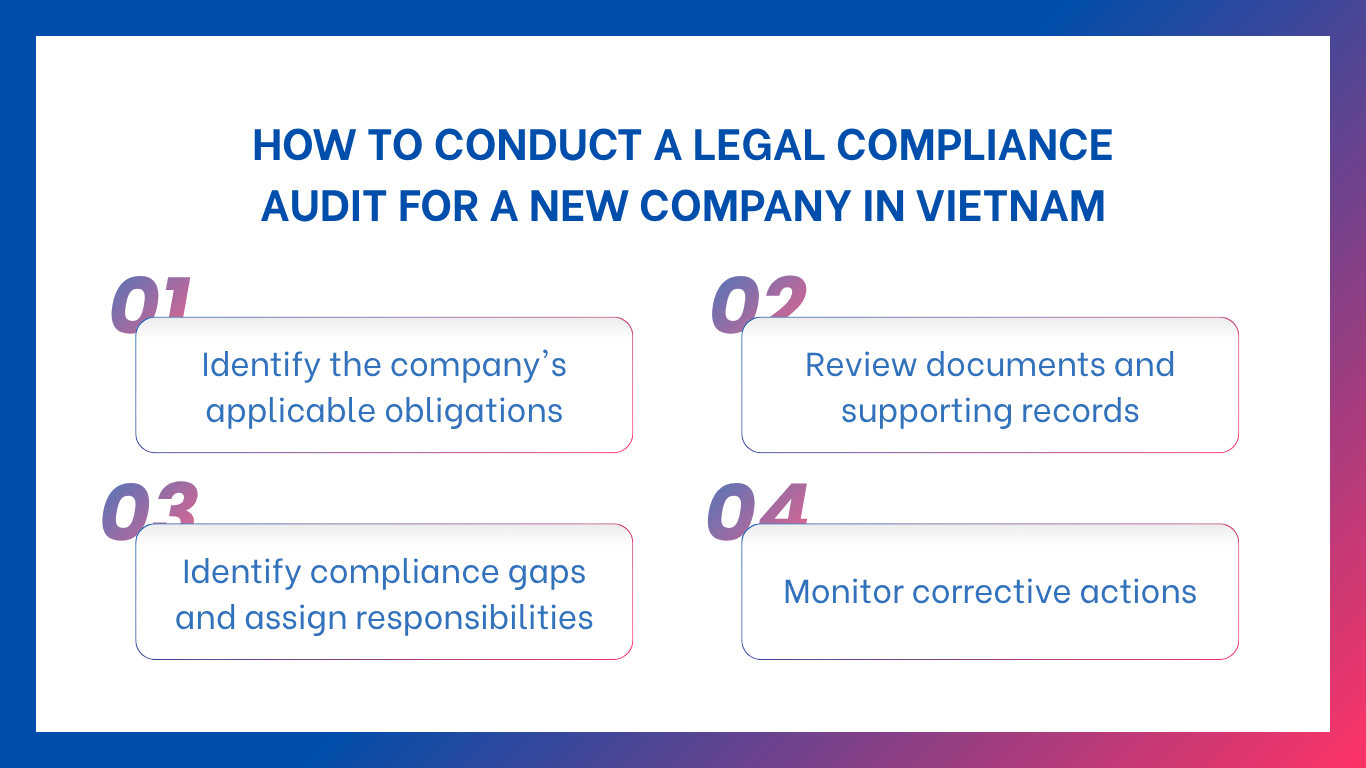
Infographic showing four steps to conduct a legal compliance audit in Vietnam, from identifying obligations to monitoring corrective actions.
A legal compliance audit checklist in Vietnam helps businesses assess whether their current procedures match applicable legal and administrative requirements. Unlike a general checklist, an internal compliance review should examine supporting evidence and identify actions needed to address gaps.
Step 1. Identify the Company’s Applicable Obligations
Start by reviewing the company’s legal structure, ownership, business activities, location, and workforce. For example, a foreign-owned trading company may have different requirements from a local consulting business or a manufacturer. Therefore, the first step is to identify which regulatory areas apply rather than using the same checklist for every company.
Step 2. Review Documents and Supporting Records
Next, collect and review the relevant documents. These may include registration certificates, permits, tax records, invoices, financial statements, employment contracts, payroll records, and corporate decisions. Where appropriate, companies should also check whether the information in these documents remains accurate.
Step 3. Identify Compliance Gaps and Assign Responsibilities
After reviewing the available evidence, record any missing documents, incomplete procedures, or items requiring further confirmation. Each issue should have an assigned owner, a target completion date, and a clear follow-up action. For example, a missing corporate filing may require support from the company secretary, while a payroll discrepancy may need review by the accounting or HR team.
Step 4. Monitor Corrective Actions
Finally, track the progress of corrective actions and document when each issue has been resolved. Companies should also review whether repeated problems point to gaps in internal processes. A practical business compliance checklist should therefore function as a working management tool, not simply a document completed once and filed away.
How to Build an Ongoing Compliance Calendar in Vietnam
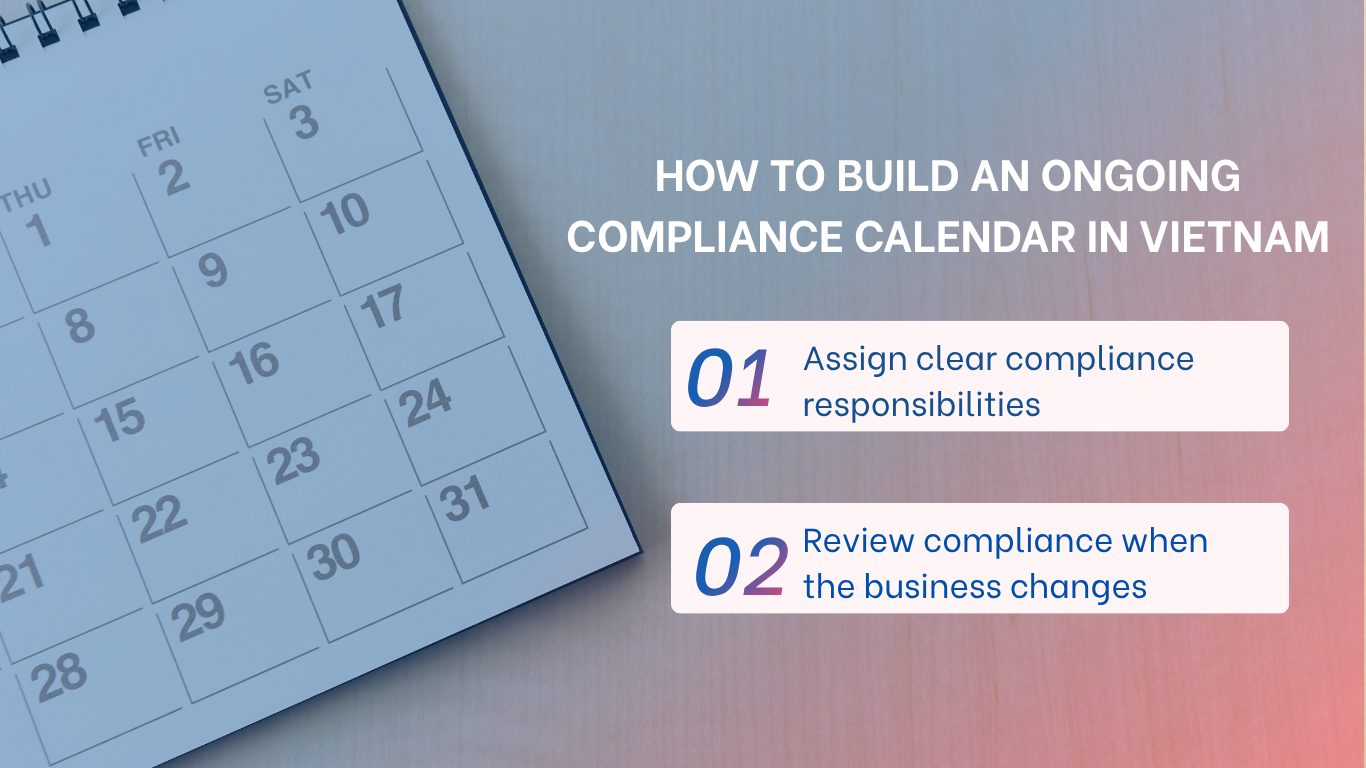
Two essential practices for managing ongoing business compliance responsibilities in Vietnam.
Compliance responsibilities occur at different times. Some tasks arise when a company is first established. Others are linked to monthly, quarterly, annual, or event-driven reporting requirements. Therefore, new companies should create a compliance calendar that reflects their actual obligations.
| Review frequency | Compliance activities to monitor |
| At company setup | Registration records, investment requirements, tax arrangements, licenses, initial employment procedures |
| Monthly or quarterly, as applicable | Tax declarations, payroll administration, insurance reporting, accounting reconciliations |
| Annually, as applicable | Financial statements, statutory audits, annual corporate or investment reporting |
| When changes occur | Corporate registration updates, ownership changes, employee changes, permit amendments |
| Periodically | Internal compliance reviews, policy updates, regulatory monitoring |
The table is a planning guide, not a universal filing schedule. Exact deadlines and filing frequency depend on applicable regulations and company circumstances.
Assign Clear Compliance Responsibilities
A compliance calendar becomes more useful when every task has a responsible person or team. For example, the accounting team may manage tax filings, while HR handles employment and insurance matters. Corporate administration may monitor registration changes, and external specialists may advise on legal or licensing requirements.
However, using an external service provider does not automatically remove the company’s own statutory responsibilities. Management should therefore maintain oversight of key obligations, filing status, and unresolved issues.
Review Compliance When the Business Changes
Businesses should also update their compliance procedures as operations evolve. Hiring more employees, introducing new business activities, changing shareholders, or expanding to a new location may create additional requirements. For this reason, a business compliance checklist should be reviewed after major operational changes, not only at the end of the financial year.
Common Compliance Mistakes New Companies Should Avoid
New businesses often focus on company registration but underestimate their ongoing compliance responsibilities. As a result, missing documents, reporting errors, or outdated procedures can create legal and operational risks. The following mistakes are particularly important for companies establishing operations in Vietnam.
Overlooking Business Licenses and Corporate Updates
Assuming company registration covers all licenses. Some business activities require additional permits or operating conditions. Therefore, companies should confirm all relevant requirements before starting operations.
Failing to update corporate information. Changes to registered addresses, legal representatives, or ownership details may require updates to official records. Businesses should review these obligations whenever corporate changes occur.
Delaying Tax, Accounting, and Employee Compliance
Delaying accounting and tax preparation. Companies may have reporting obligations even before generating significant revenue. For this reason, accounting and tax procedures should be established early.
Keeping incomplete employee records. Missing employment contracts, payroll records, or insurance documents can create compliance risks. In addition, companies should regularly review employee information to ensure their records remain accurate.
Relying on Outdated Regulations and Irregular Compliance Reviews
Using outdated regulations. Vietnam introduced significant changes to investment, tax administration, and personal data protection rules in 2025 and 2026. Therefore, companies should regularly verify which requirements apply to their operations.
Treating compliance as an annual exercise. Many obligations arise throughout the year, particularly when business activities or corporate information change.
To avoid these mistakes, companies should maintain a business compliance checklist with clear responsibilities, supporting documents, and regular reviews.
How Source of Asia Supports Business Compliance in Vietnam
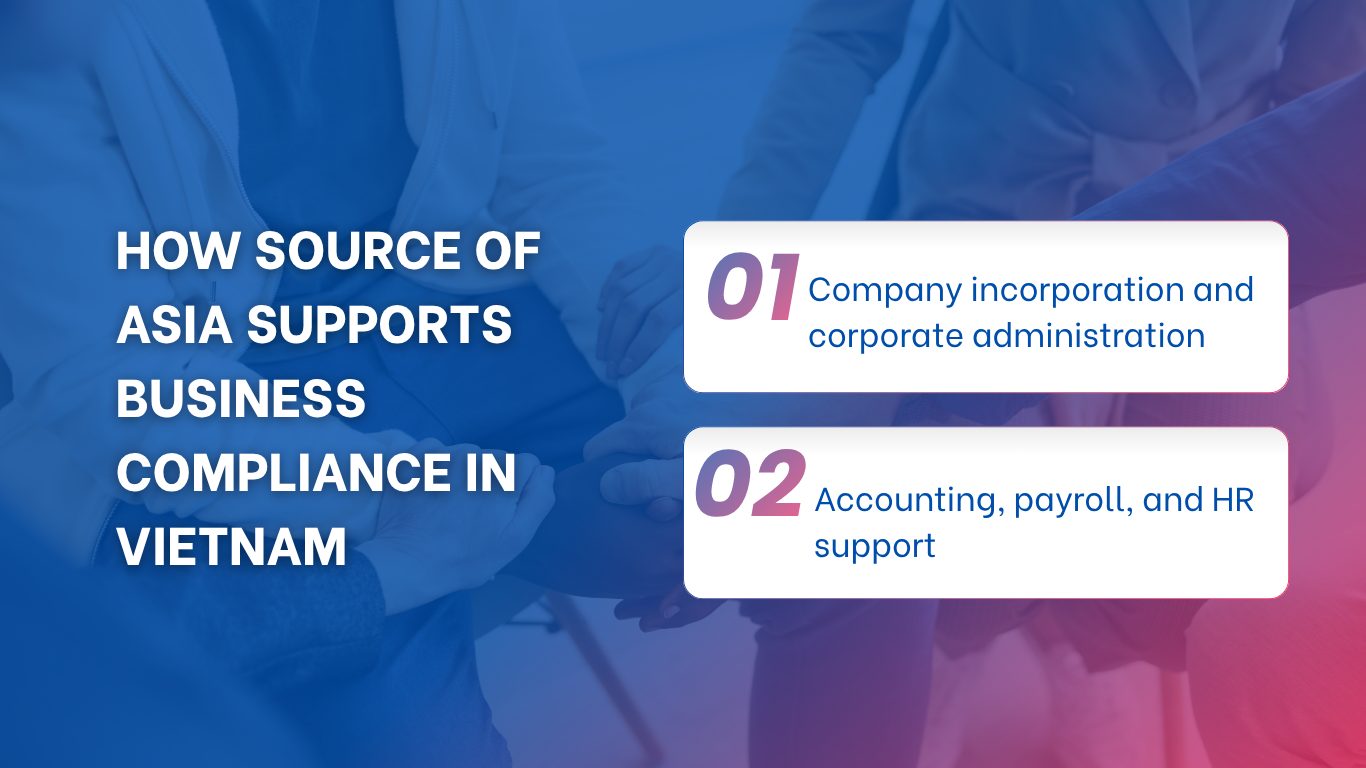
Source of Asia supports foreign companies in Vietnam with corporate administration, accounting, payroll, and HR services.
International businesses may find it difficult to manage local administrative requirements without an established team in Vietnam. Source of Asia (SOA) provides Corporate Services and HR Solutions to help foreign companies establish and manage their local operations. Its services include company registration and licensing, corporate secretarial support, accounting, payroll, and administrative outsourcing.
Company Incorporation and Corporate Administration
SOA helps businesses navigate company registration, licensing, and corporate administration in Vietnam. Through its Corporate Services, the company works with legal specialists where needed to support business establishment and ongoing administrative requirements. For foreign investors, this can help organize the documentation and local processes associated with setting up and maintaining an entity.
Accounting, Payroll, and HR Support
Once a business is operational, financial and employment administration become recurring responsibilities. SOA provides accounting management, payroll management, and annual reporting support. In addition, its HR solutions include recruitment, payroll services, personal income tax and insurance management, and assistance with foreign employee arrangements.
These services can help businesses manage selected administrative tasks while maintaining oversight of their local operations. For companies exploring different entry structures, SOA also discusses practical options in its EOR and IOR Support for Phased Market Entry in Vietnam case study.
Conclusion
Establishing a company in Vietnam requires more than obtaining registration documents. Businesses must also manage tax, accounting, employment, corporate records, licensing, and other obligations relevant to their activities. A reliable business compliance checklist helps companies identify these requirements early, organize responsibilities, and maintain more consistent administrative processes. For foreign companies planning to establish or expand operations in Vietnam, Source of Asia’s Corporate Services provide support with company incorporation, accounting, payroll, and ongoing local administration. Building compliance into daily business processes from the beginning can help companies reduce avoidable risks and establish a stronger foundation for long-term operations.