Introduction
Businesses entering Vietnam often start with a small local team to test the market, support customers, or build initial operations before committing to a full legal structure. As hiring expands, employment administration becomes more complex, and choosing the right Employer of Record (EOR) in Vietnam can directly affect compliance, payroll accuracy, employee experience, and day-to-day operations. The wrong provider may lead to unexpected costs, unclear responsibilities, compliance issues, or difficulties when the business needs to scale or transition to its own entity.
This guide explains how an Employer of Record in Vietnam works, what EOR services cover, and what companies should check before making a decision, from legal structure and compliance expertise to pricing, data security,and scalability.
Quick Answer
Why do businesses need Employer of Record services?
Businesses often need EOR when they want to hire in Vietnam but are not ready to build their own local employment structure. It can help them:
- Start with a small team while market potential is still being assessed.
- Avoid setting up payroll and HR processes too early.
- Keep internal resources focused on market development and core operations.
- Add local employees without immediately expanding internal administrative capacity.
The main value is flexibility. Companies can build a local workforce first and make a longer-term structure decision based on actual business needs.
 Add Source of Asia as a preferred source on Google
Employer of Record (EOR) in Vietnam Overview
Before choosing an EOR provider, it helps to understand how the model works in Vietnam, what responsibilities the provider takes on, and how EOR differs from a PEO arrangement.
What is an Employer of Record in Vietnam
An Employer of Record (EOR) is a third-party company that legally employs workers on behalf of a client business. It manages the employment administration, while the client remains responsible for the employee’s actual work and performance.
Typically, the EOR handles:
- Employment contracts, payroll, tax, and statutory contributions.
- Employee records, benefits, and routine HR administration.
- Compliance with applicable employment requirements.
This can help foreign companies hire in Vietnam without building a full HR function from the start. However, Vietnam has no separate statutory category called “EOR.” Therefore, companies should confirm which entity employs the worker and whether the proposed structure complies with applicable Vietnamese requirements.
How EOR differs from PEO
EOR and PEO services both support HR processes, but the employment structure is different. The main question is who employs the worker and whether the client already has a local entity.
- Employer of Record (EOR): The provider generally acts as the formal employer and manages employment administration. It may support hiring without the client’s own local entity, subject to the legal structure.
- Professional Employer Organization (PEO): The provider generally shares HR responsibilities with the client under a co-employment model, usually where the client already has a local entity.
The service names can vary, so companies should review the actual legal structure and responsibilities before choosing a model.
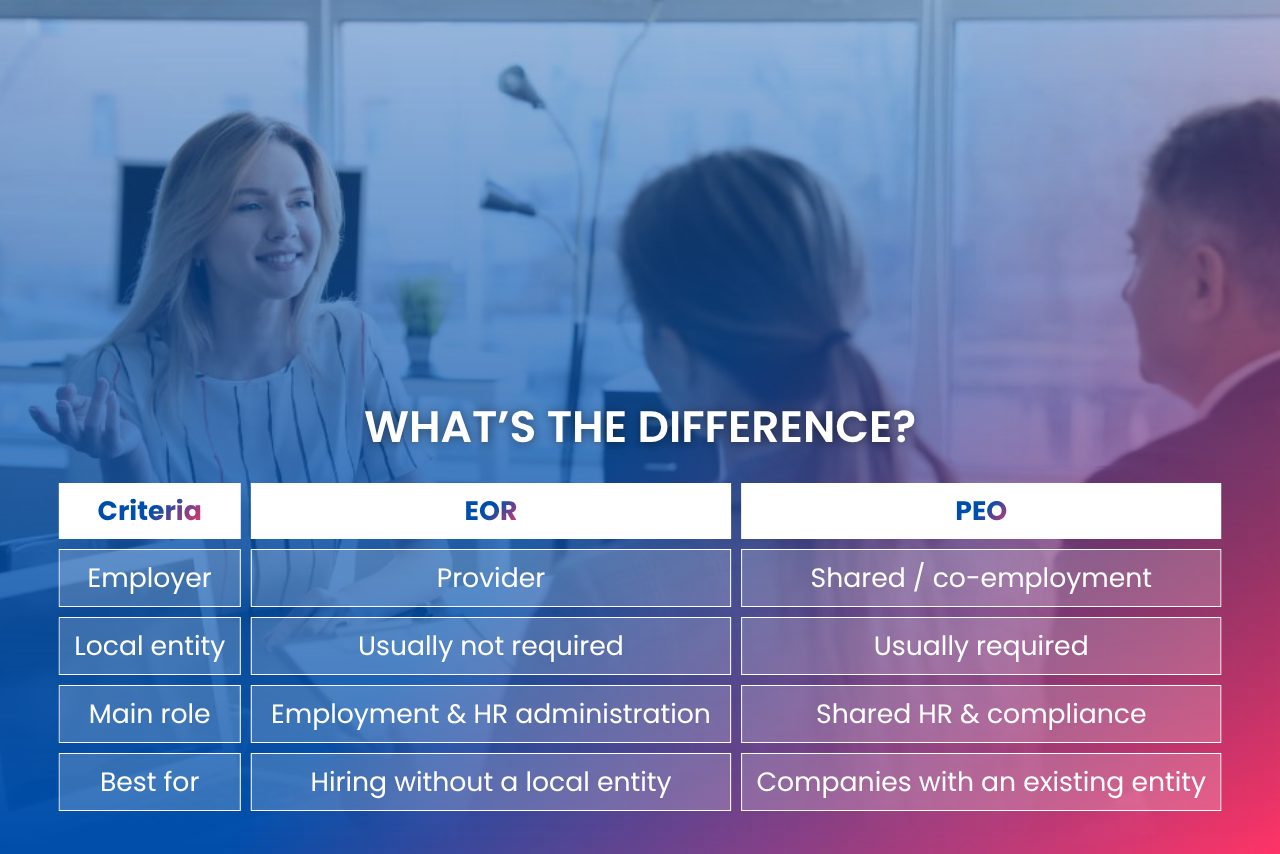
EOR and PEO differ mainly in who employs the worker and how employment and HR responsibilities are shared
What Do Employer of Record Services in Vietnam Include
EOR services in Vietnam can cover key employment processes from onboarding and payroll to benefits, work permits, and employee offboarding. The exact scope varies by provider, so companies should confirm what is included before engagement.
Employment contracts and employee onboarding
A reliable onboarding process starts with a clear employment contract and complete employee records. EOR providers typically support:
- Preparing contracts and collecting required documents.
- Recording job title, start date, salary, and employee information.
- Setting up HR records and coordinating onboarding.
Before signing, companies should confirm the correct legal employer and ensure the contract reflects the actual working arrangement. Key terms such as working arrangements, leave, benefits, and approval responsibilities should also be agreed upfront to prevent issues later.
Payroll, tax, and statutory contributions
Payroll is one of the most visible parts of EOR, but accurate processing also depends on tax, insurance, and employment compliance. An Employer of Record in Vietnam may manage:
- Monthly payroll, payslips, and reports
- Personal income tax and mandatory insurance
- Bonuses, allowances, and salary adjustments
- Employment and payroll records
In Vietnam, payroll requirements can change as tax and social insurance rules are updated. For example, regulatory changes may affect payroll costs and employee records. Therefore, companies should choose a provider that monitors updates, explains their impact clearly, and has a reliable process for reviewing and correcting payroll issues.
Employee benefits and HR administration
EOR providers can manage routine employee administration throughout employment. This typically includes statutory and agreed benefits, leave records, salary and allowance changes, and employee documentation. They may also maintain HR records and provide routine support for employee requests. The exact scope varies by provider, so companies should confirm which benefits and HR services are included in the EOR fee and which are charged separately before signing the agreement.
Work permits and immigration support
For eligible foreign employees, an Employer of Record in Vietnam may support work-permit applications and related immigration documents. The scope can vary significantly between providers. Some manage the process directly, while others coordinate selected documents or work with external specialists. Companies should therefore confirm:
- Whether work-permit support is included
- Which immigration procedures are covered
- Whether government fees are included or billed separately
- Who prepares and reviews employee documents
- How renewals and changes are handled
Work-permit support should be treated as a separate service component rather than assumed to be included in every EOR package.
Employee offboarding and termination
Finally, an EOR should also manage the employment relationship when an employee leaves. This may include resignation or termination coordination, final payroll, benefits reconciliation, and required employment documentation. Providers may also prepare employment certificates and maintain related records.
For example, if a client wants to terminate an employee, the EOR should first confirm the basis for termination, notice requirements, final salary, and required documents. The client can then communicate the decision based on the agreed process, while the EOR handles the employment and payroll steps through the employee’s final working day.
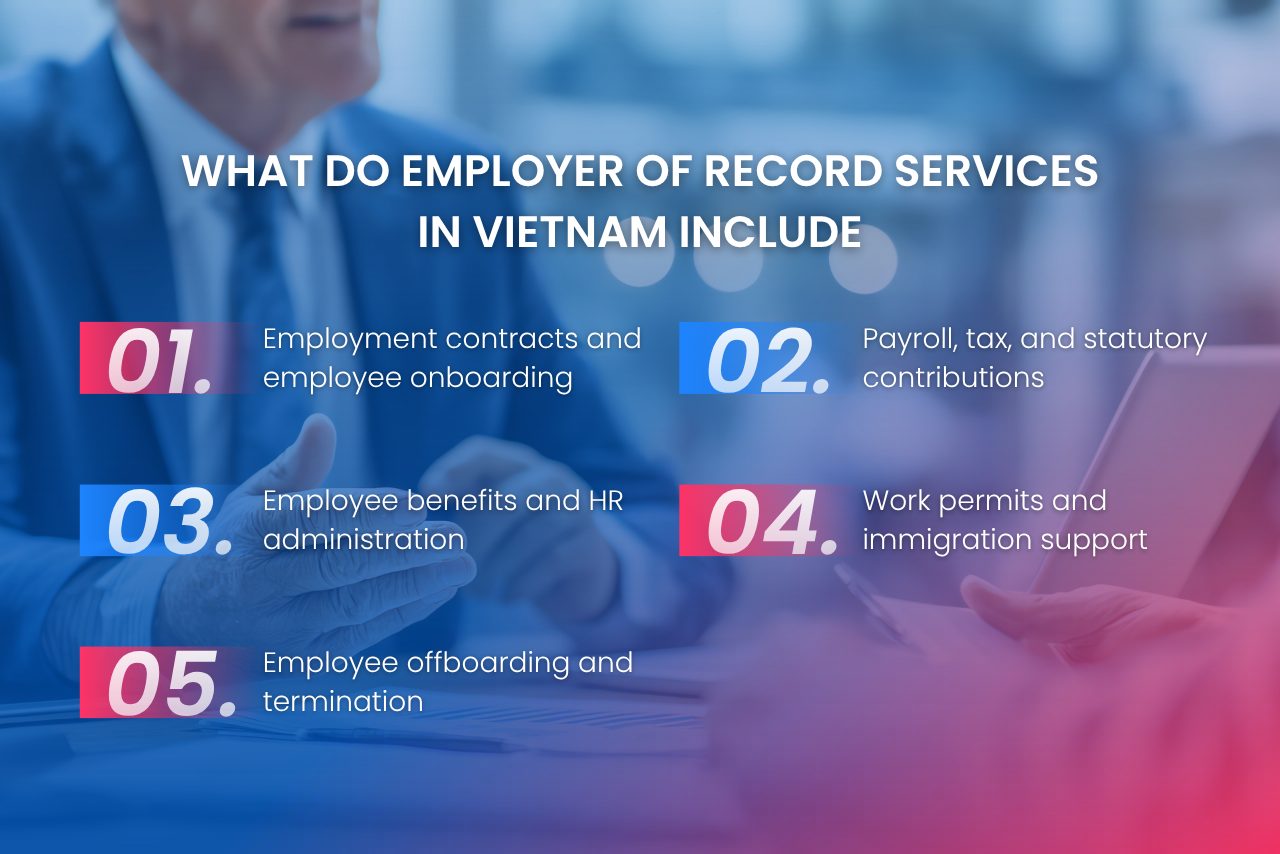
EOR services can cover employment contracts, payroll, benefits, work permits, HR administration, and employee offboarding in Vietnam.
EOR vs. Setting up a Legal Entity: Which Fits Your Business
For companies entering Vietnam, the choice between an EOR service and a legal entity depends on how quickly the business needs to hire, the level of local presence required, and its expected operating model.
| Factor | Employer of Record (EOR) | Legal Entity Setup |
|---|---|---|
| Time to market | Faster hiring without own entity setup | Longer setup before direct hiring |
| Setup costs | Lower upfront infrastructure costs | Higher incorporation and setup costs |
| Compliance | Employment compliance managed by provider | Managed internally or with local advisors |
| HR & Payroll | Payroll and HR handled by provider | Managed in-house or outsourced |
| Market flexibility | Easy to test, scale, or exit | Better for established operations |
| Commercial presence | No client-owned local legal presence | Provides own local legal structure |
| Operational control | Employment administration shared with provider | Greater direct control over operations |
| Long-term fit | Initial or changing workforce needs | Stable, long-term business operations |
The right choice depends on the business stage. EOR can be practical for a small initial team or market-testing phase, while a legal entity may better support established operations, local contracts, facilities, and long-term workforce plans.
👉 For a broader view of the options for building a local team, read more about choosing between EOR and direct hiring in ASEAN.
How to Choose the Right Employer of Record in Vietnam
Choosing an EOR is not only about comparing service fees. Companies should also assess the provider’s local expertise, legal structure, service scope, technology, and ability to support the workforce as business needs change.
Check local employment and compliance expertise
First, check the provider’s hands-on experience with Vietnamese employment requirements. Regional coverage alone does not show how well a provider can handle local payroll, tax, insurance, and employment issues.
Before signing, ask:
- How are employment contracts reviewed and updated?
- How are payroll, tax, and insurance changes handled?
- How does the provider monitor regulatory changes?
- Who handles compliance issues when they arise?
- Can the provider explain requirements for specific employee cases?
Clear answers and a defined compliance process can help companies avoid unexpected payroll issues, incorrect employment procedures, and last-minute compliance changes.
Review the EOR service scope and pricing
Second, compare what each provider actually includes in its fee. A lower monthly EOR fee does not always mean a lower employment cost if essential services are billed separately.
For an Employer of Record in Vietnam, the proposal should clearly state whether the fee covers:
- Payroll, tax, and statutory contributions.
- Employee onboarding and offboarding.
- Benefits and routine HR administration.
- Work permits and immigration support.
- Payroll adjustments and additional HR requests.
Then check which costs are one-time, recurring, or charged separately. This makes it easier to compare providers on the total cost of employing each worker, rather than the EOR service fee alone.
Verify the provider’s legal and employment structure
Next, confirm the legal structure behind the EOR arrangement. Before hiring, companies should know which entity will employ the worker, sign the employment contract, and take responsibility for employment obligations.
This matters because Vietnam does not have a separate statutory category called “EOR”. If the arrangement falls under labour outsourcing, companies should check the provider’s applicable licence and whether the employee’s role is permitted. The current framework also limits labour outsourcing to a maximum of 12 months.
Assess payroll technology and data security
Then, review how the provider’s payroll system works in practice. Payroll errors can affect employees and create extra administrative work. Check whether the system supports:
- Payroll processing and corrections
- Payslips, reports, and payroll records
- Employee access and approval workflows
- Data storage and system access
Data protection also matters because EOR providers handle sensitive information such as salaries, tax records, identification details, and bank information. Vietnam’s Personal Data Protection Law has been in effect since January 1, 2026, so companies should also understand how employee data is protected, accessed, and shared.
Evaluate client support and scalability
Finally, assess how the provider supports companies beyond routine HR administration. Check who manages the account, how support requests are handled, and how quickly payroll or employment issues are escalated.
The provider should also be able to adapt as business needs change. Check whether it can support:
- Changes in headcount and hiring needs.
- More complex payroll or HR requirements.
- New employee types or work arrangements.
- A future transition to the company’s own legal entity.
A provider that can support both day-to-day needs and future changes can reduce disruption as the Vietnam operation develops.
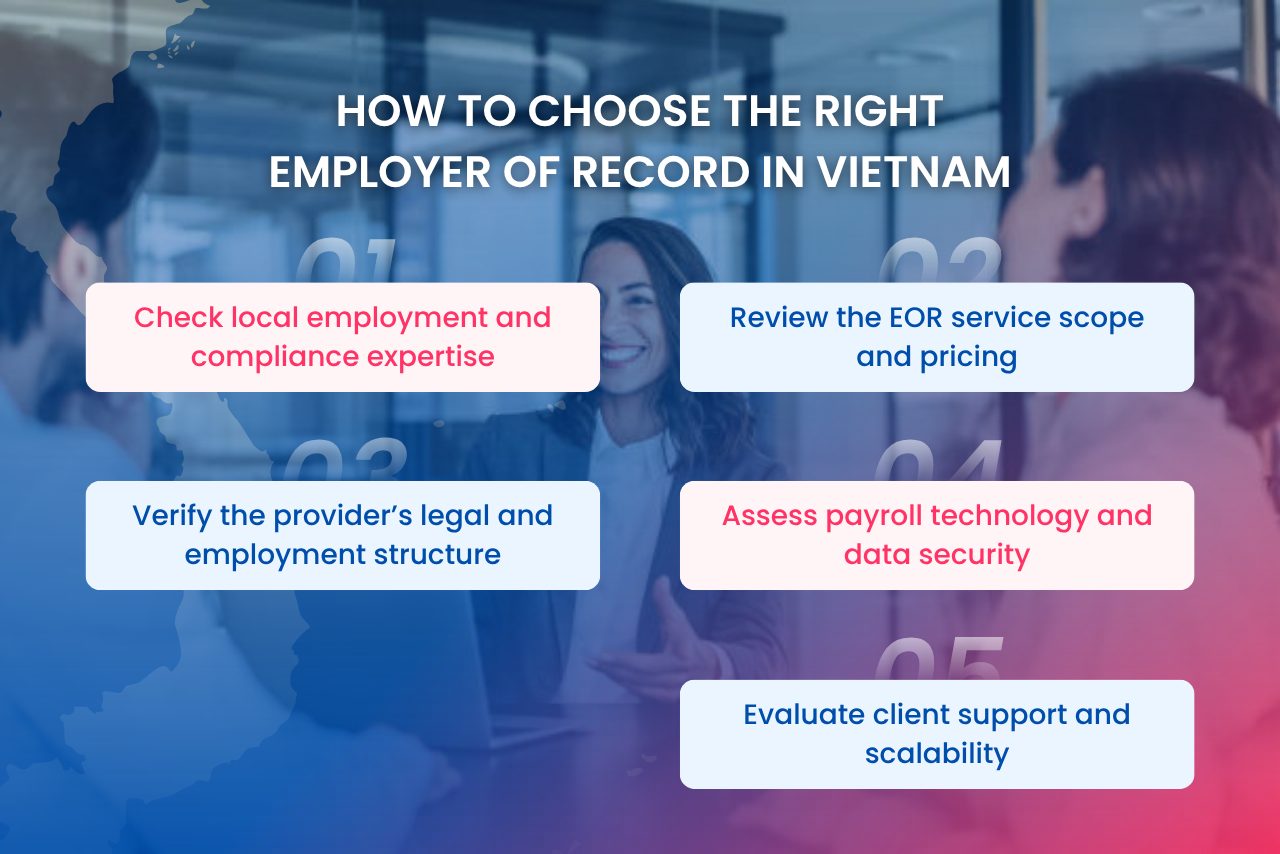
Companies should assess expertise, service scope, pricing, data security, and scalability when choosing an EOR provider in Vietnam.
Looking for the Right Employer of Record in Vietnam?
For companies hiring in Vietnam without setting up a local entity, choosing an EOR service is not only about payroll. The right partner should also provide local employment support, compliance administration, recruitment, and flexibility as the team grows or the business changes direction.
Source of Asia supports international companies with phased Employer of Record in Vietnam solutions, combining EOR and wage-hosting, recruitment, local administration, and IOR/EOR operations. This allows companies to build a local team while keeping the option to scale, transition, or establish their own entity when the business is ready.
👉 Send us your specific questions about your EOR needs in Vietnam, or see how SOA helped a client test and scale in Vietnam through EOR services.
When Is EOR the Right Solution for Your Business
EOR can make sense in different situations, from hiring a first local employee to growing a team before setting up a full local structure. The key is to match the EOR model with the company’s current needs and plans for Vietnam.
- When hiring and testing the Vietnam market
For companies entering Vietnam with an uncertain hiring or sales pipeline, setting up a local entity may be more than is needed at the early stage. EOR can provide a practical way to build an initial team while the company gathers real market information. It can be useful for:
- Testing market demand before establishing a local entity
- Hiring sales or business development staff
- Supporting existing customers in Vietnam
- Assessing local talent availability
- Building initial technical or operational capacity
- When scaling without an in-house HR function
As a Vietnam team grows, employment administration becomes more complex. Instead of building local HR infrastructure immediately, companies can use an EOR to manage recurring processes such as:
- Payroll, tax, and statutory contributions
- Employee records, leave, and benefits administration
- Employment documentation and routine HR requests
- Onboarding and offboarding as headcount changes
- When EOR may not be the right fit
EOR may be less suitable for substantial, long-term operations or when a company needs its own local structure. A legal entity may be more appropriate when:
- Headcount is expected to grow significantly
- Activities require a local entity or specific licences
- Greater control over employment is needed
- Permanent local infrastructure is planned
Companies should also check whether the employment arrangement meets Vietnamese requirements and assess any Permanent Establishment (PE) or other tax exposure.
Final Considerations
Choosing the right Employer of Record in Vietnam can simplify hiring and HR administration, but the right model depends on workforce needs, business activities, and long-term plans. Companies should assess the EOR’s service scope, legal employment structure, compliance expertise, pricing, data security, and scalability.
At Source of Asia, our Corporate Services and HR Solutions help international companies manage local employment and operations through recruitment, payroll, HR administration, and related support. This provides a practical foundation for companies building and managing teams in Vietnam.
👉 Contact our experts to discuss the right EOR solution for your Vietnam team.
Frequently Asked Questions
An Employer of Record (EOR) is a third-party provider that legally employs workers on behalf of a client company. The EOR typically manages contracts, payroll, tax, benefits, and employment administration, while the client manages employees’ day-to-day work.
Vietnam does not have a separate statutory category called “EOR.” The arrangement must comply with applicable employment laws. If the structure constitutes labour outsourcing, the provider must meet relevant licensing, permitted job, and other legal requirements.
EOR costs vary by provider, employee number, salary, and service scope. Companies should compare the management fee with payroll, work-permit support, government charges, benefits, and other services that may be billed separately.
A company may consider its own entity when Vietnam operations become substantial and long-term. This can be appropriate when the business needs greater control over hiring, contracts, commercial activities, infrastructure, and a permanent local workforce.