Introduction
Entering Vietnam through a local distributor can give international companies faster access to customers, sales channels, and local business networks. However, finding a distributor in Vietnam is only the first step.
The real challenge is finding a partner that fits your product, target customers, sales models, and growth plans. A company may have a large network but little experience in your sector. Another may be interested in your product but lack the sales team, logistics, or technical support needed to grow it.
This guide explains how to find, screen, and qualify distributors in Vietnam before you commit to a long-term partnership.
For companies that need support with Vietnam market entry, partner identification, and local business development, explore Source of Asia’s Market Expansion services.
Key Takeaways
- Define your ideal distributor profile before starting the search.
- Use several channels to find distributors in Vietnam rather than relying on online directories alone.
- Evaluate candidates based on commercial fit, operational capability, strategic alignment, and financial stability.
- Check their customer base, geographic coverage, competing brands, sales resources, logistics, and references.
- Do not confuse a distributor with an importer, trading company, agent, or supplier.
- Start with clear expectations and, where appropriate, a pilot period before granting long-term exclusivity.
- Local market knowledge can make distributor identification and qualification faster and more reliable.
What Does a Distributor Do in Vietnam?
Depending on the industry and business model, a distributor may import products, hold inventory, develop sales channels, manage customer relationships, provide after-sales support, and coordinate local logistics.
The exact role depends on your product and route to the market. A consumer goods distributor may focus on retail coverage and merchandising. An industrial distributor may need technical sales engineers, spare parts, installation, and after-sales service. A regulated-sector partner may also need specific regulatory and registration capabilities. Understanding Vietnam business culture can also help you assess how local distributors approach relationships, communication, negotiations, and long-term partnerships.
This distinction matters because the largest distributor is not necessarily the best distributor for your business.
A distributor with strong national sales may have little experience in your product category. Meanwhile, a smaller specialist may have stronger relationships with the exact customers you want to reach.
Set Your Distributor Selection Criteria
Before starting the search, take some time to define what you actually need from a distributor. A clear partner profile makes it easier to compare potential candidates later and helps you avoid building a long list of companies that look relevant on paper but do not fit into your business.
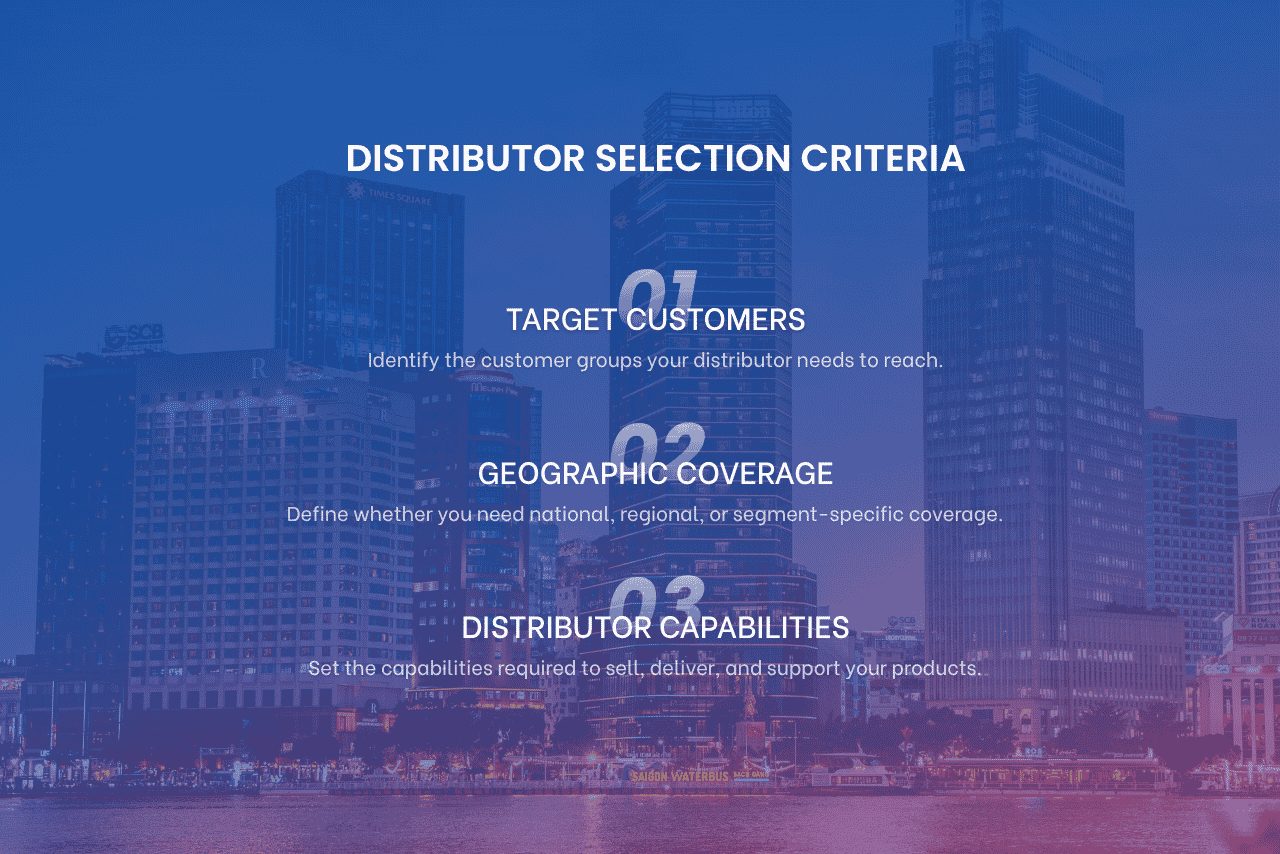
Define your target customers, geographic coverage, and distributor capabilities before starting your distributor search in Vietnam.
Define Your Target Customers
Start by identifying the customer groups you want to reach in Vietnam. The right distributor should already have meaningful relationships with the types of buyers that matter to your business, rather than simply having a large general customer base.
Depending on your industry, these may include retailers, industrial companies, wholesalers, hospitals and healthcare institutions, construction companies, food service businesses, e-commerce channels, or government and institutional buyers.
For example, an industrial equipment company may need a distributor with established relationships with factories and engineering companies, while a consumer brand may place greater importance on retail chains, e-commerce platforms, and wholesalers. Your target customer profile should therefore be one of the first criteria you use to evaluate potential distributors.
Define Your Geographic Requirements
Next, determine where you need the distributor to operate. Vietnam has distinct commercial markets across the north, central region, and south, so a distributor with a strong presence in one area may not necessarily provide effective coverage elsewhere.
For instance, a distributor based in Ho Chi Minh City may have strong relationships throughout southern Vietnam but limited commercial reach in Hanoi and the northern industrial provinces. Conversely, a company headquartered in Hanoi may have a strong northern network without the same level of access to customers in the south.
Your requirements may range from coverage in a specific city to a wider regional or nationwide network. You may also need access to industrial clusters, retail chains, or customer groups rather than broader geographic coverage.
Defining this scope early will help you determine whether you need one national distributor, several regional partners, or a specialist with access to a specific customer segment.
Set Your Capability Requirements
Finally, consider what the distributor needs to do beyond selling your products. The required capabilities can vary significantly depending on the product, industry, and customer expectations.
Technical or industrial products, for example, may require distributors to provide product demonstrations, installation, technical training, maintenance, spare parts, and warranty support. Consumer products may place greater emphasis on retail coverage, merchandising, e-commerce capabilities, promotional execution, warehousing, and last-mile delivery.
The more complex the product and sales process, the more important it becomes to define these requirements before contacting potential partners. Your ideal distributor profile should reflect the actual capabilities needed to sell, deliver, and support your product in Vietnam.
How to Find Distributors in Vietnam
There is no single best channel for finding a distributor. The strongest searches usually combine online research, industry networks, referrals, trade events, and local market knowledge. Current Vietnam market-entry guides similarly recommend combining desk research with trade fairs, associations, competitor research, and structured market mapping.
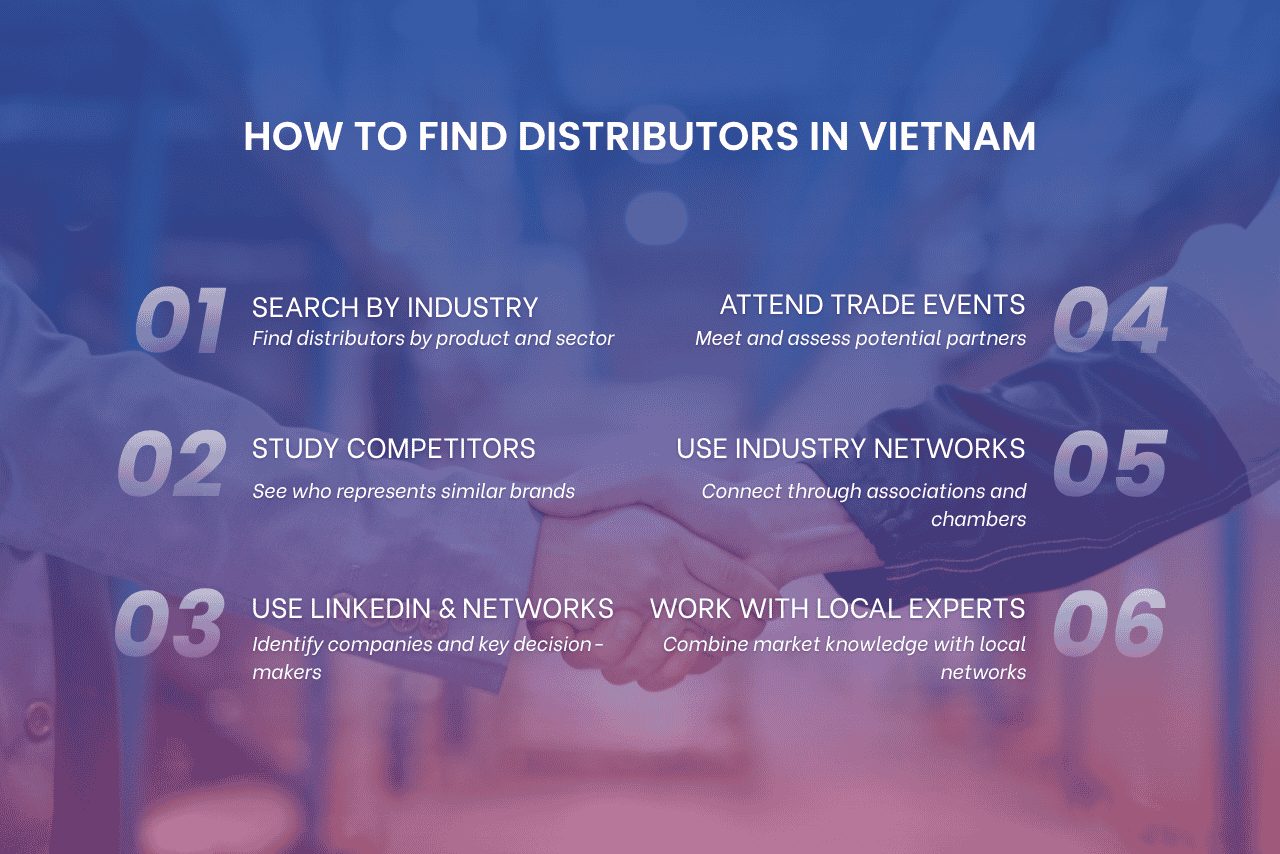
Six practical channels for finding potential distributors in Vietnam, from industry research and competitor analysis to trade events and local networks.
Search by industry and product category
Start with targeted searches rather than generic terms such as “Vietnam distributor.”
For example:
- Medical device distributor Vietnam
- Industrial equipment distributor Vietnam
- Food importer distributor Vietnam
- Cosmetics distributor Vietnam
- Automotive parts distributor Vietnam
- Packaging distributor Vietnam
Then look at which companies already represent brands similar to yours. This approach helps you understand who is active in your sector before contacting potential partners.
Study your competitors
Competitor research can reveal potential distributors faster than a general web search.
Look at:
- Who distributes competing brands?
- Which companies appear repeatedly across your sector?
- Which retailers or industrial customers do they serve?
- Which regions do they cover?
- Are they already representing competing products?
A competitor’s distributor is not automatically a good choice. However, it can provide useful evidence of market access and category experience.
Use LinkedIn and professional networks
LinkedIn can help identify:
- Managing directors
- Sales directors
- Business development managers
- Product managers
- Import managers
- Category managers
However, finding a contact is not the same as qualifying for a partner.
The objective should be to identify the company, understand its business model, and then reach the person responsible for the relevant product category.
Attend trade fairs and industry events
Trade exhibitions remain useful for distributor searches because they allow you to meet multiple potential partners in a short period. They also give you a chance to observe how companies present themselves, which brands they represent, and how they interact with customers.
For foreign companies, trade events can become much more effective when meetings are pre-qualified instead of relying only on walk-in conversations. Source of Asia has supported international companies through structured B2B matchmaking, including partner screening, targeted meetings, and market insights in Vietnam.
Work with industry associations and chambers
Industry associations, chambers of commerce, and trade promotion organizations can provide introductions and useful market context.
They can be particularly valuable when you are entering a specialized sector where the strongest distributors are not highly visible online.
Use local market experts
A local market expert can help shorten the search by combining market knowledge with an existing business network. Instead of simply providing a database of companies, a structured partner search should answer:
Which companies are relevant, which ones are interested in, and which ones are actually qualified?
That difference is important when you are looking for a distributor in Vietnam for a serious market-entry project.
Distributor vs. Importer, Agent, Trading Company, or Supplier
One common mistake is assuming that every company offering to sell your products is a distributor. These business models can be different.
| Partner type | Typical role | Best suited for |
| Distributor | Buys, stores, resells, and develops the market | Companies seeking local sales growth |
| Importer | Handles importation and may resell products | Companies needing import and logistics support |
| Trading company | Facilitates transactions across products or markets | Transaction-focused market access |
| Agent | Represents the supplier and earns commission | Companies wanting more control over customers |
| Reseller | Sells products downstream to specific customers | Narrow customer or geographic segments |
| Supplier | Provides products, components, or manufacturing capacity | Companies looking to source from Vietnam |
If you want to sell your products into Vietnam, you are usually looking for a distributor, importer, agent, or commercial partner. And buy products or manufacture in Vietnam, you are looking for suppliers or manufacturers instead.
For sourcing projects, see Source of Asia’s Vietnam sourcing solutions
What Makes a Distributor Qualified for Your Business?
Finding potential candidates is only the beginning. Qualification is where you determine whether a distributor can actually deliver. A practical evaluation should cover four areas: commercial, operational, strategic, and financial fit. This framework is also consistent with current distributor-selection guidance for Vietnam.
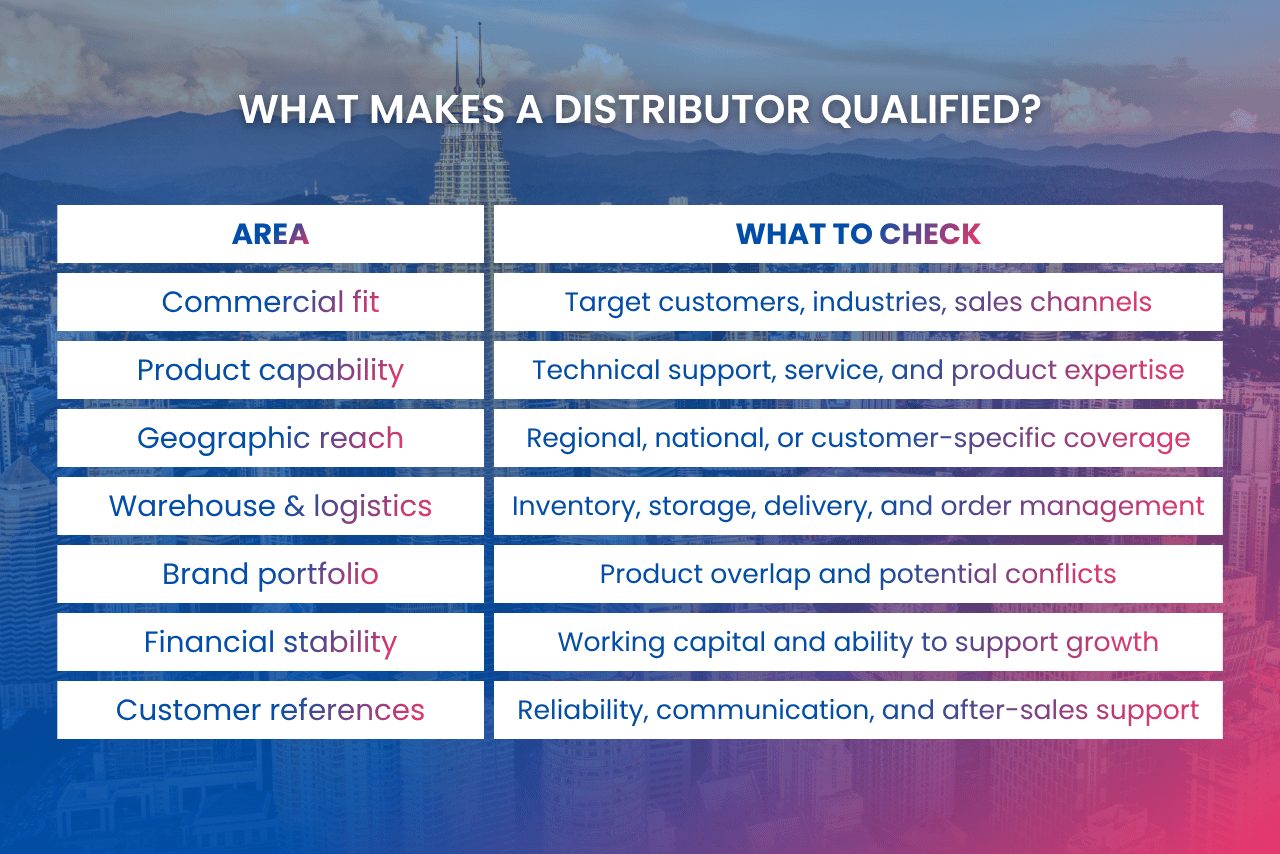
A practical framework for evaluating a distributor’s commercial, operational, strategic, and financial fit.
Commercial Fit
Start by understanding the distributor’s existing business and how closely it matches your target market. Rather than focusing only on company size or revenue, look at the customers they already serve, the industries they specialize in, the regions they cover, and the sales channels they manage. It is also useful to understand the size of their sales team and whether they already distribute products similar to yours.
This information helps you assess whether the distributor can actually reach the customers you want to target. For example, a large distributor with strong national revenue may have limited access to your specific industry, while a smaller specialist may already have strong relationships with the buyers that matter most to your business.
Before moving forward, ask potential partners to explain their current customer base, sales coverage, product portfolio, and experience in your sector. These details will give you a much clearer picture of their commercial fit than company size alone.
Product and Technical Capability
The right distributor also needs the capabilities required to sell and support your product effectively. These requirements can vary significantly depending on the industry, so the evaluation should reflect the complexity of your products and the expectations of your customers.
For technical or industrial products, for example, you may need a distributor with trained sales engineers, technical support, installation capabilities, product demonstration resources, spare parts management, after-sales service, and customer training. Without these resources, even a distributor with strong customer relationships may struggle to develop the market successfully.
Consumer products require a different set of capabilities. In this case, retail relationships, merchandising, e-commerce, marketing, promotional execution, and inventory management may be more important.
The key principle is simple: evaluate the distributor based on what your product and customers require, rather than using the same criteria for every potential partner.
Geographic Reach
Geographic coverage is another important factor, particularly if you expect the distributor to support sales across multiple regions of Vietnam. Be careful with broad claims such as “nationwide distribution.” Instead, ask potential partners to explain where their commercial network is actually active. This may include specific provinces and cities, retail chains, industrial zones, or key customer accounts.
For example, a distributor may operate a major warehouse in Ho Chi Minh City while relying on sub-distributors or logistics partners to serve customers in northern and central Vietnam. This model can still work well, but you need to understand how the network operates, who manages the customer relationship, and where the distributor has direct sales coverage.
A clear understanding of geographic reach will also help you decide whether you need one national distributor or several regional partners.
Warehouse and Logistics Capability
If the distributor will import and hold your products in Vietnam, its logistics capabilities should be part of the qualification process from the beginning. Look beyond warehouse size and consider how the company manages inventory, storage conditions, order processing, delivery, returns, and third-party logistics providers. You should also understand how stock levels are monitored and how quickly the distributor can respond when customer demand changes.
These factors become even more important for products with specific storage or handling requirements. Food, pharmaceuticals, chemicals, and temperature-sensitive products, for example, may require dedicated facilities, controlled storage conditions, and clearly defined handling procedures.
A distributor may have an impressive sales network, but weak inventory or delivery management can still create problems for your customers and damage your brand.
Existing Brand Portfolio
The distributor’s existing brand portfolio can tell you a great deal about its commercial priorities and potential conflicts of interest. Start by reviewing the brands and product categories the company currently represents. Pay particular attention to products that compete directly or indirectly with yours. A distributor may have strong market access, but if it already represents several competing brands, your product may receive limited attention from its sales team.
If there is a potential conflict, discuss how your product would be positioned, which sales resources would be assigned to it, and how the distributor would manage competing products. You should also clarify what would happen if sales targeted or commercial priorities between different brands began to conflict.
The goal is not necessarily to find a distributor with no competing products. In many industries, an established portfolio can actually be an advantage. What matters is whether the distributor has a clear reason and sufficient resources to invest in your brand.
Financial Stability
Financial stability is another factor that can easily be overlooked during the initial distributor search. However, the distributor may need significant working capital to purchase inventory, maintain stock, finance sales cycles, hire sales staff, and support marketing activities.
For this reason, request appropriate financial information during the qualification process and, where possible, verify the company’s payment behavior with existing suppliers or business partners.
The objective is not to request unnecessary confidential information. Instead, you want to establish whether the distributor has enough financial capacity to support the commercial model you are proposing. A partner that cannot maintain inventory or finance its sales activities may struggle to support your growth even if it has strong customer relationships.
Customer References
Finally, customer and supplier references can provide valuable insight into how a distributor operates after the initial sales discussion.
Where possible, ask potential distributors to provide references from existing customers, suppliers, or international brands they currently represent. These conversations can help you understand their reliability, communication, sales activity, inventory management, and after-sales support from the perspective of people who have worked with them directly.
Rather than asking only whether the distributor is “a good company,” uses specific questions to understand its day-to-day performance. For example, you could ask whether the company pays suppliers on time, actively develops new products, communicates effectively, maintains appropriate inventory, and supports customers after the sale. It is also useful to ask whether the reference would be chosen to work with the distributor again.
These conversations can reveal operational issues that may not be visible during a presentation or first meeting. A distributor can look strong on paper, but references help you understand how that company performs in practice.
How to Test a Distributor Before Signing a Long-Term Agreement
You do not always need to make a permanent decision immediately when entering a new distributor relationship. Instead, consider starting with a defined pilot period that allows both sides to test the commercial relationship before making a longer-term commitment.
Depending on your business model, the pilot could cover a limited territory or product range, with clearly defined sales targets, marketing commitments, reporting requirements, minimum order quantities, and review dates. This gives both parties a practical framework for measuring performance and identifying potential issues before the relationship becomes more difficult to change.
A distributor agreement should also define how success will be measured. The right KPIs will depend on your market-entry objectives, but they may include:
| KPI | What it measures |
| Sales revenue | Commercial performance |
| New customers | Market development |
| Active accounts | Customer engagement |
| Sales pipeline | Future opportunities |
| Order volume | Product movement |
| Inventory level | Stock management |
| Geographic coverage | Market reach |
| Marketing activities | Demand generation |
| Customer response time | Service quality |
However, revenue should not always be the only measure of success. When entering a new market, building qualified opportunities, establishing customer relationships, and developing a reliable sales pipeline may be more important during the early stages than generating significant sales volume immediately.
What to Discuss Before Appointing a Distributor
Once you have identified a potential distributor, make sure both sides have a clear understanding of the commercial relationship before signing an agreement. This is the stage to discuss not only pricing and territory, but also the responsibilities each party will take on throughout the partnership.
The agreement should clearly address areas such as:
- Territory and product scope, including where and which products the distributor is authorized to sell
- Pricing, margins, and minimum orders, so both parties understand the commercial structure
- Payment terms and inventory ownership, particularly when the distributor is expected to hold stock
- Marketing and sales responsibilities, including targets, promotional activities, and reporting
- Customer ownership and after-sales responsibilities, especially where both parties may interact directly with customers
- Warranty handling and service obligations, where relevant to the product
- Contract duration and termination conditions, including what happens if agreed targets are not achieved
- Exclusivity, if the distributor requests exclusive rights to a territory or product category
Exclusivity can be attractive to a distributor because it provides greater protection for the investment they make in developing your brand. For the supplier, however, broad exclusivity can create significant risk if the distributor does not deliver the expected level of market development.
If you decide to grant exclusive rights, define the arrangement carefully. The agreement should specify the territory and products covered, minimum sales targets, required marketing activities, review periods, and the conditions for both maintaining and terminating exclusivity.
A performance-based structure is generally more practical than granting broad exclusivity based only on initial enthusiasm. This allows the distributor to earn or maintain exclusive rights by demonstrating measurable results.
Common Mistakes When Looking for a Distributor in Vietnam
Finding a distributor is not simply about choosing the company with the largest customer base, the lowest price, or the most impressive presentation. Several common mistakes can create problems later, particularly when companies enter Vietnam without a structured qualification process.
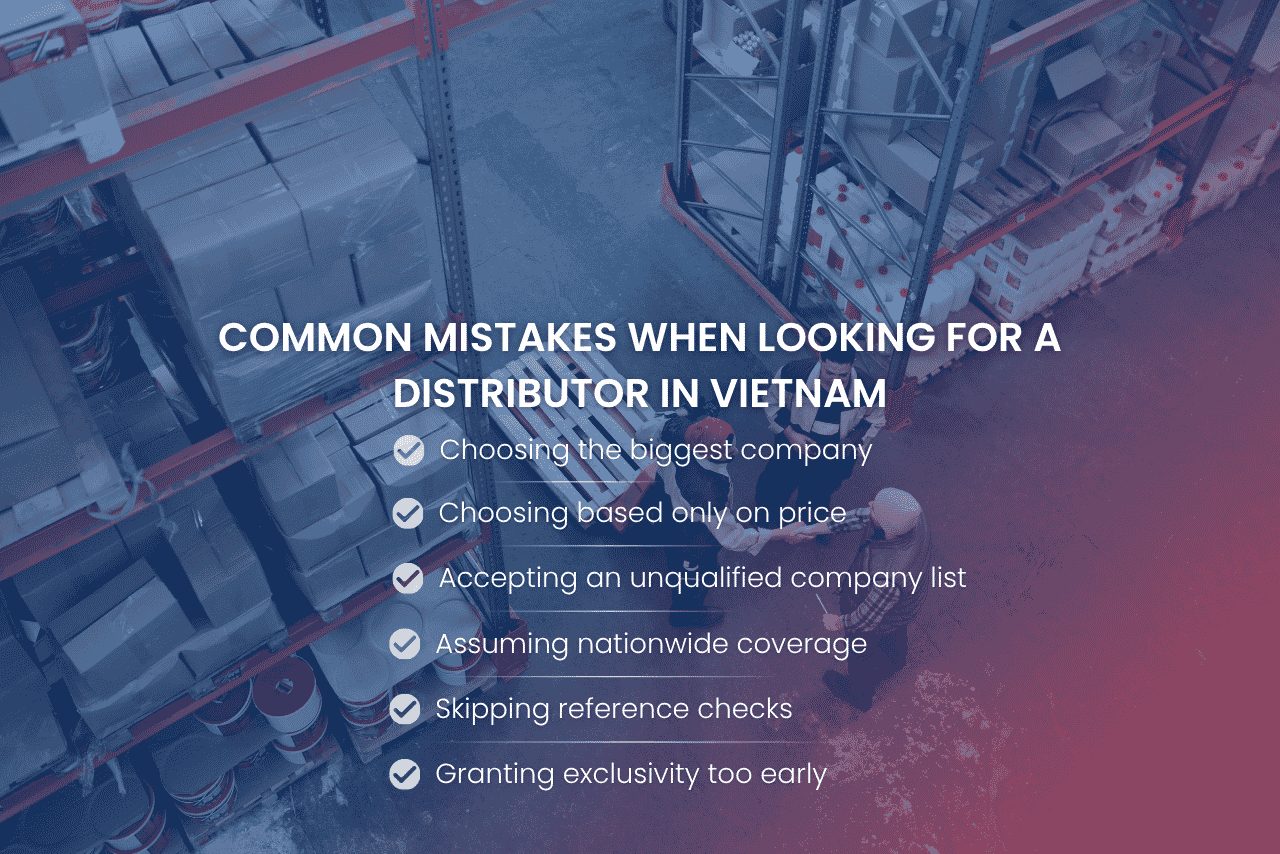
Seven common mistakes to avoid when searching for and evaluating distributors in Vietnam.
Choosing the Biggest Company
Company size does not automatically mean market fit. A large distributor may represent hundreds of brands and have significant revenue, but it may not have enough incentives or resources to prioritize your product. A smaller specialist with strong relationships in your target sector can sometimes provide much greater value than a large generalist.
Choosing Based Only on Price
The distributor offering the highest margin or the most attractive commercial terms may not necessarily generate the strongest sales results. Instead of looking at price in isolation, consider the full commercial model, including customer access, sales resources, marketing support, logistics, and expected market development.
Accepting a Company List Without Qualification
A database containing 50 potential distributors may look impressive, but it is not the same as having a shortlist of five qualified partners. The real value lies in understanding which companies fit your requirements, which are interested in your product, and which have the capabilities to execute.
Ignoring Competing Brands
A distributor may appear to be a strong candidate while already representing a direct competitor. This does not automatically disqualify the company, but it does require a closer discussion about product positioning, sales priorities, and potential conflicts.
Review the distributor’s full brand portfolio and understand how much attention it can realistically dedicate to your products.
Assuming Nationwide Coverage
A distributor may describe itself as having nationwide coverage without maintaining direct sales capabilities across the entire country. Before relying on this claim, ask for evidence of its actual customer base, regional sales activity, warehouses, and distribution partners.
Skipping Reference Checks
A successful first meeting can tell you that a distributor is interested in your product, but it does not prove that the company is reliable in day-to-day operations. Reference checks can provide valuable insight into payment behavior, communication, sales activity, inventory management, and customer support.
Granting Exclusivity Too Early
Exclusivity can make it harder to change partners if the relationship does not perform as expected. Give the relationship enough time to demonstrate its commercial potential before committing broad, long-term exclusive rights.
How Source of Asia Can Help You Find and Qualify a Distributor in Vietnam
For international companies, finding a distributor is often only one part of the wider market-entry process. Before approaching potential partners, you may need to understand the market, identify the right customer segments, assess competitors, validate pricing, and determine which type of local partner best fits your business model.
Once potential distributors have been identified, the work continues with qualification, introductions, meeting preparation, commercial discussions, and follow-up. This is where local market knowledge and execution can make a meaningful difference.
Source of Asia supports international companies with market intelligence, partner identification, B2B matchmaking, sales representation, and commercial development across Vietnam and Southeast Asia. Its Market Expansion services covers market assessment, partner search, business development, and local market support.
SOA’s experience also includes distributor qualification and local commercial development. In a Vietnam sales representation project for a European premium home linen brand, the team supported distributor qualification, local sales follow-up, market activation, and commercial development. Read the sales representation case study.
For companies entering Vietnam, the process can therefore move through several connected stages:
Market understanding → Distributor mapping → Qualification → B2B meetings → Commercial follow-up → Market development
The goal is not simply to find a list of distributor contacts. It is to identify the right companies, validate their capabilities, build relationships, and create a practical path toward market development.
Final Thoughts
Finding a distributor in Vietnam is not simply a search for a company that can resell your product. It is a partnership selection process. The right distributor should have access to your target customers, the operational capacity to support your product, a compatible portfolio, sufficient financial strength, and a clear willingness to invest in the relationship.
Start by defining your ideal partner. Then build a broad candidate list, qualify for the strongest companies, verify their claims, and test the relationship before making a long-term commitment.
For international companies entering Vietnam, local market knowledge can make this process faster and more practical. With the right approach, distributor selection becomes more than finding a contact. It becomes a structured path to building sustainable commercial growth in Vietnam.
| 👉 Looking for a distributor in Vietnam? Talk to Source of Asia about your market expansion plans. |
Frequently Asked Questions
You can find distributors through industry research, competitor mapping, LinkedIn, trade fairs, industry associations, referrals, and local business networks. The most effective approach combines several sources and then qualifies candidates against your specific product and market requirements.
Check commercial fit, customer access, geographic coverage, sales capabilities, logistics, technical support, competing brands, financial stability, and customer references. The right criteria depend on your product and route to market.
Not necessarily. Exclusivity should be linked to clear territory, product scope, sales targets, marketing commitments, and review conditions. A pilot period can help both sides test the relationship before a long-term exclusive agreement.
A distributor sells your products into the Vietnamese market, while a supplier provides products, components, or manufacturing services that you purchase. If you want to sell into Vietnam, you need a distribution or commercial partner. If you want to manufacture or source from Vietnam, you need suppliers or manufacturers.
Sometimes, but this should not be assumed. Vietnam has distinct commercial ecosystems across the north, central region, and south. For a broader Vietnam market overview, it is important to understand how customer networks, industrial activity, and business opportunities vary across the country. Ask potential distributors to demonstrate their actual customer, sales, and logistics coverage rather than relying on a “nationwide” claim.