Introduction
Vietnam’s manufacturing sector continues to attract strong foreign investment in 2026, driving demand for established industrial clusters and new production sites. However, with hundreds of industrial parks nationwide, companies must consider more than land prices or available space. Infrastructure, utility capacity, supplier networks, logistics access, and development status can vary significantly by location. As a result, a reliable list of industrial parks in Vietnam helps businesses quickly shortlist potential locations and focus their site assessment on the options most relevant to their project.
In this guide, Source of Asia highlights the top 30 industrial parks across Northern, Central, and Southern Vietnam, covering key information on location, scale, industries, infrastructure, and distinctive features to support practical manufacturing site selection.
Quick Recap
Vietnam’s industrial park landscape in 2026 is concentrated across three main manufacturing regions:
- Northern Vietnam: VSIP Bac Ninh, DEEP C, and Yen Phong II are closely linked to electronics, high-tech manufacturing, and supporting supply chains.
- Central Vietnam: Dung Quat and VSIP Quang Ngai offer different strengths in heavy and light manufacturing.
- Southern Vietnam: VSIP I–III, Sonadezi Chau Duc, and Hiep Phuoc combine established manufacturing ecosystems with strong logistics connectivity.
Therefore, the right location depends on each company’s industry, target market, supply-chain needs, and port requirements.
 Add Source of Asia as a preferred source on Google
Top 30 Highest-Quality Industrial Parks In Vietnam by Region
Across the country, Vietnam’s industrial park network spans three main manufacturing regions, each with different strengths in industries, logistics, land supply, and supporting infrastructure. More importantly, this list of industrial parks in Vietnam helps companies compare locations based on their production and supply-chain needs.
Northern Vietnam
In particular, Northern Vietnam is the most established manufacturing base for electronics, precision engineering, supporting industries, and export production linked to China and Northeast Asia. As a result, Northern Vietnam is an important region when companies build a list of industrial parks in Vietnam for electronics and precision manufacturing.
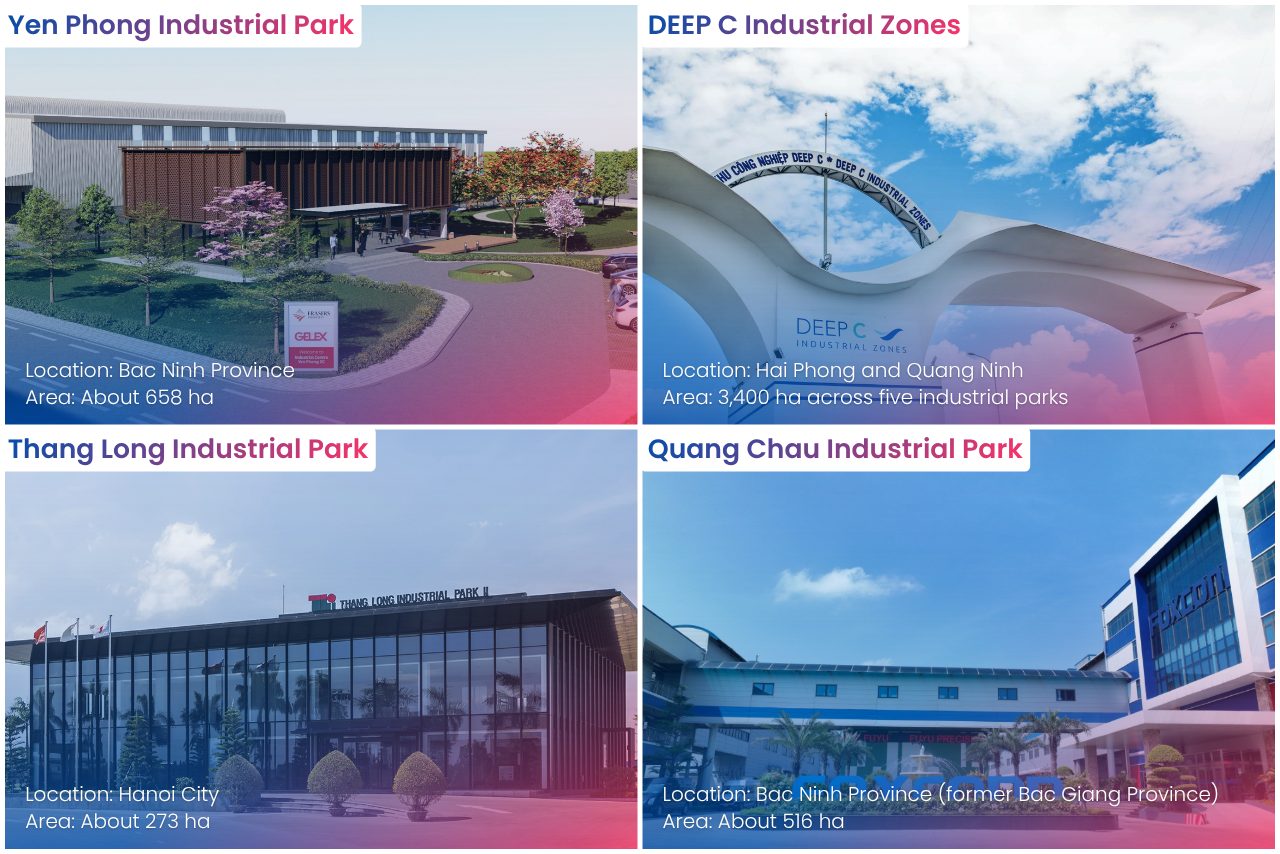
Industrial parks in Northern Vietnam support electronics, high-tech manufacturing, and export-oriented production.
VSIP Bac Ninh
- Location: Bac Ninh Province
- Area: 635 ha, including 485 ha of industrial land
- Main features: Integrated industrial–township model; convenient access to Hanoi, airports, and seaports
- Key industries: Electronics, high-tech manufacturing, precision engineering, supporting industries
The verdict: A well-established option for companies seeking access to Hanoi and Northern Vietnam’s electronics supply chain.
Yen Phong Industrial Park
- Location: Bac Ninh Province
- Area: About 658 ha
- Main features: Established infrastructure; direct power supply from the Yen Phong 110/22kV station; industrial water and centralized wastewater treatment
- Key industries: Electronics, semiconductors, high-tech manufacturing, precision engineering, supporting industries
The verdict: Its mature infrastructure and electronics ecosystem make Yen Phong a key location for technology-driven manufacturing.
DEEP C Industrial Zones
- Location: Hai Phong and Quang Ninh
- Area: 3,400 ha across five industrial parks
- Main features: Port-oriented industrial ecosystem; access to deep-sea ports, expressways, airports, and multimodal transport; integrated utilities and industrial services
- Key industries: Automotive, logistics, chemicals, electronics, light manufacturing, general industry
The verdict: DEEP C stands out where port access and an integrated industrial ecosystem are central to the supply chain.
Thang Long Industrial Park
- Location: Hanoi City
- Area: 273 ha
- Main features: Japanese-developed industrial park; about 30 minutes from central Hanoi; high-quality infrastructure and maintenance services; strong Japanese tenant base
- Key industries: Electronics, precision engineering, machinery, automotive components, electrical equipment
The verdict: Its proximity to Hanoi and established Japanese business community support stable day-to-day manufacturing operations.
VSIP Hai Phong
- Location: Hai Phong
- Area: 1,600 ha, including 500 ha of industrial land
- Main features: Integrated industrial, residential, and commercial development; access to Hai Phong Port, Lach Huyen Port, Cat Bi Airport, and the Hanoi–Hai Phong Expressway
- Key industries: Electronics, high-tech manufacturing, industrial production, supporting industries
The verdict: The combination of industrial land, urban services, and port connectivity supports both production and regional distribution.
Trang Due Industrial Park
- Location: Hai Phong
- Area: 1,088 ha planned; 687 ha in Trang Due 3
- Main features: Multi-phase development; established Phase 1 and Phase 2; Phase 3 is progressing through legal procedures; strong links to Hai Phong’s logistics network
- Key industries: Electronics, telecommunications, information technology, precision engineering, supporting industries
The verdict: Its expansion potential is attractive. However, companies should assess each phase separately rather than treat the full planned area as immediately available.
Nam Dinh Vu Industrial Park
- Location: Hai Phong
- Area: 1,329 ha
- Main features: Located within the Dinh Vu–Cat Hai Economic Zone; internal seaport; direct access to Hai Phong’s maritime and road transport network
- Key industries: Heavy industry, port-related manufacturing, logistics, electronics, light industry
The verdict: The internal port gives Nam Dinh Vu a distinct logistics advantage for businesses with high cargo volumes and seaport-dependent operations.
Thang Long Industrial Park II
- Location: Hung Yen Province
- Area: 525.7 ha, including 401.42 ha of industrial land for lease
- Main features: Adjacent to National Highway 5; about 30 km from Hanoi and 70 km from Hai Phong Port; established Japanese manufacturing ecosystem
- Key industries: Precision electronics, mechanical engineering, automotive components, pharmaceuticals, optical products, high-tech manufacturing
The verdict: Its position between Hanoi and Hai Phong makes it useful for manufacturers balancing supplier access with export logistics.
Yen Binh Industrial Park
- Location: Thai Nguyen Province
- Area: 400 ha
- Main features: Established electronics manufacturing cluster; direct connection to the Hanoi–Thai Nguyen Expressway and National Highway 3; centralized wastewater treatment
- Key industries: Electronics, semiconductors, solar equipment, mobile devices, high-tech components
The verdict: Yen Binh offers a strong technology manufacturing base, while land and labor availability should be checked early for new projects.
Quang Chau Industrial Park
- Location: Bac Ninh Province (former Bac Giang Province)
- Area: 516 ha
- Main features: Strategic position near major road corridors; developed infrastructure; large FDI manufacturing cluster; access to Hanoi, Hai Phong, and Noi Bai Airport
- Key industries: Electronics, electronic components, precision manufacturing, high-tech and supporting industries
The verdict: Together, its large electronics tenant base and regional connectivity make Quang Chau an important part of Northern Vietnam’s high-tech supply chain.
Pho Noi A Industrial Park
- Location: Hung Yen Province
- Area: 688.94 ha, including 492.1 ha of industrial land for lease
- Main features: Located on National Highway 5; about 24 km from Hanoi and 101 km from Dinh Vu Port; established utilities and broad manufacturing base
- Key industries: Electronics, mechanical engineering, automotive components, pharmaceuticals, food processing, logistics
The verdict: Its broad industry mix gives manufacturers more flexibility. At the same time, the latest provincial data shows limited remaining industrial land.
Yen Phong II Industrial Park
- Location: Bac Ninh Province
- Area: 1,200 ha, including 1,000 ha for industrial production
- Main features: Three main sub-zones; about 35 km from Hanoi and 22 km from Noi Bai Airport; links to National Highways 18 and 1A; flexible industrial plot sizes
- Key industries: Electronics, high-tech manufacturing, precision engineering, supporting industries, light and heavy manufacturing
The verdict: Its scale and proximity to Yen Phong I create a larger expansion base within an already established northern manufacturing cluster.
Central Vietnam
In comparison, Central Vietnam has a more diverse industrial base, combining large-scale land, economic zones, port access, and growing manufacturing clusters. As such, these locations add different options to a list of industrial parks in Vietnam, particularly for large-scale and port-linked projects.
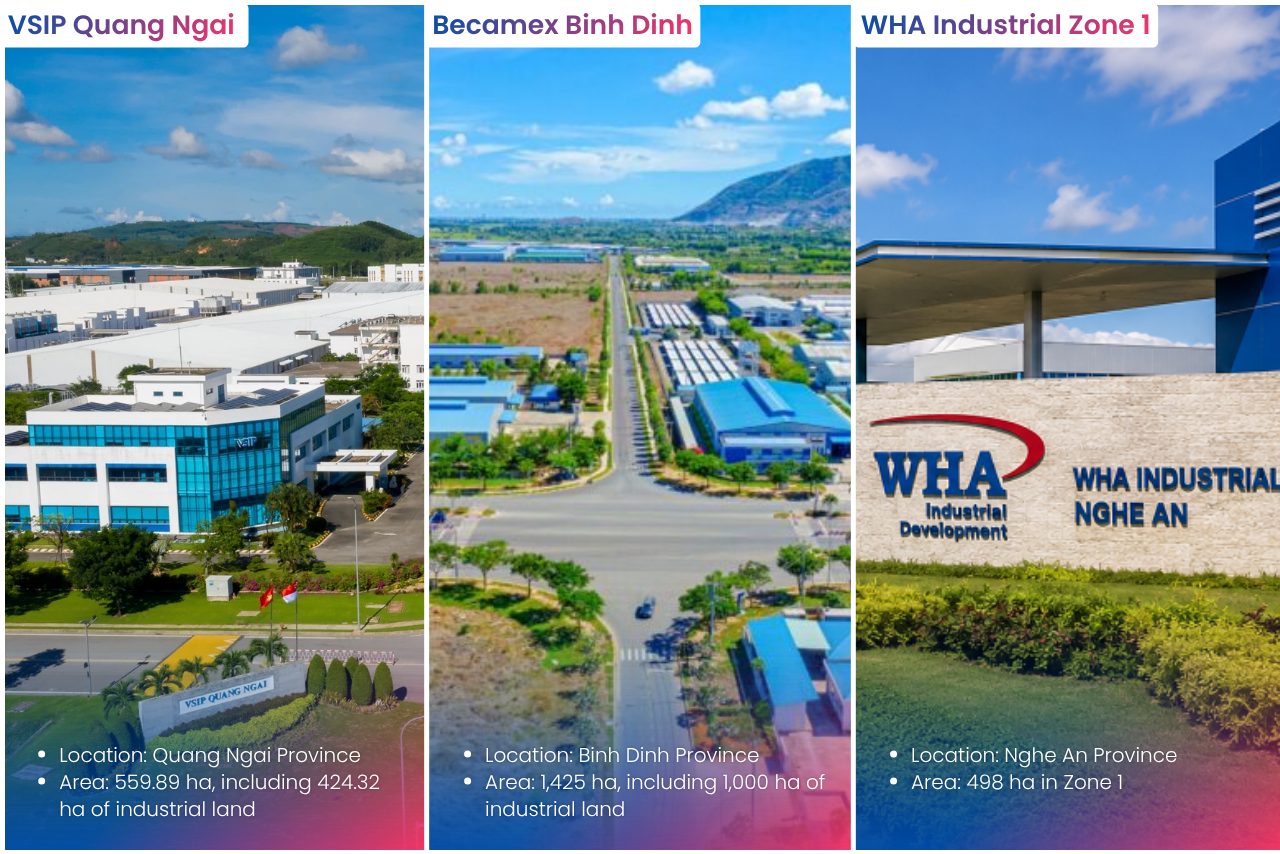
Central Vietnam offers industrial locations with large-scale land, port access, and growing manufacturing clusters.
VSIP Quang Ngai
- Location: Quang Ngai Province
- Area: 559.89 ha, including 424.32 ha of industrial land
- Main features: Established infrastructure; access to National Highway 1A and the Da Nang – Quang Ngai Expressway; Dung Quat Port and Chu Lai Airport within regional reach
- Key industries: Footwear, textiles, furniture, medical devices, supporting industries
The verdict: An established manufacturing base with a broad tenant mix and remaining industrial land for selected projects.
Dung Quat East Industrial Park
- Location: Quang Ngai Province
- Area: 5,784 ha; including 2,448.56 ha of industrial land
- Main features: Large industrial development near Dung Quat Deep-Sea Port; close to major road, rail, and airport connections; integrated into the wider Dung Quat industrial and energy ecosystem
- Key industries: Oil refining, petrochemicals, metallurgy, heavy engineering, energy, chemicals
The verdict: Its scale and industrial ecosystem make it particularly relevant to capital-intensive and port-dependent manufacturing projects.
VSIP Nghe An
- Location: Nghe An Province
- Area: 750 ha, including 367.6 ha of industrial land
- Main features: Integrated industrial, township, and service development; 3 km from Vinh Airport and 15 km from Cua Lo Port; 252 MVA power capacity and centralized wastewater treatment
- Key industries: Electronics, garments, food processing, pharmaceuticals, high-tech manufacturing, supporting industries
The verdict: A well-connected North Central location. However, the developed industrial area already has a high occupancy level.
WHA Industrial Zone 1
- Location: Nghe An Province
- Area: 498 ha in Zone 1
- Main features: Located within the Dong Nam Economic Zone; international-standard infrastructure; access to Vinh Airport, seaports, highways, and regional logistics routes
- Key industries: Electronics, automotive, plastics, textiles and garments, food processing, medical products, logistics
The verdict: Its combination of industrial infrastructure, economic-zone incentives, and logistics access supports both manufacturing and distribution operations.
Becamex Binh Dinh Industrial Park
- Location: Gia Lai Province (former Binh Dinh Province)
- Area: 1,425 ha, including 1,000 ha of industrial land
- Main features: Integrated industrial–urban–service model; 25 km from Quy Nhon Port and 30 km from Phu Cat Airport; connections to National Highway 1A, the North–South railway, and regional logistics corridors
- Key industries: Automotive components, precision engineering, industrial equipment, electronics, furniture, food processing
The verdict: A large-scale platform for manufacturers seeking expansion space and multimodal logistics access in Central Vietnam.
Dien Nam – Dien Ngoc Industrial Park
- Location: Da Nang City (former Quang Nam Province)
- Area: 357.08 ha
- Main features: Established industrial park between Da Nang and Hoi An; mature infrastructure; close to the Da Nang urban and logistics network
- Key industries: Electronics, agricultural and food processing, textiles, cosmetics, plastics, packaging, consumer goods
The verdict: A mature regional manufacturing base, but its high occupancy limits flexibility for companies seeking large new sites.
Southern Vietnam
Meanwhile, Southern Vietnam is a major manufacturing and logistics hub, supported by established supplier networks, large consumer markets, and strong connections to Cat Lai and Cai Mep – Thi Vai ports. For this reason, the region features prominently in a list of industrial parks in Vietnam.
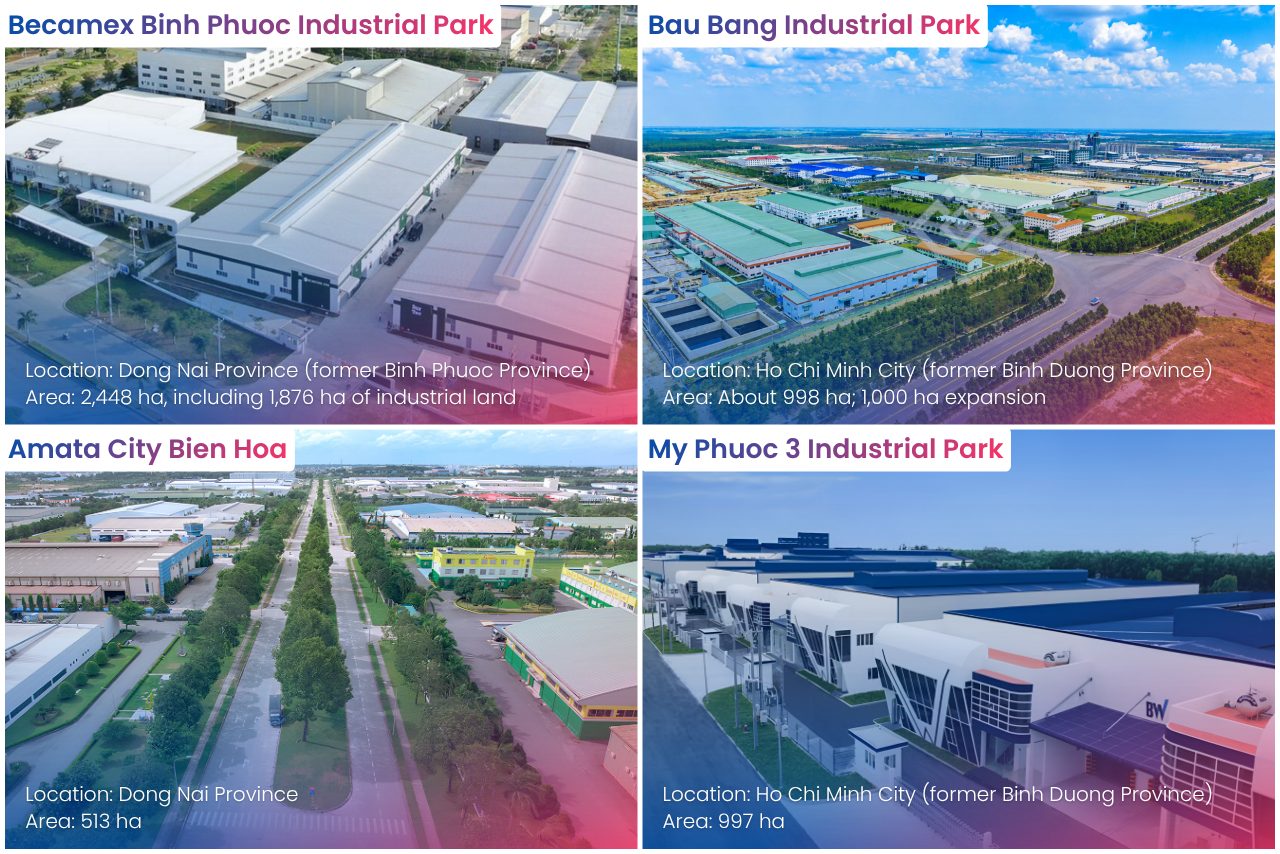
Southern Vietnam combines established manufacturing clusters with strong connections to major ports and logistics networks.
VSIP I
- Location: Ho Chi Minh City (former Binh Duong Province)
- Area: 500 ha
- Main features: Mature industrial infrastructure; access to National Highway 13 and DT743; convenient connections to Ho Chi Minh City, Long Thanh Airport, Tan Son Nhat Airport, and Cat Lai Port
- Key industries: Electronics, machinery, consumer products, electrical equipment, supporting industries
The verdict: A mature manufacturing cluster with strong connectivity. However, no industrial land is currently listed as available.
VSIP II
- Location: Ho Chi Minh City (former Binh Duong Province)
- Area: 2,045 ha, including 1,345 ha of industrial land
- Main features: Large integrated industrial, urban, and service development; access to Ho Chi Minh City, Tan Son Nhat Airport, Cat Lai Port, and major transport routes
- Key industries: Electronics, high-tech manufacturing, machinery, consumer products, supporting industries
The verdict: Its scale supports a broad manufacturing ecosystem. Yet, the industrial area is currently fully occupied.
VSIP III
- Location: Ho Chi Minh City (former Binh Duong Province)
- Area: 1,000 ha
- Main features: Green, smart, and sustainable industrial model; 504 MVA power capacity; 50,000 m³/day water supply; access to Cat Lai and Cai Mep ports
- Key industries: High-tech manufacturing, electronics, semiconductors, supporting industries, sustainable production
The verdict: In contrast, VSIP III is one of the newer Southern industrial options, with substantial available land for companies planning large or phased projects.
Amata City Bien Hoa
- Location: Dong Nai Province
- Area: 513 ha
- Main features: Mature industrial estate; 190+ tenants; established utilities and services; about 25 km from Cat Lai Port and 20 km from Long Thanh International Airport
- Key industries: Electronics, food and beverage, machinery and components, steel, plastics, moulds, garments
The verdict: Its established workforce, tenant base, and logistics access support efficient day-to-day factory operations.
My Phuoc 3 Industrial Park
- Location: Ho Chi Minh City (former Binh Duong Province)
- Area: 997 ha
- Main features: Established industrial infrastructure; part of the wider My Phuoc industrial ecosystem; road access to Ho Chi Minh City and major Southern logistics routes
- Key industries: Electronics, machinery, automotive components, food processing, pharmaceuticals, furniture, supporting industries
The verdict: A practical option within a mature manufacturing cluster, with limited remaining land for new projects.
Bau Bang Industrial Park
- Location: Ho Chi Minh City (former Binh Duong Province)
- Area: About 998 ha; 1,000 ha expansion
- Main features: Large industrial development along National Highway 13; integrated urban and industrial infrastructure; additional expansion capacity for future projects
- Key industries: Electronics, machinery, automotive components, food processing, textiles, furniture, supporting industries
The verdict: For manufacturers seeking more space, its larger land base and northern location make Bau Bang relevant beyond more congested Southern clusters.
Becamex Binh Phuoc Industrial Park
- Location: Dong Nai Province (former Binh Phuoc Province)
- Area: 2,448 ha, including 1,876 ha of industrial land for lease
- Main features: Integrated industrial, urban, service, and logistics ecosystem; direct access to National Highway 13 and the My Phuoc–Tan Van route; large utility capacity
- Key industries: Electronics, food processing, textiles, machinery, construction materials, supporting industries
The verdict: Its extensive land bank and integrated infrastructure are suited to large greenfield projects with long-term expansion plans.
Sonadezi Chau Duc Industrial Park
- Location: Ho Chi Minh City (former Ba Ria–Vung Tau Province)
- Area: 2,287.55 ha, including 1,556.14 ha of industrial land
- Main features: Large integrated industrial, urban, and logistics development; access to major roads, waterways, and Southern deep-water ports
- Key industries: Electronics, automotive components, pharmaceuticals, mechanical engineering, food processing, new materials
The verdict: Its combination of scale and proximity to the Southern port network supports larger manufacturing and export-oriented projects.
Phu My 3 Specialized Industrial Park
- Location: Ho Chi Minh City (former Ba Ria–Vung Tau Province)
- Area: About 1,046 ha
- Main features: Located about 2 km from Cai Mep–Thi Vai deep-sea port; dedicated industrial gas, water, and logistics infrastructure; on-site Phu My ICD
- Key industries: Heavy industry, chemicals, metallurgy, mechanical engineering, electronics, medical equipment, supporting industries
The verdict: Its port proximity and specialized infrastructure are particularly relevant to heavy and port-dependent manufacturing.
Hiep Phuoc Industrial Park
- Location: Ho Chi Minh City
- Area: 1,686 ha
- Main features: Port-oriented industrial development; three international seaports; integrated electricity, water, wastewater, telecommunications, and industrial gas systems
- Key industries: Manufacturing, logistics, food processing, mechanical engineering, textiles, supporting industries
The verdict: In turn, its location within Ho Chi Minh City and direct port access can reduce logistics complexity for import-export operations.
Long Duc Industrial Park
- Location: Dong Nai Province
- Area: 580 ha across two phases
- Main features: Strong Japanese investor presence; established infrastructure; close to Cat Lai Port and Long Thanh Airport; more than 8,000 workers across tenant companies
- Key industries: Electronics, electrical equipment, automotive components, medical equipment, metal products, plastics, wood products
The verdict: Its Japanese manufacturing base and established workforce make it a practical option for companies building within an existing supplier ecosystem.
Long Hau Industrial Park
- Location: Tay Ninh Province (former Long An Province)
- Area: About 500 ha across existing and expanded phases
- Main features: 3 km from SPCT and Saigon–Hiep Phuoc ports; complete technical infrastructure; worker and professional housing; ready-built and built-to-suit factory options
- Key industries: Electronics, precision engineering, automotive supporting industries, pharmaceuticals, food processing, logistics
The verdict: Its proximity to Ho Chi Minh City and nearby ports makes it useful for businesses that prioritize fast market and logistics access.
| 👉 To understand the key characteristics of each region and select the right area for a future factory, read our guide to industrial parks in Vietnam. |
Vietnam Industrial Parks Attract Record FDI In 2026
Vietnam’s strong FDI growth is increasing demand for industrial land and manufacturing capacity in 2026. At the same time, national growth targets are reshaping the list of industrial parks in Vietnam toward better infrastructure, specialized clusters, and stronger supply-chain integration.
FDI inflows into Vietnam in the first half of 2026
Vietnam’s FDI momentum remained strong in the first half of 2026. Total registered FDI reached US$34.65 billion, up 61% year on year, while newly registered capital rose 87.2% to US$17.39 billion. Disbursed FDI also increased 11.2% to US$13.03 billion, the highest first-half level since 2022. This shows continued investor commitment and project implementation.
More importantly, the trend is especially relevant to industrial parks, as manufacturing remains a major destination for foreign capital. In the first half of 2026, processing and manufacturing attracted US$10.76 billion in newly registered FDI. Consequently, stronger inflows increase demand for industrial land, factory space, suppliers, and supporting infrastructure.
Vietnam targets stronger industrial growth through 2030
Vietnam is targeting at least 10% annual GDP growth during 2026–2030, with the industrial and construction sector expected to grow 12.3% annually and manufacturing at 12.4%. In practice, this growth target points to continued expansion in production capacity, infrastructure, and industrial demand.
At the same time, Resolution No. 10-NQ/TW targets US$200-300 billion in registered FDI and US$150-200 billion in realised FDI by 2030. It also calls for stronger supplier linkages, technology investment, and for around 10% of industrial parks to become eco-industrial parks. For businesses, this means improving industrial parks in Vietnam will increasingly involve greener infrastructure, better services, and stronger supply-chain integration.
What Companies Should Know When Shortlisting Industrial Parks
A list of industrial parks in Vietnam is a useful starting point. Nevertheless, companies still need to verify each site against actual project requirements before making a final decision.
- First, check actual land and factory availability: Confirm current leasable land, ready-built factories, plot size, handover timing, and space for future expansion.
- Next, verify the park’s development status: Distinguish operating areas from planned or developing phases, and check infrastructure, site clearance, approvals, and expected handover dates.
- Then, confirm project compatibility: Review permitted industries, environmental requirements, wastewater limits, power and water capacity, fire safety, and site conditions before finalizing the factory design.
- After that, compare the full cost structure: Look beyond land costs to include service fees, utilities, wastewater treatment, factory construction, compliance, labour, transport, and logistics.
- Finally, assess location and connectivity: Compare practical access to ports, airports, highways, suppliers, workforce centres, and customers based on actual transport routes.
- Before shortlisting a site, verify the latest park information: Recheck occupancy, available land, pricing, lease terms, infrastructure, and development plans.
| 👉 For a step-by-step site selection framework, read our guide to choosing the right industrial park location in Vietnam. |
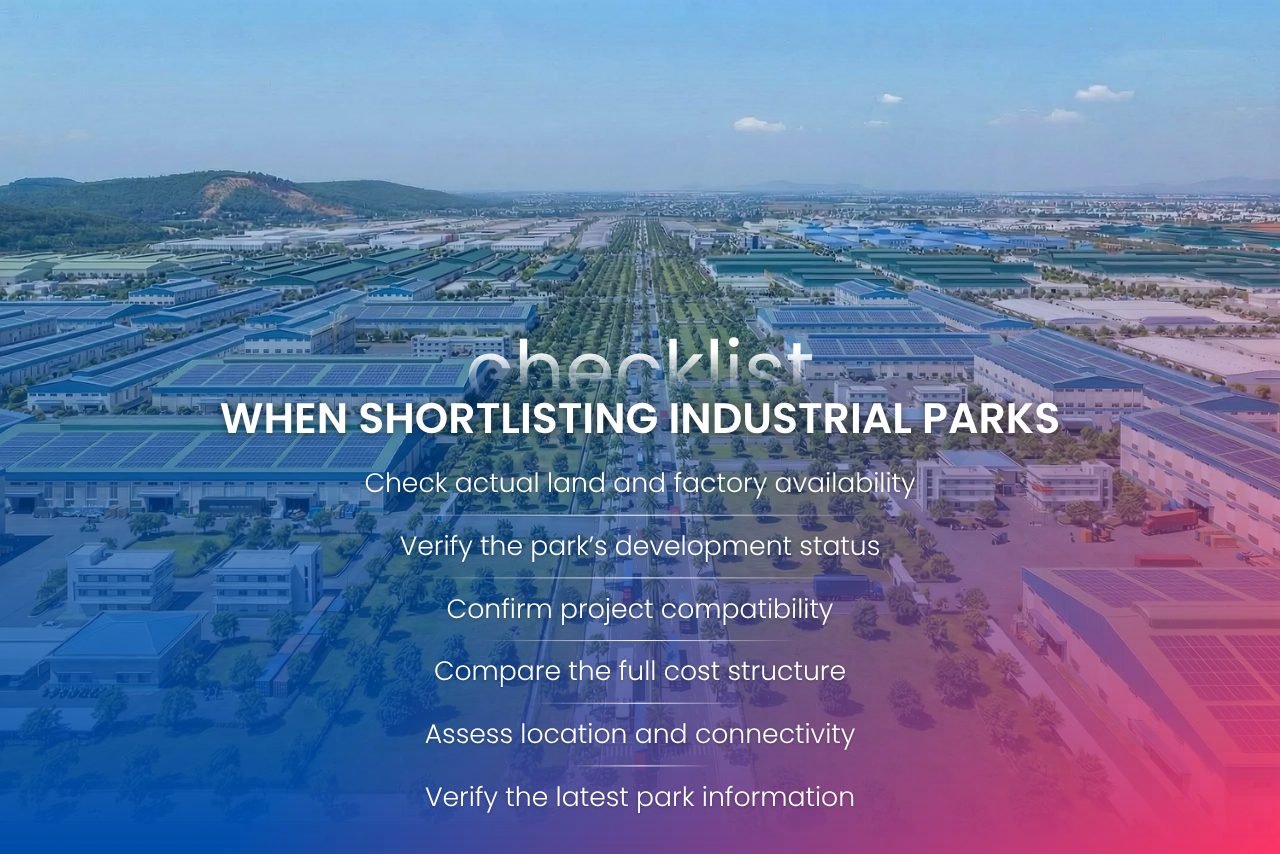
Key factors to check before shortlisting an industrial park, including land availability, infrastructure, costs, connectivity, and project compatibility.
Final Considerations
Vietnam’s industrial park market offers different advantages across the North, Central, and South, from electronics and supplier clusters to port access, larger land areas, and mature logistics networks. This reliable list of industrial parks in Vietnam provides a starting point for companies to compare locations based on project requirements, infrastructure, connectivity, utilities, and expansion plans.
At Source of Asia, we support companies evaluating and setting up manufacturing operations through Market Expansion Services. Our experts help:
- Shortlist suitable industrial parks
- Assess locations and market conditions
- Identify local partners and contacts
- Coordinate site visits and local requirements
- Support factory setup and market entry
| 👉 Facing difficulties shortlisting or assessing industrial parks in Vietnam? Contact us to discuss the right location for the project. |
Frequently Asked Questions
Vietnam has 478 established industrial parks, including 324 in operation nationwide. The total varies by source when parks under construction, newly approved projects, or sites still in planning are also counted for future supply.
By planned area, Dung Quat East Industrial Park in Quang Ngai is the largest, covering about 5,784 ha, including 2,448.56 ha of industrial land. More broadly, it forms part of the wider Dung Quat Economic Zone, supporting large heavy-industry and energy projects in Central Vietnam and beyond.
Under the current administrative structure, Dong Nai has 81 planned industrial parks, more than any other province. Its industrial footprint exceeds 39,600 ha, but the planned land is not necessarily available for immediate lease.
DEEP C and Nam Dinh Vu are closely connected to Hai Phong’s port system. Meanwhile, in the South, Phu My 3 is about 2 km from Cai Mep–Thi Vai, while Hiep Phuoc has three international ports on site, supporting import-export operations.