Introduction
Vietnam continues to attract international businesses looking to establish operations and expand in Southeast Asia. However, estimating Vietnam business costs involves more than registration fees or office rent. In addition, foreign investors must account for investment capital, staffing, taxes, compliance, and expenses incurred before operations generate revenue.
Understanding the cost of starting a business in Vietnam is essential for realistic financial planning and avoiding unexpected expenses. To manage these requirements, international companies can work with business support providers such as Source of Asia for incorporation, accounting, payroll, and local administration. This guide breaks down the initial, ongoing, and often overlooked expenses that foreign businesses should consider when budgeting for operations in Vietnam.
Quick Answer: What Are the Main Costs of Doing Business in Vietnam?
Vietnam business costs generally fall into three categories:
- Initial setup costs: Business registration fees, incorporation support, legal documentation, licensing, and office setup.
- Ongoing operating costs: Office rental, salaries, employer insurance contributions, accounting, tax administration, and compliance.
- Often underestimated costs: Setup delays, recruitment, translation, banking transactions, regulatory changes, and working capital.
The total cost depends on the company’s industry, ownership structure, location, workforce, and operating model. Therefore, foreign investors should budget for both company establishment and the first 12 months of operations.
How Much Does It Cost to Start a Business in Vietnam?
There is no fixed amount that applies to every foreign company setting up in Vietnam. For example, a small consulting business may need less office space and equipment. By contrast, a manufacturer may require factories, machinery, special permits, and much more working capital.
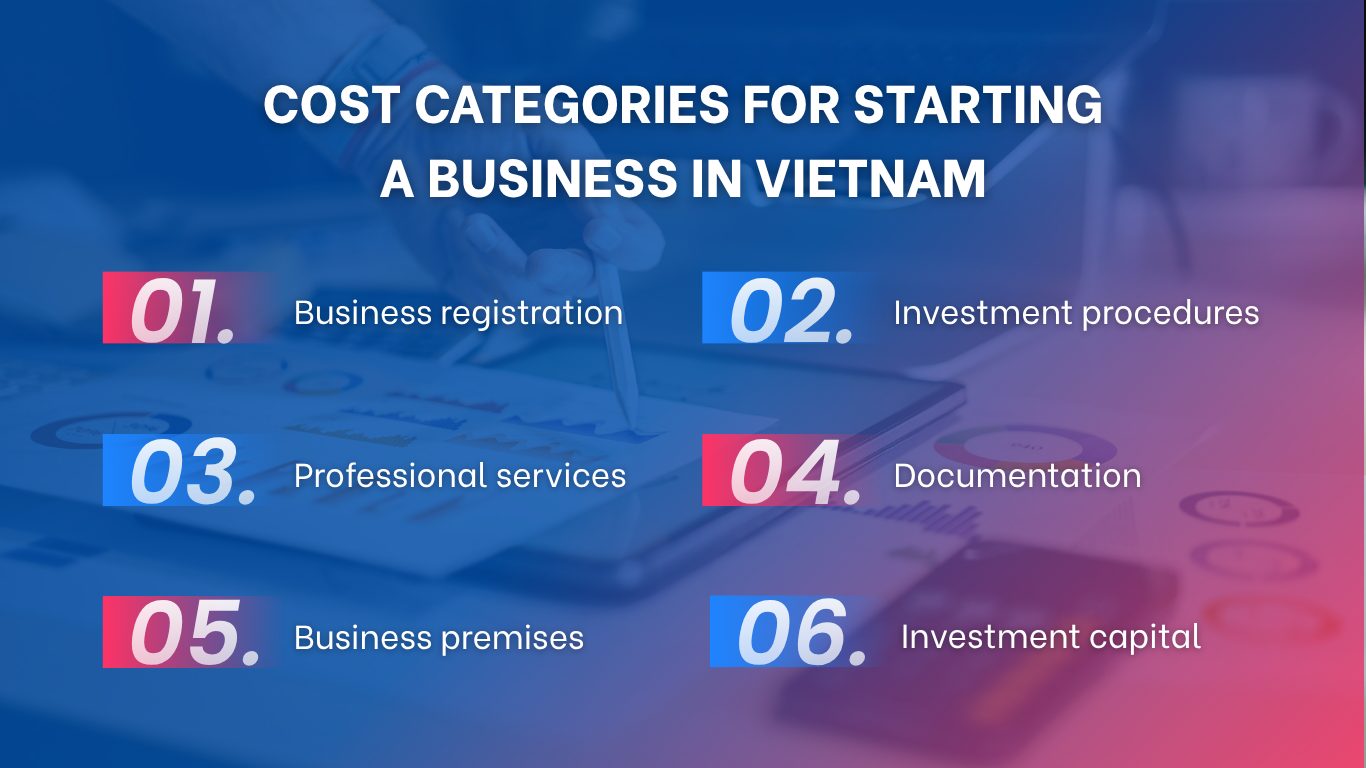
Six key cost categories foreign investors should consider when planning to establish a business in Vietnam.
As a result, companies should assess the cost of starting a business in Vietnam across several categories.
| Cost category | Main expenses | What affects the cost |
| Business registration | Registration and publication fees | Applicable procedure and filing method |
| Investment procedures | Investment registration and approvals, where required | Business activities and investment structure |
| Professional services | Legal advice, incorporation and administrative support | Complexity of the setup |
| Documentation | Translation, notarization and legalization | Number and origin of documents |
| Business premises | Deposits, office setup and equipment | Location and operational requirements |
| Investment capital | Capital committed to establishing and operating the business | Project scale and funding needs |
An important distinction is that official registration fees are only one part of the overall incorporation budget.
Business Registration Fees and Company Incorporation Costs
Company incorporation fees in Vietnam include more than government registration charges. While official registration fees are fairly low, foreign investors must also consider legal documentation, professional services, and other costs required to establish an operational company.
According to the National Public Service Portal, the standard enterprise registration fee is VND 50,000 per application. A temporary 50% reduction applies to eligible direct filings from July 1, 2025, through December 31, 2026, reducing the fee to VND 25,000. However, electronic enterprise registration is exempt from the registration fee.
The business registration publication fee is VND 100,000 per application, as listed by the National Public Service Portal.
However, these amounts cover only official administrative charges, not the full cost of setting up a company. They do not include the professional services, documentation, premises, or additional approvals that a foreign investor may require.
In addition to these fees, incorporation procedures depend on the investment structure and business activities. Foreign investors may need an Enterprise Registration Certificate (ERC), an Investment Registration Certificate (IRC), or other relevant approvals.
Vietnam’s Law on Investment 2025, effective March 1, 2026, allows foreign investors to establish an economic organization before obtaining or amending an Investment Registration Certificate, provided they meet applicable market-access conditions. Companies should therefore review the registration procedures relevant to their specific investment projects.
Investment Capital Requirements for Foreign Companies
When estimating Vietnam business setup costs, foreign investors often underestimate the capital required to establish and sustain operations. Vietnam does not have a universal minimum capital requirement for every type of foreign-owned company. However, some regulated sectors have specific capital requirements. Meanwhile, businesses without a fixed minimum capital requirement still need enough funding to support their planned activities.
A consulting company, for example, may need capital to cover office expenses, employee salaries, and initial business development activities. A manufacturing project may require substantial investment in machinery, facilities, raw materials, and logistics.
To understand these funding needs, investors should distinguish between three financial concepts:
| Capital type | Meaning |
| Charter capital | Capital committed or contributed by company owners under the registered capital structure |
| Total investment capital | Funding planned for an investment project, potentially including equity and other financing |
| Working capital | Funds available to cover day-to-day operating obligations |
Importantly, these amounts serve different purposes. Charter capital is not simply a government registration fee, and total investment capital does not necessarily represent an amount spent immediately.
Under the 2025 Investment Law, foreign investors must also consider market-access requirements when establishing an economic organization. Before determining a capital amount, businesses should develop an operating budget covering expected expenses, investment requirements, and the time needed to begin generating revenue.
Legal, Documentation, and Professional Service Fees
Professional service fees can significantly affect the cost of starting a business in Vietnam, particularly when foreign investors require legal assistance with incorporation, licensing, and administrative procedures.
For example, the level of support needed may vary by industry, business model, and ownership structure. Typical expenses include legal consultation, preparation of incorporation documents, translation, notarization, consular legalization, and assistance with relevant permits.
In some cases, local authorities require extra checks on documents issued abroad. These requirements depend on the document type, country of origin, and applicable exemptions. The more complex the ownership structure or licensing requirements, the more time and professional coordination the project may require.
Businesses comparing company incorporation fees in Vietnam should therefore examine exactly what each service quotation includes. A basic registration package may exclude legal advice, document legalization, banking assistance, or post-incorporation procedures. Therefore, companies should confirm which services are included to avoid unexpected fees during setup.
Ongoing Business Operating Costs in Vietnam
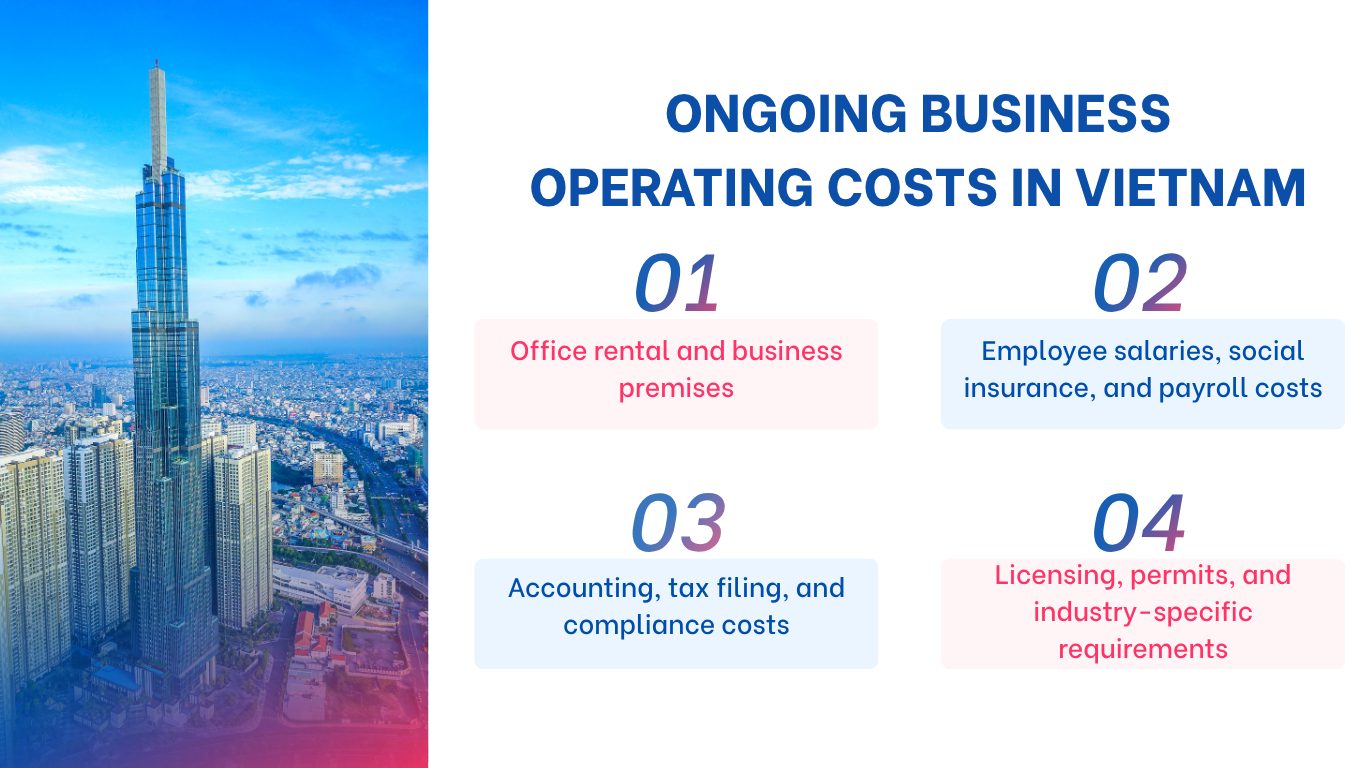
Four key operating expenses foreign companies should consider when running a business in Vietnam.
Once a company has been registered, recurring expenses become a major part of its ongoing costs. Moreover, these costs continue throughout business operations and may arise before the company generates sufficient revenue to cover them.
Office Rental and Business Premises
Office expenses depend on location, premises type, and business requirements. For example, offices in central Ho Chi Minh City or Hanoi may cost more than premises outside the city center. Serviced offices and coworking spaces may also have different pricing models.
The advertised rental price is only one component of the total premises cost. Businesses may also need to budget for deposits, building management fees, utilities, internet access, furniture, IT equipment, and fit-out work. For manufacturing and logistics businesses, premises expenses can be more complex. For instance, factories and warehouses may need extra power capacity, fire safety systems, technical facilities, or special storage conditions.
Foreign companies should compare premises according to their operational needs and total occupancy costs rather than rent alone. For businesses entering the market gradually, flexible office arrangements may provide an alternative to leasing larger premises from the beginning, provided the arrangement meets applicable registration and business needs.
Employee Salaries, Social Insurance, and Payroll Costs
Employee expenses extend beyond monthly salaries. In addition to agreed compensation, employers must consider mandatory insurance contributions, recruitment, benefits, training, and payroll administration. Vietnam’s Decree No. 293/2025/ND-CP established the following regional monthly minimum wages, effective January 1, 2026:
| Region | Minimum monthly wage |
| Region I | VND 5,310,000 |
| Region II | VND 4,730,000 |
| Region III | VND 4,140,000 |
| Region IV | VND 3,700,000 |
The applicable wage region depends on the employer’s operating location, as specified in the decree. These figures represent statutory minimum wages, not typical market salaries for professional, technical, or managerial positions.
In addition to salaries, employer insurance contributions are another major cost. According to Vietnam Social Security, the standard employer contribution for covered Vietnamese employees is 21.5% of the applicable salary base used for compulsory insurance, comprising:
- Social insurance: 17.5%
- Health insurance: 3%
- Unemployment insurance: 1%
The contribution base is subject to statutory rules and applicable limits. Requirements for foreign employees may differ.
A useful workforce budgeting formula is:
Total employment cost = Gross salary + Employer contributions + Benefits + Recruitment and onboarding + Payroll administration
Therefore, first-year workforce budgets should also account for competitive salaries, hiring timelines, and potential employee turnover.
Accounting, Tax Filing, and Compliance Costs
Accounting and tax compliance are recurring responsibilities for companies operating in Vietnam. Depending on their activities, businesses may need support with bookkeeping, financial statements, tax declarations, electronic invoicing, payroll reporting, and annual compliance procedures. Under Law on Corporate Income Tax No. 67/2025/QH15, effective October 1, 2025, Vietnam’s standard corporate income tax (CIT) rate is 20%.
However, the law also provides lower tax rates for eligible businesses based on annual revenue:
| Corporate income tax rate | General revenue threshold |
| 15% | Annual revenue not exceeding VND 3 billion |
| 17% | Annual revenue above VND 3 billion and not exceeding VND 50 billion |
| 20% | Standard rate |
The 15% and 17% tax rates apply only to eligible businesses, subject to specific conditions. Companies must also account for VAT, personal income tax, and other applicable taxes, while distinguishing recoverable or withheld taxes from actual business expenses.
Therefore, companies should budget for accounting and compliance based on their reporting duties and business needs.
Licensing, Permits, and Industry-Specific Requirements
Certain industries in Vietnam, including healthcare, education, food production, retail, and logistics, may require additional permits and compliance procedures. For example, businesses may need to pay for inspections, prepare documents, upgrade facilities, and meet ongoing compliance requirements. The 2025 Investment Law introduced changes to Vietnam’s investment framework, making it important for foreign investors to confirm applicable licensing requirements and related costs before starting operations.
Hidden Business Costs Foreign Companies Often Underestimate in Vietnam
The most difficult expenses to plan are often those that do not appear in the initial incorporation quotation. These costs arise during the transition from registration to full commercial operations and can affect the company’s first-year cash flow.
Delays in Company Setup and Operational Readiness
The cost of starting a business in Vietnam can increase when operational delays occur after company registration. For instance, banking procedures, recruitment, office setup, and regulatory approvals can delay operations. Meanwhile, businesses may still need to pay rent, salaries, and administrative expenses. Businesses should account for these delays in their financial forecasts and maintain sufficient working capital until operations and revenue generation begin.
Recruitment, Training, and Employee Turnover
Recruitment costs go beyond salaries, including agency fees, job advertising, interviews, and employee training. In addition, onboarding for foreign companies may require coordination between headquarters and local teams. Employee turnover can also increase costs through repeated hiring, training, and lost productivity. Therefore, businesses should budget separately for recruitment and onboarding, especially when building their first local team.
Translation, Legalization, and Administrative Expenses
Foreign-invested companies frequently manage documents issued across different jurisdictions. Corporate records, authorization letters, financial documents, and other materials may require translation, notarization, or legalization before submission to Vietnamese authorities. However, the exact requirements depend on the document type and relevant procedures. Extra costs may arise when the business changes its registered address, legal representative, ownership information, or business activities.
These adjustments can require further documentation and administrative support. Maintaining a separate documentation allowance helps companies prepare for expenses that may not be included in their original incorporation package.
Banking, Currency Exchange, and Cross-Border Transactions
Banking and foreign exchange costs in Vietnam may include international transfer fees, currency conversion charges, and account administration expenses. In addition, specific banking requirements depend on the investment structure and transaction type. Exchange-rate fluctuations can also affect operating budgets, especially when expenses are paid in VND but funding comes from foreign currencies. Therefore, businesses should account for these costs and potential currency movements in their financial forecasts.
Unexpected Compliance and Regulatory Changes
Regulatory changes in wages, taxes, and industry requirements can increase operating costs and require businesses to adjust their procedures. For example, Vietnam’s 2026 minimum wage adjustments and the 2025 Investment Law highlight the need to review financial and operational plans regularly. Businesses should maintain a contingency budget to cover unexpected compliance and administrative expenses.
How to Estimate the Total Cost of Doing Business in Vietnam
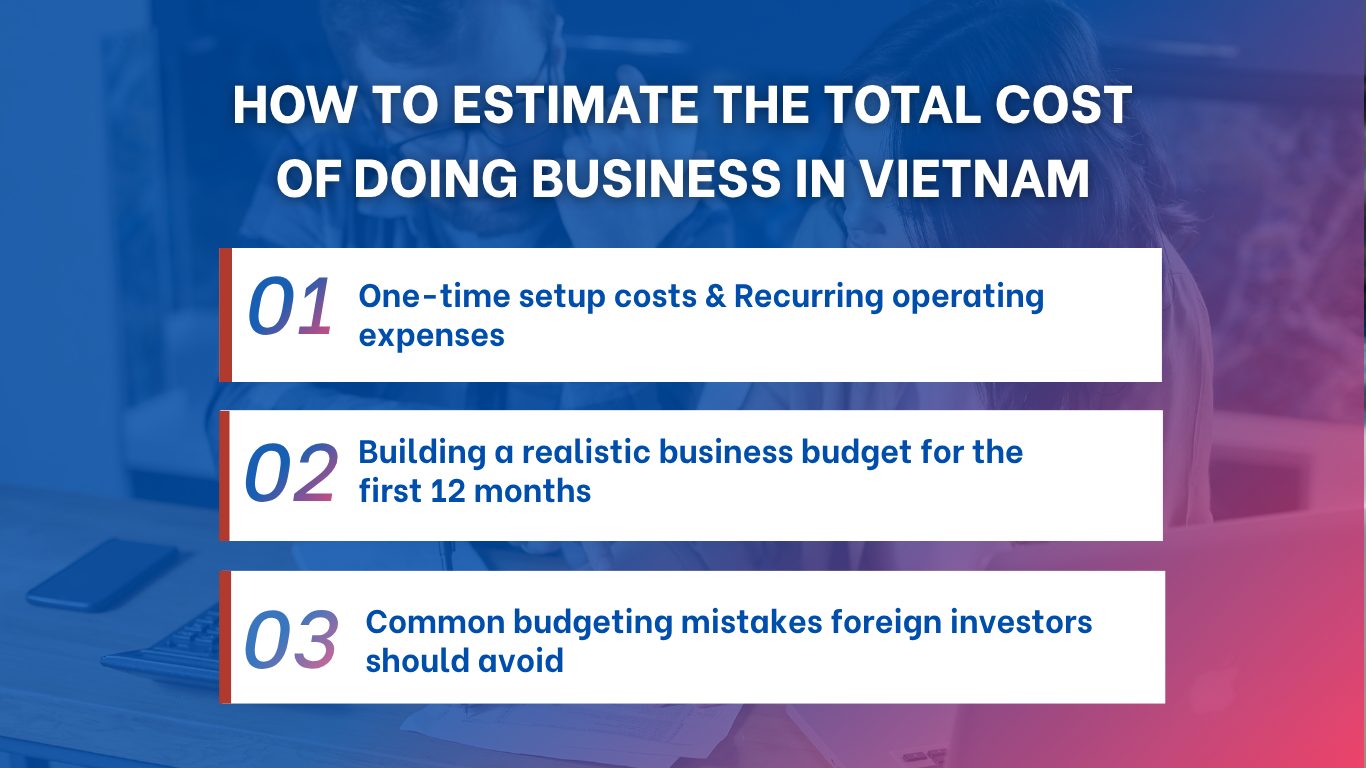
Three key considerations for foreign investors planning and managing their business budget in Vietnam.
A practical Vietnam business cost estimate should reflect the company’s operating model and expected timeline. Therefore, investors should separate setup costs from recurring expenses and forecast cash flow over the first year to identify possible funding gaps.
One-Time Setup Costs vs. Recurring Operating Expenses
Business expenses should be classified according to when they occur and how they affect the company’s financial position.
| Cost type | Examples | Budget treatment |
| One-time setup expenses | Registration, incorporation support, document preparation | Initial establishment budget |
| Capital expenditure | Equipment, office fit-out, IT systems | Investment budget |
| Working capital | Funding for payroll, suppliers, and short-term obligations | Cash flow planning |
| Recurring fixed expenses | Rent, accounting services, payroll administration | Monthly operating budget |
| Recurring variable expenses | Utilities, logistics, business travel | Activity-based forecast |
| Contingency | Unplanned expenses and delays | Separate financial reserve |
Investment capital, working capital, and operating expenses should not be treated as identical amounts.
For example, the cash contributed by shareholders may fund salaries, rent, or equipment, but the capital contribution itself is not an additional operating expense to be counted again.
A realistic budget should prevent double counting and distinguish between the funds available to the company and the expenses it expects to incur.
Building a Realistic Business Budget for the First 12 Months
A 12-month financial plan helps foreign investors estimate the cost of starting a business in Vietnam, identify when expenses will occur, and determine how much funding they need before generating revenue.
The following table provides an illustrative framework.
| Period | Main activities | Costs to anticipate |
| Months 1–3 | Incorporation, documentation, premises, initial recruitment | Registration, professional fees, deposits, early payroll |
| Months 4–6 | Systems setup, recruitment, market preparation | Salaries, training, accounting, premises |
| Months 7–9 | Commercial development and operational activities | Ongoing operations, business development, supplier expenses |
| Months 10–12 | Performance review, administrative updates, financial reporting | Operating expenses, reporting, adjustments |
This table illustrates a budgeting sequence. Actual incorporation and operational timelines depend on the project and applicable procedures.
Businesses can structure their cash flow forecast using the following approach:
First-year funding requirement = Initial setup payments + Capital expenditure + Forecast operating cash outflows + Contingency reserve − Expected operating cash inflows
In addition, the model should account for payment schedules, available funding, and capital already contributed by investors.
Companies should also prepare scenarios based on different revenue assumptions. A base case may reflect expected sales development, while a downside scenario can assess the financial impact of slower customer acquisition or delayed operational readiness.
This approach helps management identify how much funding is required to maintain operations under different conditions.
Common Budgeting Mistakes Foreign Investors Should Avoid
Foreign investors often underestimate the cost of starting a business in Vietnam by overlooking expenses beyond company registration.
- Focusing only on registration fees. Official government charges are relatively small compared with the combined costs of legal support, business premises, staffing, and ongoing administration.
- Underestimating employee costs. Payroll budgets should include employer insurance contributions, benefits, recruitment, and onboarding.
- Assuming immediate commercial activity. Companies may incur expenses before completing operational preparations or generating revenue.
- Overlooking recurring compliance obligations. Accounting, tax filings, and corporate administration can create costs even during periods of limited business activity.
- Failing to plan for cash flow. Supplier deposits, customer payment terms, foreign exchange movements, and delays can affect liquidity.
The most effective budget connects financial assumptions with the company’s actual operating plan, rather than relying on a general estimate of the cost of company registration in Vietnam.
How Source of Asia Helps Foreign Companies Manage Business Costs in Vietnam
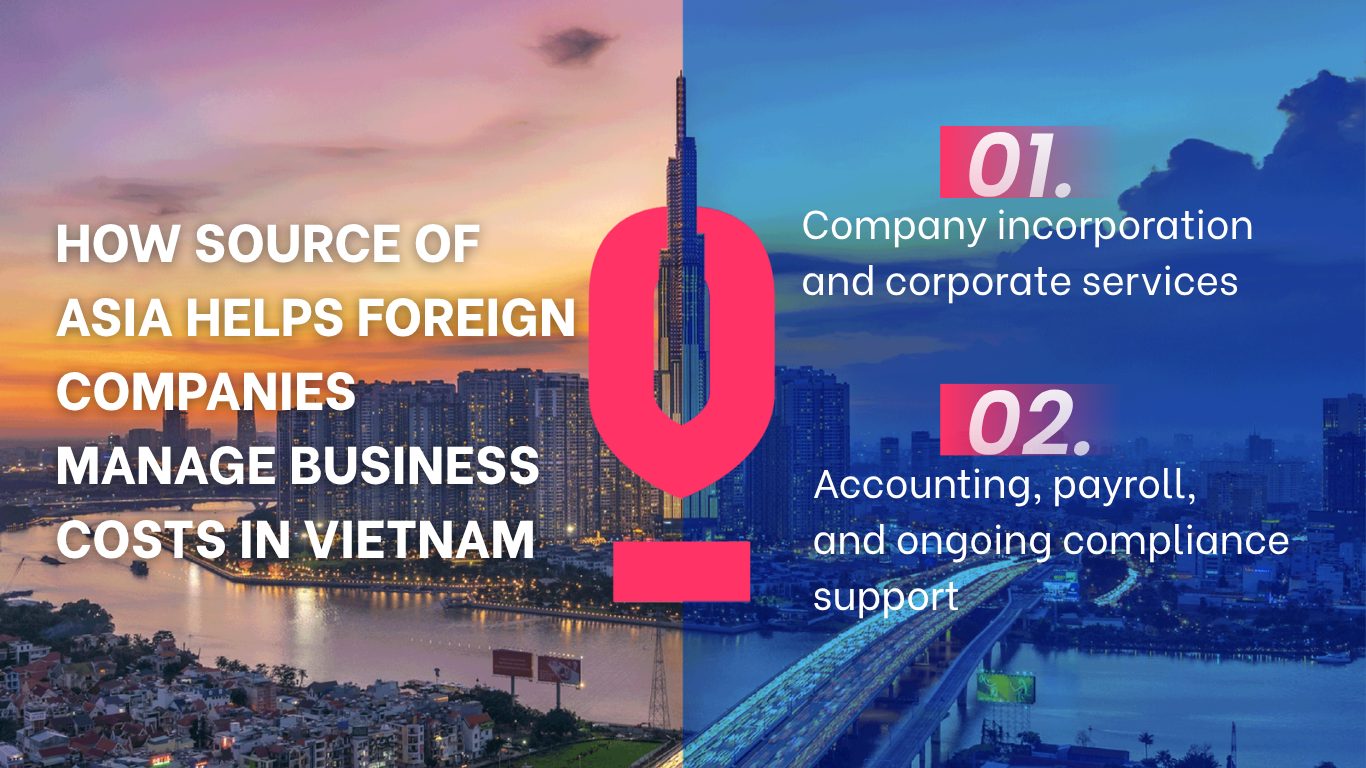
Source of Asia supports foreign businesses in Vietnam with company incorporation, corporate services, accounting, payroll, and ongoing compliance.
For international businesses, managing Vietnam business costs starts with choosing an appropriate setup model and understanding which operational functions need local support. Source of Asia provides corporate and HR services for foreign companies establishing or operating in Vietnam, including incorporation support, administration, accounting, payroll, and workforce solutions. As a result, businesses can better organize local operations and plan the resources needed at each stage of expansion.
Company Incorporation and Corporate Services
Establishing a company in Vietnam involves decisions about legal structure, registration procedures, licensing, and administrative responsibilities.
Through its Corporate Services, SOA supports businesses with company registration and licensing, corporate secretarial services, and coordination with legal experts where required.
The company also provides office solutions and assistance with local workforce arrangements.
For foreign investors considering different market-entry approaches, these services can help determine which functions should be established internally and which administrative activities may be outsourced.
The appropriate approach depends on the company’s business activities, staffing requirements, and expansion plans.
Accounting, Payroll, and Ongoing Compliance Support
After incorporation, accounting, payroll, and compliance become recurring responsibilities.
SOA’s Corporate Services and HR Solutions include accounting management, payroll administration, personal income tax and insurance management, and annual reporting support.
The company also offers recruitment, Employer of Record (EOR) arrangements, and foreign employee relocation support, depending on the business’s needs.
For example, companies without a full local administrative team can outsource selected tasks. This allows them to access support while gradually building their own team.
Understanding the full cost of doing business in Vietnam requires a realistic view of establishment, staffing, compliance, and working capital needs. Foreign investors should evaluate these commitments before entering the market and review their budgets as operations evolve.
Companies planning to establish or expand their operations in Vietnam can explore SOA’s Corporate Services to assess their company setup, accounting, payroll, and local administration requirements.